
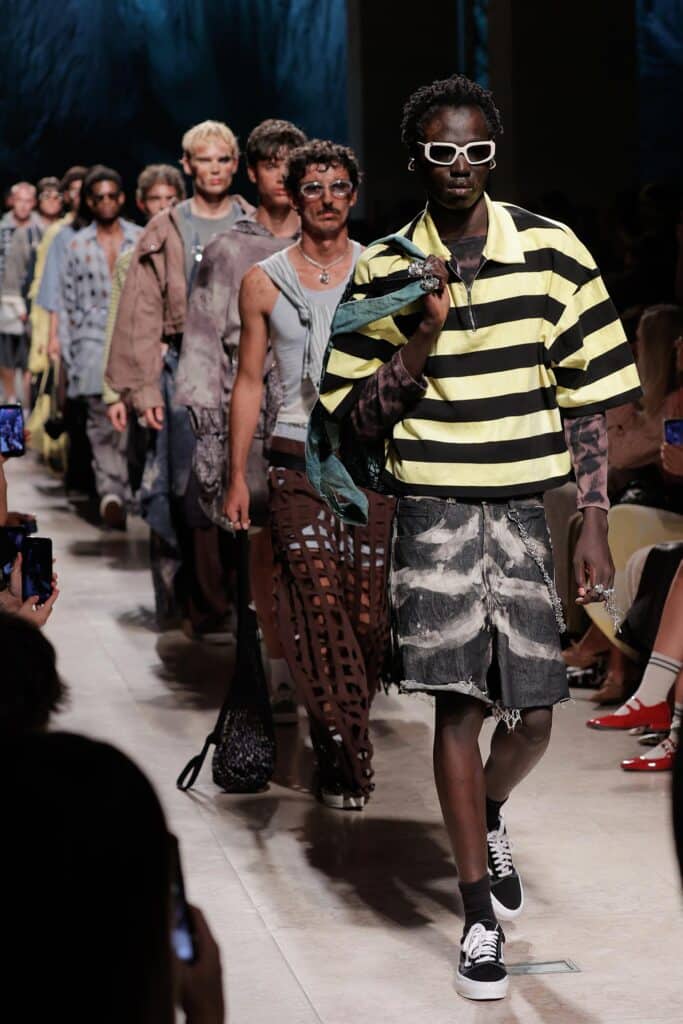

While Portugal might not (yet) rival Italy or France as a global fashion powerhouse, its disruptive energy is impossible to ignore. In Lisbon, better known for sun-drenched hills, tiled façades of azulejos, and pastel de nata pilgrimages, a new generation of designers is reshaping what Portuguese fashion can mean on the international stage. Twice a year, ModaLisboa (Lisbon Fashion Week) brings this scene into focus, spotlighting the country’s distinct blend of craftsmanship, experimentation and, above all, an impressive dose of originality.
In October, The Cold Magazine attended ModaLisboa, the 65th edition of Lisbon Fashion Week. Under the theme BASE, the city’s designers gathered not only to question what lies beneath fashion’s surface, but to confront a more urgent challenge: how to generate income and stability in an increasingly precarious creative economy.
Founded in 1991 in partnership with Lisbon City Council, ModaLisboa remains Portugal’s most vital platform for emerging design, a multidisciplinary project that bridges education, industry, and culture within a national ecosystem that has, silently, become world-leading. The country now exports footwear to 170 nations, accounting for the majority of its production, and has positioned itself – through initiatives like BioShoes4All and FAIST (multi-million-euro investments in sustainability, automation, and digital innovation) – as a model of circular design and technological advancement.
I’ll admit, I hadn’t fully grasped the intricacy and craftsmanship behind this country’s fashion scene before this trip. But I left Lisbon with a renewed appreciation for the trade – and, particularly, for the passionate figures shaping its future (special thanks to APICCAPS for the incredible work they continue to do in promoting Portuguese footwear worldwide).
Still, this vitality exists within a fragile economic framework. The fashion and footwear industries together employ over 200,000 people in Portugal, yet like elsewhere in Europe, rising production costs and global competition continue to put pressure on small labels and independent creatives. It’s a reality every designer here seems to be acutely aware of, and one that makes their work all the more powerful.
Despite the uncertainty, these designers have chosen to channel joy, colour, and emotion to create collections that celebrate resilience, play, and human connection. There’s something radical about that optimism, especially in an industry that can often, as we all know, feel anything but kind.
Amid this landscape of progress and preservation, The Cold Magazine met six designers – some new, some more established – whose work captures the emotional and material foundations of contemporary Portuguese fashion: a scene as introspective as it is forward-looking.
Francisca Nabinho – A ALEGRIA É A COISA MAIS SÉRIA DA VIDA


Lisbon-based designer Francisca Nabinho, who holds a master’s in Fashion Design from the Faculty of Architecture (UL) and has worked with The Garment and Designers Remix in Copenhagen, bridges visual art, nature, and fashion through a conceptual and material lens. Her collection A ALEGRIA É A COISA MAIS SÉRIA DA VIDA (Joy is the most serious thing in life) draws on Almada Negreiros’s 1932 declaration to explore joy as a resistant and communal force, translating his modernist language of geometry, rhythm, and colour into garments that embody movement and energy.
Describe your collection in a few (buzz)words.
Joyful, graphic, conscious, resistant and rhythmic.
Tell us more!
Inspired by José de Almada Negreiros, the collection sees joy as something serious, a conscious act of resistance and vitality. Through color, geometry, and rhythm, it turns that idea into movement and emotion you can feel and wear.
What was it like bringing this collection to life?
It was an energetic and emotional process, shaping concepts into forms, and seeing them come alive through pattern, texture, and motion.
What’s next for you?
I’m working toward my next presentation, keeping a strong focus on natural materials and innovation in craft. I’m also looking to expand my brand online and, in the future, open a physical space. I really value the personal connection that comes from meeting my audience face to face.
What excites you the most about the Lisbon fashion scene?
The mix of cultural influences that constantly blend and evolve. Lisbon is a lively, fast-moving city, full of creative energy, but still with so much room to grow and develop.
Bárbara Atanásio – Anarchy of Innocence


Bárbara Atanásio, a Lisbon-based designer and Modatex graduate, creates multidisciplinary works that blend upcycling, deconstruction, and humour to explore memory and the poetics of everyday life. A former intern at Valentim Quaresma and Marques’Almeida, she won the 2024 ModaLisboa x RDD Textiles Award and debuted on the Workstation platform later that year. Her latest collection, Anarchy of Innocence, channels childhood’s raw creative energy as a poetic barricade, celebrating play and freedom.
Describe your collection in a few (buzz)words.
It’s an anarchic utopian rebellion built by children: raw, unfinished, and self-made.
Tell us more!
This collection is an ode to La Ciudad de los Muchachos, a utopia turned reality where children were the rulers, where the circus was part of everyday life. It’s an exploration of that pulsating feeling of new life and childhood, reflected in the techniques, materials, and styling. The process was driven by a carefree spirit, and the prints and dyeing methods were designed to recreate the look of children at play: mud, stains, and a playful, comic mix of materials, colors, shapes, and details.
What was it like bringing this collection to life?
It’s always different, you give so much of yourself, and it’s so personal that everything is inevitably shaped by what you’re living through. It was a moment of artistic growth; each collection is a step forward, a lesson, and a series of choices. This collection came to life amid the chaos of the world around us, and that’s visible in the work. The environment seeps into every aspect, from the process to the design, to the materials themselves.
What’s next for you?
Everything. I always feel like I’m at the beginning. I want to keep building the brand and continuing the work: to grow, to keep setting goals and achieving them, to build a sustainable business. I’d love to collaborate with other designers and artists, and to keep challenging myself creatively.
What excites you the most about the Lisbon fashion scene?
The fact that we are a community, very diverse, yet everyone knows each other, and collaborations are always within reach. It’s a scene with so much to offer and one that’s gaining more and more attention, which feels very special. It’s our little corner of the world, finally getting a bit more light.
Béhen – LOVES ME, LOVES ME NOT


Joana Duarte, founder and designer of BÉHEN, studied at Kingston University and the Faculty of Architecture before interning with a Fair Trade brand in India, where she developed her commitment to ethical production and artisan collaboration. Returning to Portugal, she founded BÉHEN to preserve local heritage through storytelling and craft, an endeavour that has earned her the AWE Female Entrepreneurship Award and the Golden Globe for Fashion Personality of the Year. Loves Me, Loves Me Not is a collection of singular pieces crafted from antique materials and found treasures that celebrate time, memory, and the poetry of fate.
Describe your collection in a few (buzz)words.
Time, craftsmanship, memory.
Tell us more!
“Loves Me, Loves Me Not” is a collection made entirely of unique pieces, developed in our Lisbon atelier from antique materials that carry fragments of history. Treasures that preserve techniques and knowledge on the verge of disappearing. Each garment is both a rescue and a transformation: a dialogue between tradition and contemporaneity, between letting go and holding on. Like the name itself, the collection plays with contradictions: love and loss, fragility and strength, the past and the present.
What was it like bringing this collection to life?
Working with antique fabrics means accepting imperfection, embracing what already exists, and finding new meanings in it. Each piece took shape slowly, often guided by the material itself. The process was deeply intimate, it demanded attention, patience, and care, which is why we decided to present it privately, to a small group of guests, allowing space for observation and emotion.
What’s next for you?
We want to continue expanding Béhen’s reach while keeping its essence of storytelling through craft and emotion. The next steps involve new collaborations with artisans and exploring how to show our work in new ways that honour slowness and authenticity, even as we grow internationally.
What excites you the most about the Lisbon fashion scene?
Lisbon has the potential to be a place where designers create with meaning, not trends and that is exciting to think about. However, it’s also a city in transformation where the cost of living and constant change make it increasingly hard for local creatives to stay and create. That fragility seeps into the work, it becomes part of the stories we tell through our work, at least with what we do at Béhen 🙂
Luís Onofre – COLORFUL


Luís Onofre, born in Oliveira de Azeméis in the early 1970s, began his career designing for brands such as Cacharel, Daniel Hechter, and Kenzo before launching his own label in 1999, now distributed across five continents. Decorated with numerous honors (including the Prestigious Collection Award in Italy, the GQ Man of the Year, and the Golden Globe for Best Designer) he has served as President of APICCAPS – the Portuguese Footwear, Components, Leather Goods Manufacturers’ Association – since 2017 and previously led the European Confederation of the Footwear Industry. His Spring/Summer 2026 collection, COLORFUL, reimagines classic elegance through chromatic contrasts, intricate weaves, and sculptural silhouettes.
Describe your collection in a few (buzz)words.
Above all, this collection is a celebration of color, form, and boldness, and an invitation to experience fashion as a timeless expression of freedom.
Tell us more!
The Spring/Summer collection is themed COLOURISED. I wanted to create a manifesto of aesthetic boldness where colors reinvent themselves, mainly through unexpected and irresistible combinations that break conventions and surprise. For example, brown meets vibrant orange, merging with deep royal blue and lush leaf green; fuchsia and dusty pink contrast with the sophistication of antique gold. A chromatic game that challenges the eye and redefines the classic. On the other hand, I aimed for daring shapes: pointed stilettos create elegant silhouettes, while woven styles emerge as the true must-have of the season, adding texture and movement. This season, I’ve also returned to vertiginous sandals (a personal signature) that elevate femininity to new heights and introduced the big novelty of the collection: wedges, reinterpreted with modern, unexpected lines that contrast with vintage- inspired styles lost in time.
What was it like bringing this collection to life?
It’s always thrilling to bring a collection to the runway. Everything happens so fast, yet it represents months of work, of sketches, ideas, and creation taking shape.
What’s next for you?
I’m currently working on a project that pays tribute to the craftsmanship of master shoemakers and big names of the fashion industry. For now, my main goal is to strengthen the brand’s international presence.
What excites you the most about the Lisbon fashion scene?
What excites me most is witnessing the incredible talent that exists within Portugal’s fashion industry and discovering the creative proposals that young designers are bringing forward. Let me just say that the fashion industry in Portugal is one of the country’s most important sectors, with over 40,000 companies and 200,000 jobs. ModaLisboa is, therefore, an excellent showcase not only for Portuguese fashion but also for the country itself.
Mestre Studio – TRUGIA


Founded in 2023, Mestre Studio debuted at Sangue Novo with a focus on knitwear and the deconstruction of traditional techniques, establishing its nostalgic and memory-driven identity. Directed by designer Diogo Mestre, who holds degrees in Sculpture and Fashion Design from the University of Lisbon, the brand’s latest collection, TRUGIA, draws on the Alentejo term for “objects without use or value,” transforming forgotten relics and personal remnants into poetic reflections on time and memory.
Describe your collection in a few (buzz)words.
Craft, memory, imperfection, colour, texture.
Tell us more!
“Trugia” reflects on objects that carry stories: borrowed, forgotten, or reinvented. The collection explores a shared material culture from Alentejo, where things pass from hand to hand and gain new meanings. Through craftsmanship, knitwear, and textile manipulation, I translate that lived intimacy into clothes.
What was it like bringing this collection to life?
It was a slow and layered process, a mix of research, craft, and intuition. I worked closely with local artisans, experimenting with traditional techniques like basketry and crochet, reinterpreted through a contemporary lens. Each piece feels like an artefact: imperfect, but perfect at the same time.
What’s next for you?
I’m continuing to explore the dialogue between heritage and experimentation. There are collaborations in development that connect Mestre Studio’s world with other forms of making: ceramics, textiles, and design objects. The goal is to expand the brand’s universe beyond clothing while staying deeply rooted in craft.
What excites you the most about the Lisbon fashion scene?
Lisbon has a rare authenticity, a strong sense of community and a genuine curiosity for material, process, and storytelling. It’s not about trends, but about building something with identity. That honesty makes it an incredibly inspiring place to create from.
Dino Alves – MAIS ALÉM


Dino Alves, often dubbed the enfant terrible of Portuguese fashion, is known for his bold experimentation and cross-disciplinary work spanning fashion, theatre, dance, and visual art. A graduate of the Escola Superior Artística do Porto, he has been a fixture at ModaLisboa since 1997, continually redefining creative freedom through design, styling, and education. His Spring/Summer collection, MAIS ALÉM, is a meditation on transcendence, an exploration of creativity as boundless vision and authenticity, transforming the ordinary into the extraordinary through contrasts of form, texture, and emotion.
Describe your collection in a few (buzz)words.
This collection is about GOING FURTHER, as a challenge of freedom. It’s inspired by the ability of artists to see the invisible and transform it into something extraordinary.
Tell us more!
Because being creative is being free.
What was it like bringing this collection to life?
It was primarily an exercise in overcoming challenges and achieving freedom. It was as if every idea, transformed into a piece of clothing, had two phases. First I had a normal idea, like in the previous collection with different concepts, followed by a short pause and I thought about how I could add or remove something to surpass the initial idea and make it really special. It was a great challenge.
What’s next for you?
To continue expressing my principles and values, and my concerns about the world around me through my visual aesthetic, always with the goal of presenting a fresh perspective and leaving a signature, a legacy.
What excites you the most about the Lisbon fashion scene?
The most exciting thing about Lisboa Fashion Week is about having my own stage and realizing how the legion of fans I’ve won over follow my work and I manage to keep them loyal.