On my arrival outside of Canary Wharf station, I was immediately disoriented (which wasn’t helped by the incoming rainstorm). This is an area of Google Maps that is truly lacking, and it’s shockingly easy to get lost among massive skyscrapers from the moment you exit the tube. I ended up walking directly past the venue a few times before I recognised it… When I circled back around, it was clear as day. Signposting guides you forward, requesting that you hold handrails tightly as you descend into the belly of the boat. I was greeted with cheery smiles and excited chitchat as I tried drying off before the event filled out.
Sapphic Cinema is an expertly curated queer events series founded and hosted by Abi Asisa. The programming focuses on FLINTA (femmes, lesbians, intersex, non-binary, trans, and asexual) storytellers, performers, filmmakers, and beyond. The events prioritise Black and PoC communities, and are open to all. Working to highlight stories that explore the complexities and nuances of queer experiences through a cinematic lens, the series uncovers sapphic film and performance – and how it intersects our past, present, and collective futures.
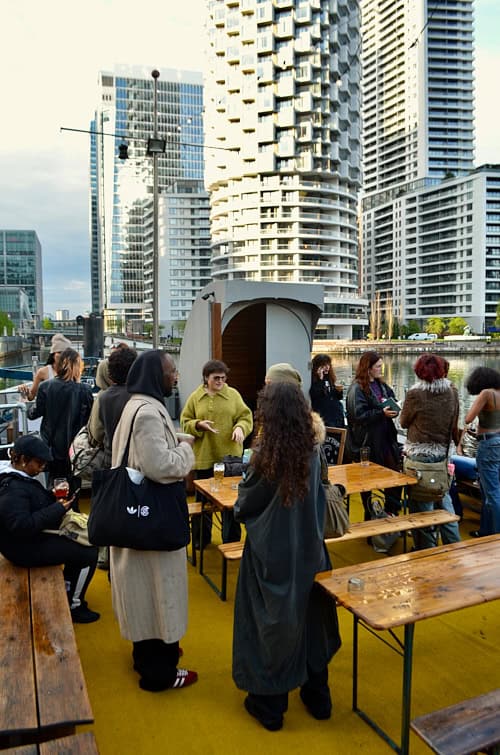
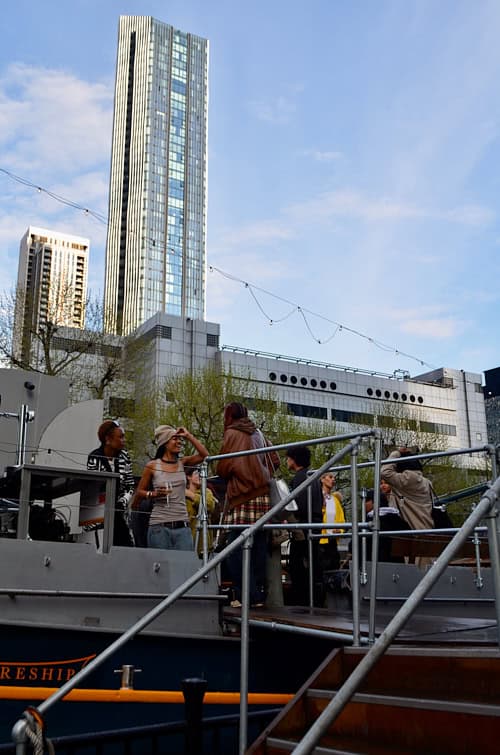
Theatreship is an independent project, hosting events like Sapphic Cinema alongside secret gigs and documentary screenings. I spoke with the Head of Film Programming at Theatreship, Natalie Hill, who said, “it’s a truly independent space, having a glass of wine here supports the arts.” She continues, “I particularly love that people feel so welcome here, they’re happy to come on their own.”
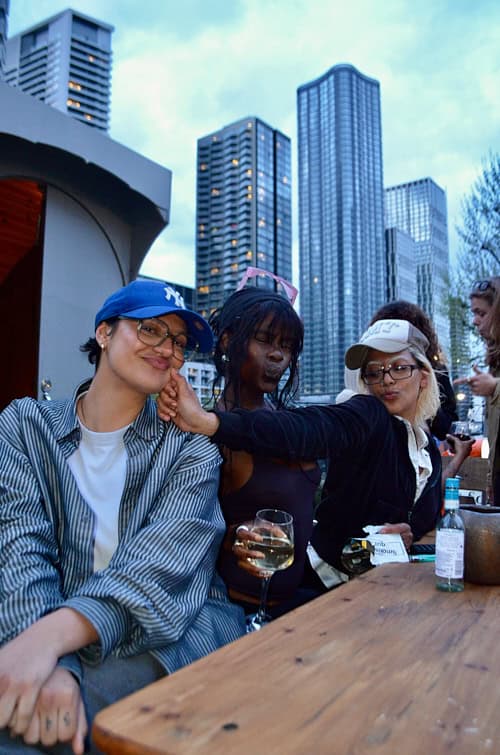
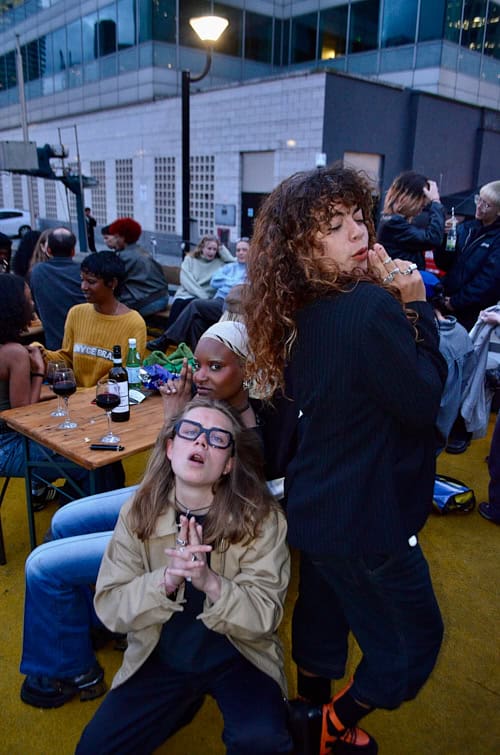
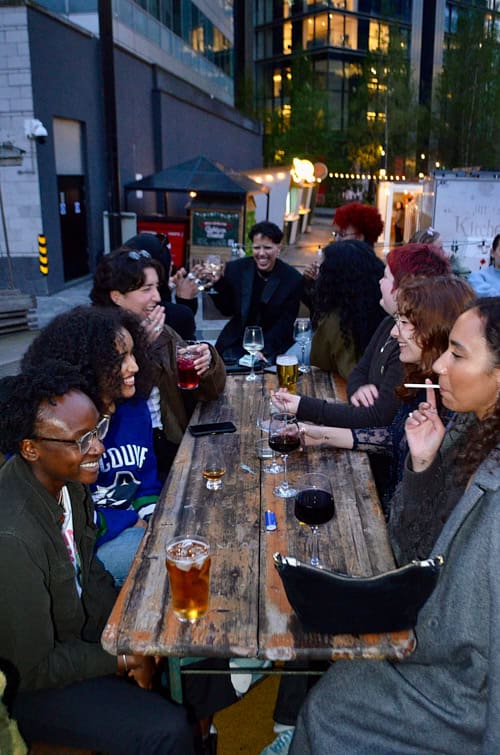
At Sapphic Cinema, it’s clear the crowd was a mix of returning guests and all new participants. It also seemed that there was an equal number of those coming alone, while others arriving in groups. Vogue cigarettes bummed from strangers were just one highlight amidst chatter about the film, interspersed between general workweek updates and queer gossip. There were many guests who were visiting from out of the country – someone had even travelled from Canada, arriving at Sapphic Cinema that night on a complete whim.
As the venue filled out, I chatted with Theatreship Project Director Inigo Lapwood, who is responsible for the vessel and project evaluation. “Theatreship does what it says on the tin, it’s a theatre on a converted cargoship.” In Inigo’s mind, the history of the docks brings people together in “what makes London such an interesting place.”
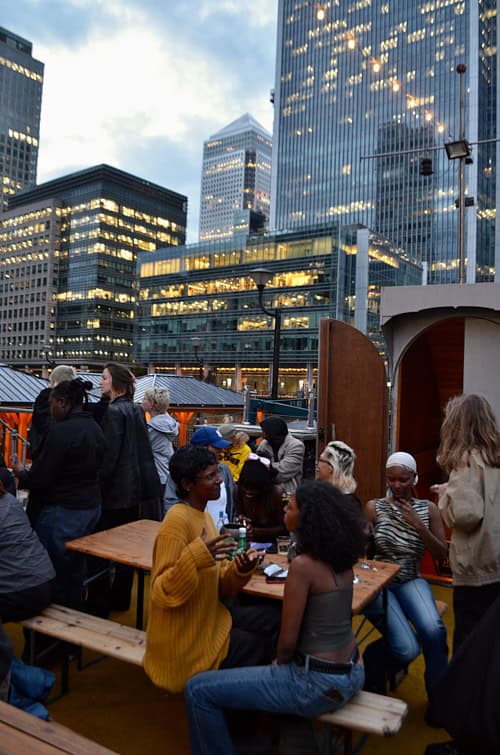
With a decade’s worth of experience in marine salvage, he says “it seems obvious to open that up again as a public space,” as spaces within the docklands haven’t always been accessible. Theatreship’s work is designed to reflect the way communities, programmes, and arts interweave into each other.
Inigo adds that event hosts “bring so much more exciting programming than I would ever think.” He further expresses that working at the venue, “is an opportunity to be surprised.” The series hopes to platform voices of Sapphic filmmakers and storytellers, presenting space for underrepresented queer people in the industry to shine. Through “themes of love, identity, intersectionality, and social justice,” the series creates a spherical understanding of Sapphic, queer, and PoC experiences.
I attended the April 2025 edition of Sapphic Cinema, where the film in question was Beyond The Aggressives – a sequel zooming in on the lived experiences of a specific group of queer, trans, and lesbian community members who first appeared in The Aggressives twenty-five years ago. The original film was itself a pioneering documentary which showcased the lives of Aggressives or AG’s, who are masculine presenting and/or identifying queer PoC during the years of 1997-2004.
Abi notes that while she loves showing more lighthearted films like But I’m a Cheerleader, it is also important to pay homage to the authentic lived experiences of queer people – including the harder truths that face Sapphics and PoC communities. Awareness of our origins helps us step towards a more inclusive and understanding future. This film brought bounding laughter and silliness to the space, but I could not count the number of times I found myself tearing up during the screening too.
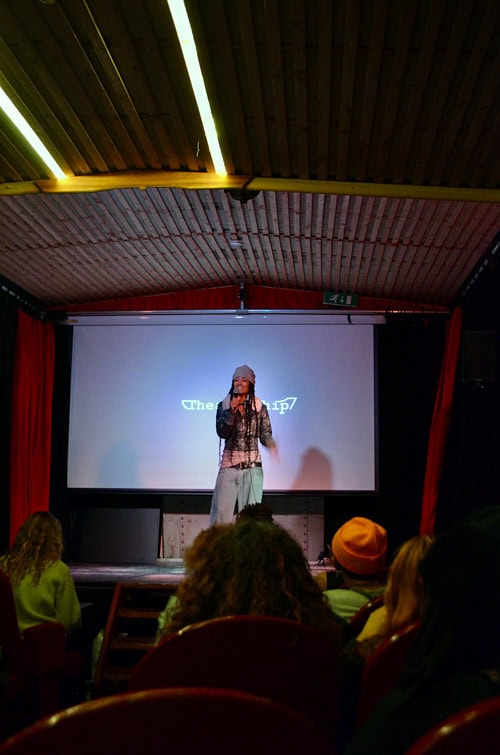
At this edition of the series, Abi hosted poet, model, and visibility activist Kai Isaiah Jamal to read some of their original works and participate in a Q&A session at the end of the evening. This section of the night tied a nice bow on the festivities, bringing art, culture, film, and community together under one roof, below deck. In the same breath that we cry for the suffering our communities endure, we also laugh, as light glimmers in the eyes of audience members forging hopeful new connections.
To get a slight amount of quiet away from the excited crowd, Abi and I popped into the vacant cinema, both with a glass of white in hand as we began discussing her background as a creative, why community is so important, and how she’s arrived to this point, celebrating over a year of Sapphic Cinema.
The Cold Magazine (CM): How did Sapphic Cinema come to be? Abi Asisa (AA): I came to the venue as a performer and once I saw the space I was really keen to put on an event here. I’d been thinking of running a Sapphic movie night anyway. I was doing a little one at a friend’s house – but then the friend in question, who was the only one that had a living room and a TV, moved house. At one of the last ones we had, we Ubered a TV from Ladbroke Grove to New Cross, just so we could watch Bound on a 40-inch TV. After that it was clear that the original structure wasn’t viable, and I was really keen to find a space, then Theatreship just kind of fell into my lap.
CM: London hosts a lot of club nights and big parties. What do you think bringing people around an art form like film does for the community? AA: I love my club nights, I love my Pxssy Palace where all these nights are fantastic… But I really noticed coming out of COVID there was a real absence of queer space that wasn’t centered around nightlife or drinking. You’re able to make a very different kind of connection in that space. The movies are almost tangential to the event itself – the purpose is to bring people into the space and allow space for conversation.
CM: Were live performances something you always wanted to do with these film nights?
AA: It was an idea of the space. I’ve learned a lot about how to curate the event, how to find a performer that really enhances the experience of the film. My favorite thing to do has been the Q&As, something that kind of dissolves the boundary between the audience and performer. Sometimes people sing, there’s poetry, there’s dance. It always brings something very different and very special.
CM: What specifically does Beyond The Aggressives: 25 Years Later represent? Why did you choose to show it? AA: In March and April 2025, we’ve been showing The Aggressives and Beyond the Aggressives. The first part is an early 2000s documentary about Black trans queer identities, the second is a follow up 25 years later.
We show a lot of fluffy films and I love them. I love But I’m a Cheerleader, I love Bound, but these kinds of genre films are a bit more lighthearted. They’re easy watches. But I never had as good an experience as when we did Shakedown, where people are able to see their real lives reflected back at them in a way that feels much more tangible than when you’re watching Natasha Lyonne play gay for the thousandth time. They’re some of the only ones that we have when it comes to Black representation on screen.
CM: When you aren’t working on Sapphic Cinema, where are you expending your creative energies? AA: I play the cello, that’s my main thing – I’m a musician.
I work as a session musician playing for other artists, and I’m also part of a project called Life is Beautiful, who do collective improvisations in London and around, wherever will pay us to be there. I do some modelling stuff to actually make money but my time is spent on curating these events and working on music.
CM: How did you carve out your space and find community?AA: It hasn’t been without its trials. I always push back on the narrative that the creative industry is like an evil Beelzebub of nightmares. It is like any industry, you’re going to have good actors and bad actors… and if you’re lucky, you’ll encounter more good than bad.
I’ve been lucky, I’ve had wonderful experiences and after five years in London I feel like I’m finally settled. I’m surrounded by good people that I enjoy creating with, I am lucky in that aspect. But, the London creative scene is financially inaccessible, so it is very difficult to navigate.
You’ve just got to be quick on your toes. If someone has bad vibes, you’ve just got to step away.
CM: When you imagine someone coming into the space for the first time, what is your ideal first impression of the space for someone to walk away with? AA: That it is a space anyone can come to. I don’t want it to feel like it’s cliquey or that only specific people are welcome, specific presentations are welcome. I never wanted it to feel that way. The feeling I want people to have is the feeling that I have in the space, which is just joy at seeing so many lovely faces, so many open faces, so many people who are willing to connect and share in a collective experience. That’s my main desire.
CM: If you could go back in time and give yourself advice, what would you say? AA: I would tell myself, don’t focus on the idea of “creative” as a noun. I don’t think “creative” is a set identity. “I am a creative, and therefore I create.” I don’t think that’s how it is at all. I never grew up in the creative industry. I played instruments, but I was always an academic person.
I think people should focus on the thing in itself they’re trying to create as opposed to the labels attached to that thing. So to my younger self, I’d say just relax, don’t stress that you didn’t get all As, it’s going to be fine. You’re going to figure it out.