
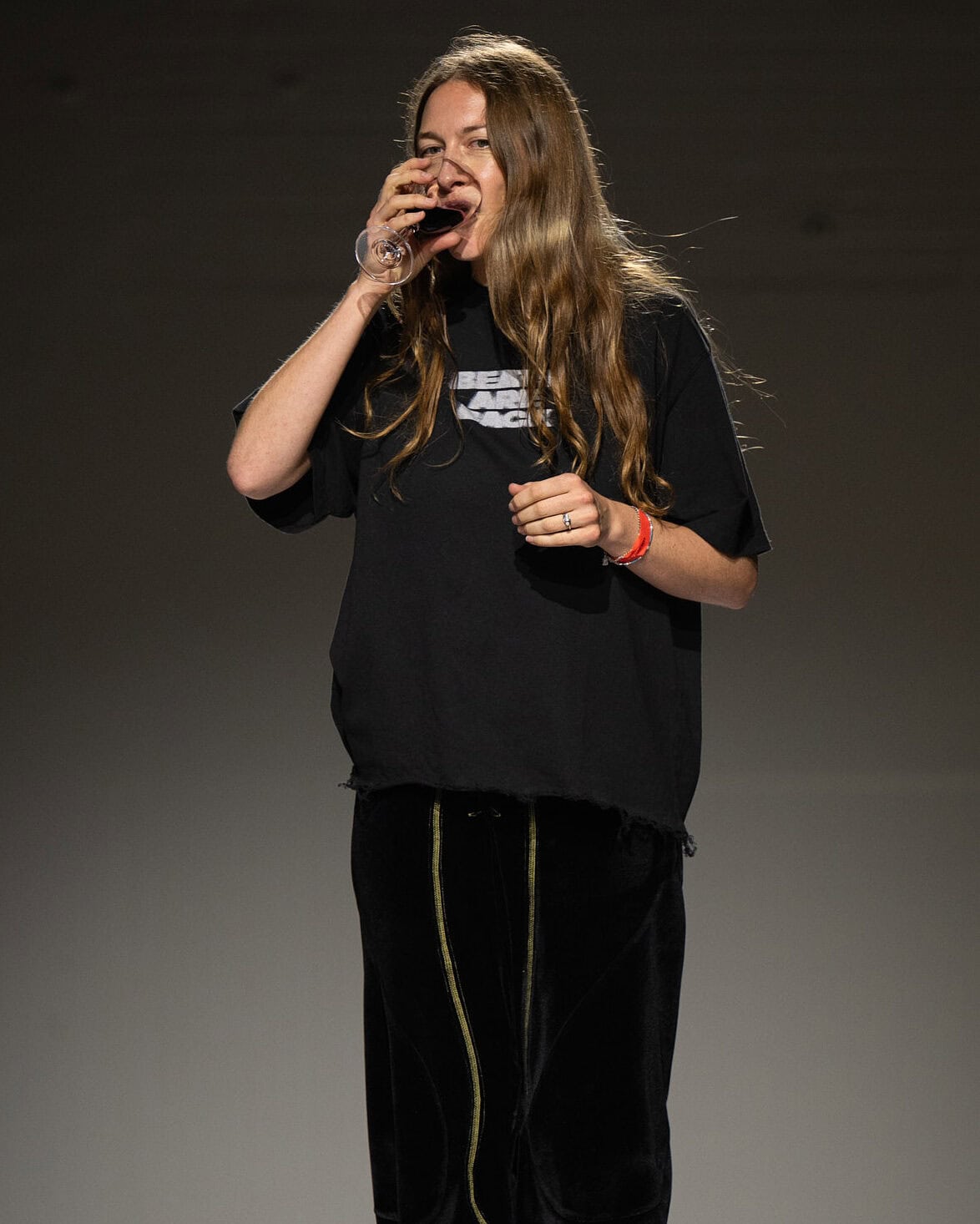
In a bunker beneath 180 The Strand, the Newgen Catwalk Space has been transformed into a feast for the senses. A few lucky guests find themselves around an ornate — if partly destroyed — dining table. Red wine splatters across a muddied, white tablecloth, and a carnival of plates, goblets, and silverware makes chaotic appearances atop piles of simple wooden chairs. What’s more? A playlist by British DJ Manuka Honey rings out above the whispers emanating from one of the world’s biggest fashion scenes.
This scene sets the stage for LUEDER’s Spring Summer 2026 offering. Known for its rave-ready fusion of contemporary armour and the decked-out costumes of medieval nobility, the brand is helmed by German designer Marie Lueder. Today’s show, Convivium, features hooded maxi dresses, drawstring-bound skirts in sweat-style fabrics, and ensembles reassembled from vintage football kits. Named after the Latin word for a ‘banquet’, it invites guests to feast upon curl-toed shoes, quench their thirst for irony with an array of slogan tees, and devour the brand’s decidedly modern take on classic lorgnettes — each with a lens bearing the single word: LUEDER.


What’s equally exciting is a collaboration with Pull&Bear. A highly anticipated iteration of the Spanish clothing giant’s Canvas for Creativity initiative, the capsule features everything from denims to a footy scarf-turned-hood — all extending on the label’s experimentation with silhouette, material, and form.

This spectacle is no surprise from the British Fashion Council-backed designer. Earlier this year, her show at Berlin Fashion Week featured an installation from visual artist Esben Weile Kjær. There, gigantic carnivorous plants were rendered as silver inflatables, reaching upwards with pointed teeth and open mouths as models darted around in the instantly viral slogan tee declaring, ‘MEN ARE SO BACK’. This shirt alone solidified LUEDER’s position among the vanguard of British brands making headway today.
A few days before the show, I visited Lueder at her East London studio to discuss the most exciting developments of the season. Over the course of an hour, we spoke about everything from FKA Twigs to the links between art and fashion, Berlin, upcycling, and whether men are actually back.


–
Joshua Beutum (JB): We’re sitting outside your studio. Give us a tour.
Marie Lueder (ML): At the moment, it’s manic because we have to get everything done before the show. There are fabrics everywhere, which we’re trying to reuse. We’re making laser-cut labels out of dead stock and using fake fur from the Autumn Winter 2025 collection. It’s leaving fluff everywhere.
JB: You need a lint roller.
ML: Yeah. A life-size one.
JB: How did you end up in London, and how did LUEDER come about?
ML: I started as a tailor. My mother made my costumes for this medieval camp I went to as a child, which spurred the interest. I did an apprenticeship as a menswear tailor at the opera for three years, before I came to London for an internship with COTTWEILER in 2015. I loved how Ben [Cottrell] and Matthew [Dainty] operated and collaborated with their friends. After I studied at RCA, we had an exhibition — it was a fashion show as an art project. In 2020, I showed at Discovery Lab at London Fashion Week. In 2021, I got my first sales agent at htown. In October of that year, I made my first sale.
JB: There’s an interesting overlap between fashion and art there.
ML: The label itself is a fashion brand, and it operates as that. When I escape into art, it’s mainly through collaboration with others. For this London Fashion Week show, we’re working on a little artwork, and that’s what brings me the most pleasure. But it’s a collectible item, rather than specifically a garment.
JB: Let’s move on. In the past, you’ve spoken about how sustainability and craftsmanship are vital to your process. Is there a tension between these values and the pressure to keep up with growing demand?
ML: I struggle with it. I make too many things because of the way I operate — it is a problem that I must make a whole new collection every season. That doesn’t really align with my values, so I try to rework items across the seasons. I often re-use fabrics in different ways. Every tailor has learned to cherish materials — you don’t want to waste them.
JB: Is there anything re-used on stage this London Fashion Week?
ML: My worst enemies in overconsumption are T-shirts produced for single occasions like baby showers. I’ve been integrating these garments through a couture process, which creates a space to talk about them again. It’s not cheap, but it’s essentially a type of craftsmanship against fast fashion.
JB: LUEDER began as a menswear brand. Would you say you’re still creating clothing for men?
ML: It’s unisex. There are a lot of women who wear men’s clothes, and a lot of male models who want to cross-dress for me. Gender doesn’t matter so much. My challenge is to make the pattern work on all bodies — you see it in the way we cut, the kind of waistbands we use. That said, a lot of labels revisit women’s clothing from the past — like corsets. I’m interested in men’s tailoring. I research historical garments and use the present as a reality check. How would this feel for someone now? How can I make this contemporary? Then, I add a token of a dreamscape or something futuristic like a modern material or a way of working with the body.
JB: Let’s touch on the ‘MEN ARE SO BACK’ T-shirt. How did that come about? How did you feel when it went viral?
ML: For a while, I didn’t talk about men because it’s such a complicated topic. But that T-shirt had its time. We made it a week after Donald Trump was re-elected last year and we used it to draw attention to the rise of those values. I wasn’t trying to make a statement, more of a provocation for discussion. But I liked that it happened. It made people want more.
JB: Is that how you see all your work? As a provocation?
ML: At the beginning, I was thinking about a shape which represented my desire to work with communities — that’s where the spiral began. The shape itself often represents sand, or a journey, but for me it’s a symbol for community. But with the slogans we use, I’m a bit more careful. If I ever make a statement, it’s more about provoking a conversation because I’m not a priest. I just want to engage with people about topics.
JB: What are you most excited about from the show?
ML: The set. It looks like a banquet or a feast. The models walk across a dining table. Plus, the collaboration with Pull&Bear is very exciting.
JB: A standout piece? Or a favourite process?
ML: We worked with British Millerain, which is a very traditional fabric. But we gave it a specific kind of LUEDER dirt, made it more contemporary. That’s a fabric I would really highlight from this collection.
JB: Do you want to touch on what makes this show in London different from Berlin, where you showed earlier this year?
ML: In Berlin, it’s very much about performance elements and more grown-up. I had this opportunity to work with Esben Weile Kjær, an artist and friend, and he made this inflatable for our show that season. But that show was just an introduction. The collection looks different now.
JB: And finally, who’s the dream person to wear your clothing?
Mickey Rourke always comes to mind. I’d dress him like a gym mom in leggings. Plus, I always enjoy when Yung Lean wears something — he’s a good description of who I imagine wearing LUEDER. Or FKA Twigs, but she’d need a custom piece. Because she’s FKA Twigs.


