The other day, my quinquagenarian mother texted me a link to an Instagram reel, imploring me to watch this heartwarming video that had brought her to the threshold of tears. The video in question was slop: an AI simulation of a snow leopard inexplicably lost at sea then miraculously saved by a quasi-Christological pack of dolphins. Of course, I rolled my eyes, then dutifully texted her that famous creed, Don’t believe everything you read (or, nowadays, see, watch, or hear) on the internet. But the Polish-born theatre iconoclast Łukasz Twarkowski would identify a philosophical, ontological dilemma buried somewhere in the anecdote: If a mother sheds a tear at a laughably fake AI video, does that make the real emotions she felt worthy of laughter and derision too? Does it make her feelings any less real?
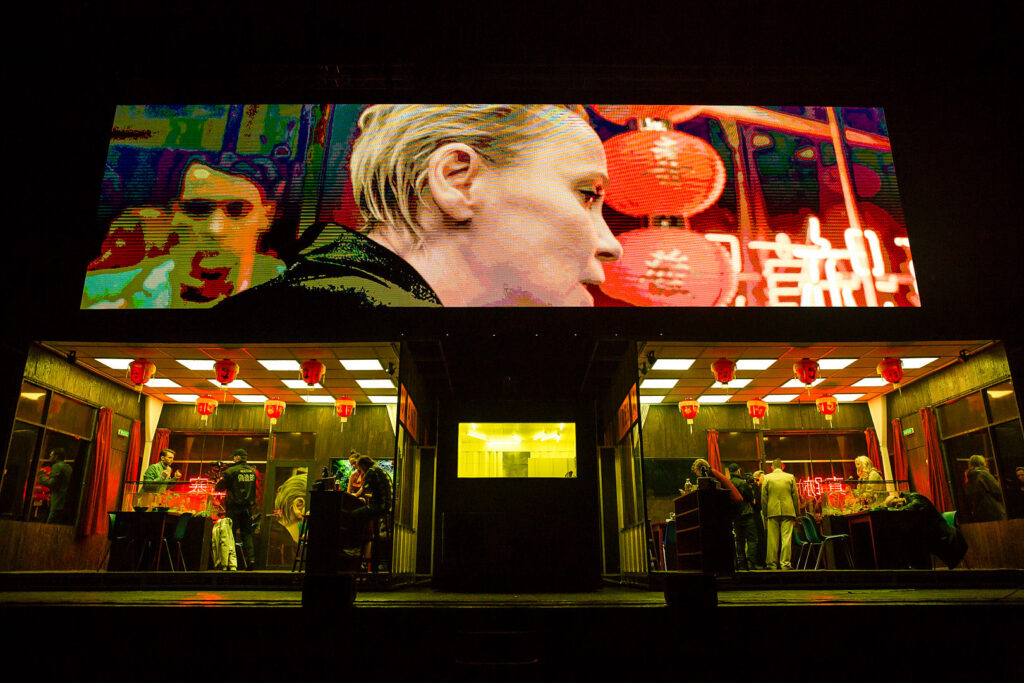
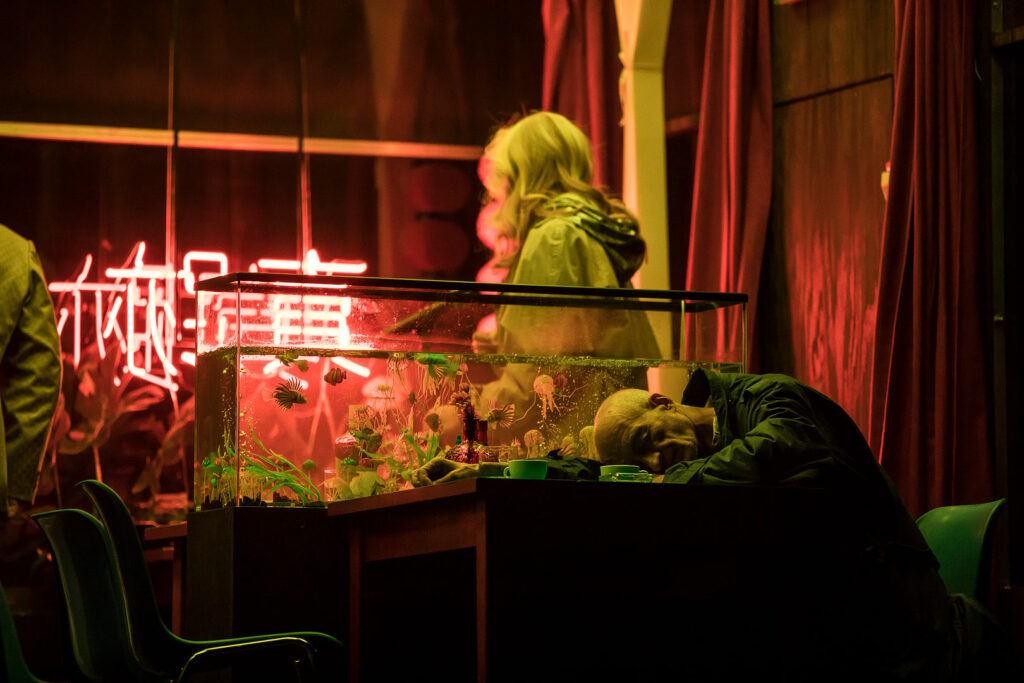
This is a convoluted – and unfairly simplistic – way to introduce the core quandary of Twarkowski’s latest on-stage offering, ROHTKO. Inspired by the irl case of a Chinese maths teacher in Queens who successfully forged and sold off a Rothko painting for millions in 2009, it experimentally asks what it means for something to be considered real, or original, or authentic, or true.
Debuted in 2022, its prescient dissections of a post-post-truth world, the ensloppification of art, and the contemporary emotion economy have since survived culture’s quantum-speed permutations to remain stubbornly, dispiritingly, and satirically current. As ROHTKO readies to go to stage at the Barbican Theatre (2-5 October 2025) as part of the venue’s UK/Poland 2025 season, The Cold Magazine catches Twarkowski to ask him about protest, form, and the role of art in an age of AI-generated reproduction and videos of daring dolphins saving imperiled felines from icy Antarctic seas.
The Cold Magazine (CM): In an interview on your previous work, Respublika, you stated that “theatre on its own is no longer enough.” You were commenting on form, however it reminded me of a tagline used during the AIDS crisis by the activist group Gran Fury, that “with 42,000 dead, art is not enough” – as in, art alone cannot reverse or redress cataclysm. What does it mean, for you, to create in our current context of global poly-crisis? Is art or theatre or any form of creation ever enough to address the contemporary condition?Łukasz Twarkowski (LT): It’s not enough on its own. It is pretty hard not to lose the sense in what we are doing in the arts. With ROHTKO, we finish the show with the Ukrainian flag and “Russian War Ship – go fuck yourself”, a protest slogan from the time we premiered the show, which was two weeks after the full scale Russian invasion of Ukraine. We keep this in the show because this was the only statement we could make.
We were working in Riga [the capital of Latvia, Rothko’s home country], which shares a border with Russia, and I had friends who were being bombed in Ukraine. I struggled to find any reason not to drop everything, to continue working to open our show about authenticity and originality. I had to completely disconnect from the news. In order to finish the show and not to disappoint people and my company’s months of work, I had to deconnect from the reality.Somehow I believe that theatre is some kind of vehicle for the survival of human beauty.
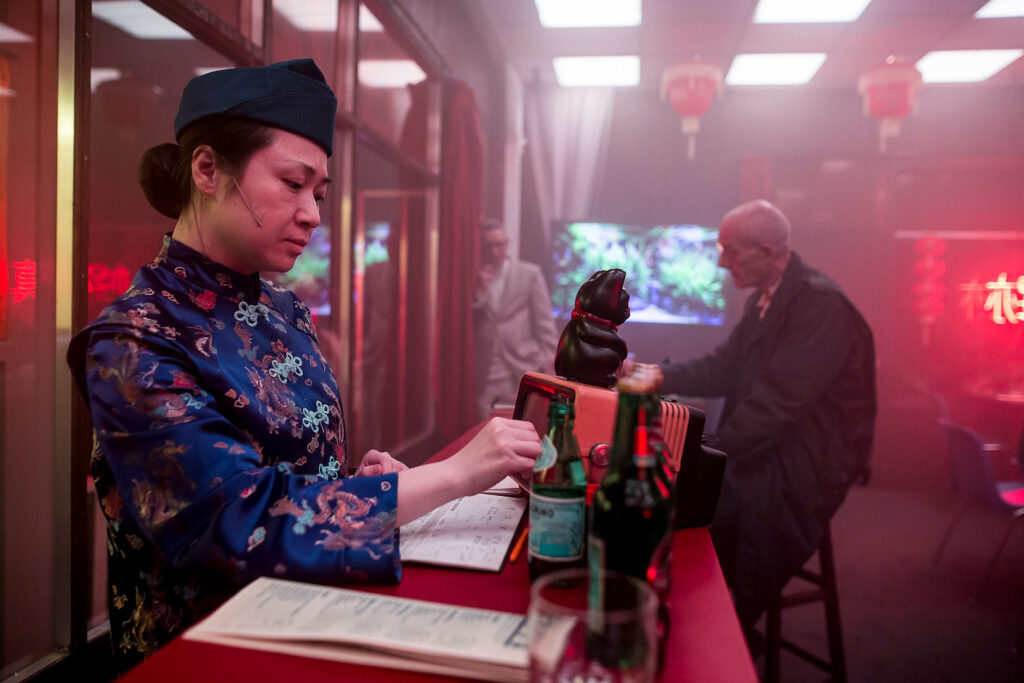
CM: As you mentioned, ROHTKO is a work that deals with questions of artistic reproduction, ownership, originality, and authenticity. These are also questions that Walter Benjamin famously floated in the 1930s, arguing that the “age of mechanical reproduction” would turn art from an aesthetic, auratic object into a political and fascistic one. Nearly a century later, new artforms and mediums like NFTs and artificial intelligence have reignited and hyper-charged these anxieties. Was this new, digitised aesthetic frontier something you had in mind while creating ROHTKO?
LT: It’s interesting because we started this production thinking about questions of originality and authorship, and then we were also inspired by the boom in NFTs that happened around the time we were in R&D [research and development]. Since we premiered, the show has become even more prescient around anxieties over authenticity and global developments in digital spheres like AI or deepfakes. So while the content hasn’t changed, the urgent challenges and realities of the time we’re living in continue to find new resonance in the show.
CM: One of the fears about mass-produced and/or AI-generated art is the question of what happens to art when it is mediated through a machine, when it is no longer fully “human” or “organic”. It’s the same critique that painters, for example, once lobbied against photographers, that photography was a lesser artform because it needs a machine. Nowadays, this critique would seem absurd. How should we define art in this context? LT: This is one of the main questions of ROHTKO. The question is not really about the object itself but the relationship between the art object and the human being, and what emotions it evokes. Thinking about the show, the complexity starts with the couple of art collectors who bought this fake Rothko painting. Throughout the trial, they claimed that they wanted to be paid $25m compensation for the emotions and the tears they cried in front of the painting. If the painting was faked, was their emotion ‘fake’ too, less ‘real’?
You can see this a little bit from the Quantum way of seeing the world, that it’s not really the particle that matters so much but the relation which happens somewhere in between the observer and the piece of art. This is not going to change if it’s mediated by machines or not. It will still be the relation between the receiver and the object that matters most, where the real test lies.
CM: ROHTKO also presents a confrontation between Eastern and Western epistemologies and conceptions of authenticity. Could you explain that difference for readers?The main concept of originality in Western culture comes from the idea of beginning and end.
In Oriental culture there is no such beginning and end, because instead there is an eternal, never ending process of changes. This is extremely difficult to imagine from our European perspective because we are rooted so much in the Judeo-Christian tradition where everything is marked by the beginning and the end. It’s a world view that we cannot imagine without. But it is absolutely not more reasonable, and equally as untestable, as the idea of not having the beginning and the end.
It’s the same with the question of what it means to be original. What we consider as original doesn’t need to be the only way of categorising this term. From the Asian perspective, ‘original’ is not necessarily connected to the material life of an object but to the moment it was created.
What is fascinating is that in the history of Chinese art, a copy can become more valuable than the original. Because in a very Platonic way, the piece of art is a representation of a certain idea, and you can always do it better. So actually you don’t copy a physical painting itself, you copy the idea behind it. That’s why it can become more valuable than the original from centuries before.
These were some of the notions that we were working on, thinking about the Oriental and Occidental way of seeing authorship, originality or copy.
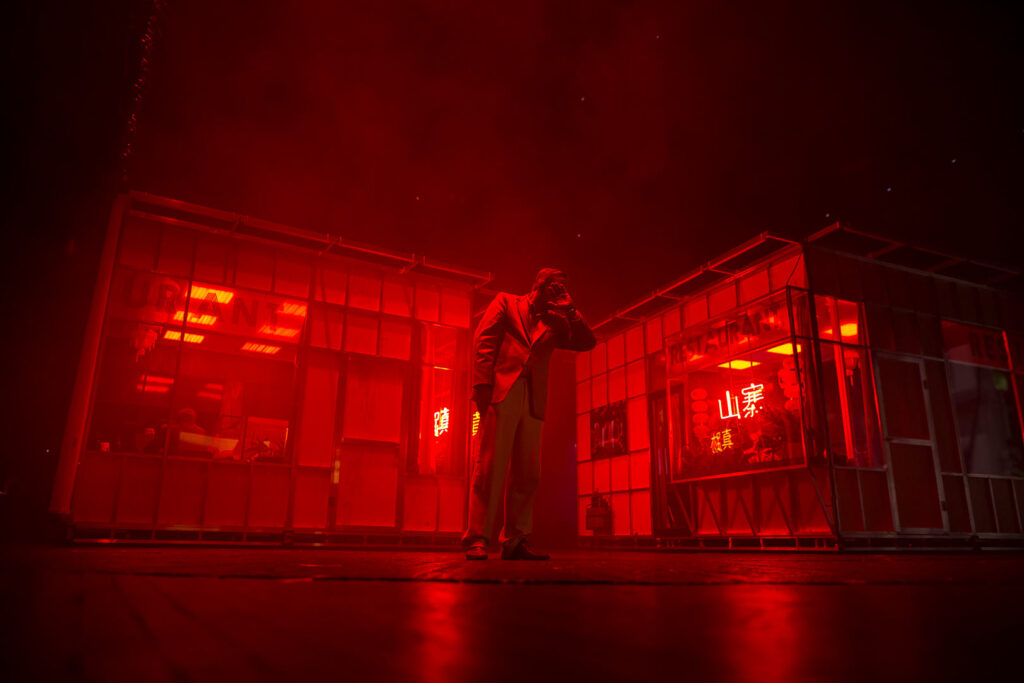
CM: So, ROHTKO is a critique of Western understandings of authenticity and originality, which have picked up a lot of cultural cache over the last decade or so. People are urged to be “authentic” or their “true selves” online, while simultaneously metabolising targeted algorithms that instruct them how to perform this “authenticity” and how to achieve their true selfhoods digitally. Can authenticity still exist in a chronically online age?
LT: I don’t think [authenticity] exists in the online age and I don’t think it ever existed before computers. The notion of authenticity is one of the most false ideas in our culture. This is exactly what quantum physics teaches us. We should maybe not consider ourselves as solid independent entities. There is no such thing as ‘me’. There is a different ‘me’ in relation to different people, in different situations, changing all the time. Seeing the world from the Asian perspective as a never ending process of changes makes you understand that there is nothing stable or consistent about authenticity.
It is the same as when you’re thinking about the altered state of mind – being ‘under the influence’ etc. But what is the authenticity of perception? We are always chemistry-dependent creatures. You don’t need to take drugs to feel completely different when you do yoga, when you dance – you start seeing the world in a completely different way. There is no such a thing as being sober because we are high on feelings and endorphins non-stop. We are constantly under different influences.
So that’s why I think the concept of authenticity has never existed and is one of civilisation’s constructs.
CM: These questions of authenticity might also link to the debate around “stuck culture”, the idea that all cultural products nowadays are a reproduction, remix, or reimagining of something made before. Every film is a remake, every song samples another: Nothing is original, everything is haunted by the past. In your opinion, is culture stuck, self-cannibalising? Are we still moving forwards artistically, aesthetically?LT: It is connected to the previous question I think. There is no such thing as artistic development, this is not something you can simply ‘achieve’. Art exists in certain moments, in certain conditions. If it has receivers, observers, spectators, if it provokes debate, if it evokes feelings, that means that it works. The art itself doesn’t have a growth that you can measure, only in the number of relations [between people and the art event or object] that certain artforms can create.
So I would say that the idea of development, of course we still develop the technology we use, and strategies for narration. But it is not a sports championship where you try to achieve something better than your ancestors, right? It is about finding the ways which engage spectators and receivers with the reality of the moment through certain issues, emotional or thought processes.
For me, I’m fascinated by mixing these different forms: cinema, rave, live performance, visual art. I continue to experiment and research creating these kinds of synergic forms, multiplying the possibilities into a hybrid, transcendent experience for spectators.
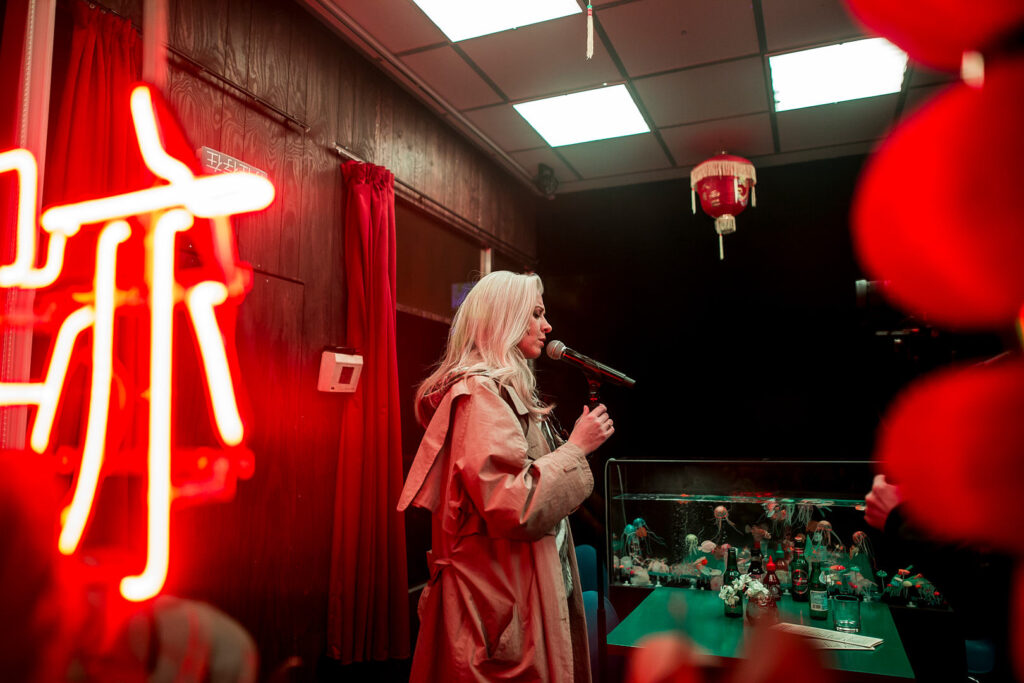
CM: Sight is often ontologically privileged as the primary of humankind’s five sense: we are understood as visual, scopic beings. However, your work gives equality – sometimes even primacy – to sound. What does a sound-based approach to experiencing the world offer versus one based on sight?
LT: We tend to focus so much on visuals. But, in fact, it is in sound that you first notice if something isn’t right; like the expression, you hear a ‘false note’. And it is even the same when I’m working with actors in rehearsals. I don’t need to see actors performing to feel if it’s going well or if something needs to change. You cannot understand the scene with only visuals, without hearing them. Thinking about the ideas of originality and authenticity in the show, their voices create a certain melody, or harmony, that resonates powerfully on a physical and an emotional level as a spectator.
We use many layers of sound in our shows, similar to how cinema works, and it can affect your sense of reality and how you experience time. For ROHTKO, we start with found footage or background noise, add ambient music to create the sense of place, and then another layer of emotive music on top. We also use strong electro-beats, bass and trance rhythms to enhance the interaction for the audience, which brings in much more of the feel of being at a concert.
CM: Do you have a first memory of sound?LT: Not really, but I have two foundational experiences – not only sound, but proper trance. Though I had attended clubs and the techno scene before, my first real experience of the power of sound was very late. It connected with my first real experience of freedom, at the illegal rave festival in Crimea, Ukraine in 2006 with five sound systems where we were dancing day and night for a week. This was the most extreme sound experience that I had.
The second one, probably it was the first time listening to the concert of Merzbow – and feeling physically this wall of sound, it was kind of a transgressive experience. That was probably around the year 2008.
CM: What do you want viewers to take away from watching ROHTKO?
LT: If I knew how to express myself in words, I would not do theatre. Spending so much of so many people’s time creating something, and four hours of spectators’ time watching it, because I would just explain. The theatre is the most sensual form of communication and I hope that every spectator is going to get a different outcome. We know from our experience that it often works like this.
Directed by Łukasz Twarkowski, with text and dramaturgy by Anka Herbut, ROHTKO is a production of Dailes Theatre (Latvia), presented by the Barbican as part of its autumn–winter programme. With the support of the Adam Mickiewicz Institute and the Polish Cultural Institute in London, ROHTKO is part of the UK/Poland Season 2025.