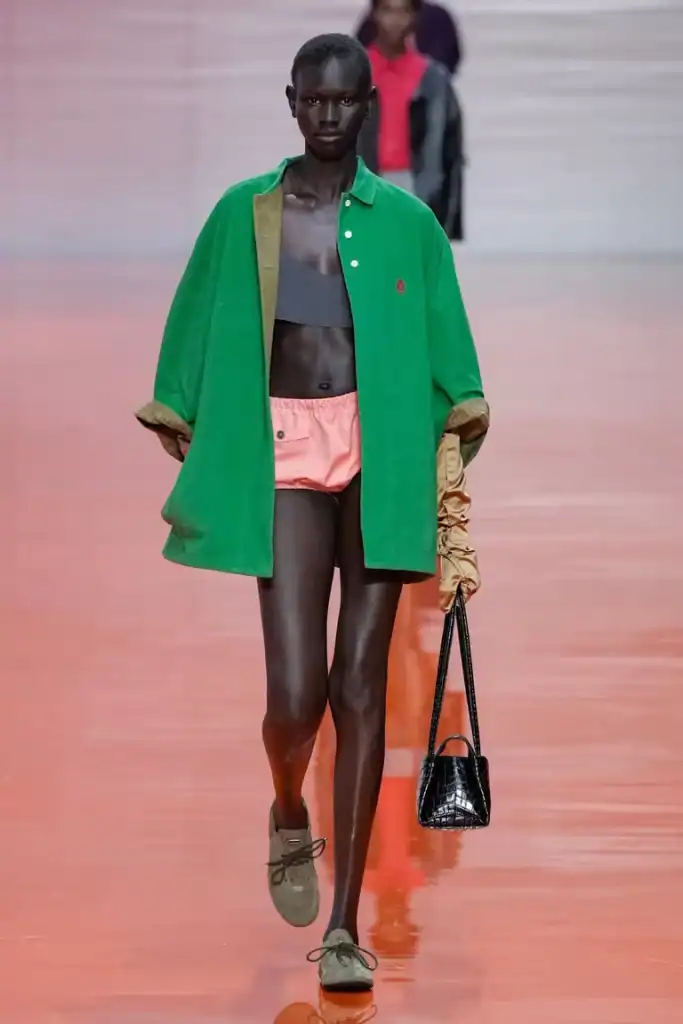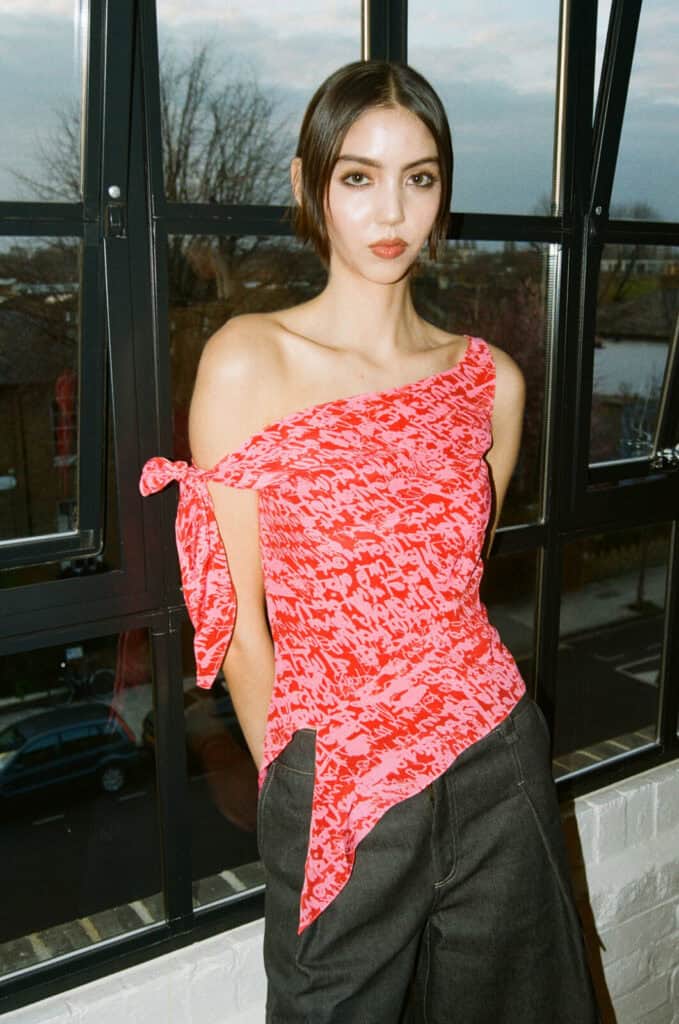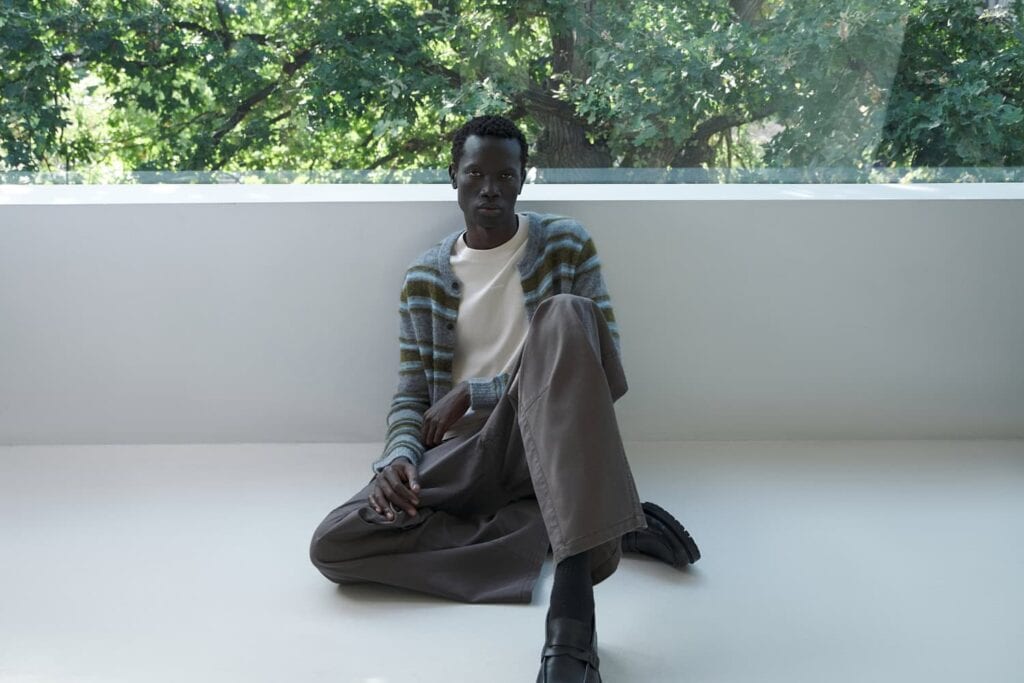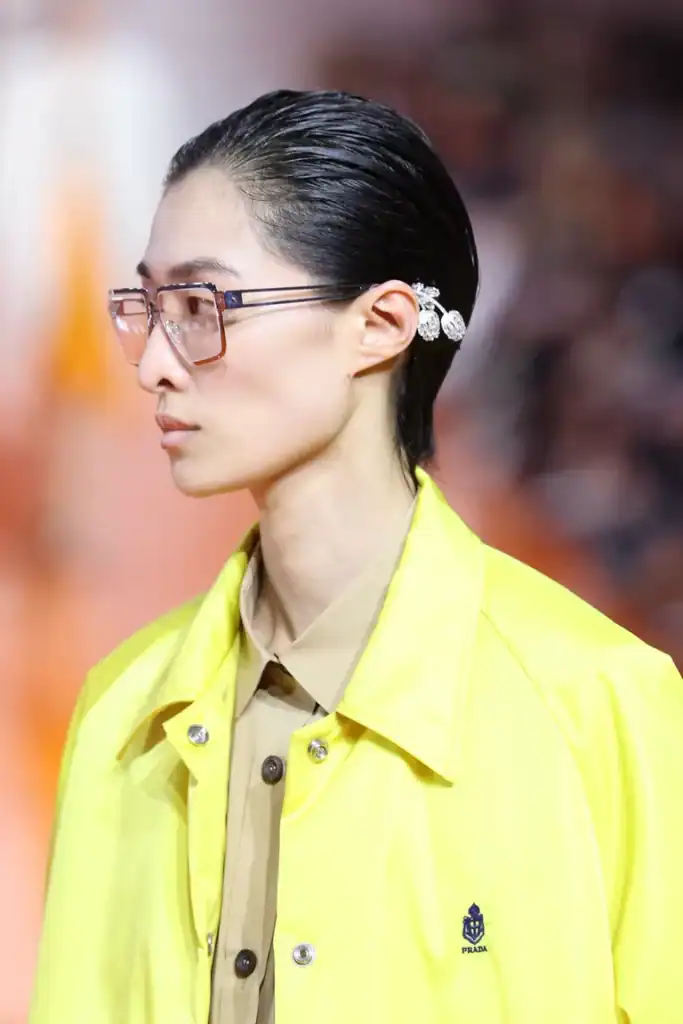
At Milan Fashion Week Spring/Summer 2026, Prada delivered a collection that rejected fixed ideas of purpose, function, and femininity. Held at the Fondazione Prada’s Deposito–this time set against a lacquered orange floor, saturated with sunlight–the show was not about narrative or cohesion, but about the act of composing: of putting things together in ways that resist logic and still create meaning.
Miuccia Prada and Raf Simons continued their long engagement with the idea of the uniform. But here, it was less about uniformity and more about modularity – the uniform as something to be broken apart and reassembled. Military shirts and pleated trousers opened the show, worn with opera gloves and embellished kitten heels.
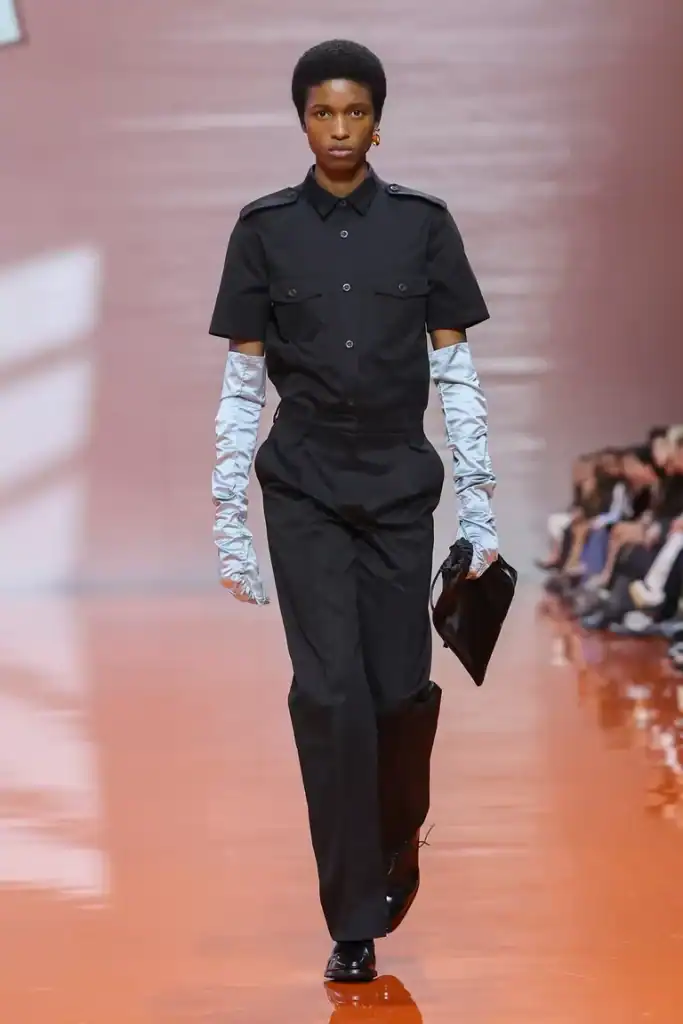
This fluidity extended across the collection. Skirts came spliced from various codes – kilts, dirndls and evening lace, tied together with grosgrain ribbons. Bra tops floated, unstructured. Slip dresses looked suspended rather than worn. Structured outerwear–from coach jackets to flaring cardigans–introduced volume and rigidity that contrasted sharply with the lightness underneath.
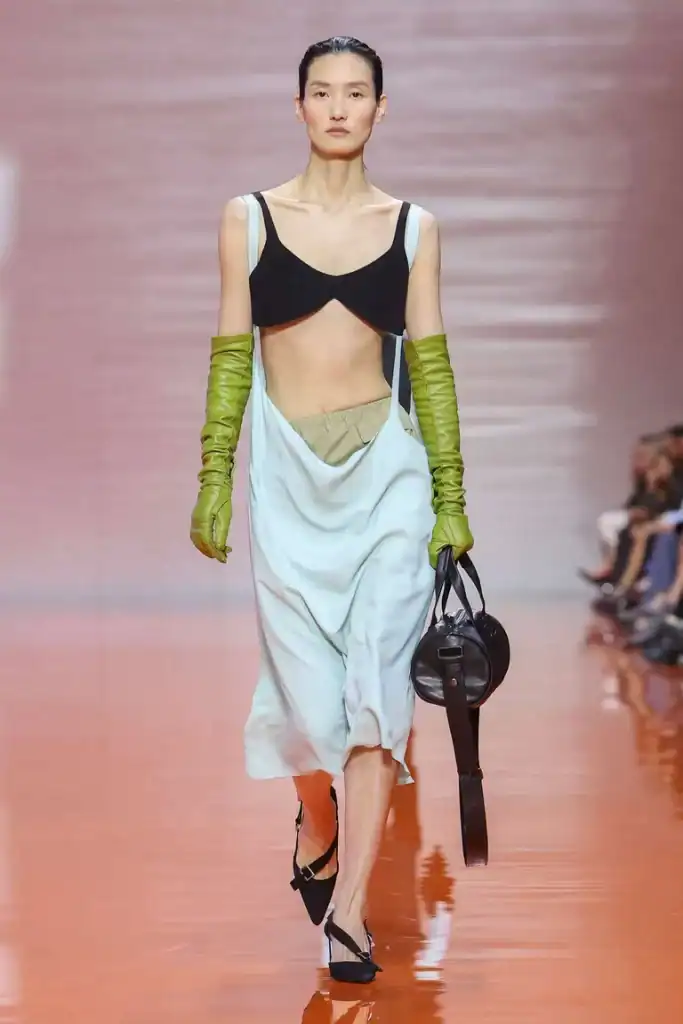
Rather than chasing a clear silhouette or a unifying theme, Prada offered what it called a “toolbox” for composition, an open invitation for individual expression. The garments didn’t just mix high and low, masculine and feminine, or minimal and maximal; they challenged the premise that such binaries need to be resolved at all.
In their show notes, the designers described the collection as a response to the “overload” of contemporary culture. Simons spoke of freedom – physical, stylistic, conceptual. Prada noted the uncertainty of the present moment, and the need for clothing that can shift and adapt – using fashion not as an escape, but as a kind of preparedness, not in the utilitarian sense, but in the emotional and intellectual one.
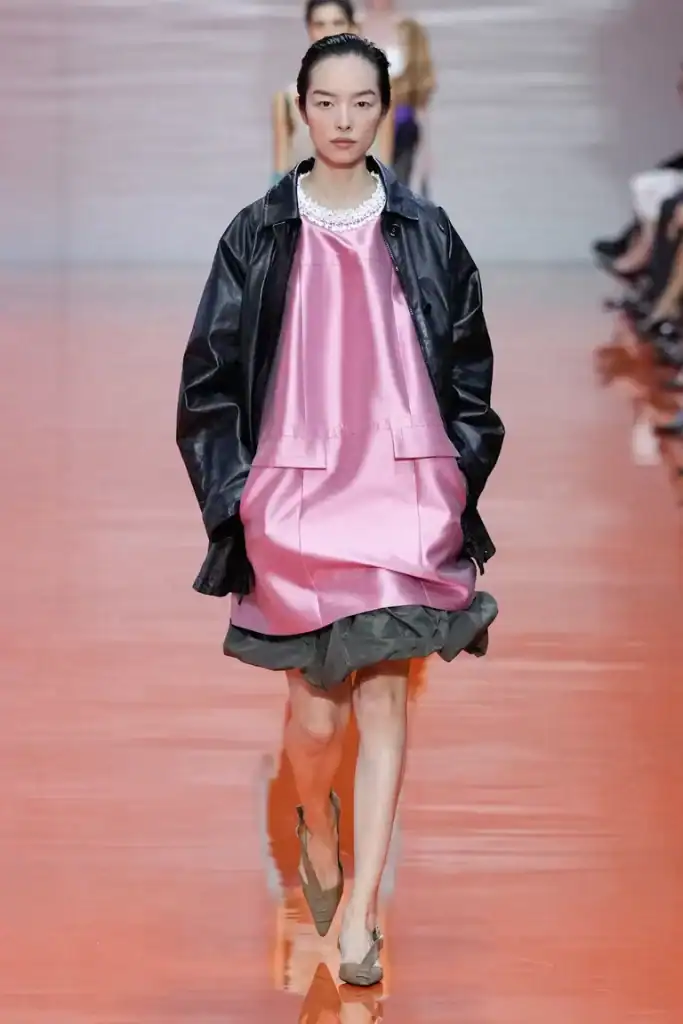
There was boldness in the collection’s dissonance – from its fragmented skirts and floating bras to its oversized polo coats and layered folkloric dirndls. And yet, it felt considered. Every contrast, soft and hard, clean and chaotic – was an argument for letting the wearer decide how meaning gets made.
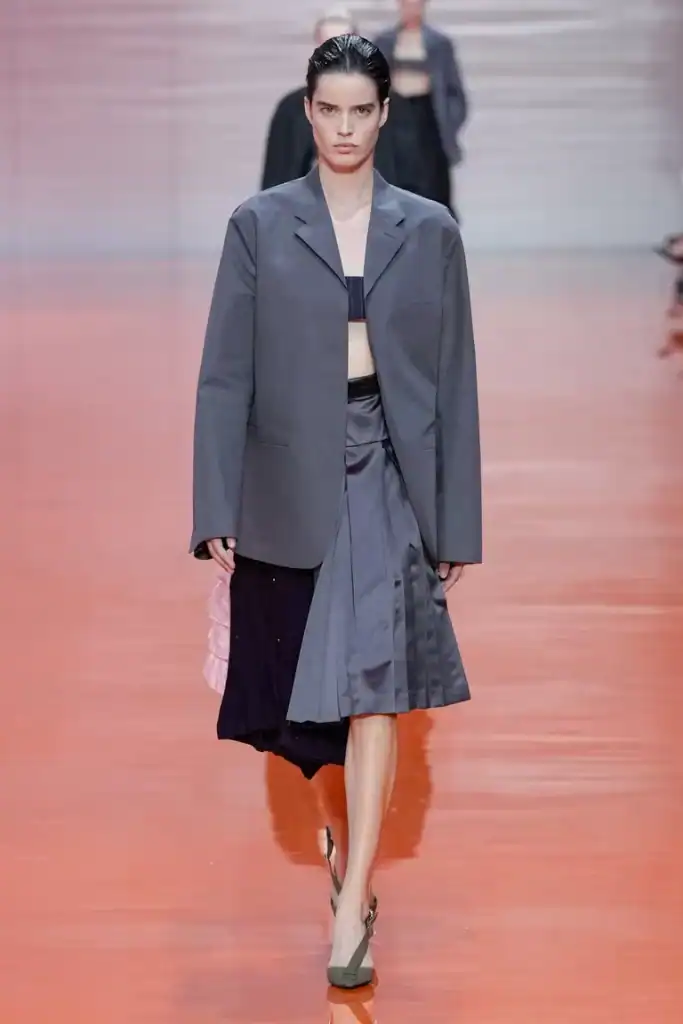
Rather than dictating a seasonal aesthetic, Prada SS25 posed questions: What does it mean to dress freely?
In stripping garments of their expected context and recombining fragments from across time and type, Prada proposed a method, one where the act of dressing becomes a process of editing, assembling, and asserting. In a fashion landscape often preoccupied with clarity or concept, Prada leaned into the complexity – and trusted its audience to do the same.