
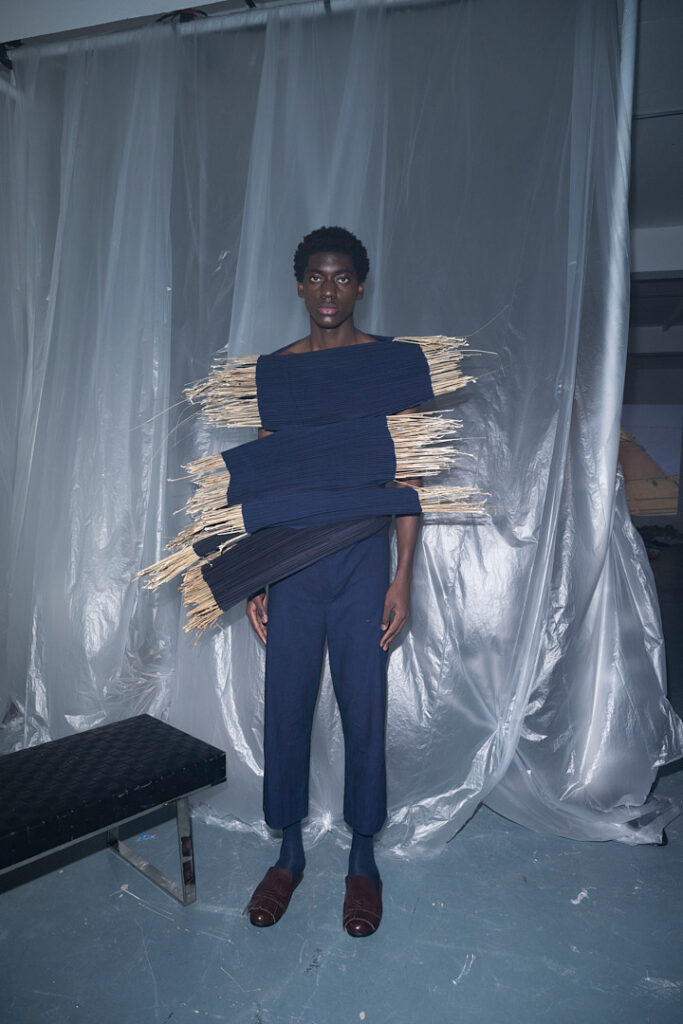
What does migration look like in cloth? In Runners, Timisola Shasanya answers with garments shaped by heritage and the movement of materials across borders. For her BA graduate collection, the Central Saint Martins designer and Sarabande Foundation scholar translated her transnational upbringing into hair-raising sculptural menswear. Born in Ireland and raised between England and Nigeria, her childhood was shaped by life across borders, experiences that continue to inform her approach. When we spoke over Zoom, Shasanya had just relocated to Paris to begin her master’s at Institut Français de la Mode (IFM), continuing her explorations across geographies.

Presented through Hi-Fi, a non-profit platform aimed at supporting emerging designers and artists, Runners unfolded in a staged environment of plastic sheeting and dim lights, each corner resembling a page torn from an old photobook – a glimpse of time passed, but composed through a dichotomously distinctive modern vision.

The collection rethinks the codes of menswear. Iterations of a one-piece jumpsuit, developed in pre-collection, reinterpret traditional Nigerian tailoring –from the abada [overgarment] and buba [undergarment] to the sokoto [trousers] and the voluminous agbada [robe] – where eliminated seams create drape and ease. Indigo-dyed textiles sourced in Kano, a city whose dye pits have operated for over five centuries, are stitched with broom fibres from her family home. A fringe-like full-length garment emerges from her father’s farmer bags, reworked into a resilient form. Red leather, also from Kano, was carried back by her father, cutting through waxed Barbour cottons and coated fabrics – a series of unorthodox objects that together narrate modern-day exodus through her lens. Footwear produced with a Lagos-based cobbler and shoemaker extends this dialogue, tying her work back to the local community.


Shasanya’s work proves that fashion itself migrates, acquiring new meanings as it travels: a fabric woven in Kano, carried across the Sahara and then stitched in London may shift in significance with every crossing and body it encounters; Runners is a meditation on how clothing can carry the weight of tradition while allowing new identities to take form.


In this interview, Shasanya reflects on the journeys and materials that shaped her collection.
The Cold Magazine (CM): What was the starting point behind Runners?
Timisola Shasanya (TS): The main idea was really my migration story and upbringing. I grew up in England, was born in Ireland, and also lived in Nigeria. It’s about that duality of living in both spaces, and how memory, materials, and visuals from back home could be brought into the UK. Craft is central to me – I’m always drawn to textures and materials that speak to how I’m feeling. Even though I only lived in Nigeria for two years, I was always moving back and forth, visiting family, and seeing the beauty of Lagos. That back-and-forth became the framework. I also did a research trip to Kano and Lagos, so it became about bringing those materials back, interpreting them in my own way, and situating it within menswear.
CM: What inspired the name of the collection?
TS: The name actually came from a pleating technique that runs through the collection. I first used it for the White Show at CSM – everyone gets the same white fabric and has to make it their own in three weeks. I brought in these brooms I’d been working with, and my tutor said, “oh, you can embed them, almost like runners.” The technique itself is called pintucks, but I kept calling them “runners.” When it came time to name the collection, it just clicked. It worked on two levels: the literal technique I’ve carried from the first year into my BA collection, and the theme of migration: running, fleeing, moving. My own journey wasn’t like that, but migration more broadly often carries that weight.
CM: Can you tell us about the materials you used and why they were significant?
TS: I worked mainly with cottons, treated and untreated: indigo-dyed in Kano, natural broom fibers, and wax cottons I was sponsored. People assume I used a lot of leather, but it was actually a smaller percentage. Most of it was coated fabrics, to create this liquid, watery effect based on my research imagery, alongside the dusty indigos. Barbour sponsored about ten meters of fabric and a wax coating tin, which was amazing, because waxing connects both to my boarding school memories and to Nigerian textile traditions. I also pulled from my dad’s farm in Nigeria – things like the tarpaulin bags he used. It became a mix of sponsored textiles, treated fabrics, and found materials that carry personal meaning.
CM: Migration is a central theme in your work. Do you see clothing as a way of carrying memory and identity on the body?
TS: Definitely. I think about the clothes my dad wore in Nigeria, but also about Barbour jackets in boarding school in Kent–everyone had one. For me, it’s about how I can instill those memories into something present. Waxing is a perfect example: it’s both a school memory and a Nigerian technique. Merging those two geographies through fabric and construction lets me carry both experiences at once.
CM: You often design with dark skin in mind. What conversations do you hope this sparks in the wider fashion system?
TS: For me, it’s about how material, light, and reflection work on darker skin. As a dark-skinned woman, that’s always in my mind. It’s not that I design only for dark skin, it’s about questioning what it means to design through your own lens when you’re often the only Black person in the room. I want to push that perspective into the real world. At the same time, I think about everyone I see around me: all skin tones, different personalities. For me, design starts with the body and the individual, not a generic idea.
CM: Do you think the traditional runway can still hold the kinds of narratives you’re telling? What does your dream presentation look like?
TS: I think it’s about bridging the two. When I first got into fashion, I loved the chaos and energy of the runway, versus the stillness of backstage. I feel my work fits a presentation space more than a runway right now, but mainly because I haven’t yet had the chance to create a runway fully from my perspective. My dream would be an immersive runway, something between a catwalk and an exhibition. I want people to watch the garments in motion, but also get close to them, experience them almost like sculptures.
CM: Fashion is often obsessed with speed and novelty. How do you reconcile that with your slower process?
TS: Reflection in fashion has to happen fast. Shows are in two weeks, deadlines are constant. But because I developed my pleating technique years ago, I’ve been able to build on it over time. Even though the graduate collection happened in a year, I could draw on that earlier foundation. I think fashion moves quickly, but you can still revisit past ideas, rework them, and make them feel new without compromising creativity. It’s about using what you already have and finding fresh ways to express it.
CM: Who would you dream of seeing wearing Runners?
TS: For this collection, definitely Bryant Giles. He has this very cool, contemporary masculine energy I really like. And Malick Bodian, the photographer. I love his work. I saw him when I was working at Ferragamo and his presence was incredible. I’d love to see him in one of my pieces.
CM: Looking back at Runners, what feels most personal to you and what do you want to carry forward?
TS: The most personal part is definitely the tactile way of working. It’s easy to hand things off in fashion, but I always want to have my hands on the process – that’s when the work speaks the most. Even if I’m directing others, I need that communication. What I want to carry forward is the attention to detail, and the ability to reflect even when things don’t work. How do you make it work anyway? Or stand by it, uncompromised? That’s what I’m taking with me.


