
Few places carry more storied reputations than London’s Soho. With a murky past as the city’s red-light district, it’s no surprise that the area has long been a hotbed for those seeking its unique brand of free-thinking bohemianism. In fact, art world hard hitters like Francis Bacon, Lucian Freud, and Damien Hirst have all at one point found solace in Soho’s creative scene.
Enter the Soho Open. Extending this rich cultural legacy to today, The Soho Housing Association — which has advocated against homelessness since the 1970s — is playing host to the area’s latest art competition at Great Pulteney Street Gallery (@gpsgallerysoho). Packed tightly across white walls on two floors, 105 artworks have been chosen from over 2,500 entries spanning an incredibly diverse range of mediums and subjects. To name a few: a vagina on an elevator reading ‘career gap’, a painted spear of broccoli burning like a candle, and the bust of a drag queen who looks suspiciously like the late Queen Elizabeth II.
Chosen by a panel — curator Paul Carey-Kent, gallery director Monika Bobinska, Chair of the Holburne Museum Mervyn Metcalf, and artists Frances Richardson and Shanti Panchal — four winners were selected for their own solo shows next year. For some of them, the opportunity represents their greatest platform to date.
After the ceremony, The COLD Magazine caught up with all four winners to discuss their creative practice, their fondest memories of Soho, and what we can expect from them in 2026.
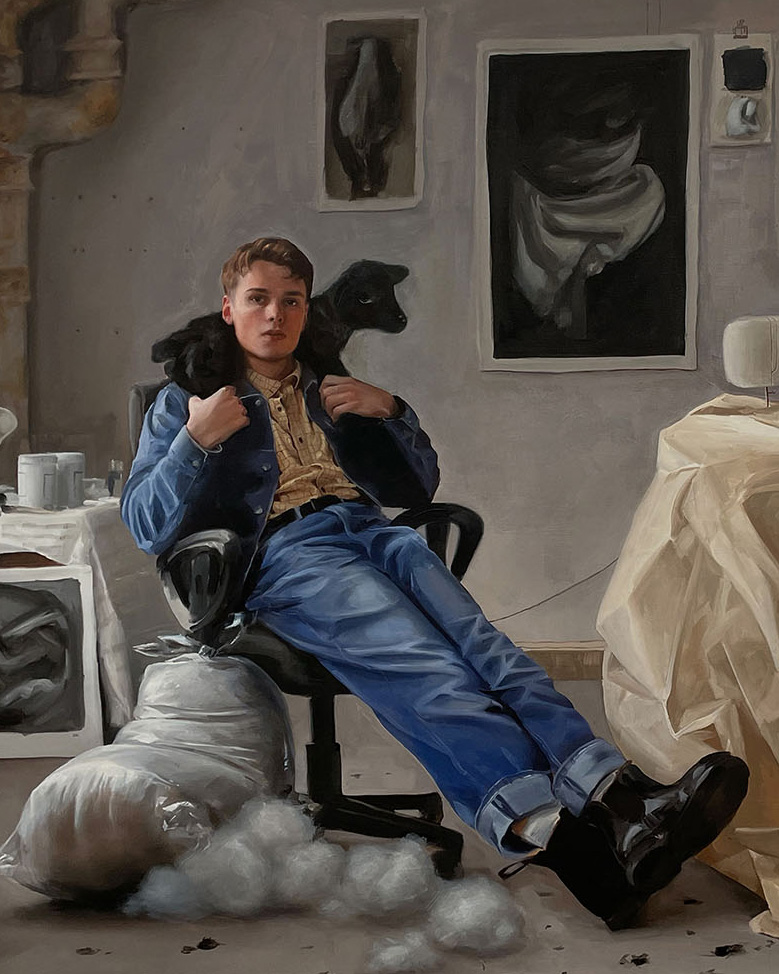
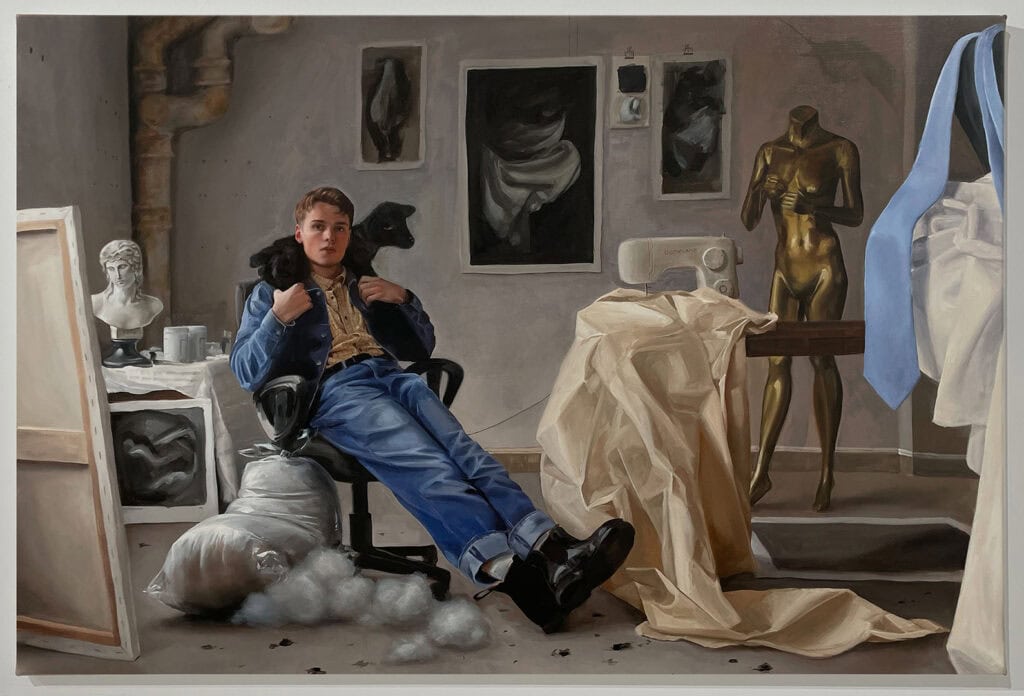
Conor Quinn, ‘Spring’
The COLD Magazine (CM): How do you approach your practice?
Conor Quinn (CQ): I like to approach my practice with an enjoyment of the process as my main priority. Often, l’ll use paint to express the things I struggle to say, and this form of release is the reason I create art. I love to create something where the viewer can find a similar feeling.
CM: How did your winning piece emerge?
CQ: ‘Spring’ emerged from the vulnerability of an artist’s studio. I only ever exhibit finished paintings — they often have to achieve a sense of personal closure before they can open to a relationship with the public. In the raw state of my painting studio, I try to bridge a gap between my working process and the polished outcome.
CM: What do you have in mind for the solo exhibition?
CQ: This will be my first ever solo show. There is often very little opportunity to share the journey of one’s art, so having the space to include early sketches and experimentation will help audiences understand my work in a wider context.
CM: Favourite thing about Soho?
CQ: I know Soho is forever changing and reestablishing itself within the London scene, but the first thing I think of is its underlying queerness. I grew up feeling safer in Soho than any other part of London and it became a place where I could express myself and my sexuality. It let me more closely embody the honest self-expression I hope to achieve in my paintings.
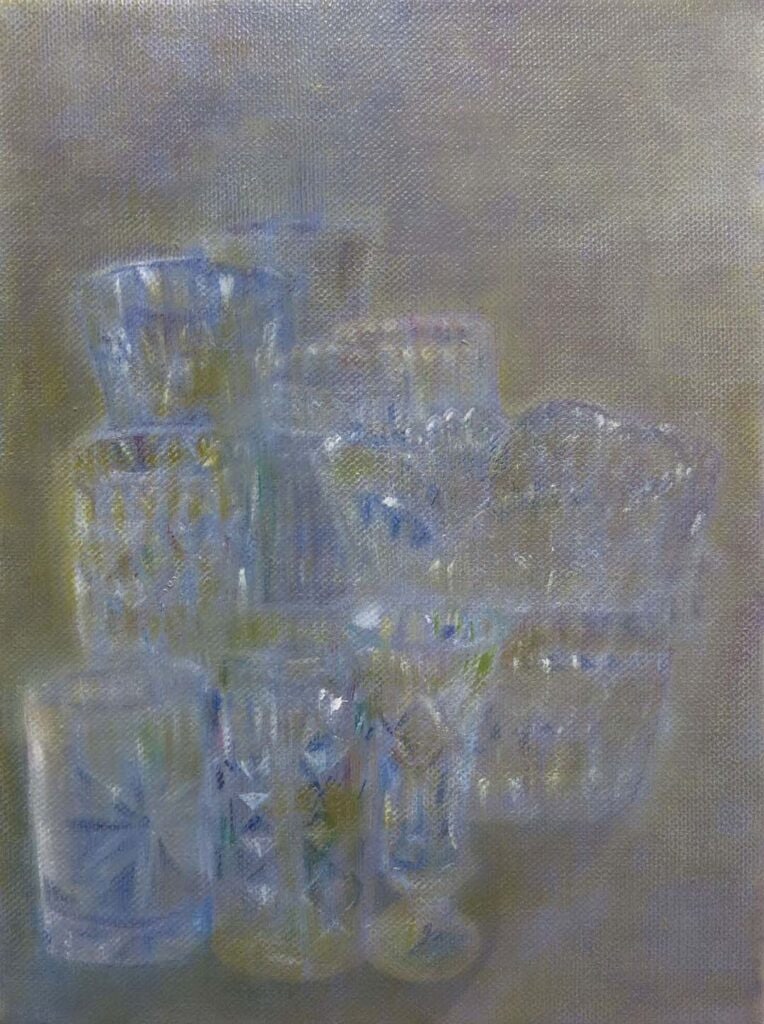
Mandy Hudson, ‘Glassware’
CM: How do you approach your practice?
Mandy Hudson (MH): My paintings are based on the things I see around me — things glimpsed in shop windows, on market stalls and in junk shops, as well as plants and debris I see on walks along the Thames. Lately, most of my paintings have been focused on groups of a particular type of object. As I get more involved in the painting, I develop them in varied abstract ways.
CM: How did your winning piece emerge?
MH: There is often a shelf of glassware somewhere in the second-hand stores I visit. ‘Glassware’ started with that image and then became more about brush marks and the elusive quality of the glass. At the same time, I was thinking about the past lives of things.
CM: What do you have in mind for the solo exhibition?
MH: I’m so surprised to be chosen that I’m still getting my head around it. But I’m excited. I paint as often as I can, and associations tend to come together — even if the pieces are different. I think I’ll carry on with this approach, then choose the works as a group.
CM: Favourite thing about Soho?
MH: I lived in North London from the 1990s to 2020. Most of my memories of Soho are of music venues, old pubs, and cheap cafés. I like the feeling of history, the variety encapsulated by this distinct area. I like that there are still hardware shops and off-licences and that I can stumble across a gallery hidden on the upper floor of a building.
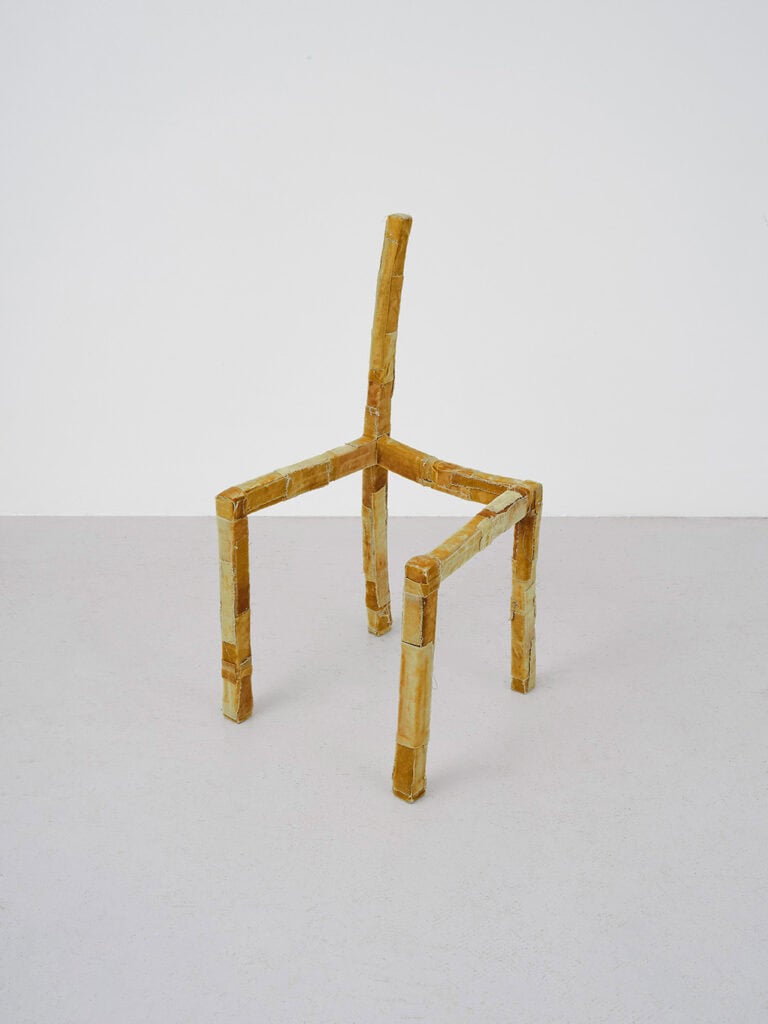
Alice Sheppard Fidler, ‘Being Together’
CM: How do you approach your practice?
Alice Sheppard Fidler (ASF): I work with found spaces and materials, intervention and action to create sculptures, installations, performances, and works on paper. I often begin by identifying a zone of rigidity — a rule, a social code, or a physical surface — before working into the space around it, rubbing up against everyday conventions until their obviousness disintegrates. My approach is often performative, critically repurposing skills from my previous career in set design and using objects to stand in for bodies or traces of human contact.
CM: How did your winning piece emerge?
ASF: The chair is a recurring element in my work, a familiar support and a suggestion of potential occupancy. I often use old velvet for its layered associations and its ability to record time through wear. My sculpture’s components are deliberately adaptable, allowing for shifting configurations and evolving relationships within the space they inhabit. This flexibility is central to my practice — keeping the work open, fluid, and receptive to multiple readings.
Reading Rebecca Solnit, I was struck by her words describing what I was investigating: “The self is a patchwork of the felt and unfelt, of presences and absences, of navigable channels around the walled-off numbnesses.” ‘Being together’ suggests a sense of unity with others but also points to the solitary task of maintaining one’s own coherence, of consolidating a self.
CM: What do you have in mind for the solo exhibition?
ASF: I’m planning on showing sculptures at varying scales with accompanying two-dimensional works. I often work site-specifically, so I’ll be thinking about how these works are activated by their surroundings. I’ll also consider the role The Soho Housing Association plays within the community. I have works that question what shelter is and how we value human life and experience. Those could be interesting. I might also bring in other chair forms and include a performative element. I’m hoping that through my work I can offer experiences that oscillate between absurdity and poignance, pointlessness and tenderness.
CM: Favourite thing about Soho?
ASF: Borovick Fabrics on Berwick Street. And lots of great memories at Ronnie’s, Bradley’s and The Wag Club, and work meetings at production companies on Wardour Street.
James Robert Morrison, ‘There is never more than a fag paper between them – Harry and Tom’
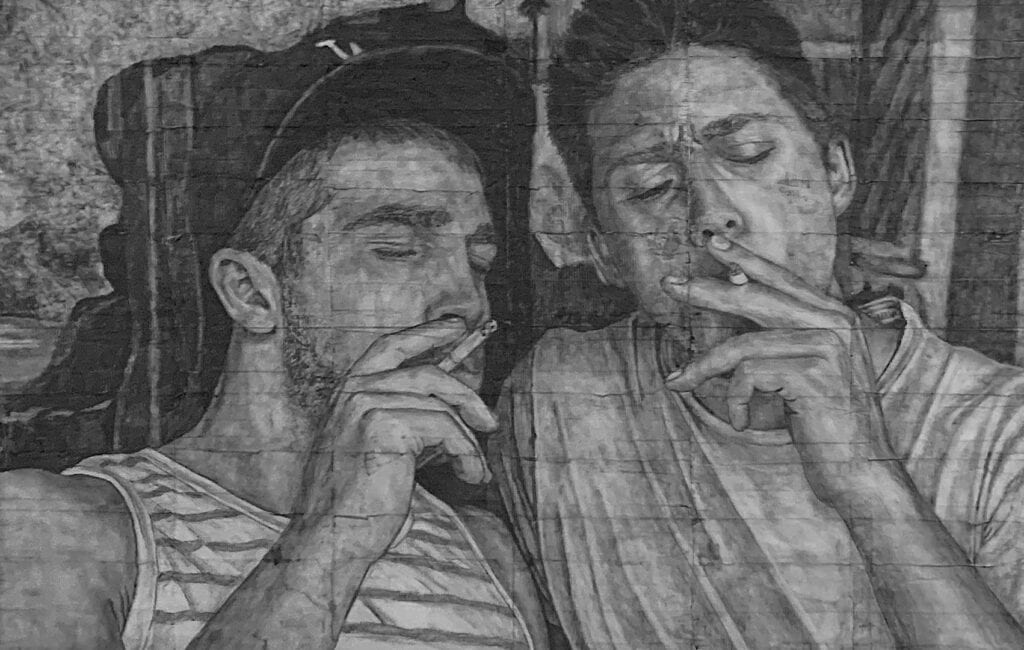
CM: How do you approach your practice?
James Robert Morrison (JRM): My practice explores queer identity, intimacy, and visibility. Growing up during Section 28 — when positive queer representation was almost non-existent — the only images of queer intimacy I encountered were in the gay porn magazines I hid away. Following seventeen years in the cultural sector after my MA at CSM, I returned to my practice to reappropriate that deeply personal material.
By transforming what was once hidden into art, I reclaim those memories as moments of resilience and tenderness. My work spans pencil drawings on fag papers, collages, paintings, and embroidery. Each allows me to play with ideas of hiding and revealing, intimacy, and exposure. Through this practice, I aim to normalise non-heteronormative identities and speak to generations who — like me — grew up without the positive queer images we needed.
CM: Tell me a story about your winning piece. How did it emerge?
JRM: Two of my drawings were selected for The Soho Open — both from a series titled ‘There is never more than a fag paper between them’. The series gets its name from an overheard comment describing a gay couple. In the UK, a “fag” is both a cigarette and a homophobic slur — a dual meaning that mirrors the tension of my teenage years. Transforming explicit source material from gay porn magazines into tender, intimate portraits, I draw male couples on cigarette papers. The delicate pencil on this thin medium reflects the fragility of queer visibility.
CM: What do you have in mind for the solo exhibition?
JRM: I’m looking to expand the series, but it will also be an opportunity to show the full breadth of my practice. I have two series involving hand embroidery, which I haven’t shown fully before.
CM: Favourite thing about Soho?
JRM: Its inclusivity. Soho has a long history as the focal point of London’s LGBTQIA+ community. It’s where I first felt that visibility was possible, and where so many stories like mine have found a place to exist.


