
Amidst the hype surrounding Guillermo del Toro’s decades-long passion project Frankenstein, recently released in cinemas and on Netflix, Twitter/X user @bIoodfangs declared: “Guillermo del Toro has the imagination and creativity of a woman who spends her time maladaptive daydreaming in her bedroom about meeting her soulmate in the most gothic situation imaginable and that’s why I love him so”.
Some male directors may balk at being associated with the fantasising fangirl. Not so Guillermo del Toro. Responding directly to @bIoodfangs’ tweet, the Academy Award-winning Mexican director cheekily declared “I believe I do…”.
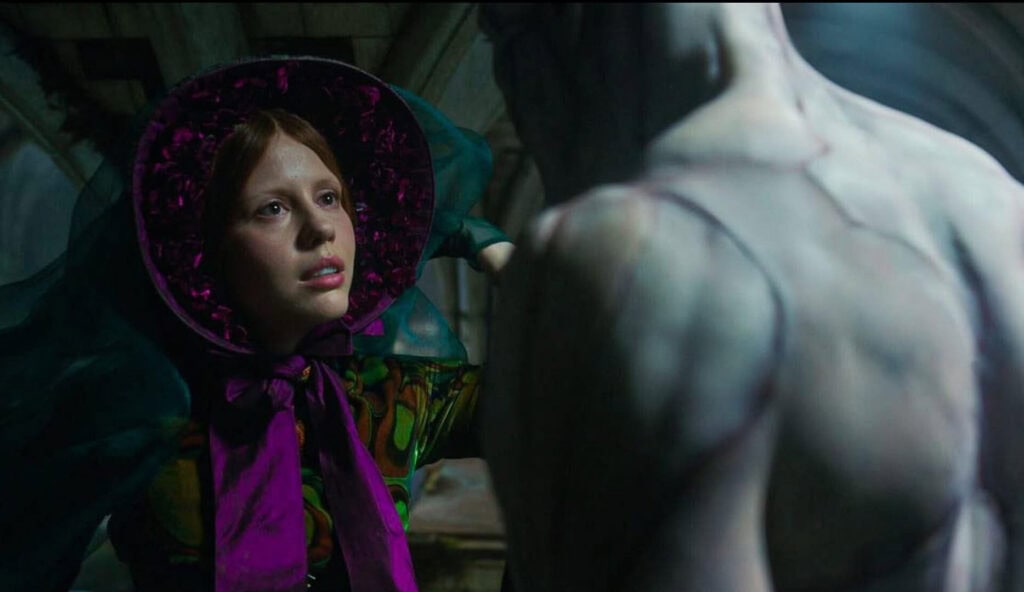
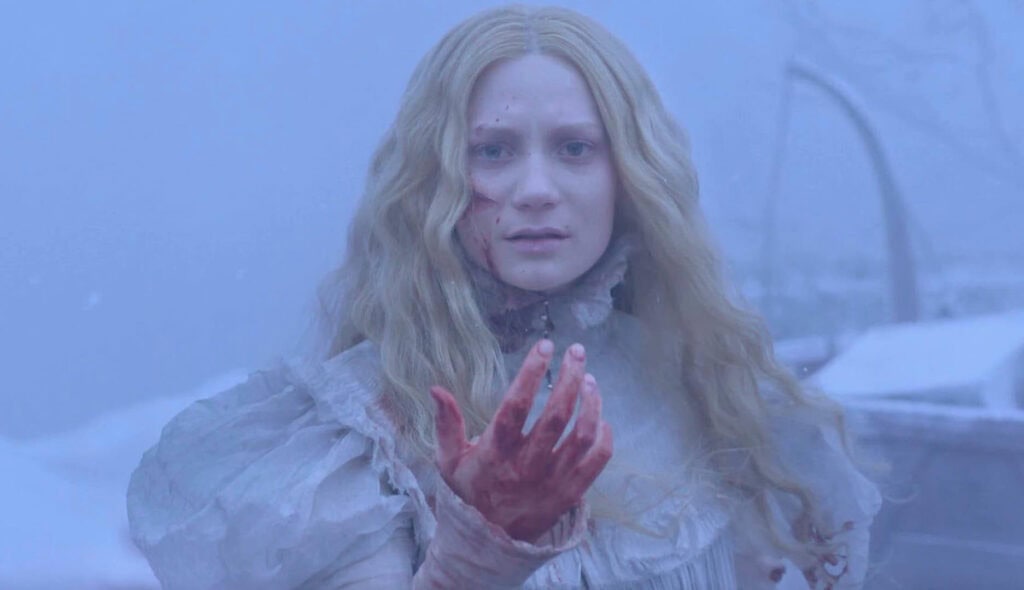
Whilst the relationship between Elizabeth (Mia Goth) and the Creature (Jacob Elordi) has captured particular attention online, del Toro has long explored this dynamic. His oeuvre is filled with women fascinated by the abject, maligned, and monstrous: Ofelia is enthralled by the wandering Faun in Pan’s Labyrinth (2006); Edith is seduced by the charming, ghostly Sir Thomas Sharpe in Crimson Peak (2015); the entire plot of The Shape of Water (2017) rests on the romance between Elisa and the Amphibian Man. In all these, women go against the prejudices and violence of men, finding beauty in the wild danger of creatures, loving them for their monstrousness rather than in spite of it.
This in itself isn’t unique. Many male fantasy/horror film directors feature relationships between women and monsters – from Nosferatu to The Creature from the Black Lagoon to Beauty and the Beast, cinema is filled with stories of noble, innocent women falling for the monstrous male. However, what makes Guillermo del Toro unique within this sub-genre is his open identification with his monster-loving heroines, figuring the feminine presence as rooted in the same empathy for the monstrous that del Toro himself frequently expresses. One might even, to build upon @bIoodfangs’ observation, go so far as to call del Toro’s heroines his “self-insert”, in internet fandom terms.
The expectation might be that, if del Toro identifies with anyone in his movies, it’s the monsters themselves. Indeed, the monster is often associated (both positively and negatively) with the odd, maligned outsider; similarly, del Toro describes himself as “a strange, pale creature”, who as a child stood apart from his peers with his unconventional interests and quirks (CBS Sunday Morning). However, this expectation is challenged when we consider the language del Toro uses when he talks about his relationship to monsters. In a 2018 interview with The Talks, del Toro declares “I am in love with monsters in a way that is very intimate and spiritual” (The Talks); to CBS Sunday Morning he observes, “‘monsters tell you, look, it’s okay to be you. It’s okay to be imperfect’”. Notice the wording: del Toro is ‘in love’ with monsters; monsters ‘tell [us]’ it’s okay to be different. In both statements del Toro identifies not with the monster, but with the person interacting with the monster: he is the one in love with the monster, and who, through his love for the monster, learns to love himself.
And who in del Toro’s movies is in love with the monster, and through her love for the monster learns to love herself?
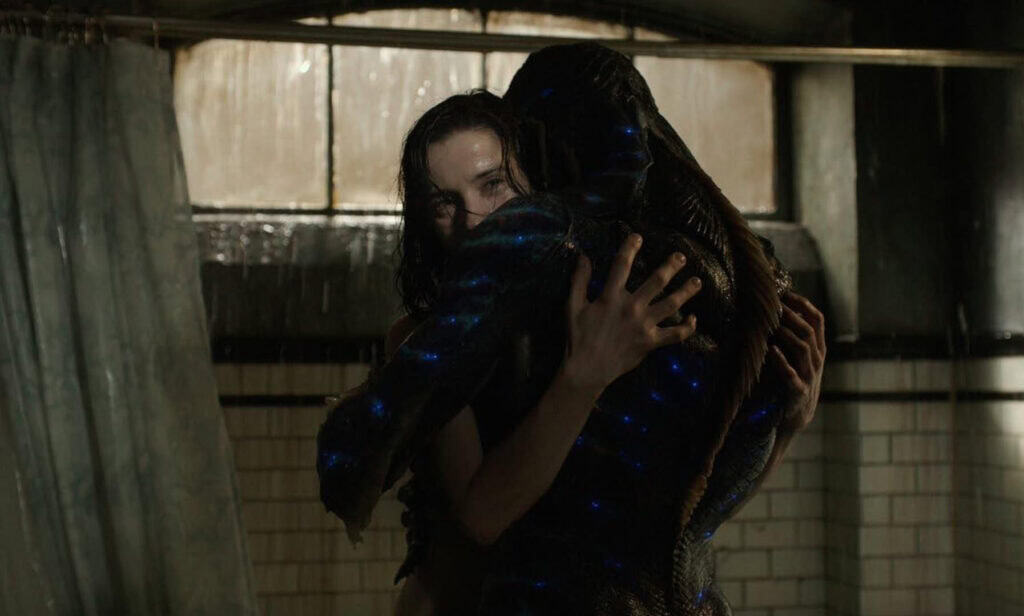
The Shape of Water is the first of del Toro’s films to explicitly (in every sense of the word) explore the love between woman and monster, as the mute Elisa (Sally Hawkins) falls in love with the mysterious Amphibian Man (Doug Jones). The traditional ‘Beauty and the Beast’ trope of monstrous love starts with revulsion, and ends with romance: the woman is rewarded when the monster transforms into a handsome, human man. But in The Shape of Water and, later, Frankenstein, del Toro rejects such a proposition, asserting that the trope is ‘the most horrible trick romantic love stories ever played on us: love is understanding, not transformation’ (NYT). Elisa, excluded from society because of her disabilities, falls for the cat-eating, webbed-foot fish-man because “he just sees me for what I am. As I am. And he is happy to see me, every time”. Through Elisa’s passionate declaration, we hear echoes of del Toro, a man who grew up in Mexico on a diet of 1930s horror movies; whose house is filled to the brim with monster iconography; who has dedicated his craft to telling the stories of the maligned and misunderstood. If love is understanding, del Toro may be the biggest romantic hero(ine) in horror history.
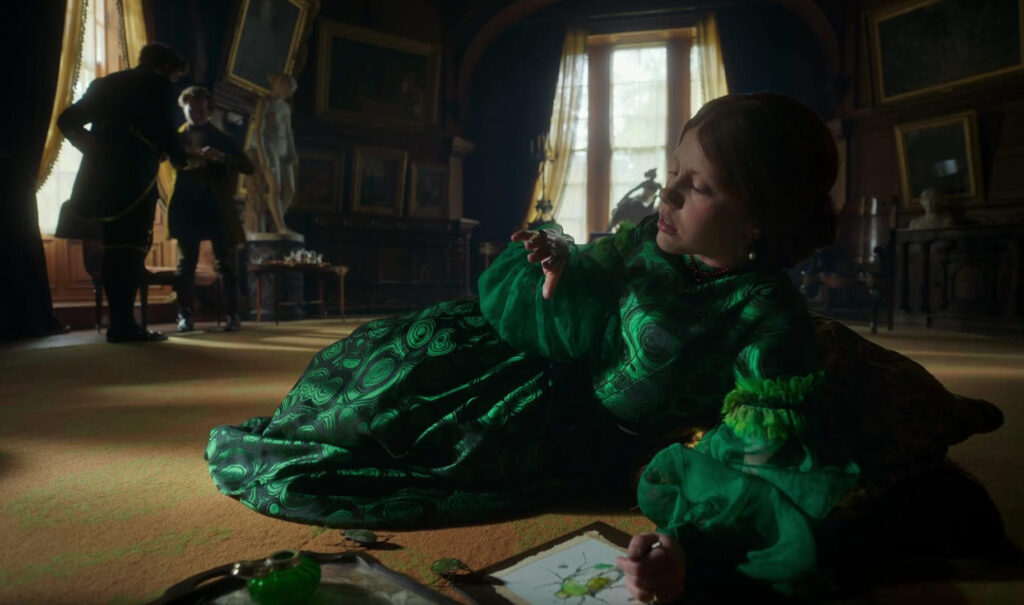
Del Toro characterises The Shape of Water as a ‘rehearsal’ (Little White Lies) for Frankenstein. Indeed, with Frankenstein’s relationship between Elizabeth and the Creature, del Toro delves further into the concept of monstrous love as understanding love, and in doing so demonstrates his identification with the feminine in the monster/woman dynamic. Like del Toro’s other heroines (and del Toro himself), Elizabeth (Mia Goth) is “strange” and “weird” (CBS Sunday Morning), struggling to fit in with the demands of women in society. In particular, Elizabeth has a fascination with insects, those misunderstood creatures so often trapped in jars or pinned in boxes. Elizabeth finds kinship in their plight: like insects, she too is trapped and misunderstood, her world shrinking as she is lusted after and condescended to by Victor (Oscar Isaac), propelled into a marriage and conventional life she does not desire.
“A lot of people still cannot allow femininity to have any grotesqueries or any malfunctions,” says del Toro in an interview with Little White Lies, “but in reality, it’s monstrous”. The women in del Toro’s movies love their monsters because, in a patriarchal world, to be a woman is to be inherently monstrous, a creature existing outside the cis-het male norm, something to be ridiculed and subdued. Thus, when she discovers the Creature chained and abandoned in the cellars below Victor’s lab, Elizabeth “recognise[s] herself immediately”, feeling platonic (and, depending on who you ask, romantic) love for a fellow maligned being confined by society’s disdain. We then return to del Toro’s key concept: “love is understanding”.
Some might question how del Toro, a man, can possibly identify or ‘self-insert’ as the feminine presence in his films, especially in Frankenstein, where Elizabeth’s affinity for the Creature is linked to her status as a woman. However, it is important to remember that the ‘monstrous’ in our white, patriarchal, cis-het society is anything that goes against these ‘norms’. As a self-professed “weird, weird kid” (CBS Sunday Morning), as a Mexican living in ‘exile’ in the increasingly anti-immigrant, anti-Mexican United States (NPR) , del Toro has experienced firsthand the feeling of being perceived as the monstrous other. And to whom does del Toro turn with “the imagination and creativity of a woman who spends her time maladaptive daydreaming in her bedroom about meeting her soulmate in the most gothic situation imaginable” when he needs to be reminded “it’s okay to be you”? Like Elizabeth and Elisa before her, del Toro seeks those “patron saints of imperfection” (CBS Sunday Morning): monsters.
Upon accepting the BAFTA for Best Director for The Shape of Water, del Toro identified once more with a woman fascinated by the monstrous. “The most important figure [for me] incredibly, is a teenager by the name of Mary Shelley”, del Toro revealed, “she gave voice to the voiceless and presence to the invisible”. Though del Toro’s Frankenstein takes many liberties with its source material, in this one essential way, he remains faithful. “My place was never in this world,” Elizabeth professes to the Creature, “I sought and longed for something I could not quite name. But in you, I found it”. In her words we hear del Toro himself, describing the fateful night in which he first watched Boris Karloff’s Frankenstein: “It was through that film that the creature became my saviour, my avatar.” Woman and monster, del Toro and monster; they are, in his films, one and the same.


