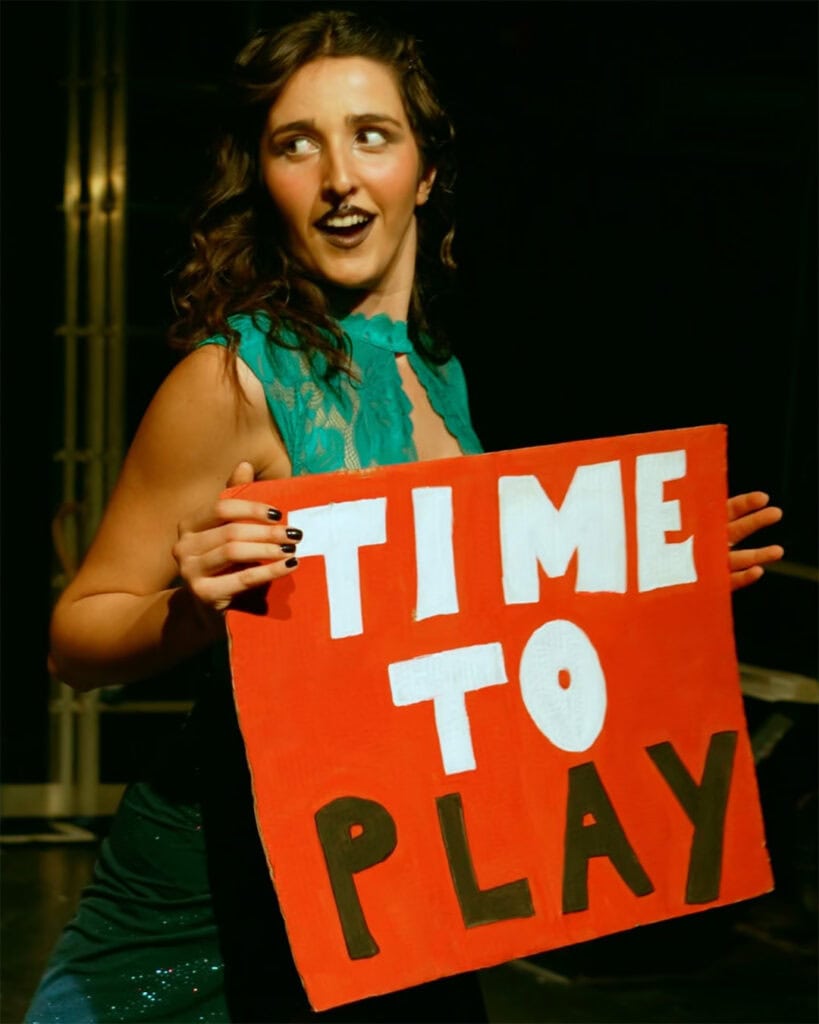
The one-woman cabaret show opens with an overwhelming auditory collage of songs and sounds from French, Italian, and British pop culture. What appears initially as an invitation to spot the childhood cartoon reference, catch the hidden national anthem, or mouth along with quotes from viral politicians (the infamous “io sono Giorgia, sono una donna, sono una madre, sono italiana, sono cristiana” makes an entertaining appearance as the actress kneels, straddling the stage floor) soon becomes the backdrop to an experiment in myth-making and an exploration of what makes us monstrous.
Sofia Natoli, writer and performer of Babel Beast, is originally Italian, raised in France and based in London. Her previous and current work explores female bodies and performance, and the theatricality of gender performance. In Babel Beast, a cabaret show that reimagines Greek myths and Ancient Greek women through a range of acts, we see Natoli use her own body as a tool with which to explore her position within, between, and outside of the Italian, French, and British cultural spaces she is divided between.
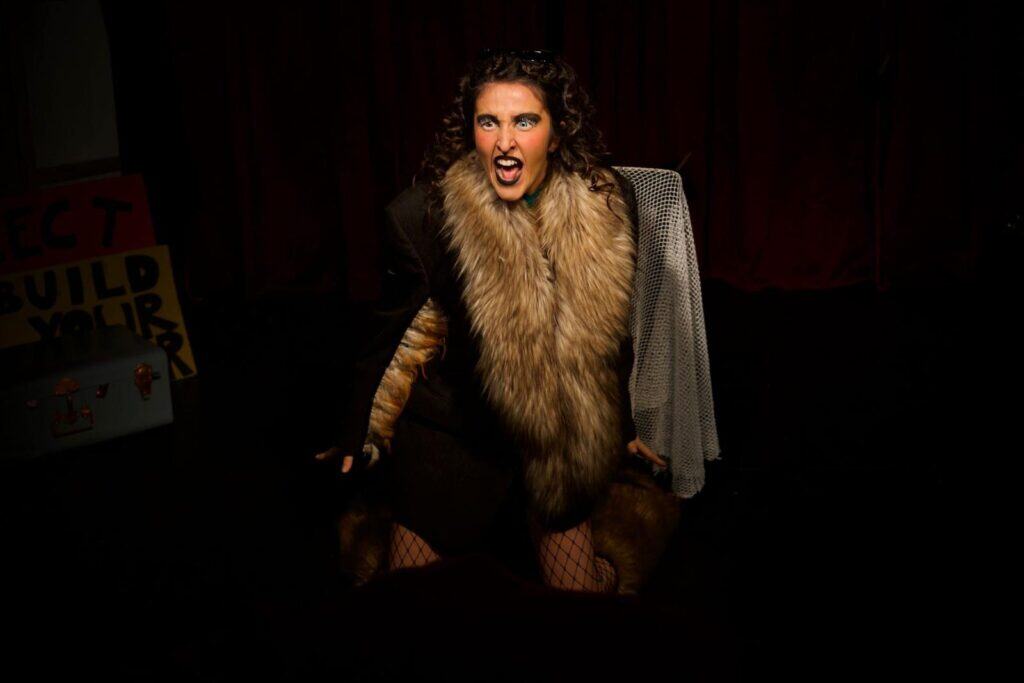
Though we get no formal introduction as we later receive for the official characters of Babel Beast, Natoli’s body is squarely a protagonist in this show. From the moment she steps onto the stage she demonstrates a controlled choreography that allows her to glide between characters, often avoiding what could otherwise become awkward transitions. Alongside this control is a healthy dose of camp; within the first moments of the show Natoli has ripped off her fur coat and revealed a perky set of drag queen tits. I have your attention now, we can see her think. And have our attention she does; the audience laughs and sits higher in their seats.
She presents the audience with her first mythological temptress, the Sphynx, making absolutely clear that no one in her audience is leaving without being tried in her court. Natoli-as-Sphynx tells a story of a hybrid beast who is tasked with what resembles ancient Egyptian border control – a parallel our Sphynx is quick to spot, weaving a contemporary political theme neatly into the ancient underworld she has begun to construct.
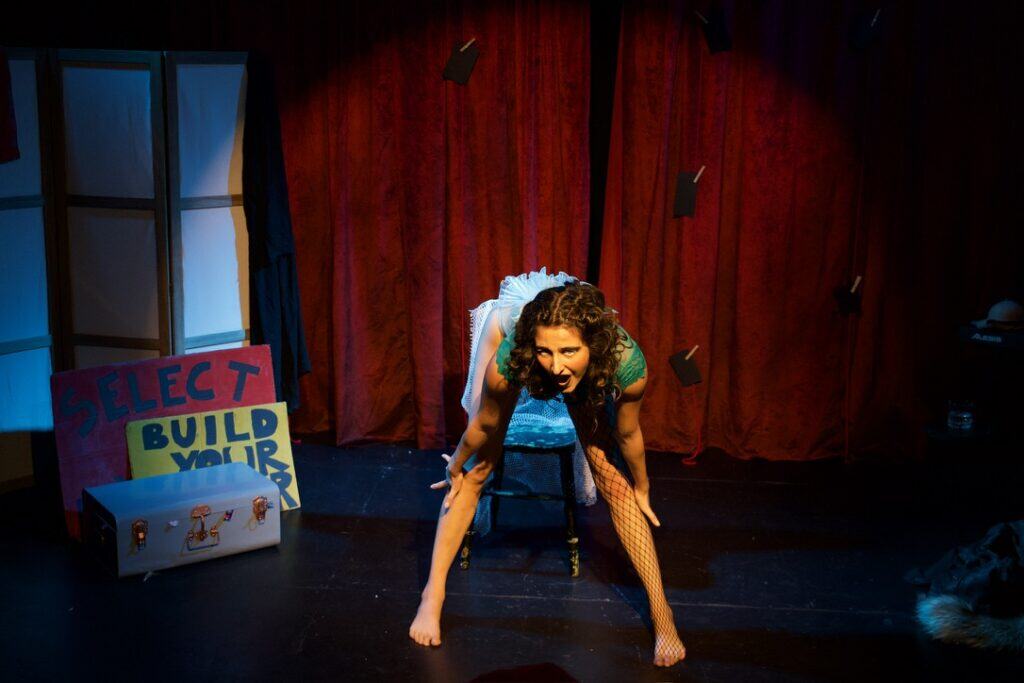
In presenting her show as retellings of well-known Greek myths, Natoli raises her personal experiences to the level of myth, and in turn suggests to her audience that these stories of manifold, tangled identities have been foundational to the myths many of us already know. At her best, we see the actress experiment with mythologizing her own story, examining how we might be able to use myth as a lens into our own lived experiences to make sense of the inexplicable intricacies of a multicultural life and identity.
Despite her investment in mythologising her experiences, at no point does Natoli make any claims to universality. She achieves a humility in her performance that allows her to indulge in a self-exploration of her personal experiences of French-Italian-British-ness without crossing over into trite or overly self-interested storytelling.
The show is most successful at this when the actress is at her most confessional. Midway through the show, she takes a seat centre-stage and opens a diary. As though this is her first encounter with the anecdotes transcribed within, Natoli reads passages aloud, deftly flipping between English, Italian, and French, mid-sentence, mid-thought. Where the camp of her earlier acts captivates, the intimacy she delivers moves. She reveals the emotional underbelly of the show to be an understated but compelling story of isolation: not only is she isolated from those around her in her endeavours to be understood, but she is isolated within herself, split between three entire yet stunted identities.
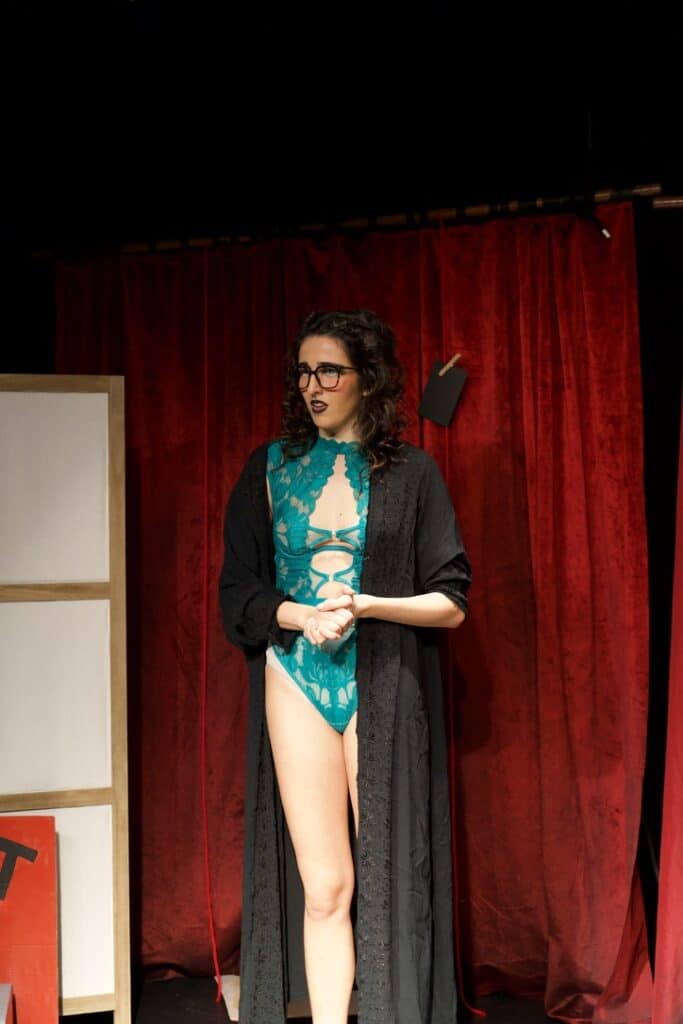
Natoli then takes a step even further into the personal, the intimate, the internal. She steps behind a screen and reemerges dressed in a white sheet, a single pomegranate in her hand, and sits on the stage floor in silence, devouring the pomegranate piece by piece to a soundtrack that we can assume is a home video from the actress’s own childhood. Unlike the straightforwardly confessional style of the previous act, or the romping and exciting burlesque of the opening acts, this pomegranate act is an inward-looking subversion of Natoli’s outwardly interactive performance so far. She eats before us while we listen to the melodic voices of her childhood. It functions as a moment of rest for both the actress and her audience, a return to the origins of the myth of Babel Beast and of Natoli herself. We are not offered the chance to understand, or to translate, as in previous acts. Instead, we sit in stillness alongside her.
To close, Natoli returns to the cabaret tone of the opening acts and becomes the French teacher, readying her class for their exam. The teacher distributes her prepared texts to the audience and, on command, we recite the scripts we’ve been given. The room is enveloped in a cacophony of indistinguishable language. It is reminiscent of Natoli’s opening sonic collage, except that now the audience has become both producer and observer – we are immersed in the confused and disjointed world Natoli has tried in so many ways to show us. Then the house lights go down.
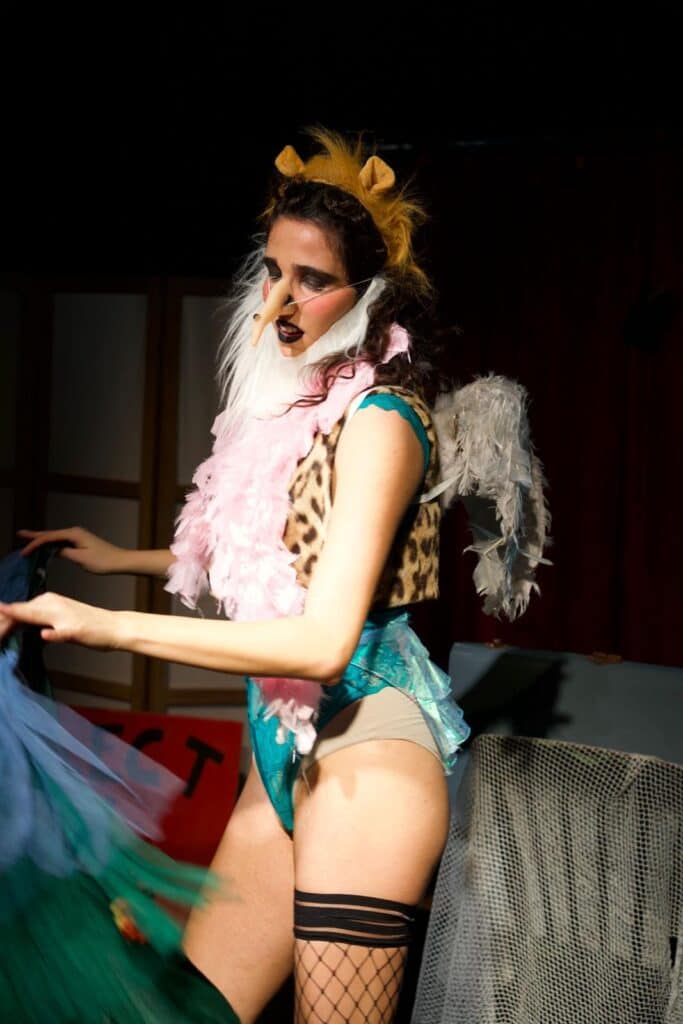
The choice to end the show at this moment creates a pause amongst the audience, a sense that we still await answers from the show about how the myth will end. Optimistically, this leaves Natoli and her team – Luna Laurenti, Al Hawkins, Martina Bizzarri – with room to expand, perhaps to build out these vignettes into discrete episodes or to spin this show into something longer. Pragmatically, the audience is left wanting more. If the pomegranate wasn’t enough to make us hungry, Natoli’s departure from the stage under the cover of the dark theatre is.
Nevertheless, as the Horatian platitude suggests, this poetic performance delights and instructs her audience, bewildering us, inviting us to reconsider the fixity of our myths and our identities. Natoli in her many forms is a danger and a threat to those who can’t control her, evident in the discomfort she invokes in her audience while she herself maintains control throughout the entire show. As she cycles through a seemingly-endless cast of characters she presents and inhabits, Natoli’s primary accomplishment is clear: she makes the confusion of being multicultural monstrously sexy.
Get a taste for yourself – Babel Beast is coming to Talos Festival on the 12th and 13th of December 2025. Tickets can be purchased here:
https://app.lineupnow.com/event/talos-v-science-fiction-theatre-festival-babel-beast