
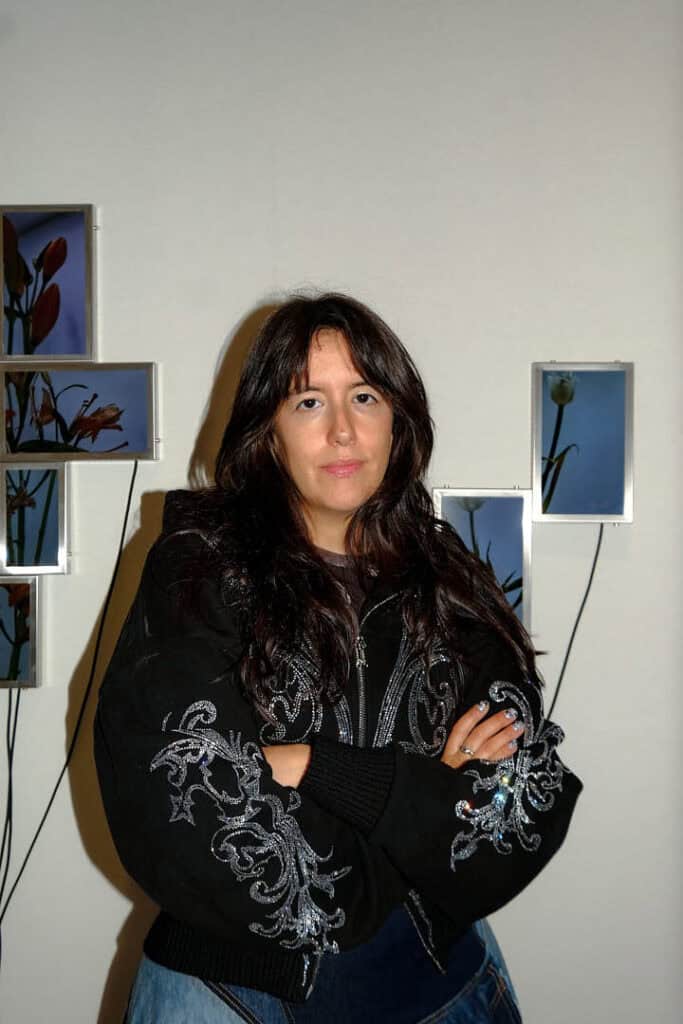
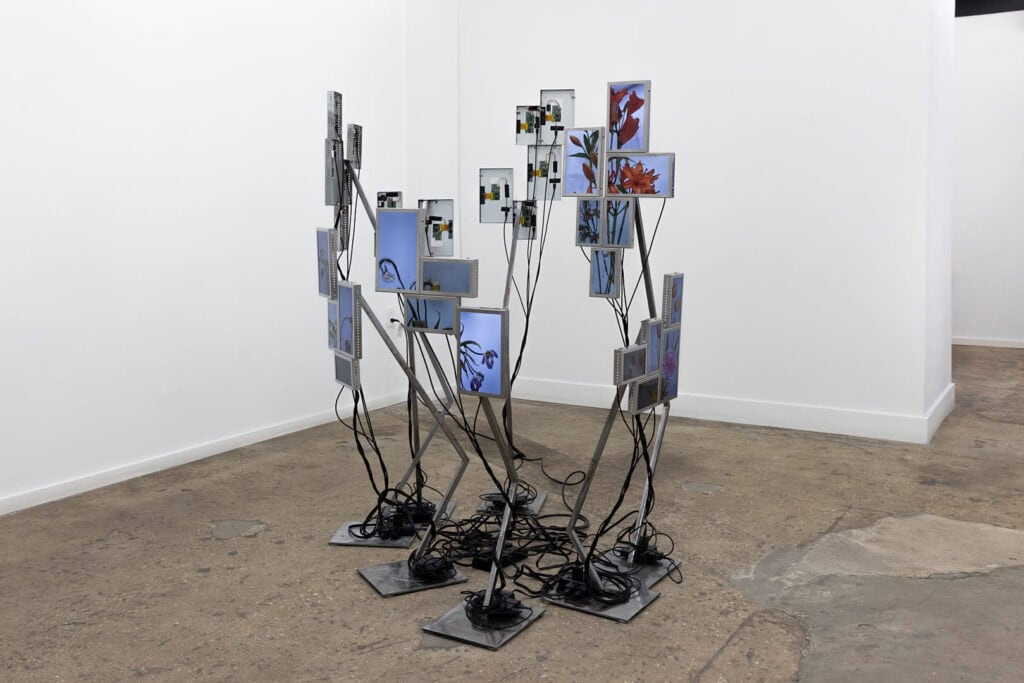
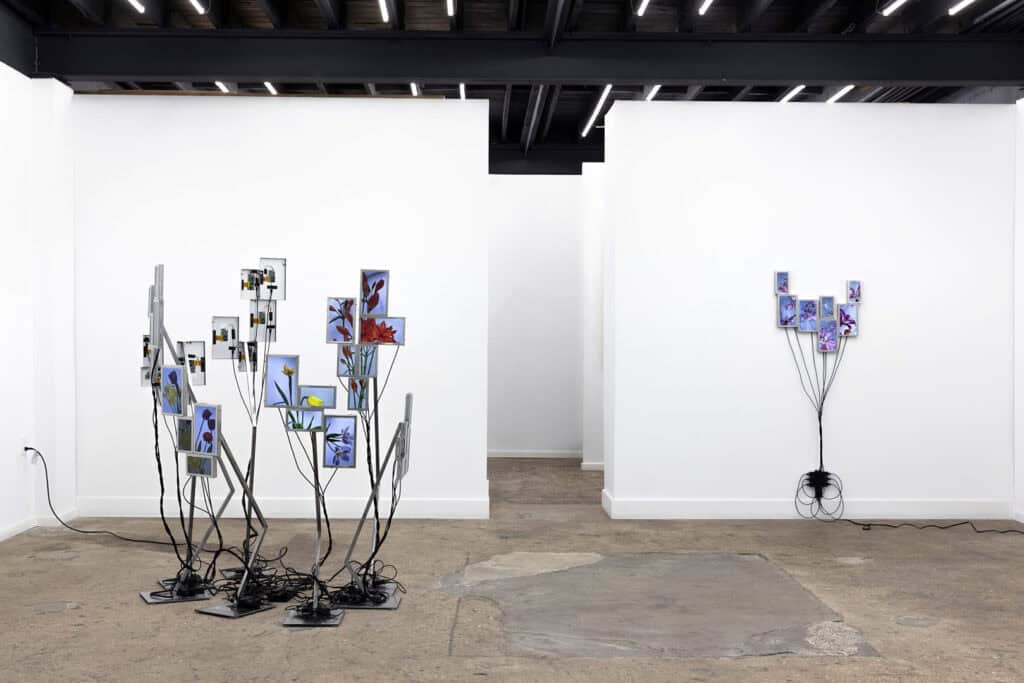
It was there — an audiovisual sculpture of several screens looping time-lapsed flowers, perched on stainless-steel legs and threaded with wires like an exposed root system. Displaying ‘The Secret Life of Flowers’ by Julieta Tarraubella, the entire Rolf Gallery booth at Paris Photo 2025 had transformed into a kind of cyborg garden, a glimpse at how admiring nature might look in a distant future.
Surrounded by striking works spanning AI and data-driven visuals in the fair’s digital section, Tarraubella’s exploration of new creative technologies — which she has been developing since 2018 — felt rare, and perhaps, a little eccentric. The flower is an active participant in this installation. Viewed from an apparatus, we monitor its mediated blooming and gradual decline. It is the performance of a process that is at once organic and a controlled vision rendered by a camera, a screen, a technique, and ultimately, a human.
Part of the work feels speculative. What if our destructive ways shape nature? What will our future environment become? But Tarraubella is quick to clarify that her work is rooted in the present. For the Buenos Aires Young Art Biennial Award recipient, her work exposes a visual violence embedded in our mediated, overly digital, and surveilled world. It also ruminates on the normalized performativity we are asked, consciously or unconsciously, to maintain in a state of constant observation. More than an ecological warning, her multimedia works are a social one. They call, she says, for a kinder gaze toward one another.
After her presentation at Paris Photo earlier this month, The COLD Magazine caught up with Tarraubella to talk about environment, technology, and the future of our shared existence.
The COLD Magazine (CM): ‘The Secret Life of Flowers’ brings together nature, technology, and myth. What sparked this hybrid ecosystem in your imagination?
Julieta Tarraubella (JT): Everything started because I was wondering about the residual energy that our bodies hold as a result of being exposed to the constant presence of cameras. I’m not referring only to surveillance systems, but also the lenses we are always surrounded with — our phones, computers, satellites, and those that belong to others. We embrace an element of performance because of this. I started wondering, How can I make that phenomenon visible? How can I perceive and register that invisible effect?
CM: Can you walk us through the inspirations that shaped this project?
JT: I was inspired by the experiments of Masaru Emoto, where he basically studied the ‘behaviour’ and formation of water crystals. Long story short, he took water samples from different cities and noticed that those exposed to happier, more positive environments created outstanding crystals. The ones that were going through intense or hard settings didn’t develop as beautifully as the others. If we, as humans, are seventy percent water, our bodies must carry and channel the energies that surround us.
As a lens-based artist, I also thought about the influence generated in our bodies by devices. I wanted to create the experience of recording a full lifecycle under the effects of being watched 24/7. But to do this, I needed a living being. Since humans were not viable subjects and animals were not of my interest, I gravitated toward nature — particularly flowers. I always loved their company, as they bloom and die.
CM: How did ‘The Secret Life of Flowers’ develop from this point?
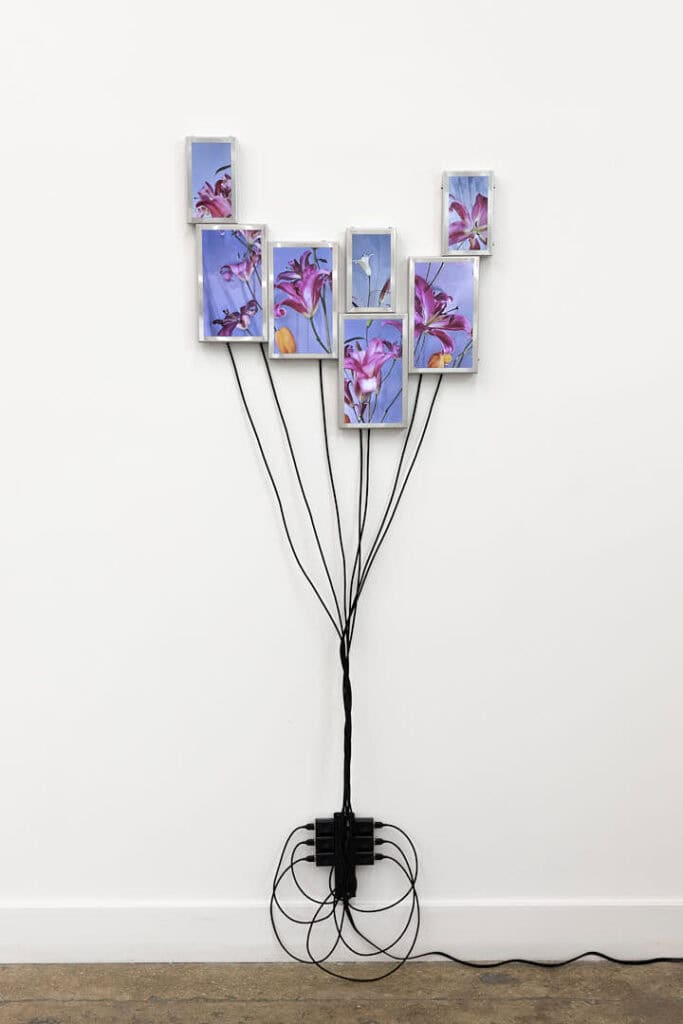
JT: These video-sculptures were originally more fragile systems. Working with the lack of resources Argentina, I did maybe two or three pieces a year — aligned with the seasons. When I started working with Rolf Art gallery, the possibility of creating a garden of flowers in a wider space opened up, along with an improvement in the technical infrastructure. I began recording flowers — from budding until they lost their petals — with a closed circuit of three to five security cameras. The duration varied depending on the type of flower, the process of decay, and my feeling towards it. I edit the footage from each camera, and assemble each as a mosaic in a video-sculpture, reconstructing the life of the flowers in shape and in time.
CM: Your process integrates digital tools in very intentional ways. How do you decide what to use?
JT: I am interested in giving body to photography and to video, to take it away from its two-dimensionality. For the series, I started working with surveillance cameras because the idea of constant recording was fundamental — a persistent camera on a living subject. For the composition of the video-sculptures, I was inspired by 1980s and 1990s surveillance centres, Portuguese and Greek mosaics, and Gino Severini’s paintings. I wanted to use multiple screens to reconstruct one subject over time — to bring together the multiplicity of gazes, to bring a certain volume to the pieces, and most of all the idea of time alterity. Beyond that, I am interested in giving body to photography and to video, to take it away from its two-dimensionality.
CM: Your work often blurs the boundary between the organic and non-organic, natural and human. How will this tension impact the future of digital photography as a medium?
JT: I am trying to create an encounter with the beauty of life mediated by the constant coldness of technology. We are humans with hopes, dreams, and love. Like it or not, we are spiritual beings, living in an intense, harsh contemporary dominated by cold technology, cynical mediatization, concrete, and metal. Digital photography — or ‘Soft-Photography’, as I call it — has a responsibility to remember that, even while working with raw numerical mediums like CGI and AI, our duty as creators is to connect to human feelings, to our spirituality and tenderness. We must use it to foster human togetherness amid all this electric chaos.
CM: How do you engage with the conventions of still-life photography? Do you push or challenge its traditional approaches?
JT: Traditional photography inherits from painting the idea of fixing a single moment — the desire to stop time and own a fragment of life. My project continues that lineage but stretches it across multiple durations instead of compressing it into one frame. I’m interested in what becomes visible when you stay with the same body through its whole lifecycle. The way the video-sculptures are presented — visible cables, screens, and frames — pushes the work from contemplation into a self-conscious, technological image. The flowers are not just a motif. They exist inside an apparatus of observation that I intentionally expose. In that sense, the work dialogues with classical photography by re-staging its core questions: Who is looking? What are we trying to suspend in time? What are the effects of this persistent, intense gaze?
CM: Looking forward, how do you envision your practice growing? Are there new landscapes you’re eager to explore next?
JT: I am developing two new projects. One is called ‘Archaeology of Birth’. Using a mix of AI and my personal family archive, it revisits Miculla — the archaeological site close to Tacna, Peru, where I was born. I am also working on a series of photo-sculptures researching the effect of body-improving propaganda.


