As soon as Panchanit Suriyaworakul – the Thai tattoo-artist-turned-designer behind Jaoka Jaokha – begins talking, one idea tumbles into the next, looping back without warning, and I try to keep up. On camera, she’s bright and funny, with this delightful inability to stop mid-thought. “If people start talking to me, I’ll never stop talking,” she jokes. I believe her instantly. We quickly bond over the concept of home – when you live somewhere for so long you don’t understand how much you’ll miss it when you’re gone. London might sometimes eat you up and spit you out whole, but, we consider, it’s a place you can find freedom in, also. “People here are really nice,” she maintains. “Actually I never experienced racism here. Maybe because I don’t really leave the house,” she says, immediately cracking herself up.
She tells me she grew up in Bangkok watching Sex and the City with her mum, who subscribed to every fashion magazine, Thai as well as international. “She always dressed up for work,” she says, “but I never really accepted that maybe I like fashion too.” She studied communication design first where she learnt about graphics and photography, only to realise she didn’t want either of those things as a job. “I didn’t want to sit at a computer for eight years,” she declares. So she moved to London “to try the thing I’ve been wanting to do,” even if she hadn’t admitted that to herself until then.
Tattooing, she insists, was an accident. During the pandemic at university, a friend asked for a tattoo. “I was like, I’m not ready, I’ve only ever practiced on fake skin,” she says. “But she said I don’t care, do it.” She tried. Someone else wanted one, then another, until she’d tattooed half the dorm. “Basically their skin was my practice skin,” she laughs. This isn’t unheard of in the industry; younger artists often bypass traditional apprenticeships that historically kept tattooing a male-dominated, gatekept space. For decades, Western tattoo culture grew inside working-class masculine environments (for example, biker subcultures) where women and queer artists were rarely given access. According to Zippia, around 75% of tattooists globally are still men, even though women are now more likely to have tattoos.
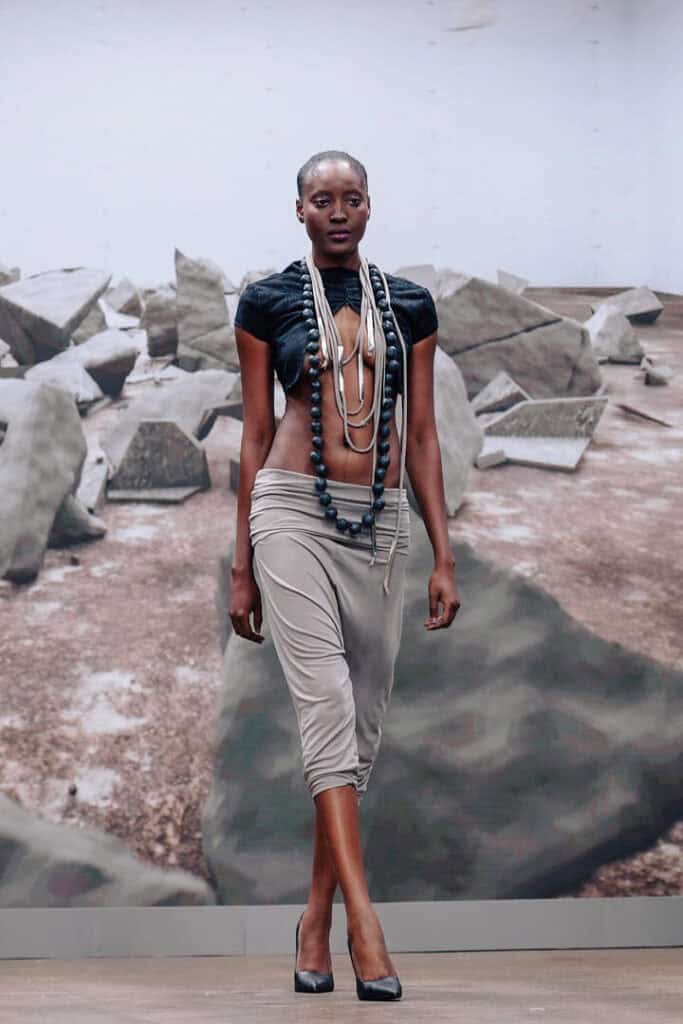
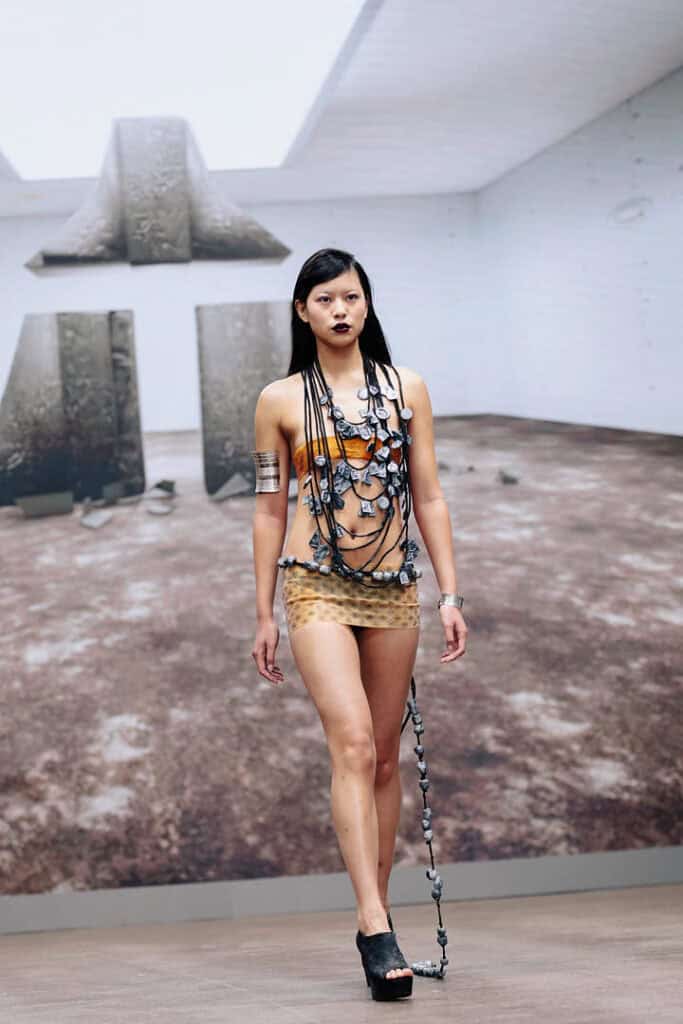
“Sometimes clients were crying,” she says, “or telling me why this tattoo means something. Even when they don’t think about it, I feel like it already says something about them.” She began thinking about skin as something expressive, and clothing as something equally expressive, just “less permanent”. So when she realised latex could behave like skin, something she could inscribe directly onto, the shift felt inevitable. “I wanted a material I could tattoo,” she says. “Something that felt like skin.” She likes liquid latex, essentially an air-drying liquid rubber, because it’s a surface that remembers. She tattoos directly onto it, almost building a second membrane to the human form. Why choose when I can do both? her Instagram captions proclaim, and by both she means her two loves, tattoos and fashion, merging into wearable tattoo skin.
When she moved to London two years ago, she realised how much she’d stopped seeing in Bangkok. “Because I grew up there, I didn’t appreciate things,” she says – food, weather, culture, all the beauty she took for granted. “Like now I know we have the best food in the world,” she admits, half-laughing. (As an Italian interviewing her, I feel qualified to confirm that when someone complains about London food and weather, they’re rarely wrong.) “Now when I do something, I want to appreciate those things in my collection,” she says.
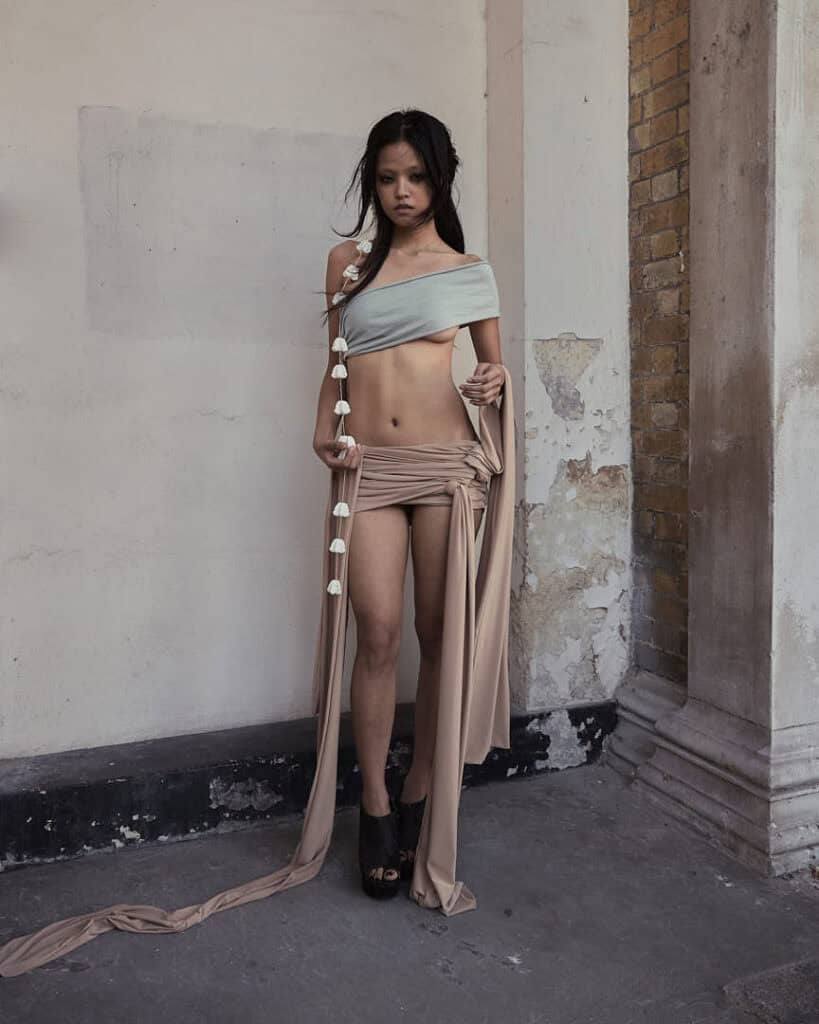
This led to the inspiration behind her latest body of work, Temple of the Mind, which came about after she graduated last December and one of her reels went unexpectedly viral. “It was nice,” she says cautiously, “but I wasn’t prepared for people to say, ‘oh I want your garments’, and then not take care of them.” Some stylists returned pieces damaged. “It’s handmade stuff, I can’t just stitch it back. I have to make a new one.” A celebrity stylist even cut one of her garments. “They say they’re busy,” she says, “but we’re busy too.” She learned quickly, as we’ve all learned in this industry, that visibility doesn’t necessarily equal care: the experience made her rethink access and boundaries. “I need to protect myself,” she says. “I need to protect my peace.” Which is exactly how Temple of the Mind emerged; a collection about protection and sanctuary, resulting in the six looks shown at London Fashion Week in September.
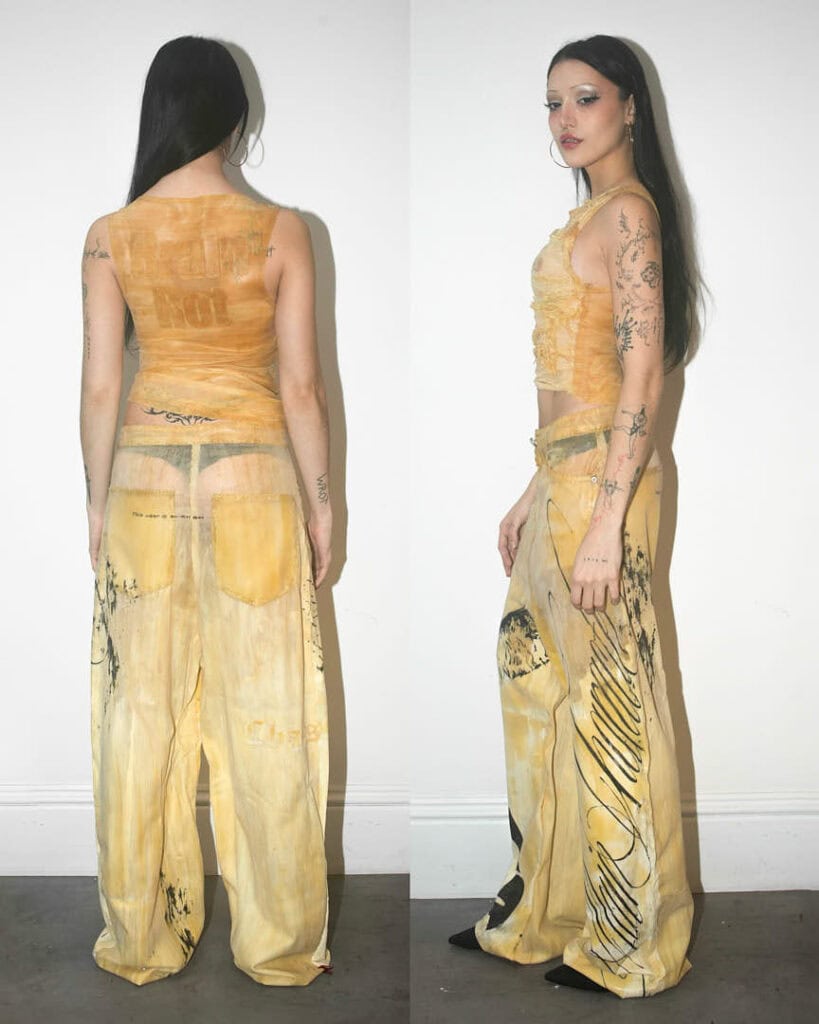
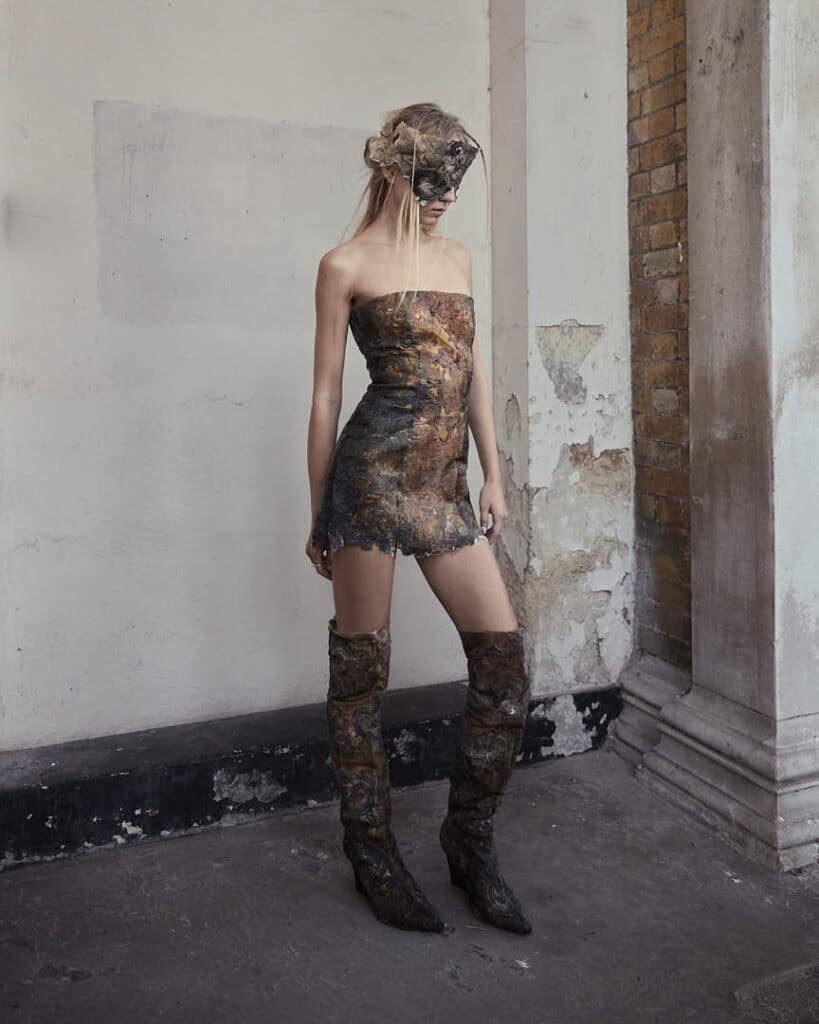
The silhouettes reference Thai ceremonial dress, reinterpreted through soft jersey draping so they remain wearable. “I chose jersey because it’s easy,” she says, “100% cotton, very soft.” There’s a latex bodice embedded with hand-dyed lace, sealed between layers of liquid rubber. “What if I imprint something?” she wondered. “What if I dye it? What if I put lace inside?” The colour palette is earthy and weathered; a tattooed skirt carries a flower motif simplified from traditional Thai silk patterns. Across the accessories, 3D-printed talismans protect the models down the runway. In one look, an oversized metal chest form is inspired by Thai amulets traditionally worn around the waist to ward off harm. “What if I just make it super big?” I notice the collection is built on all types of questions, ones which have clearly pushed Jaokha to experiment in imaginative material territory.
When I ask about femininity, she hesitates. Tattooing, she acknowledges, is very male overall. “But in my studio it’s mostly women,” she adds. I sense that she’s aware of being part of a cultural shift, but she doesn’t want to claim to be pioneering. “What I’m doing is not new for tattoo artists,” she says. “People tattoo couches, leather jackets… but I tattoo the actual clothes.” Around the same time she began posting her work, she noticed other women stepping into similar territory. “I saw Dilara [Findikoglu] do it,” she says, “and I feel nice about that because it shows someone also wanted to do something and this idea is coming.” She sees more and more designers and latex artists experimenting in this space, also. “Maybe I’ll see people copy me,” she says, “or copy latex artists, but that’s okay. It means people love it.” Recently, she dressed FKA Twigs for the VMA afterparty, but she really doesn’t chase big names. Is there anyone else she would like to dress in the future, I ask, but she doesn’t have anyone particular in mind. “I wanna see her wear my clothes more,” she says. “Other than that, I don’t think I need to dress very big celebrities. It matters if they fit the vibe of the clothes.”

When asking her what stories she wants to explore next, she keeps circling back to the idea of being away from home, the feeling of something missing. “Every time I worked on projects, even before fashion, it was about the self,” she says. “Human, emotion, sentiment. Even when I want to explore other things it always comes back to something human-related.” Her same core impulses of identity and memory are clearly hard to shake, and I completely understand where she’s coming from. I have always deemed artistic introspection to be integral to creative development; understanding what we make, and why, becomes a form of self-recognition in itself (somewhere near the bottom of Maslow’s hierarchy of arts, if such a thing existed). For Suriyaworakul, that search takes the shape of humanity.
“I guess I just can’t escape the human part,” she says, with a smile that proves she’s not complaining.