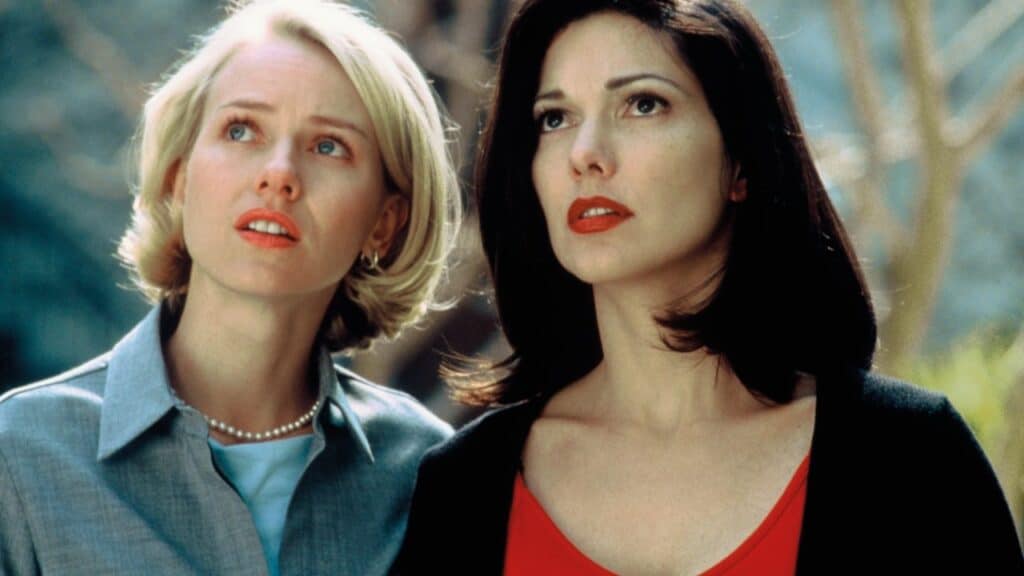
A glowing blonde sets foot in Los Angeles for the first time, all smiles, stars in her eyes. She’s here to make her dreams come true: an ingénue made flesh, ready for whatever the biz has to throw at her. Meanwhile, in another corner of town, a sultry brunette bolts through the streets. She is pursued, nearly murdered, her evening dress bloodied and tattered. Amnesia scatters the memories of her past life – surely in the biz herself – before the car crash that leads her, mysteriously, into the home of the blonde: Betty.
These are the two women of the late David Lynch’s Mulholland Drive, his 2001 masterpiece, which turns 25 this January. It’s among Lynch’s most approachable films, telling the story of two women in Hollywood and their exploitation – in many ways, the story of Hollywood itself, an ever-churning machine that crushes the bodies it disposes of. A chimeric project, it’s at once mystery and love story, horror and comedy, impossible to evoke in one swift explanation. Above all, it remains one of the most critically beloved films of recent decades.
As 2026 begins and the first quarter of the century slips into history, that esteem is easy to confirm in the film’s dominance across last year’s “Best of the 21st Century” lists. Amongst these, the NYT 100 Best Films, which polled 500 industry professionals, placed it at number two; The BBC, also compiling a list of 100 Best Movies, gave it the gold.
So what is it, exactly, that makes Mulholland Drive such a pervasively beloved film, such an essential watch for the current century? With its retrospective season on Lynch, David Lynch: The Dreamer, running until the end of January, the BFI has brought together a group of experts and lovers of the director to present each film – who better to ask than them?
“Well, if there’s one thing that people who love movies love, it’s movies about movies,” Tom Huddleston, author of David Lynch: His World, His Work, tells me. “Mulholland Drive is a film steeped in Hollywood history, from the shot of the studio gates borrowed from Sunset Boulevard to the casting of Ann Miller to the fashions, make-up, music, all of it. So cineastes love it, which I suspect is why it places so highly in those polls. The fact that it’s a great film doesn’t hurt, of course.”
The film’s Hollywood narrative extends beyond aspiring actress Betty (or the version of her we meet at the outset). As she becomes entangled with her new amnesiac brunette friend, who christens herself Rita after spotting a poster of Rita Hayworth, Lynch also follows the story of film director Adam Kesher. He struggles to make his own movie while unseen forces above him – the studio, the mob? – close in on his creative control. “This is the girl,” they insist, coercing him into casting a perky, up-and-coming blonde against his will.
When asked why Mulholland Drive remains so relevant, Dr Lindsay Hallam, author of David Lynch’s Twin Peaks: Fire Walk With Me, says: “I think [it] has to do with how the film comments on Hollywood and the film industry, such as the exploitation of young women seeking stardom as well as the ways that directors are made to compromise their integrity. The origins of the film as a failed TV pilot, which was then salvaged into a spectacular film, also speaks to how the film highlights (and transcends) Hollywood’s creative bankruptcy and lack of vision.” More than one person highlights the TV origins of the script, how the film was fractured from the very beginning. Hallam continues, “That the innocent hopes of Betty descend into the desperate tragedy of Diane speaks to the post-#MeToo era and the corruption of a system built on the backs of so many women who are used, abused and discarded.”

The more Betty and Rita investigate the latter’s murky past, the more a sense of unreality begins to tug at the audience. Betty’s unwavering morale, her unfaltering smile, the determination with which she faces each problem ahead – it all moors us within the narrative, holding fast against the great waves of Rita’s mystery identity. But with Lynch’s signature forays into the unconscious, dreamy Los Angeles is transformed into a hypnotic, labyrinthine nightmare: the city of dreams, yes, but one washed in a Lynchian pallor. Dr Paul Sutton, City Lit film scholar and tutor for a BFI course on the interpretations of Lynchian dreams, tells me: “The everyday is rendered strange, uncanny, and something monstrous stalks the edges of consciousness in this beautiful yet nightmarish evocation of the US in 2001. A quarter of a century later it feels as if the nightmare has become reality.”

No discussion of Mulholland Drive can overlook Naomi Watts’s performance, a point Sutton emphasises. “It is a timepiece in many ways,” he notes, “in that Naomi Watts’s outstanding performance brought her to international attention and marked her breakthrough role.” It’s a fact made all the more striking in retrospect: before being cast, Watts was on the verge of quitting acting altogether and moving away from LA. Appearing on Live! with Kelly and Mark, she recalled, “I was literally alienating people… making them uncomfortable, like, I need a job, I need a job.” How ironically relevant to the film, and how fortunate we all are that she waited long enough to be in this film.
What makes Watt’s performance so brilliant is that she balances an impossible dual role in Betty. The closer she gets to finding out Rita’s identity, the more we must doubt hers – in the language of Lynchian dreams, more than one refracted double appears before us. How to account for all the pain of the film, and all the uncertainty? Ben Tyrer, Lecturer in Film Theory at Middlesex University, tells me: “Mulholland Drive shows us that we might try to escape the trauma of reality for the dream, but we will eventually have to wake up to reality in order to escape the trauma of the dream itself – because the only thing worse than not getting what you want is getting it after all. With this film, Lynch encourages us to embrace the mystery – to accept what we cannot have – and through it to liberate ourselves from the constant push to more, more, more that brings catastrophe upon us.”
That’s one theme that will be ever-relevant. How can we deal with our pain, where can we put the depth of our despair? According to Sam Wigley, BFI Digital Features Editor at Sight and Sound, Lynch even foresees our present, fragmented online personalities. “A film about fractured identity, the toxicity of fame and the instability of reality could hardly be more 2026,” he tells me. “Its dream logic anticipates the algorithmic echo chambers and deepfakes that blur authenticity today. Yes, I think it will endure – the way it tackles ambition and illusion isn’t tied to any particular point in time. These are perennial themes, and Lynch’s film is so rich with meaning and interpretation that viewers are going to be wrestling with it for a long time to come.”
The constant possibility of revisiting this film, and the passionate interest we have in its story, means these interpretations can constantly appeal to our interests. Philippa Snow, author of It’s Terrible the Things I Have to Do To Be Me: On Femininity and Fame, is not presenting at the BFI this season but gave a talk on Mulholland Drive in connection to her book at the ICA earlier last year. For Snow, the film’s enduring power lies in how it binds ambition to gendered performance. “It’s a film that takes the pursuit of stardom and – arguably – makes it synonymous with the pursuit and performance of desirable, successful femininity,” she argues, “and it does that so effectively that it’s actually kind of startling that it’s the work of a male auteur.”
And where does it lie within the rest of Lynch’s oeuvre? Many of the experts I spoke to highlight its connection to Inland Empire, another exploration of refracted identity set amid the Hollywood Hills. Snow also situates it alongside Lost Highway, the three forming Lynch’s Los Angeles trilogy. On this, she tells me: “I’m convinced that Mulholland Drive is not simply a mirror-film for Lost Highway, but its gendered opposite – that Lost Highway is an ultimately masculine film, and Mulholland Drive an essentially feminine one. (I could also make an argument for Inland Empire being the nonbinary part of the trilogy, because I am an insane person, but you’d need to give me about two thousand words to explain.)”

Where will Mulholland Drive rank on the lists we make in 2050, 2075, or 2100? Will we still be making lists at all?
Fortunately, Lynch himself would likely have balked at the question, so we needn’t dwell on its place in the century’s canon. As long as we continue to chase glamour, and as long as those without power are exploited in its pursuit, the film will remain in our hearts – and that’ll be a very long time indeed.