Rome is not the place to brazenly talk about coffee, unless you’re ready to risk being humbled. The city runs on bar counters and espresso so affordable (around 1€) that most Londoners’ heads would spin. It’s familiar and delightfully nondescript, so much so that it barely registers as something you’d be searching for ‘tasting’ notes.
Italian coffee culture was built on a bar-espresso model prioritising speed and consistency. Dark roasts and blended coffees are engineered to taste the same, from one establishment to the next. Early 20th-century local price controls on merit goods helped reinforce the belief that espresso should be cheap, making it essentially a public utility. In Rome, these standards are famously deeply entrenched, enough that any change can feel like a personal attack.
But that ‘public utility’ fantasy is getting harder to defend, even for the most stubborn traditionalists. Research reported by Tridge, a B2B platform for the food and agriculture industry, notes that the price of coffee drinks in Italy has risen by nearly 50%. This increase is tied to the rising cost of raw materials (coffee, but also cafè staples like butter and chocolate), driven by decreased production in Central and South America and Asia. As Perfect Daily Grind, leading publication for the global coffee industry, notes, Italy’s traditional market has resisted specialty coffee partly because espresso has been priced unrealistically low for so long, so specialty gets dismissed as “expensive” rather than “fair.” Add the latest EU regulations aimed at limiting deforestation-linked products, and the result is straightforward – prices are rising before the coffee even reaches the bar counter. The espressonomics are changing, and this sacred ritual is having to adapt.
All said, Rome has undoubtedly changed. The pandemic years shook businesses, but also reshuffled what people were willing to try (and pay for). At the time, COVID itself felt like something out of a sci-fi film, with its deserted streets and shuttered bars. In that altered landscape, FARO, the specialty coffee bar that helped change the capital’s relationship with coffee, founded by Dario Fociani and Arturo Felicetta alongside Dafne Natale Spadavecchia, became one of the city’s reference points.
Gambero Rosso, Italian food and wine magazine, notes a quintessentially Roman marker of progress: people don’t really complain about price anymore when they know they’re coming for something different, even when their espresso (doppio, by house philosophy) starts at €2.50. In that context, ALIENA Coffee Roasters, the group’s Rome-based roastery, starts to make sense: a roastery that leans into extraterrestrial language, its website filled with science fiction terminology and cosmic coordinates. Like a small research station dropped into a city where coffee is basically civic law. Which raises the real question: how Roman do you have to be to get away with being “alien”?
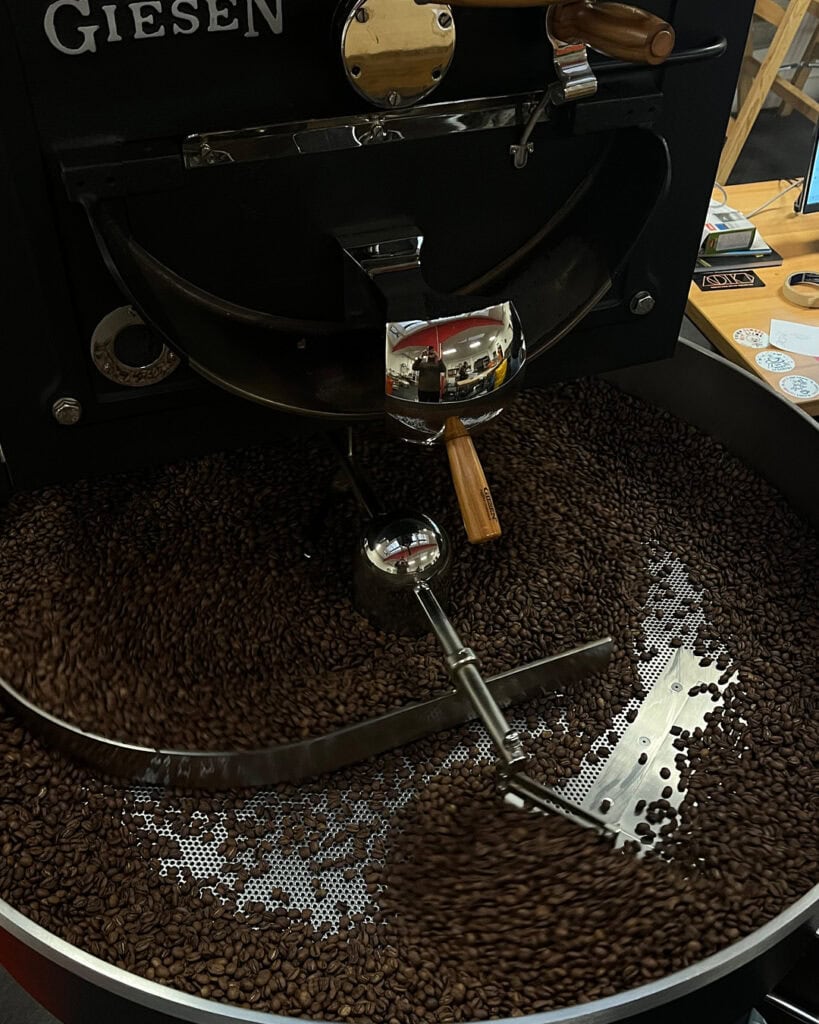
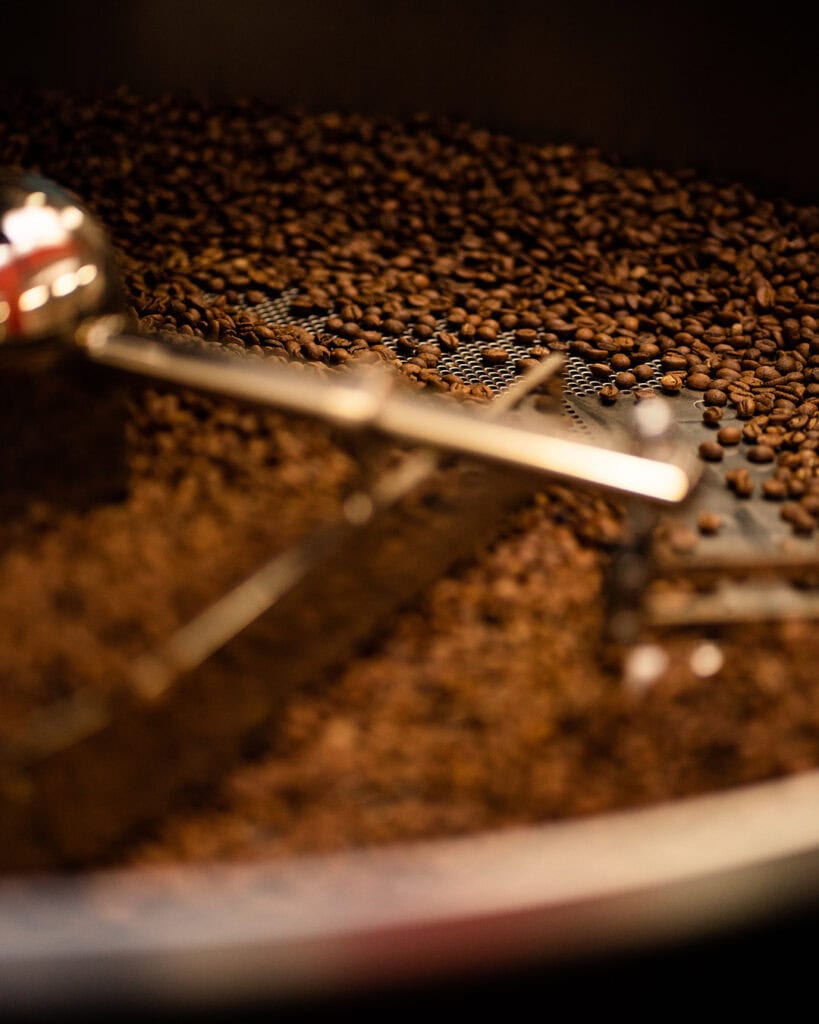
The answer sits in the supply chain, in everything consumers don’t usually see. On their educational channels, they break it down plainly. Conventional coffee is often mechanically harvested and mixed (ripe and unripe fruit together), while specialty coffee relies on selective hand-picking for ripeness. Where conventional roasting tends to run darker to flatten variation (and hide defects), ALIENA roasts to preserve the coffee’s fruit character, with its sweetness and aromatics. Just as importantly, they seem to have mastered how to communicate it. Its blog transforms the familial moka into a futuristic object (“una macchina terrestre per distillare tempo e caffè”, a terrestrial machine for distilling time and coffee).
There’s also something more personal in the ALIENA story. Born and raised in Rome with a food critic mother, I grew up with the best of the best at my fingertips, coffee included. That privilege quickly dissipated in London, where caffeine became more of a mechanical coping mechanism than a custom, usually purchased in bulk and swallowed between lectures. Somewhere along the way, I became a sort of “alien” too: Roman-born but London-adapted, with a palate that never fully made the move.
When I went to ALIENA’s guest shift at Rosslyn London Wall in November, the difference was immediate. Talking to Dafne made it even clearer. She teared up speaking about how hard COVID had been on their business, then lit up at the idea that young London-based creatives wanted to ask questions in the first place. Their product is deeply personal, built through difficult years and trips across the world (she tells me about Brazil with love as I sip), chasing flavour back to its source.
In conversation, the team behind ALIENA unpacks what it means to be “alien” in Rome, and what we aliens really know about habit and tradition.
The Cold Magazine (CM): Let’s start from the beginning: Where and how do you select ALIENA’s coffees? What criteria guide your choices when you build relationships with producers and micro-lots?
Aliena Coffee Roasters (ACR): The selection begins long before tasting. It begins either with a relationship or with the desire to build one. We work with importers who truly know the producers, who can tell us not only a sensory profile, but a real story of work, of agricultural choices, of attempts, even of mistakes. Micro-lots interest us because they’re spaces of freedom where the producer experiments, takes a stance, takes risks. They put something of themselves into it through innovative processes. We’re not looking for “the perfect coffee,” but for coffees that have something to say. When we taste, we look for identity rather than homogenisation.
CM: What do you look for, beyond sensory quality, in a coffee you decide to roast? How much do factors like sustainability and working methods matter to you?
ACR: Sensory quality is only the beginning. If a coffee tastes great but comes from a system that doesn’t respect the people who produce it, or the land itself, then to us it loses value. Sustainability means understanding whether that project can truly stand over time, whether it creates dignity, whether it allows the producer to grow. We care about the way the work is done, the attention and intention. A coffee always tells you how it was treated, by whom, and why.
CM: Why start an independent roastery today, in a saturated market and in a city like Rome, which already has such a deeply rooted and complex coffee culture?
ACR: Precisely because of that. Rome has an incredibly strong coffee culture, but often one that doesn’t move. Rome is a city of traditions and millennia-old habits. Starting an independent roastery here means entering into dialogue with an enormous tradition, without wanting to tear it down, but also without simply submitting to it. ALIENA was born from the need to create a space of possibility, not competition. We didn’t want to “convince” anyone, but to offer an honest, coherent, living alternative, something that represented us as people.
CM: How has this Roman context influenced your approach to specialty coffee?
ACR: Rome teaches you to be patient and radical at the same time. Here, aggressive evangelisation doesn’t work. You have to work by subtraction, through experience. We began with word of mouth: one person at a time, every individual who crossed the threshold of Faro. Simple words, questions, information, curiosity. That’s how we broke through. Then we began writing: on the café walls, on social platforms, in presentations… Words are a powerful medium. That led us to a kind of specialty coffee that is less loud, less performative and a lot more human. An approach that doesn’t ask the customer to “study,” but simply to feel.
CM: ALIENA… when you chose this name, what did you feel the need to ‘distance’ yourselves from? What does it mean to be an “alien” in the coffee world?
ACR: From everything that is taken for granted. Being alien means not belonging to a single narrative, neither the traditional one, nor the hipster-ised specialty one. ALIENA is a space for lateral observation. We look at coffee as something that can still surprise us, generate questions as well as answers. To be alien is to remain curious, untamed.
CM: How do you describe the complexity, traceability and research that clearly goes behind production without making the coffee feel elitist or overly didactic?
ACR: By never starting from above. Complexity doesn’t need to be explained all at once, immediately. It has to be lived, otherwise you risk a boomerang effect. If someone feels something new in the cup, then curiosity is born. Only afterwards do the words arrive, if they’re needed. We share what we know, but we leave space for what the coffee can do on its own. We like subjectivity.
CM: Following from this, how important is it to you that a consumers’ first encounter with ALIENA happens through experience rather than technical explanation?
ACR: It’s fundamental. Explanation without experience is noise. Experience creates memory. We want that first encounter to be sensory, emotional, even imperfect. Technique comes later, but only as a tool, not as a barrier.
CM: With ALIENA entering international contexts (in London with Rosslyn, for example), what values feel non-negotiable? What must remain intact, regardless of place?
ACR: Coherence. Respect for the product, for the people who produce it, and for the people who drink it. The refusal of shortcuts. We can adapt the language and the rhythm, but not the intention. ALIENA must remain a project that listens, that engages in dialogue, that doesn’t simplify for convenience.
CM: What are your aspirations for ALIENA today (both as a coffee project and as a cultural space)?
ACR: We want ALIENA to continue being a place of research, not only into coffee, but into ways of being together. A place where coffee is a pretext for talking about work, aesthetics, supply chains, care. We don’t want to grow at all costs. We want to grow well. To stay faithful to that initial feeling: still being slightly out of place, and turning that into strength.
Discover Aliena Coffee Roasters on their website, https://caffealiena.com/it.