I felt nervous standing in the queue. I had travelled two hours by train and god knows how many clammy minutes on tubes to get here: the entrance to Gagosian. It was Mayfair, late January, blue hour. I was one single vertebra in a long column of people waiting to enter the doors of Nan Goldin: The Ballad of Sexual Dependency.
Created between 1973 and 1986, the photo series has long been considered Goldin’s magnum opus. Shown in its entirety here – all 126 photographs – for the first time in the UK, it was no wonder that every fashion student and art scene aficionado had turned up for the reveal.
I watched birds fly low through the bones of winter trees, black London cabs wind slowly around the corner of Davies Street. The street lamps, black and iron and old school, began to twinkle on. The people in front of me in the queue were men with cropped jean cuffs and curly mustaches, gesturing wildly to their partners. Meanwhile, ladies with slicked back blonde buns balanced phones crunched between their ears and shoulders, rummaging through tote bags.
At one point, an incredibly tall blonde woman entered the queue with a small, cappuccino-coloured dog under her arm. The dog had a thin, silver chain around his neck. My wife and I watched as a man opened the glass door of the gallery and motioned quickly for this woman and the little dog to clomp ahead and enter the doors. A friend of Ms Goldin?

Nan Goldin The Ballad of Sexual Dependency, 2026, installation view. Artwork © Nan Goldin
Photo: Prudence Cuming Associates Ltd
Courtesy Gagosian
The thing is: the art world isn’t really my world. I have always felt uncomfortable around fashionable people, standing before giant splashes of colour in cold white cubes, chatting about their ski trips and how they once met the artist in Provence. In the day, I work at an art museum. I shiver with fear any time I happen to pass the slightly cracked door of a catered dinner – the clinking of glasses and pearls of white laughter: thank you, thank you so much for the money.
I felt that same fear as I walked through the threshold into this exhibition of the Ballad. You see: the art world may not be my world, but I always felt that I belonged in Nan Goldin’s world. From the first time I witnessed her photographs from a smudgy laptop screen in my childhood bedroom, I felt drawn to them.
Couples in rumpled shirts gaze into each other’s eyes, smelling each other’s breath, wrapped up in musty-looking sheets. Thin, withdrawn women smoke cigarettes at tiny bar tables. Even thinner, thinking women stand naked in showers. Children skitter around the edges of this world, too, the tops of heads appearing over ashtrays and glasses filled with golden liquid. I was one of those children.

Nan Goldin, Cookie at Tin Pan Alley, New York City (1983) from “The Ballad of Sexual Dependency,” 1973–86, 126 archival pigment prints, in frames, each: 15 3/4 × 11 × 1 1/8 inches (40 × 27.9 × 2.9 cm), overall dimensions variable, edition of 10 © Nan Goldin
Courtesy the artist and Gagosian
In one, track-stopping image, Goldin herself appears, young and round-faced with one red eye. Her face is badly bruised, sallow under both eyes. “Nan one month after being battered” is its title. It is painful to look at her.
Over 40 years old, this series of photographs is an unflinching look at Goldin’s friends and lovers in New York City. It was first presented as a slide show, with various soundtracks and voiceovers, then as a film, a book, and sometimes, as an exhibition on a gallery wall. Goldin once said the Ballad is the diary she lets people read.
As I shuffled one foot in front of the other across the shiny floors of the Gagosian, waiting my turn, I understood the comparison. Each image is a tiny window to another world, emitting hot, dark light, and raw sexuality. There are many I would like to climb into, and many I would not.
Me and the other gallery-goers snuggled in tight. The queue outside was growing and the guards at the door were running a “one in, one out” policy. We grazed in slow-moving circles, like prisoners walking the yard. The images are so exposing, so thick with story, that my eyes felt hungry, roaming over each square frame, trying to drink in each confession before the pages of this decades-old diary were closed forever.
Nan Goldin, French Chris on the convertible, New York City (1979) from “The Ballad of Sexual Dependency,” 1973–86, 126 archival pigment prints, in frames, each: 15 3/4 × 11 × 1 1/8 inches (40 × 27.9 × 2.9 cm), overall dimensions variable, edition of 10 © Nan Goldin
Courtesy the artist and Gagosian
The Ballad has been so famous for so long, and has become so beloved, that the figures in Goldin’s images have taken on a life of their own. There’s Robin smoking, Cookie lounging in a hammock, her son Max at her side, a guy called French Chris sprawled almost Biblically across the blue top of a convertible.
What struck me, seeing the collection of images in person, is how different the people in the images seemed to the people who were looking at them. These art types, long trench coats and clacking bracelets, had not a single sweat stain among them. “What do they want with Goldin?” I thought. As I took in the silhouettes of the gallery goers, I remembered the boy with the droll Irish accent who once told me, speaking about his love of thrift shops, that his goal was to exude “American white trash.”
Call me naive. But I didn’t know the Ballad would attract such a moneyed crowd. The people in Goldin’s images are not wealthy or well-connected, or glamorous. They reveal the dirt and desperation of addiction. The pills and the drugs may not take centre stage, but they leave their trace on the series, like a water ring on an oak table.
What originally drew me into the artworks, all those years ago, when I was a little nobody, writing nothing for no one, rotting in a small town on the Georgia-Alabama state line, was how real it seemed – how it reflected my own life.

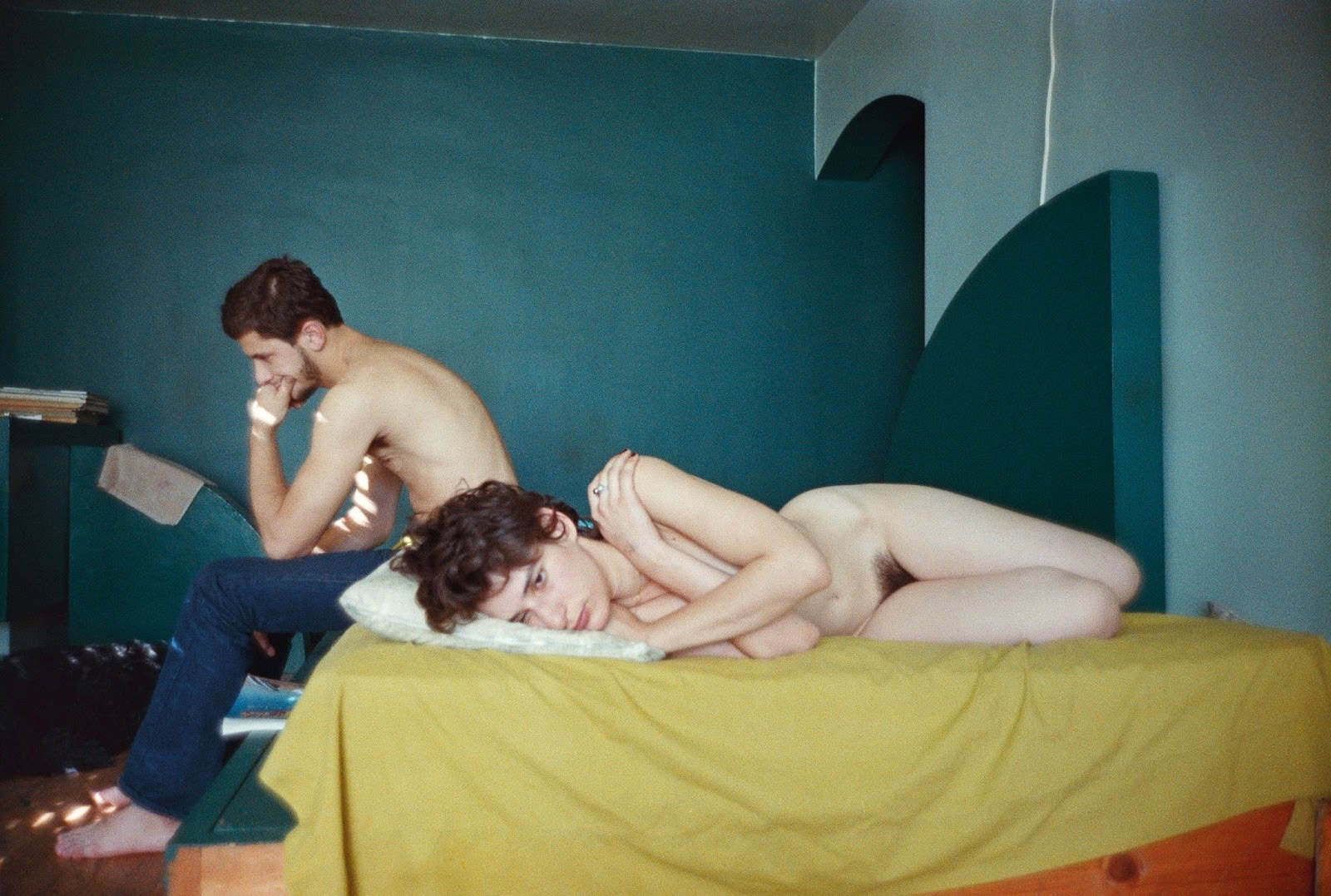
Nan Goldin, Couple in bed, Chicago (1977) from “The Ballad of Sexual Dependency,” 1973–86, 126 archival pigment prints, in frames, each: 15 3/4 × 11 × 1 1/8 inches (40 × 27.9 × 2.9 cm), overall dimensions variable, edition of 10 © Nan Goldin
Courtesy the artist and Gagosian
Today, Goldin helms Prescription Addiction Intervention Now (PAIN), an activist group she founded in response to the American opioid crisis. The group’s main target is the Sackler family, owners of the pharmaceutical company Purdue Pharma and manufacturers of highly addictive opioid painkillers.
The group has staged protests at museums around the world, including New York, Paris, and London. With art at the centre of their fight, the group demands that the Sackler name be removed from gallery walls, that art institutions refuse their money, and that the family help fund addiction treatment.
In 2018, Goldin wrote, “I survived the opioid crisis. I narrowly escaped […] Most of my community was lost to Aids. I can’t stand by and watch another generation disappear.” This political advocacy, to me, is inextricably tied to the Ballad.

Nan Goldin, Warren and Jerry fighting, London (1978) from “The Ballad of Sexual Dependency,” 1973–86, 126 archival pigment prints, in frames, each: 15 3/4 × 11 × 1 1/8 inches (40 × 27.9 × 2.9 cm), overall dimensions variable, edition of 10 © Nan Goldin
Courtesy the artist and Gagosian
Nevertheless, as I circled the gallery, I wondered if the people around me knew about this chapter of Goldin’s career. Did they see traces of P.A.I.N. in the photographs? What would these people think of the work of photographers like Stacy Kranitz, who works in the Appalachian region, exploring the opioid crisis and poverty as it exists today? Or Richard Billlingham, whose exploration of poverty is decidedly more British and less heroine chic? What would people in the gallery think of some of my own images of family, friends, and neighbours?
None of this is to say that there is one right way to look at Goldin’s photos, or that you need to have personal experiences of addiction to understand the series. Art is universal. Even now, as I write, I wonder, who am I to minimise the experiences of those around me to this thin caricature? I’m sure more than a few of the people I rubbed shoulders with that night in Mayfair were living lives far from St. Moritz and Art Basel.
And yet, years from now, when I look back on my experiences of seeing the Ballad in the flesh, for the first time, in all its painful unglory – I will always remember this impression of dissonance. The feeling of something being appropriated.
If this showing of the Ballad at Gagosian London is the latest chapter of the work’s varied exhibition history, then it seems a very fitting one. To me, the most interesting story to be told about the Ballad in 2026 is a tale of how art about the underclass becomes the aesthetic delight of the upper echelon.
Robin, Cookie, French Chris – they had come far from the rough house. But I worry that someone who stood near me in the gallery that night, snaked into a vintage shop the next day, picked up a leather jacket, and said: “It’s kind of giving Nan Goldin, isn’t it?”
Nan Goldin: The Ballad of Sexual Dependency is on view at Gagosian, London until March 21, 2026