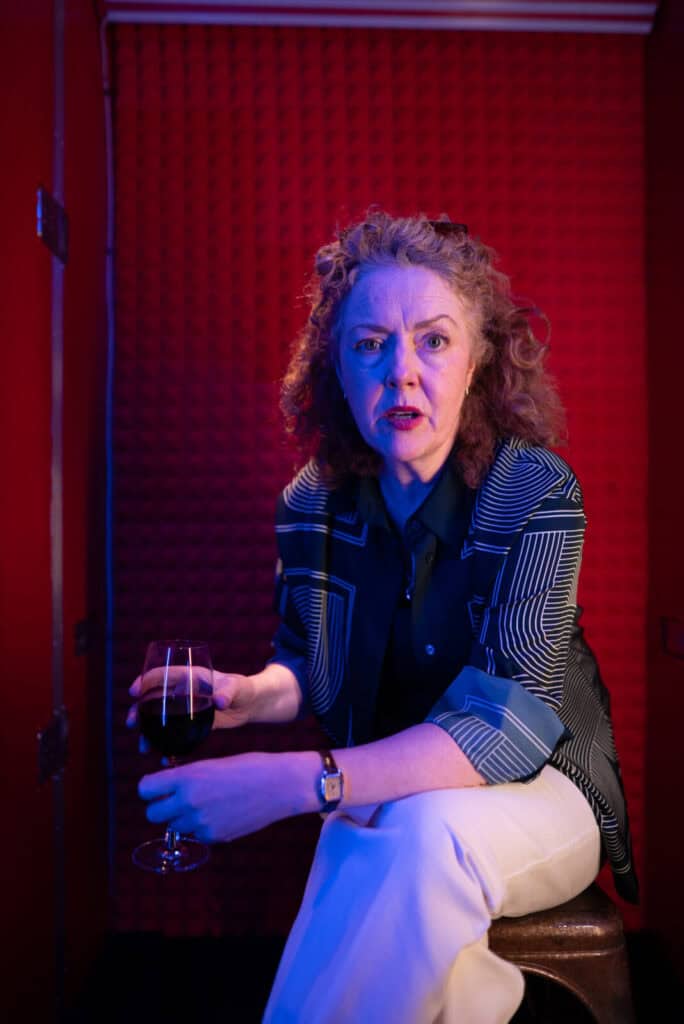
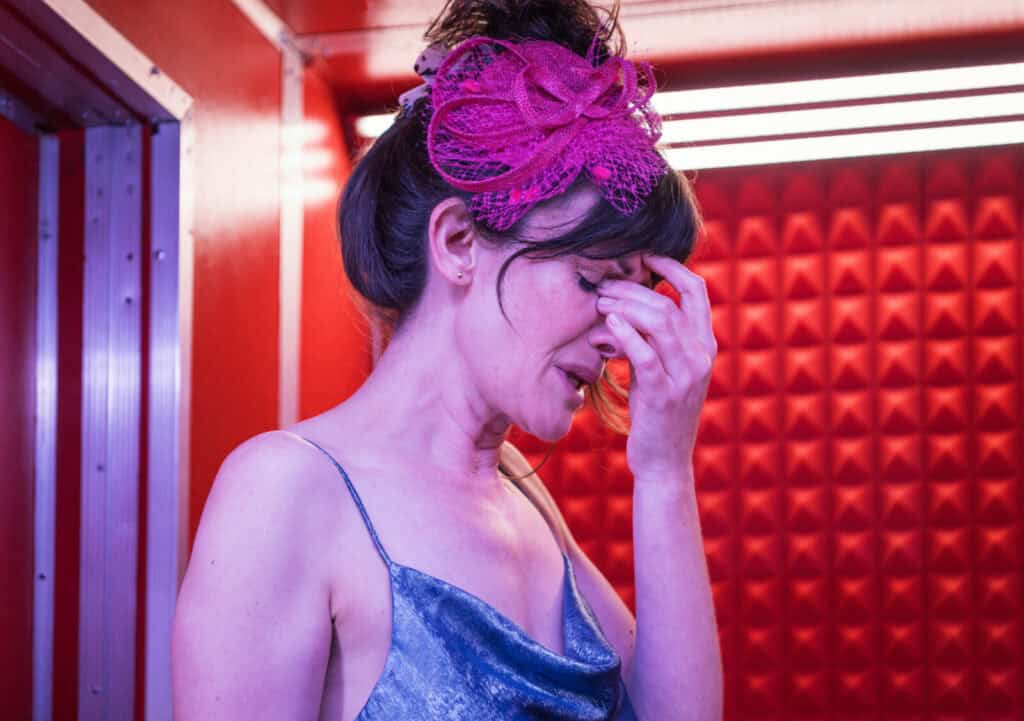
Theatre For One presents an unusual provocation: works of theatre performed for one audience member at a time. The project was created by Canadian theatremaker Christine Jones and has taken place in locations as varied as Times Square, the Chicago Architecture Biennial, and now the foyer of the Barbican in London. The concept is simple: six writers, monologue plays lasting five minutes, and nothing revealed to the audience member before they enter. You don’t know which play you will see before you enter the booth.
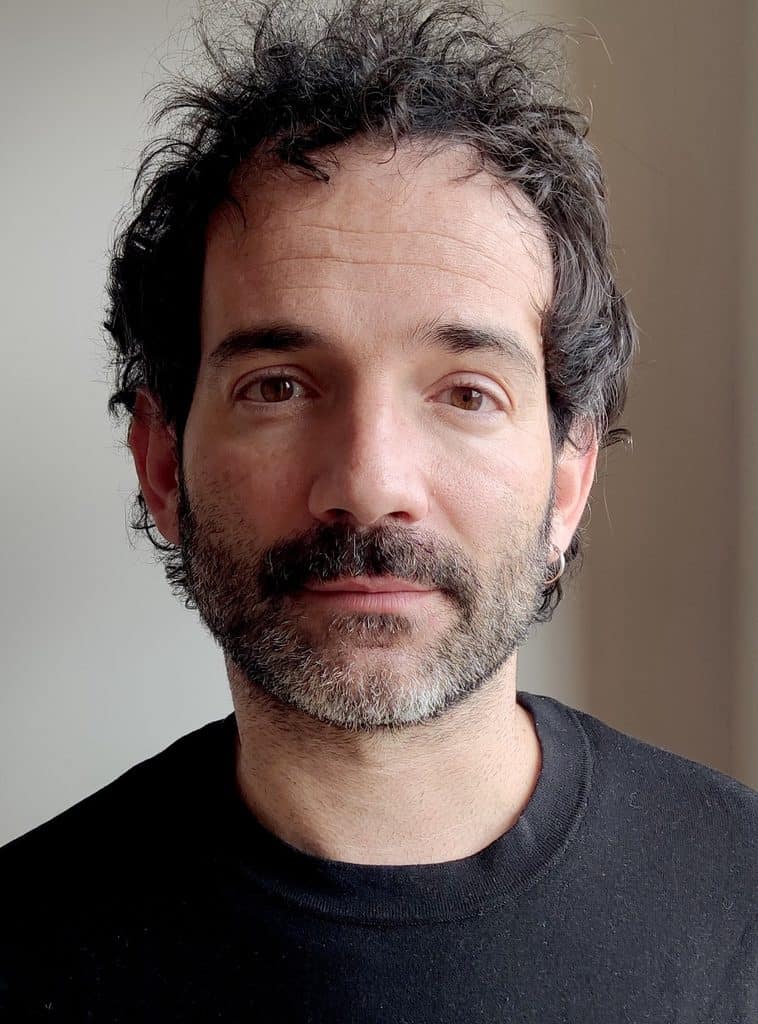
The Cold Magazine speaks to some of the writers involved with the project – Joy Nesbitt, Mark O’Rowe and Katie Holly – about writing for the booth, the relationship between theatrical forms and lived experience, as well as the cultural relationship between England and Ireland.

Joy Nesbitt
The Cold Magazine [CM]: So, obviously, the project is one-on-one, it’s immensely intimate – I’ve seen many people compare the experience to being in a peep-show booth or a confessional or a psychoanalyst appointment, all those various kinds of private experiences.
How did you find writing for such intimacy? What possibilities does that open up for you as a writer?
Joy Nesbitt [JN]: In my work, I’m really interested in the ways in which we come up with these absurd stories to understand the legacies that we live in. To understand who we are amidst those legacies – that’s always a really exposing experience, right? So I felt that writing for this space was really freeing because there are secrets that your character has that they’re able to expose because it’s just you and another person. So, what you get is the secrets around the top, and then the deeper secrets are the ones that we’re trying to mine, which I think is a really great gift in a theatrical space… I think I was really lucky to have Enda Walsh as my mentor on the first go-round, and I love him, he’s the best. So I was really grateful to him for giving me license to say the things that might be uncomfortable in someone’s face and to license my character to have that honesty that they wouldn’t necessarily always have in a big, theatrical, one-person show delivered to a two-hundred-seater theatre.
[CM]: I love that that’s opened up the possibility to be more honest.
[JN]: This particular play, or this space, requires that in a very short period of time I get to the deep, deep part without the subtext – which is a total challenge, but it was exciting.
[CM]: Speaking about Enda Walsh, actually, I was going to ask you how you found being mentored by him.
[JN]: When I first started working with Enda, I was quaking. But he was the nicest man in the whole wide world and so down to earth. And I really appreciate his acceptance and admiration for craft. I already believe that we live in drafts and we try things and they fail, and that’s fine, but I just really appreciated him coming in and being like, what if we just threw a bomb in here and see what happens? Like, what if we do something crazy-weird? And then it doesn’t work? Okay, cool, let’s do it. Let’s see. The stakes are never that high when you’re a writer-in-process. They’re high when you’re working.
[CM]: Could you say a bit more about living in drafts?
[JN]: Yeah, I feel… I believe we see versions of ourselves, and then we try another version and put on another hat and put on another hat. And I think that’s beautiful. I think that’s a really good thing. And in this exercise… Because we only have a short time in the space, we only have one person that we’re getting to know, we might get the opportunity to live in drafts or to see that person in drafts. And then we, as the solitary viewer, get to decide who did we just meet: the true person, or did we meet a version of them that they are trying out? I think that’s a gift, you know, to be able to live that, but also to experience that in a theatrical setting.
[CM]: Was there a specific play that brought you into theatre?
[JN]: In college I worked on For Colored Girls Who Have Considered Suicide by Ntozake Shange.
[CM]: Gorgeous.
[JN]: That play! And then it was this play called What to Send Up When It Goes Down by Aleshea Harris. And both of those plays put me in a context where I was like, oh my gosh, not only do I feel seen by this, but I also love to see these two black women writing plays that show real… shift?
And then also anguish that we haven’t reached the… Sorry, I just keep talking about drafts, but we haven’t reached the final drafts in who we are, what we are, right? And I just remember those plays having a big effect on me, but I didn’t really know what to do with that.
So when I got to Ireland, I got really lucky to be able to get stuck in and to engage with some really beautiful Irish artists. And I feel really, really blessed to be able to have engaged with writers like Enda Walsh, but also writers like Martha Knight and writers like CN Smith and and Kwaku Fortune. It feels really wonderful to see the next generation of Irish writing and what happens when we start talking about the diversity of Ireland at this time. I do really want to keep working with Irish artists and working in Ireland. So that’s a big goal for me, especially with Black Irish artists. Tishé Fatunbi is playing the role of Adeola in my play. I feel so, so, so overjoyed having her coming to the Barbican to do this show because it feels like a fulfilment of what I wanted to do, in that I really wanted to invest in connecting with Irish artists and especially Black Irish artists who are striving for bigger spaces, bigger names and bigger recognition.
[CM]: It’s interesting talking about that shift from Ireland to the UK. How do you feel the piece travels between Ireland and London or if it changes at all in that journey.
[JN]: I feel like when you’re making black theatre in the States, or you’re making theatre about any marginalised community in the US, you’re always talking to your coloniser. You’re always talking to your oppressor in the theatre, at least, because your oppressor is the people who can afford it. So in a way, it doesn’t feel unexpected to be doing a show like this in the UK. This play is about straddling two identities. Adeola certainly feels black, she also feels Irish and she feels like her blackness and her Irishness are in competition with each other. And so that’s certainly a double-consciousness concept that I feel many different communities across diaspora have to deal with, which I think is a good thing for this audience, right? That this conversation is happening here as well. I’ll be interested to see how those nuances translate in this context.

Mark O’Rowe
[CM]: Now, I know you have a long history with the monologue form. You’ve been influenced by Conor McPherson and Samuel Beckett’s Molloy — what is your own relationship to the monologue?
Mark O’Rowe [MO’R]: It’s funny. Apart from this play, I haven’t written one in many years. As you write – particularly over a long period of time – you find yourself evolving into different areas of interest. You always write by instinct, and your ideas always come by instinct. And your concerns change as you get older. Having said that, though, I’d love to write another monologue play. And to be honest, I’m slightly aching a bit at the moment to do one. That doesn’t mean I will. But one thing that the monologue play allows us to do is just to really indulge in language – you know, that idea of a stream of consciousness and allowing a story to take you where it’s gonna take you. The monologue has lovely qualities in that way. Often, particularly when I was directing, I realised it’s a little bit like stand-up comedy, because whenever I’ve directed them I’ve always felt that the more stand-up the performance is, the more effective the play is. I suppose what I’m trying to say is, the stand-up comedian goes out there, and all he has is what he’s got to say. And I always find that the more engaged with us, and the more connected to us, and the less decorative the actor is or the less he adds to what he’s saying, the better it is.
[CM]: I love the idea that the forms come out of life, that as your career expands the forms answer various things going on in your life.
[MO’R]: They do.
[CM]: Do you ever, in hindsight, see things emerging that you wouldn’t have been able to recognise at the time, but that when you look back make sense of certain periods and concerns?
[MO’R]: Yeah. Particularly when you’re very young, in your late twenties and early thirties, it’s so much about rock ’n’ roll, showing off and virtuosity. I remember I got to a point where I thought, ‘why am I so bored? So frustrated?’ And it was because I felt I’d gone as far as I could with that. And I think what happens to most writers is you start to go a bit deeper. Your work becomes a little bit less turbo-charged or a little bit more awful. I think you become a little bit more confident, and also you become just a little more thoughtful because of all the new things that life throws at you like relationships, feelings, that kind of stuff.
[CM]: Does this feel like a different kind of writing for you with just one person sitting with the actor? Does it feel like a different form for you? Is it still theatre or is it something else in your mind?
[MO’R]: It’s funny, because when I was writing I always worried about, not about the actor, not about the text, but about the poor audience member who had to sit there.
[CM]: It’s desperately exposing, isn’t it?
[MO’R]: It really is. You sit there going, “am I giving the actor what they want? Am I nodding at the right places? Do I look interested enough?” You know, all of that stuff. And that gaze, that connection is very intense and probably too intense. But I watched a few of them, and I was very surprised because it didn’t feel like I thought it would feel. It felt very collaborative. It felt like I was really important. Because this person has only me to look at. They’re not looking at a bunch of shapes in the darkness. There’s actually a real connection happening here, and yet there’s this agreement which is: you get to talk, I don’t. I have to listen. And I found that very intense and powerful and much more enjoyable than I thought it would be. The act of writing the piece is very similar I think, except for the time limitation on the pieces, you really have to be… I found it quite tough to write, actually, and it was really just down to the time limitation.
[CM]: What I’m gathering across the course of our conversation is that you’re interested in a theatre that asks its audience to sit up, to take notice and to engage.
[MO’R]: That’s completely right. Going back to that earlier question, what are the things that you’ve become more interested in, having left the other stuff behind, that would be it. It feels like you want somebody who is smart and there to play a major part in the experience. I found years ago when I was interrogating other plays and wondering why certain things bored me and certain things excited me, I realised that – and usually this would be at the theatre – I realised that whenever I had work to do in the process I sat forward and the play was amazing.
Drama asks us questions, and mysteries, and what’s going to happen, and why did he say that? I think a lot of writers do mix up “good writing” with “good drama”, and one thing doesn’t necessarily mean the other.
Katie Holly Interview
The Cold Magazine [CM]: How did you find writing the five minute monologue, one-to-one?
Katie Holly [KH]: So, first of all, I was brainstorming ideas for it, of stories that could be encapsulated within five minutes. And I rapidly became aware that that’s very, very difficult to do. And someone said, “it’s really important that you think visually – what’s the first thing that the audience sees?” So I started thinking more visually than I ever have before.
[CM]: So you came to an image first and then the play arose out of that?
[KH]: Kind of. It was like an image came into my mind of the type of character I was going to see, what kind of costume they would be wearing, what kind of props they would have that they could fit into that small space. And then the story came out of that. It was kind of… I don’t like using the word, but it was kind of organic the way it came about. It didn’t really become clear to me until later that there’s only going to be one person looking at this. It’s going to be in a really small space. It’s going to be super weird if you’re any way awkward like I am – it is incredibly awkward. I’ve only seen the play once. I laughed uncontrollably, probably out of nerves as well. I mean, there are gags in the show, but I was very nervous watching it because it’s a very unusual experience to not have seen your own show before it’s up and running. There was very little I could do about it if I didn’t like it. Thankfully I did because Julie [Kelleher] did a great job on it.
[CM]: Do you have a model for that actor-audience relationship? Is there any analogue in life that you reach for? Is it friendly? Parental? Romantic?
[KH]: I think it’s a friend. I think that’s a really good way to look at it. I think it’s about making connection with a friend that you haven’t seen in a while. So it might take a little time to get back into the relationship. But once you do, it feels like you’ve never been apart. I’m not into making audiences feel like… And this is a perfectly reasonable performance contract, to challenge audiences and push them. It’s very interesting to visit, but it’s not what I do. It’s just not my bag, you know?
[CM]: Do you have someone in mind when you’re writing?
[KH]: I don’t really think of a specific person. To be honest with you, I like writing for myself. I think what would I like? What would I enjoy? What would entertain me? What would challenge me? What would upset me? So really, I am my ideal audience member.
[CM]: So you’re writing back to yourself in a way?
[KH]: Oh, yeah, I would say so. I don’t think I’ve ever written anything that I wouldn’t enjoy watching. Because if I did I’d be like, “why am I putting this out there”? Why would I make someone else watch something that I don’t want to watch myself? I try and follow those instincts more than anything else.
[CM]: Do you consider yourself to be an “Irish playwright”? What might that mean?
[KH]: I think I’m heavily influenced by Irish playwrights. I can see it coming through sometimes, in themes, in turns of phrase, in archetypes, in obsessions… Yeah, I think I would be very happy with being known as an “Irish playwright”.
[CM]: That word you use there – ‘obsessions’ – is interesting. What would you say our national obsessions are in the theatre?
[KH]: Well, I’ve noticed in the last few years, I seem to be writing a lot more about rage.
Now, that could be that could be to do with my age as well. I don’t know. I feel like how people deal with rage and how they rage against controls is very interesting. No matter what way they deal with it, I find it interesting, whether they suppress it or they just give themselves over to it or they ignore it – I find all of those responses interesting because they bring their own kind of sensibility of what kind of person they are, where they’ve come from. Some people are just able to deal with rage better than others, I think. How people deal with that anger is of interest to me.
[CM]: It feels like Ireland is at a point in its history where more and more people are able to voice their grievances with the state, with the church, with so many different parts of Ireland. And so there’s a rage that’s awakening culturally that we’re still learning day to day how to articulate and whether it can, in fact, be articulated.
[KH]: 100%. We’re still colonial, we’re still post-colonial. We’re still very polite a lot of the time. Very apologetic a lot of the time… I think probably younger generations will be less apologetic but it’s still kind of ingrained in us, I think. Apologising for existing.
[CM]: What do you make of the current arts climate in Ireland? Do you feel supported? Particularly with the Basic Income for the Arts (BIA) scheme.
[KH]: I know there’s a lot of differing opinions about it…. Look, I think it’s brilliant. I think it’s life-changing for people who get it because you can stop worrying about bills which frees up so much headspace for what you’re supposed to be doing, you know? And [which] actually does affect artistic decisions as well in the type of thing you decide to write, in the type of things you decide to take chances on. Even if it’s only for three years, what you could do with three years is phenomenal.