The end of war exists not as a single endpoint to violence, but as a “persisting rupture in cultural memory.” The Beck & Eggeling gallery’s latest exhibition showcases the lasting impacts of post-war trauma to the general public. Over the years, collector Valeria Rodnianski intuitively gathered various German and post-Soviet artworks that make up this exhibition. The collection of pieces are marked by two indelible turning points, the construction of the Berlin Wall in 1961 and Russia’s invasion of Ukraine in 2022. Although once separated by the Iron Wall (and by time itself), these historical events don’t sit diametrically opposite. Artists from across the continent grapple with processing memories that have become spliced and fragmented. Its title, Art from War to War: Chasing Butterflies on the Verge of a Cliff, is borrowed from a metaphor penned by the poet Camillo Sbarbaro. It encompasses the unsettling sentiment of an individual feeling suspended amidst sociopolitical upheaval and transformation. The exhibition, not bound by a chronological order, allows for a fluid, non-linear conversation on physical and psychological displacement to emerge.
Curated as a themed triptych by Antonio Geusa and Kay Hemer, a “dialogue between two post-totalitarian experiences” unfolds in three sections: Topos (place), Anthropos (person) and Logos (reason). The exhibition itself broadly reflects the lived experience of contemporary art collector Valeria Rodnianski, who grew up in Kyiv and later moved to Germany. She was drawn to artists like Anselm Kiefer, Gerhard Richter, A. R. Penck, and Georg Baselitz for how they seemed to process trauma visually, and often more convincingly than works of literature. Perhaps the subjective nature of art allows for greater, more sobering nuances to emerge too.
Topos:
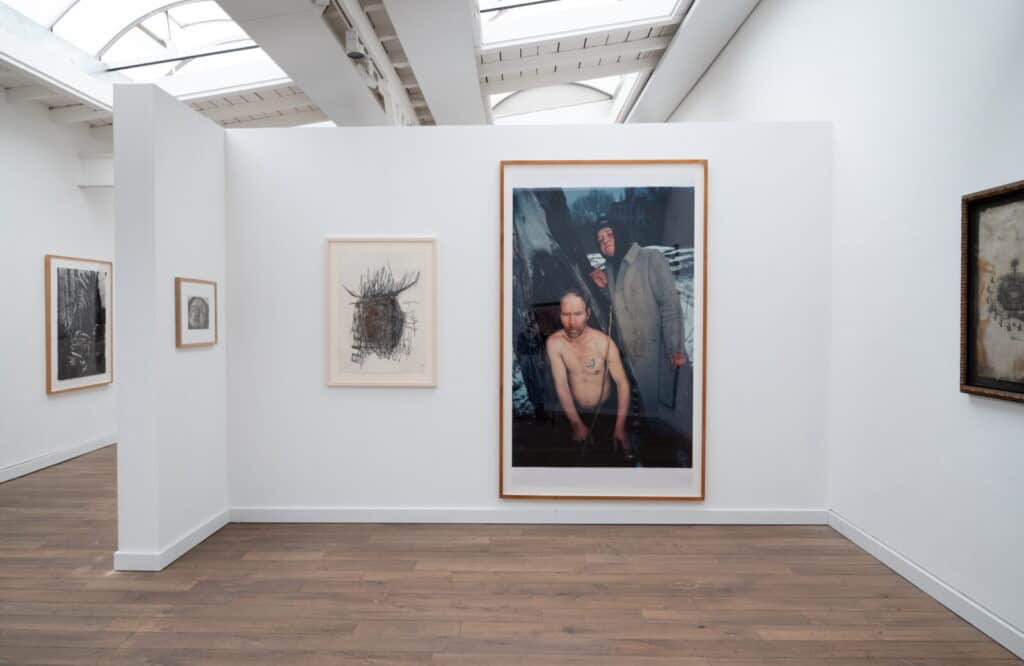
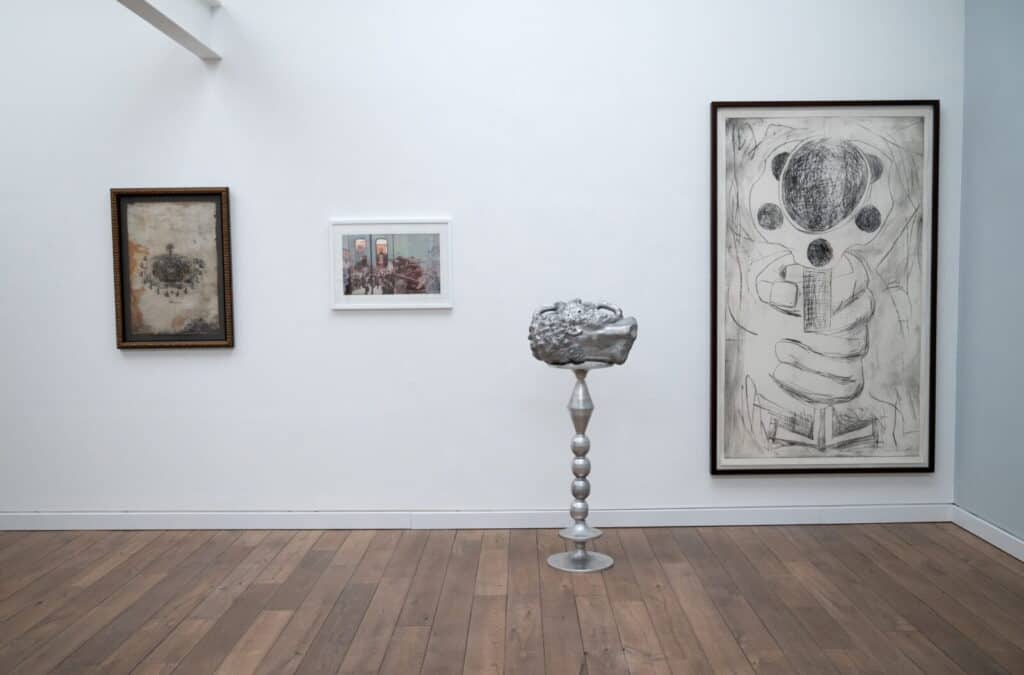
Topos draws on the hauntings of a bygone place that has become distorted and marred by militarisation. There is little more curiosity-inducing than an untitled, undated piece. In his “Golden Lines” series, Moscow Conceptualist Andrey Monastyrsky superimposes star-like constellations onto photographs. Here, a landscape is swept with snow and at the centre of the frame stands a group wrapped in hats and coats, clustered around what appears to be a giant, cut-out rabbit. Spindly trees blur the horizon behind and fine gold lines and metallic rivets extend from the edges of the huddle. Its spiritual undertones and Monastyrsky’s activist background could be read as a response to the Soviet-enforced Socialist realism movement.
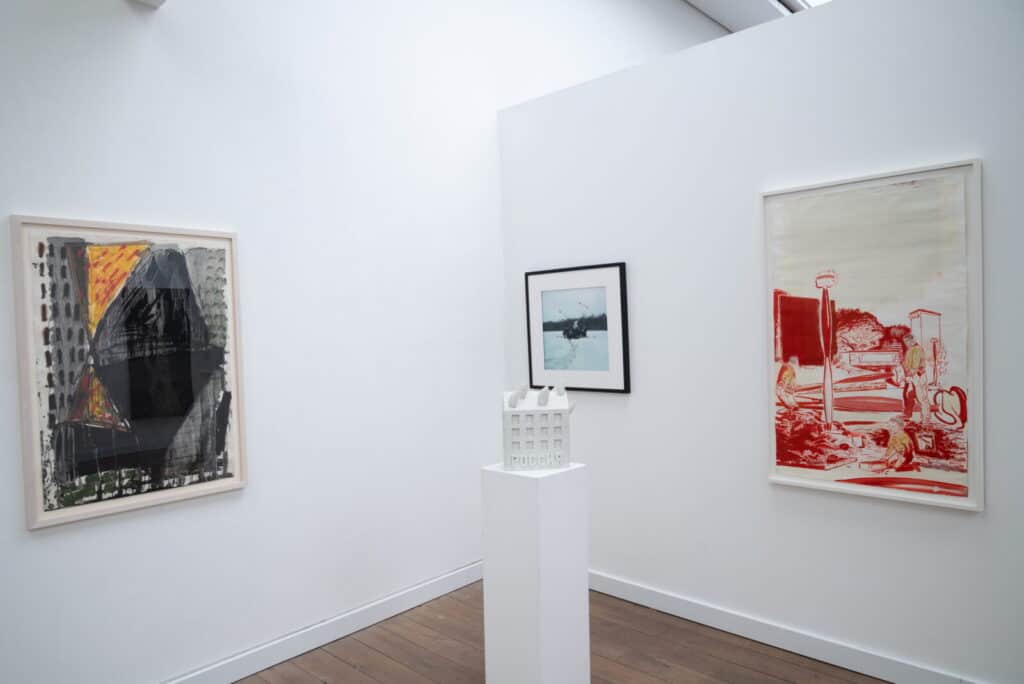
In Markus Lüpertz’s “Stil-Architektur” (1977), an urban space is cut up by deep black triangles. This abstraction follows his “German motifs” series that used figurative objects like a standalone military helmet, taken away from its usual propagandistic context, to confront Germany’s harrowing role in WWII. Although conceptual, “Stil-Architektur” is arresting. What appears to be a brutalistic high-rise is shunted to the edge of the frame in favour of slices of orange dashed with red. A direct pictorial reference is not clear but the nature of the drips of gouache and scribbled crayon create an oppressive environment, one that feels uninhabitable.
Anthropos:
Anthropos centers around how identity and personhood evolve when one is exposed to repeated traumatic events, especially those aimed at cultural erasure. Sasha Kutovyi is a Ukrainian contemporary artist who uses installation and sculpture to re-interpret Soviet imagery. His “Atherma (head of Aphrodite)” (2021) features an artificial marble head of the goddess of desire being impaled between the eye sockets by a metal pole. Slipping beneath the nose, it gorges through the hollows of her eyes. The sculpture evokes an unabashed ignorance to the horrors it could witness.
Irina Nakhova’s “Choices” (2019) shows a silkscreen print diptych of two pallid, mournful figures peeking from the cut-out of a tank. Nakhova was born in 1955 in the USSR and is a key figure of Moscow Conceptualism. On her website, Nakhova notes she is “interested in space in general — not just visual but intellectual, mental, psychological and physical space and its ambiguity.” The piece itself subverts post-war art that typically centers casualties or victims. Instead, the title “Choices” holds a subtle irony. Perpetrators too suffer for lack of autonomy where mandatory military service is enforced.
Logos:
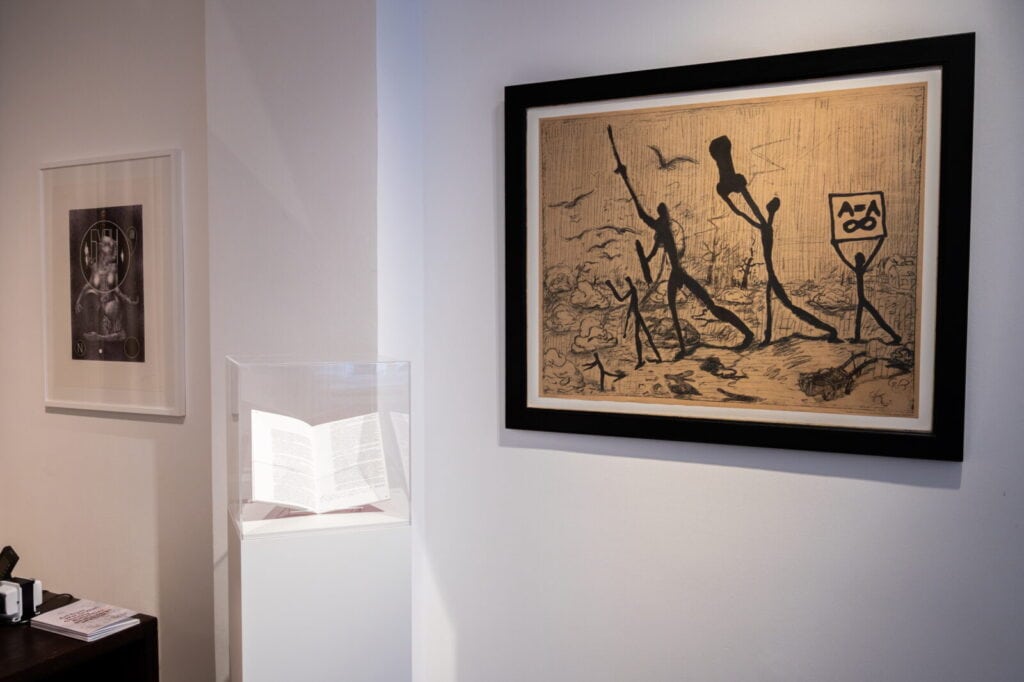
In early Greek Philosophy and early Christian doctrines, logos is defined as “the divine reason implicit in the cosmos.” Georg Baselitz and A.R Penck’s untitled lithograph (1969) sees ghoul-like figures marching, trance-like through clouds of dust and swarms of birds. One stickman displays a sign with “A=A” and an infinity symbol. German philosopher and mathematician Gottfried Leibniz is credited with using the symbolic formulation A=A to express “everything is what it is.” Perhaps here it implies that the senseless violence of the system should not be questioned. Both artists were provocative figures in post-war German art. Baselitz was expelled from Art School for “sociopolitical immaturity”, whilst A.R Penck was under surveillance by the Stasi for his anarchist, cave-like paintings.
Gerhard Richter’s “P 25 – for 110 × 250” (2012) collage sees horizontal stripes of colour tumbling down the paper. At 10 years old, Richter was conscripted into the Hitler Youth, although never served in the army. He later escaped East Germany in 1961 before the Berlin Wall was constructed. “P 25 – for 110 × 250” seems to reference his series Colour Charts, born from the 1960s to 1970s which saw a palette of hues arranged in rectangular blobs. In late 2025, the Fondation Louis Vuitton held the first major retrospective of Richter’s work.
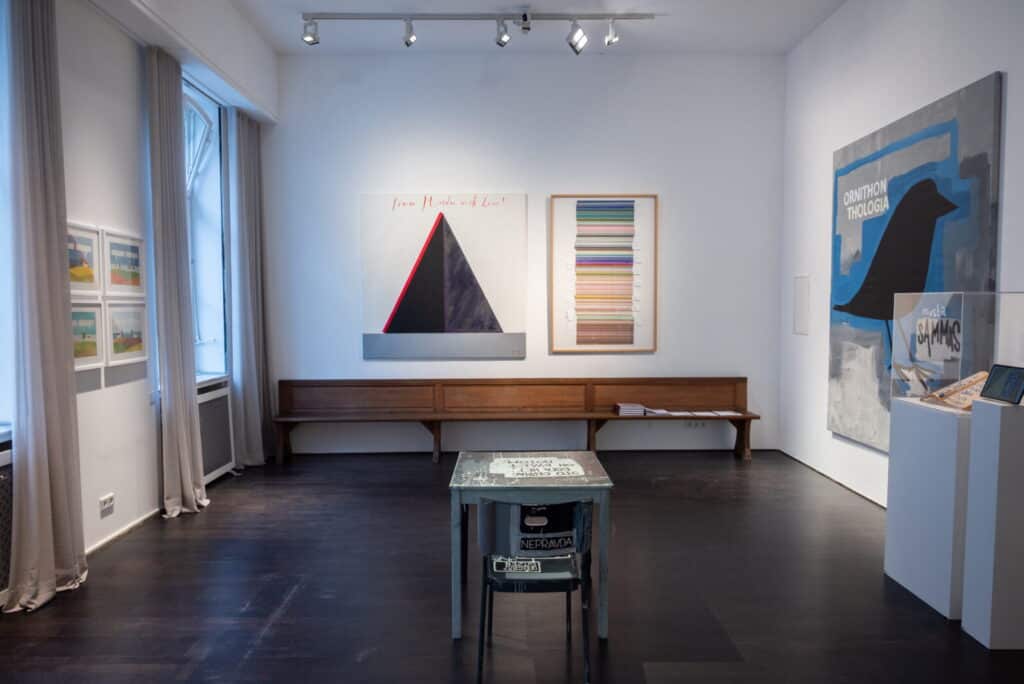
In today’s political environment, the dictum “Never Again” feels less like a commitment to the future and more an aching reminder of hope. For Art from War to War: Chasing Butterflies Over the Verge of the Cliff, Rodnianski was compelled to share the common thread of humanity and displacement that weaves throughout the collection. Specifically, the resilience of living through a “rupture” and the collapse of a familiar world. In her words, she was compelled to highlight the importance of sharing the human experience through artistic means “in a world where political systems repeatedly seek to subordinate the individual”. Through the non-chronological, open dialogue in the gallery space, division is rejected. This exhibition is evidence enough that regardless of catastrophe or censorship, our innate desire to create will prevail. In the words of Jerry Saltz, Senior Art Critic of the New York Magazine, “just get to work, you big babies.”
Art from War to War: Chasing Butterflies Over the Verge of the Cliff is on view at the Beck & Eggeling gallery in Düsseldorf, Germany until the 15th August.