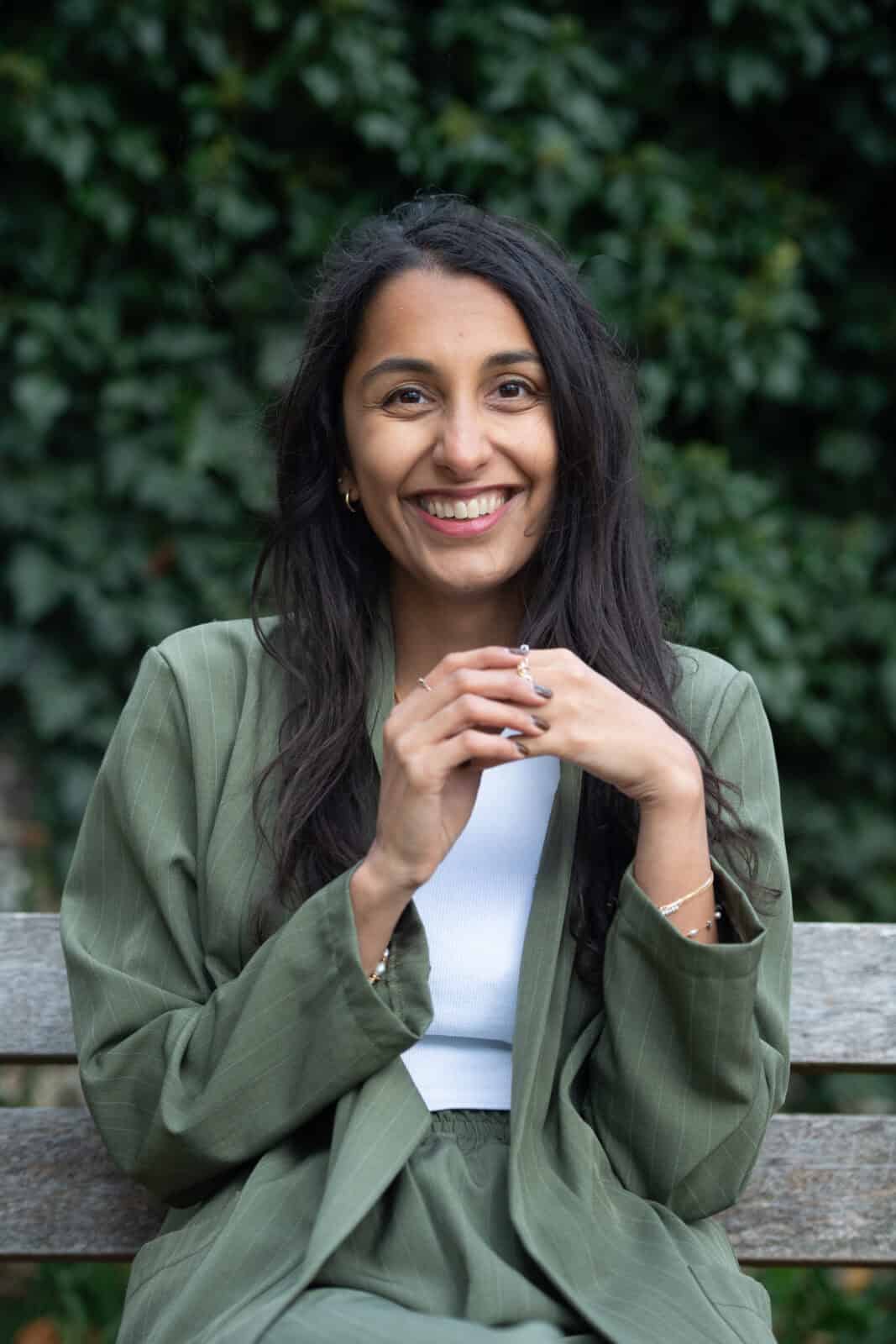
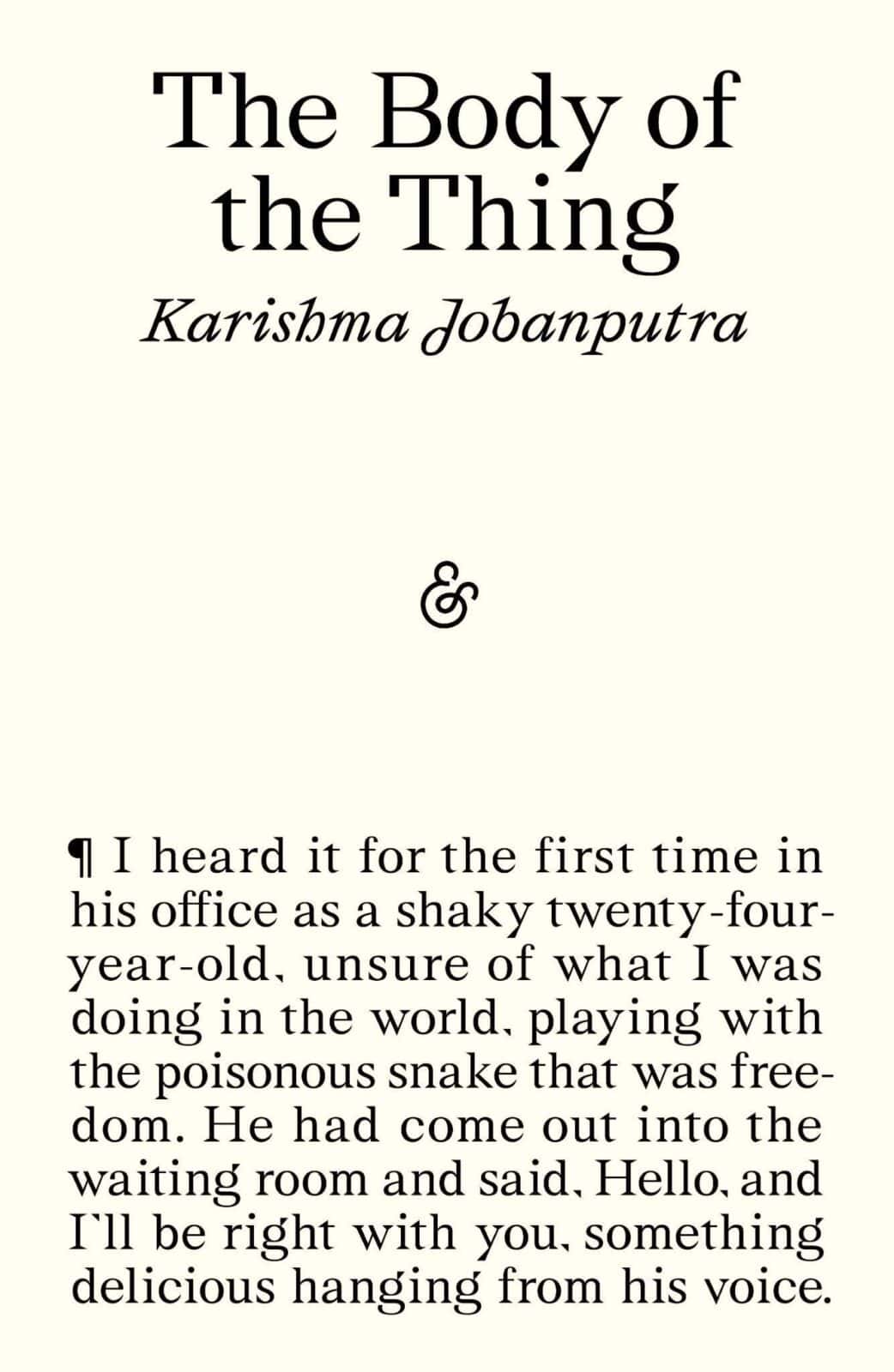
How were you mothered – badly? Well? Do you want it back? This is the question at the heart of Karishma Jobanputra’s debut short story collection The Body of the Thing. The British-Indian writer studied in New York, lives in London, and has been listed for the Brick Lane Short Story Prize.
Here, in her first full-length collection of stories, she probes deep into the way women relate to their bodies, how we control them, shame them, or let them loose in the throes of love. Most poignantly, though, Jobanputra wonders at those tiny little creatures many of us create with our bodies – children. What does it mean to break your body open for another person, and how do we relate to the person whose body broke open for us?
Between tales of food, beauty, desire, and class, Jobanputra makes the case for the short story. Sumptuous and sharp, her writing is endearingly human and moves deftly between frequencies of the human experience. Lonely lovers, grieving mothers, and starving women all populate her pages – and they will leave you wanting more.
In our conversation for The Cold Magazine, Jobanputra and I spoke about the opposing experiences of motherhood that sit side by side in her collection, food as both love and control, and what it means to write about bodies in an era of Ozempic and GLP-1s.
The Cold Magazine: Your collection has these really striking juxtapositions around motherhood. In “Norma Jean Baker of Troy” you write about grief following miscarriage, and then immediately after, in “Mum?” we meet this woman who is a mother but doesn’t seem to really want to be one. Why did you put them next to each other?
Karishma Jobanputra (KJ): I think I felt like I kind of had to, for that exact reason. There are so many experiences of motherhood, or a lack of motherhood. To me, it was picking experiences that felt very different, almost opposite, experiences of being a mother, or trying to be a mother.
I started writing “Mum?” while I was editing “Normal Jean Baker of Troy” because I was thinking, I wonder what it might feel like to desperately want something that someone else completely doesn’t want? In the context of motherhood specifically, there’s so much conversation around it – how we should want it or not want it. I thought it would be really interesting to think about completely different experiences of this thing that everyone is talking about and often even policing.
And then, more broadly, I was thinking about motherhood as a thing that happens to the body. On that level, it was a broader questioning of what makes someone a mother. How do we let go of motherhood, both physically and literally? Is that a choice that one can make?
CM: The idea of motherhood feels like it’s on the tip of everyone’s tongue at the minute. Everywhere I turn, someone’s talking about freezing their eggs, or whether surrogacy is ethical. Were you seeing these conversations as you were writing?
KJ: Motherhood is so many things at once, which is why I find it to be interesting material for writing. When I was writing both of those stories, I was reading Motherhood by Sheila Heti, which is so brilliant.
Motherhood feels like everything at once, right? It feels like an incredibly personal choice, but it is also so often used in a political way. It’s an incredibly intimate thing that’s happening within the contours of your own body, but then everybody else external often has an opinion about it because it shows up in a physical, external way.
And that expands out. It feels like everyone’s talking about overpopulation or population control. I was talking to a friend about it recently who had just read Yesteryear, and talking about it in the context of more conservative values, traditional values, the function of our bodies. It’s fascinating to me because it can be so many things all at the same time – function vs love, a matter of personal vs public interest.
CM: The story “Luxurious Relaxation” feels like it’s touching on these same pain points, but from the perspective of the daughter. How do you see that story working with the other two?
KJ: I love reading novels or books where you see dual or multiple perspectives. I purposely wanted to capture the other side of the coin: yes, what does it feel like to be a mother, but also what does it also feel like to be mothered, or not feel mothered? And where and when do we have compassion for people?
I think “Luxurious Relaxation” asks those questions in reverse to “Mum?” or maybe in some was “Your Dying Breath’, which is intentional. It makes the reader think about where their loyalties lie, or where their empathy lies and confront how that might change too.
It’s purposeful, to speak to the layers of experience that come from everybody involved in that relationship, not just one side of it.
CM: I also wanted to talk about food and bodies, particularly in relation to thinness and fatness. So many characters have very big feelings about these things. How does it feel to write about bodies, especially in this era of Ozempic and a resurgence of fatphobia?
KJ: I started writing this collection ten years ago, so it’s somewhat separate from that. But I think that actually speaks to just how prevalent this is – how much we are always thinking about bodies and how they look and how they’re presented, and in relation to that, food.
Food is just such a primal thing. It’s such a universal thing. We’re all interacting with it every day, and it’s beyond want, right? It’s a need for us to survive.
I often thought about food as being so many things. It’s culture or love or art or fuel. I was most interested in writing about the tensions in those places rather than writing about them head-on. I was curious about what those tensions are.
When food is presented as a form of love, when does that shift from being about love to being about control? And how does that then manifest on someone’s body, or their relationship with their body and food? If they’re in a relationship where it’s being used as a form of love or control, how do they then think about it? Do they become obsessed with being controlled around that? And how are they affected by their external environment around thinness, fatness, all that stuff?
CM: It’s also connected to ideas of worth and beauty.
KJ: We’re fed this one image of what it means to be, among many other things, beautiful or have value, both of which interact with thinness. The early stories are especially about the social currency of what it means to be perceived as beautiful, where thinness fits into that, and how much beauty can often be intertwined with how we think about value.
And you’re right, it’s deeply connected to all of this stuff with GLP-1s. It just feels to me like a resurgence of something that’s very latent, that’s always living in media and culture and society.
It’s almost unsurprising that this has happened, or that we’re here, or that people are using GLP-1s to reach a certain physical form. Not to say it doesn’t have its health benefits, or that it’s not a good choice for people, but it’s interesting to me how it’s framed. To me, it feels like this broader conversation around physical form, which is an ongoing one, about what we think of as “good” or “bad”.
CM: Your stories feel invested in this idea of the body as public property – that you’re performing something by having a body, and therefore we can all comment on it.
KJ: Very much. I feel like that’s what the whole book is about, if I had to nail it down into a sentence or a sentiment. It’s like our bodies being something that other people can see almost turns them into this public property or public domain and the effect of that on relationships.
The stories ask: So, what does it mean that when people are seeing our bodies and making – often subconscious – decisions about how they’ll treat you based on it?.
Do we treat people differently if we perceive them as thin or not, or beautiful or not, or of a specific race or not, or ill or not? All those things.
CM: One of my favourite stories in the whole collection was “The Love Story”. It’s this really beautiful, sweet, foodie love story. It was nice to see this person falling in love with food at the same time as she’s falling in love with a human. Where did that one come from?
KJ: I moved to New York and I’d never been there before, and so it was very much just inspired by that.
I just love food. I was walking around this place and I was just like, I must eat everything here in this short amount of time that I have. So it was super inspired by just the joy of food. And so it’s about falling in love, about how love can be food, and the way those things can define each other sometimes.
CM: I loved that one. It’s my champion of the collection.
KJ: I feel like I’m not meant to have favourites because it’s like choosing children, but it’s totally one of my top three, I think. One of my favourites.
CM: I’m also curious about why you decided to debut with a collection of short stories in this era of epic, novelistic trends. What do you think short stories give us that novels can’t?
KJ: I hadn’t honestly thought about it. I just sat down to write, and it felt like, for me, a plot or a story or a character only has a certain amount of elasticity to it. I’ll sit down to write and then go, cool, well, that’s the end of this. That’s the end. It’s run out of legs now.
I hadn’t actively thought, I’m sitting down to write short stories over novels. My thinking was: I’m writing these stories, and they need a certain amount of space. When that space is filled, I’ll stop writing.
CM: And yet, these stories are all connected by similar themes.
KJ: Interestingly, at an event a few weeks ago, the person I was in conversation with described it beautifully. She said there’s a sort of novelistic intent about the collection, where you reach that last story and it feels like it plays a final card, and you look back at the other stories in a slightly different way.
That was somewhat intentional. I started writing these and hadn’t fully thought about how they would cohere together. But as I ended up with eight or nine stories, I was like, okay, I think these could work together. What is the broader narrative happening across all of these, rather than just within each one?
I love reading epic novels, big, sweeping novels, and generational or family stories. With this, the stories are ordered in a way to hopefully give a sense of that. Not a whole-life arc, because it isn’t really a full life in that way, but it is kind of a narrative.
In the earlier stories, the protagonists are probably in their early or mid-twenties, figuring out who they want to be in the world and what the world has decided for them based on bodies and physicality.
And then, as you reach the end, there are stories about caretaking and death, and that’s when our bodies fail. It’s meant to feel a little bit like a novel, where you feel like you’ve moved through time, but also emotional experience or life experience.
CM: And what can short stories give us that novels can’t?
KJ: I think they’re just different mediums. I’m trying to write a novel at the moment, and in the same way that I feel when I read a collection of short stories versus a novel, writing it feels like a totally different beast. A totally different creature.
I love short stories because I think they can give us a concentrated, saturated zoom in and zoom out into a world. If we’re using the example of “A Love Story,” where at the end they’re not together anymore: he’s left, and that’s meant to be quite a sad thing. But then if you have 200 more pages, it changes some of that emotion. You could see that she’s going to move on and find someone else, and you forget about this. Or she pines for ages, and it depends how well you can pine for 200 pages. Do we still feel it – that emotional punch of the ending of “A Love Story” 200 pages later?
Ultimately, I think they’re just different creatures, but I do just love a short story.
CM: I think it’s also about what effect you want to have on the reader, and what residue is left in their brain after they finish. If you have 200 more pages after a love story, does it then become a story about this pathetic longing or lost love, rather than a really tight story about an intense connection?
KJ: Exactly. And I think some things just lend themselves so wonderfully to a shorter form where it’s exactly that way. I want to leave the reader with this raw emotion of longing or sadness or joy or whatever.
I think, inevitably, when you have something that’s longer form, it’s difficult to end in that same way. I personally find it much more difficult to write. Which is why, trying to write a novel now, it feels pretty difficult.
CM: Can you give us any hints or sneak peeks about the novel? What are you writing?
KJ: The broader theme is wealth politics. It’s about one specific relationship where someone essentially feels indebted to someone else because they’ve helped them in all these ways in their life. And that person, the helper, is also much wealthier and lives a very different kind of life.
It’s a zoom in on that relationship: the tiny nuances, the unsaid things, the behaviours that we make ourselves into based on where we feel we are in a relationship, and those hierarchies around wealth that are also similar to the body.
There’s that kind of unsaid thing where we maybe shift how we talk to someone, or our behaviour, or even our priorities and value systems, if we feel like we’re at a disadvantage – even if we’re told that we’re not. That’s the broader theme.
CM: I can see the parallel. There’s the liberal idea that all bodies are beautiful and you shouldn’t feel ugly, but you do anyway. Or that you shouldn’t feel shame about growing up working class, but you do anyway.
KJ: Yeah. To me, again, it’s almost a continuation of thinking about how we move through the world, and how other people might think about us, or how we think about other people in our place in relationships.
Whether or not we realise it, how much of it is subconscious, how much is realised, and if it is realised, what do we do about it? It’s also interesting in the current context of extreme wealth and power – I’m talking tech billionaires, for instance – and all the impacts that can have on the world and on our lives.
CM: I have a slightly more fun question I want us to end on after all the heavy body talk. In The Body of the Thing, you swing between London and New York. As someone who’s lived in both cities, what are your go-to bookshop recommendations?
KJ: Such a great question. New York – oh God, there are so many. I only recently went back last year and went to McNally Jackson in Seaport, and it’s just very pretty. It’s really, really beautiful, and I love it there.
I also really love Books Are Magic, which is in Brooklyn. It’s beautiful. Their colour is pink, to, which I love. Favourite colour. And Emma Straub founded it and runs it, which is really cool. I really like her and she’s a fabulous writer. Those are probably my top two in New York.
And then in London, I think everyone knows about it, but I love Daunt Books. You go in there and you feel like you’re in another world. I also really love BookBar, Lala Books, and Brick Lane Bookshop, too.
The bookshops I love most are ones where you feel like you could just sit there for hours, with books all around you, and where the booksellers are genuinely excited to talk to you about what they love. All of those places have that, which is just so special.
Karishma Jobanputra’s The Body of the Thing, was published by And Other Stories on 11 August 2026. It will be out in the US on 15 September 2026.