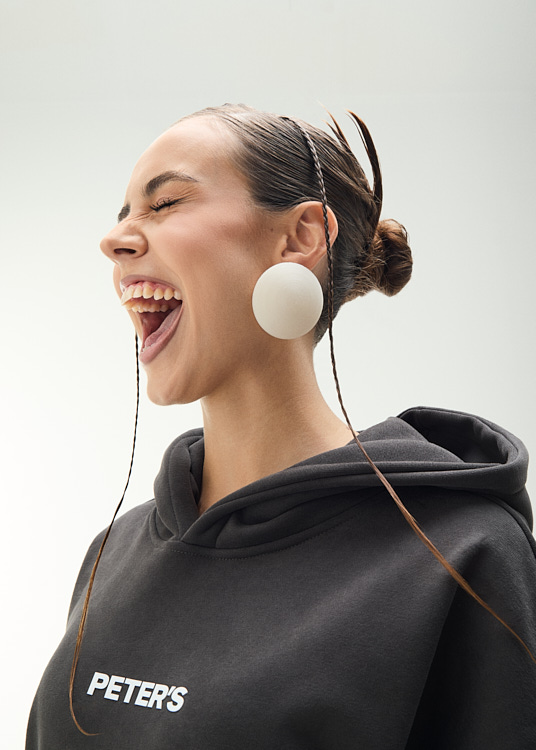
With fast fashion and microtrends ruling the fashion industry, Peter’s stands as a refreshing defiance. Blending personal storytelling, cultural commentary, and sustainability into every stitch, this brand is an exploration of identity, politics, and the everyday moments that shape our lives. With collections inspired by everything from
Mediterranean summers to social justice movements, Peter’s brings bold statements to life through craftsmanship and technology.
In this exclusive interview, we sit down with the designer to discuss the journey behind Peter’s, the philosophy driving their creations, and how they’re reimagining the future of fashion, one collection at a time.

Your work combines fashion, art and storytelling. What was the original spark that led to Peter’s?
Since I was little, I’ve been signing drawings and stories I made up at school with the pseudonym “Peter’s” (which comes from a cartoon series). So when I started studying fashion design, I decided that from then on, my way of expressing myself would be through clothing, accessories, and art, since I can’t leave behind drawing or sculpture. It was a pretty natural transition for me, as I’d been doing it since I was 10 years old.
“Viewer discretion advised” – that’s a bold statement. What does it mean in the context of your brand?
That collection was for the final year of my degree. I wanted to make a collection inspired by NWA, and that was my first step. NWA was very much about politics, so the title seemed appropriate to me since not everyone in fashion accepts these kinds of themes or more radical messages. I was looking, reading and investigating all of this for the collection while Trump was in power for the first time, and I saw a line connecting the issues NWA advocated for to current events. For me, making these kinds of collections with strong statements is a sign of intention, and I like being able to stir up or even make people uncomfortable with them; it’s fun.

Your collections seem deeply personal, weaving in themes like tourism, social conflicts, and tech. How do these themes manifest in your design process?
These elements are all present in my daily life, so it’s very natural for me to talk about them or present them in my collections. For example, I usually walk down the street and see Asian tourists in groups doing tours with something similar to a radio guide in their ear that tells them interesting facts about the city. I write it down and save it for my list of “things that inspire me” because I find it curious and fun to see.
Sometimes I get angry about some social injustice (the fast food delivery men for the “Viewer discretion is advised” collection, for example), and I decide to write phrases in my notes which I then work on and some may end up being a slogan or an object in the collection. I could go on, but, pretty much, I get almost all my inspiration from situations I see on the street or on television. I think my kitschiest references come from television.

How does your Mediterranean background influence the aesthetics and storytelling of Peter’s?
Living in a city 10 minutes from the sea and so touristy makes you grow up seeing all kinds of things that perhaps in a smaller town you wouldn’t see so often, and you grow up normalizing it. It also makes you more aware of environmentalism, since there are always campaigns about having clean beaches/sea, and at the same time you hear many stories about the sea that stir up your imagination. I am influenced by the graphics of the biggest clubs in the area, from programs like Gandia Shore, which, even though they are very commercial, end up getting into your mind and becoming part of the collective thought of the country.
As with most Mediterranean tourist destinations, new people arrive in summer, and that’s the time when you make friends, go to the beach, and generally have a good time. In my collections, I’m always inspired by these moments of summer; winter really depresses me. In winter, there’s no beach.

Sustainability is a big part of Peter’s. How do you balance craftsmanship with technological innovation like 3D printing?
I think craftsmanship is the most important part of the fashion process, and 3D printing helps complete certain pieces that would be harder to achieve because of their shape or because you want to create something that only exists in your imagination at first. I like to make garments with super unique buttons, for example, ones you can’t find anywhere else, because I’ve designed and printed them in 3D myself. This makes a Peter’s garment more exclusive and, therefore, more valuable. The jewelry we make is 3D printed as well. I like it because it avoids unnecessary overproduction, and we can create the exact shapes and colors we want.

The idea of a single annual collection is quite rare in today’s fashion. What led you to adopt this approach?
When I was younger, I worked at a very popular store, Stradivarius, and every single day I had to unpack new boxes of clothes, it was too much. Even brands that aren’t fast fashion, like Louis Vuitton, make five collections a year, and I think that’s too much too, because I really only remember the best collection of the year.
When I started, we were doing almost one collection every three or four months, and it was so exhausting. I concluded that putting out four collections a year was pointless if I didn’t have time to develop them the way I really wanted and give them enough time for the brand’s followers to understand what they were seeing, to understand the story behind it. A single collection a year makes me think more about each garment and gives it enough space to be promoted as it deserves. I’m not Zara, I’m not Shein, and I wouldn’t like to be; we don’t need so many collections a year.

So you feel like you can say everything you want to say in one collection?
Yes, exactly, but also when it comes to, for example, 3D printed accessories, I produce one when someone orders one. They are all made to custom order, when one person buys a pair of jeans I then go ahead and make that pair of jeans.
Do you think that as Peter’s grows, you are going to stick with that production Technique?
I think so. If I were to have 500 orders in one day, I could produce a stock, but it still wouldn’t be millions of pieces. I don’t see the necessity of overproduction, as we also want to create a kind of exclusivity. I don’t want to be a millionaire through this, so I don’t feel the need to sell a lot of pieces. If 10 pieces are bought in a week, I have enough money to keep going.
I also really support mindful shopping, and I want customers to think about what they want, what specific pieces they connect with, and how to balance the economic side of fashion with their desire for self-expression.
I love the work of Marine Serre; for me, they’re a major reference. It’s a big brand that sells a lot, but they still make their clothes in such a sustainable way. What they do is really hard. I love their process.

Peter’s designs seem to exist at the intersection of the physical and digital worlds. How do you see fashion evolving in the metaverse and online spaces?
I think the digital standard was raised significantly two years ago with Meta’s virtual glasses, and we started to see more possibilities for moving within a virtual world.
I believe the future lies in dressing virtually, whether to try on clothes or attend a meeting with our digital avatars. I’d love for people’s avatars to be able to wear Peter’s clothes, like your Snapchat avatar or your League of Legends characters. It can feel scary, but I see it as a new game for fashion.

Spanish artisanal techniques play an important role in your work. How do you approach the modernisation of these traditions without losing fidelity to their Roots?
It is a difficult question to answer. It is difficult to remain “traditional” because times change and we evolve, but I think there are certain pillars that must be respected or valued when making a collection. I think the limit is to respect that there are certain techniques that can only be done by artisans by hand and not by machines. For example, near the area where I live, there is a very strong culture of craftsmanship that works with wicker and esparto grass (popular fabrics in this area), and they sell many products that they produce by hand because some more creative shapes could not be made by a machine.
How do you hope Peter’s will influence conversations about sustainability and craftsmanship in the fashion industry?
I would like more brands to consider why they produce so many collections in such a short time. Overproduction overwhelms me and worries me a lot when I see news about the textile waste we create.
I would also like for them to see that I do and think “she does what she wants, I want to be like that too, screw everyone.” And I hope they are more mindful with claiming social causes and adding artisan techniques that involve artisans from their area.

Can you give us a sneak peek of the May collection? What story are you telling with it?
I’ve already shared a small spoiler, the Asian tourists with the audio guide will be present. For this next collection, I’ve spent two years researching myself and my family, being very introspective in everything I think and do, and I’ve poured almost everything into this collection. With it, we’re going to travel back to the summer of 2012 or so.
I didn’t want to create something that was overtly personal in its aesthetics; my story will be found in the details. I want people to wear the clothes, it’s so special because they’ll be wearing garments made with my own hands and time. That’s deeply personal.

What’s next for Peter’s? Future projects, collaborations or unexpected directions?
I would like to continue growing and reaching more people, we still have a long way to go. The next step for me is to be on a catwalk soon, presenting the May 2025 collection. As for collaborations, I’m very interested in working on something related to gastronomy.
I love cooking, and one of my dreams is to have my own cereal brand, so maybe we’ll see something like that on petersofficial.com.