
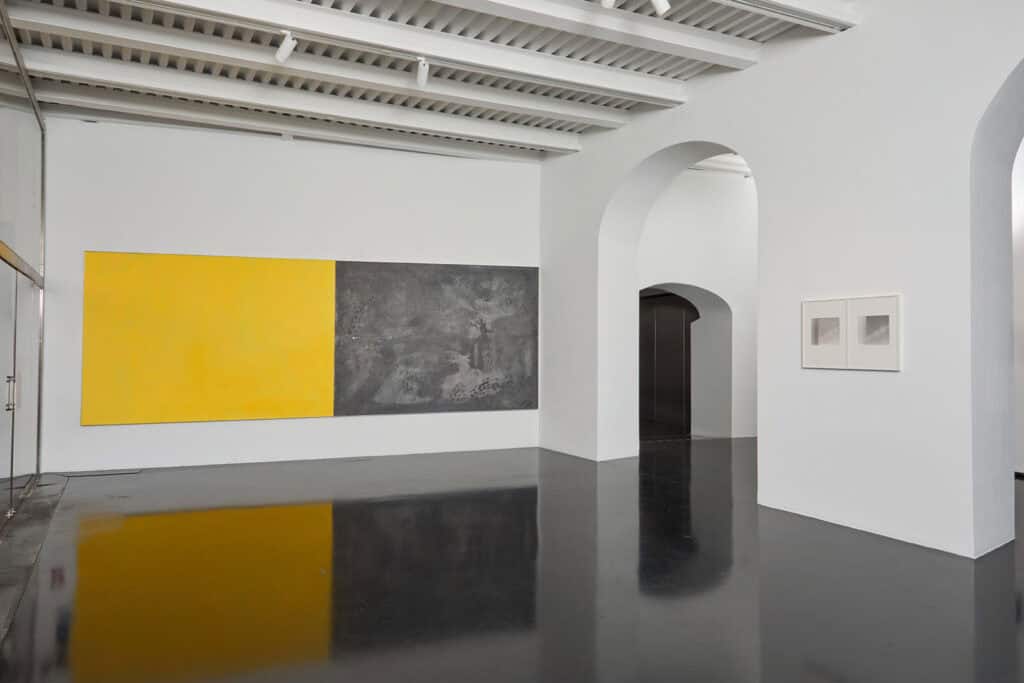
Col Tempo (“Over Time”), the second chapter of a three-part project at Rome’s rhinoceros gallery in collaboration with Paris’ Bigaignon gallery, deepens an inquiry into time as both a material and a conceptual force. After a first act dedicated to light, this new exhibition positions time as the structural hinge of the trilogy, an element that binds artistic gestures, processes and memories, while resonating with the stratified temporal identity of Rome itself. Through works that measure, reveal or embody duration, the show invites visitors to experience time not as abstraction but as physical presence: something that accumulates, erodes, expands or persists. Alongside the exhibition, Olivier Ratsi’s immersive installation offers a parallel and overarching reading of the entire project, synthesising the trilogy’s themes across light, time, and space.
In the following conversations, Alessia Caruso Fendi, creative director of rhinoceros gallery, and Thierry Bigaignon, curator and founder of the Paris–based gallery in residence, reflect on how this act shapes the trilogy, how it dialogues with Rome, and why slowness, duration, and temporality have become urgent tools for seeing and feeling today.
Alessia Caruso Fendi:
“Col Tempo” is the second act of a trilogy that will conclude in 2026. How does this chapter fit into the broader narrative you are building with Rhinoceros gallery together with Bigaignon, across light, time and space?
Alessica Caruso Fendi (ACF): This chapter takes on an almost structural role within the trilogy: it is the conceptual axis that allows us to understand how light and space elements that will be further reworked in the third act are always defined within a temporal dimension. Time here is not an abstract theme but a device that connects the artists’ poetics: the repeated gesture, the trace of duration, the imprint of an entire year, the layering of memories. It is an act of passage, but also the core of the project.
Rome is a city where time feels almost physical, stratified in its architecture and ruins. How does the exhibition dialogue with this context, and what does it mean for you to “make time visible” within Palazzo Rhinoceros?
ACF: Rome is a place where the perception of time is inevitably amplified: its ruins, its stratifications and the constant intersections between past and present make the city a unique temporal device. The exhibition embeds itself in this context by emphasising the idea that time is not only what flows, but what remains.
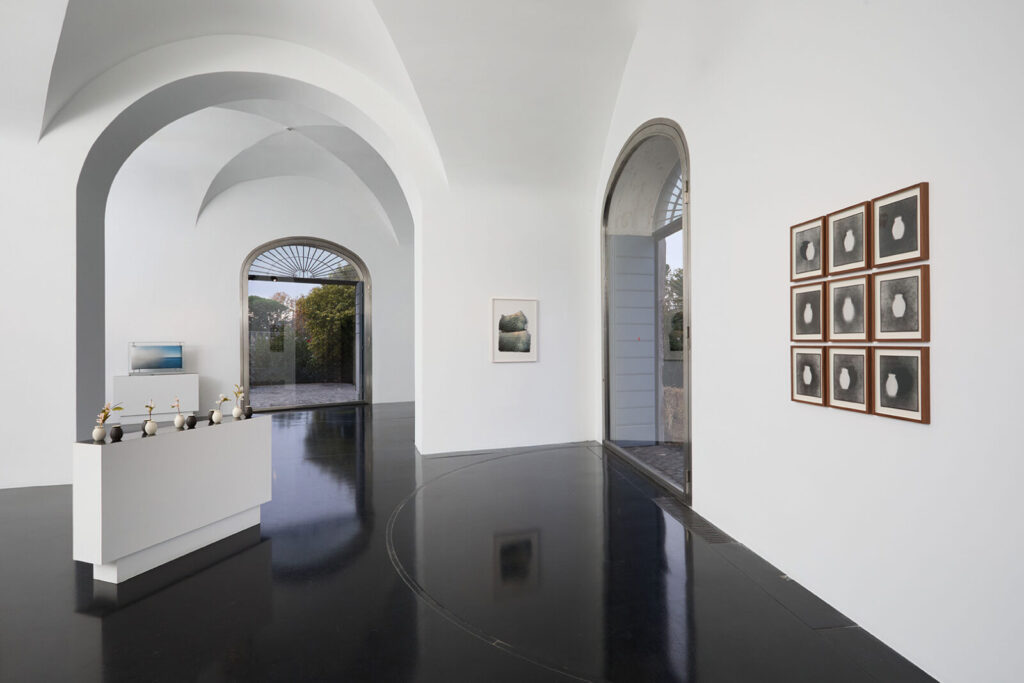
The works make time tangible, visible, measurable. Even the building itself, through Jean Nouvel’s design, pays homage to stratification. The presence of modernity is expressed through stainless steel blocks that contrast with the patinas on the walls, patinas that reveal different layers of paint, cracks and heterogeneous materials. It becomes a sculptural interpretation of the passage of time and sedimentation. The steel is positioned in a direct, unapologetic way. An optimal contrast emerges between contemporary objects and what is left of this ancient world that hosts them: preserved old tiles, new metal structures for lintels, pillars and staircases all decisively mark a new layer in the building’s historical sedimentation. It’s a play of encounters collisions between times, from the oldest to the most modern.
The presentation text suggests that reconsidering time – its slowness, its depth – today is “almost a political act”. How has this idea guided your curatorial choices and the relationship between the works and the audience?
ACF: Thierry Bigaignon’s curatorship has built a path that asks the viewer for active engagement, inviting them to slow down and imagine time as a qualitative, not quantitative, experience. It is an exhibition to be savored slowly; behind each work lies the story of an artistic practice that often takes several years to reach completion. It is as if time becomes the true protagonist and signs each work alongside the artist. In this exhibition, time itself becomes inquiry, becomes research, until it becomes almost tangible.
In parallel, Olivier Ratsi’s immersive work occupies the first floor as a synthesis of the three acts, bringing together light, time, and space. How do you imagine the overall experience for visitors who move through both the exhibition and the installation?
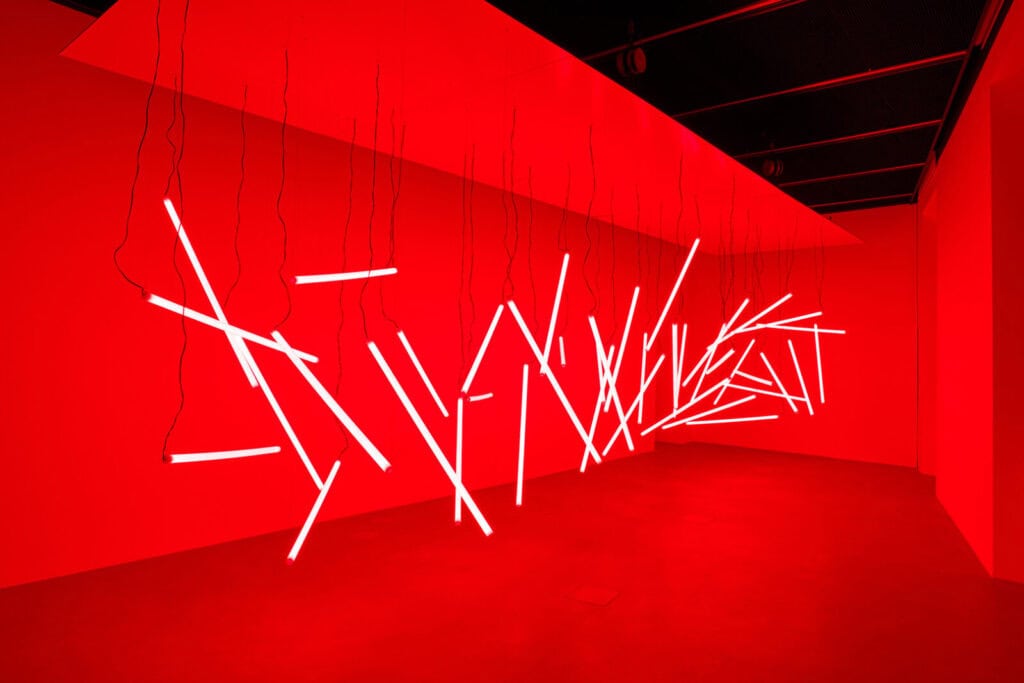
ACF: Olivier Ratsi’s installation on the first floor functions as an interpretive key for the entire project: it is an immersive synthesis of the three acts. It is particularly interesting to visit the installation at the end of each act’s exhibition path, because one’s gaze will inevitably be shaped by the curatorial experience of the three chapters. It is a strong, enveloping installation that allows visitors to truly feel the sensation of entering a deep dimension where the concepts of light (the red neon), time (the sequence of neon tubes exploding one after another) and space (the explosion of light filling the room and making it seem almost endless through perspectival play) become unmistakably clear.
The exhibition invites visitors to reclaim slowness as a practice of looking. What role does slowness play in your personal and curatorial experience, and how does it shape the way you imagine the audience’s experience inside rhinoceros gallery?
ACF: Curatorially, it means privileging works that demand a prolonged relationship, that cannot be consumed in an instant. Slowness here is not nostalgic, but methodological: a way to rediscover a sensitive relationship with matter and, ultimately, with oneself. I am happy that anyone entering rhinoceros encounters many different stimuli: the works on the ground floor, which present the curatorial perspective of the international gallery in residence; the artistic and cultural installations of Fondazione Alda Fendi – Esperimenti, which always express a sentiment drawn from contemporary living; the music, voices, sounds, and noises that accompany visitors across the building, like the whisper of a friend guiding them through the experience. I like the idea that those who enter rhinoceros undertake a journey within themselves. I like that they get lost… and find themselves again.
Therry Bigaignon:
Your gallery has long explored the fundamentals of light, space, and time through minimalist and conceptual practices. How did you translate this research into the selection of artists and works for Col Tempo?
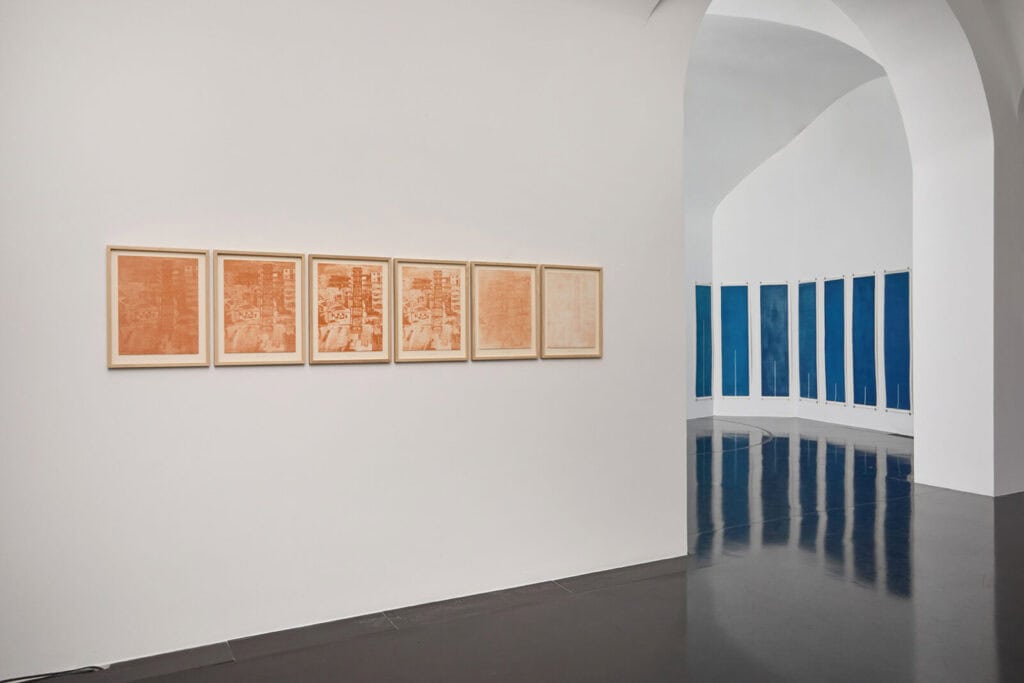
Thierry Bigaignon (TB): For this second act at rhinoceros, we decided to highlight some of the most important artworks by each of the participating artists. For instance, Yannig Hedel’s De Labor Solis, a composition of 45 vintage silver gelatin prints, is the only complete set available, making it not only a masterpiece but an exceptionally rare one.
The monumental piece by the Belgian collective Lab(au), presenting the very first time-based monochrome in the history of art, is another example of the importance of the works we decided to bring to Rome. Beyond these curatorial choices, we sought to create conversations among the works. In the second room, for example, Thomas Paquet’s pieces naturally converse with those of Charles Xelot and Yannig Hedel; and I believe this resonance occurs across all four spaces. Ultimately, we always aim to present profound and conceptually strong works – pieces that are visually striking but become truly mind-expanding once you understand them.
Many of the works seem to “measure” time through different devices: from the year-long cyanotypes by Thomas Paquet and Juan Couder, to the performative traces of Morvarid K, all the way to Lab(au)’s monochrome transformed by uranium decay. What kind of dialogue were you seeking to establish between these diverse approaches to the same invisible matter?
TB: As a gallerist and curator, in this second exhibition I am trying to ask the only question that truly matters: does time exist? Through their attempts to measure, reveal, or visualise time, the artists propose their own answers to this fundamental question. These responses are heterogeneous, of course, and that is precisely what makes the dialogue so rich. The works not only speak to one another; they create a broader conversation that includes the viewer. Building and shaping that conversation is what genuinely interests and excites me.
The project often returns to themes of memory and duration from Hideyuki Ishibashi’s Latent to the “living time” permeating the images of Fernando Marante and Harold Feinstein. In your view, how do these artists respond to the saturation of instantaneous imagery that defines our present?
TB: Yes, absolutely, and this is true for almost all the artists represented by the gallery. My vision is quite simple: after 200 years of photography, the medium is mature enough to free itself from its technical identity and constraints, and to evolve in a direction other than the one it was once “meant” to follow.
Just as painting changed profoundly with the invention of photography in the early 19th century, no longer needing to depict reality because photography had taken over that role, photography today no longer needs to document anything, since smartphones and artificial intelligence now do that quite well. This shift allows contemporary artists who use the medium to take it somewhere entirely new and the results are fascinating.
This collaboration with rhinoceros gallery places you in dialogue with Rome, a city where time is historically sedimented. What differences do you perceive compared to your work in Paris, and what does this Roman residency give back to your vision as a gallerist?
TB: I feel at home here, and the entire rhinoceros team has a lot to do with that. So I don’t believe we work differently here than in Paris. In my view, there are not two distinct approaches or curatorial philosophies—and that’s a good thing. Our name is on the front door, so it was important that visitors feel they are entering Bigaignon’s world, even though we are in Rome. I wanted Roman, Italian, and international art lovers and collectors to discover the full spectrum of what we do as a gallery. We only have six months to achieve this, so it was essential to treat these exhibitions as a manifesto – a manifesto in three acts. If you attend all three, you should not only grasp the evolution and renewed importance of the medium, but also gain a clear understanding of the gallery’s vision, DNA and program.
Each work adopts a different temporal device – from human gesture to chemical reactions to seasonal cycles. Which of these approaches to time continues to surprise you the most, and why is it important to present them in a context like rhinoceros, where art engages with a highly diverse audience?
TB: rhinoceros is truly a unique space within the art market. Yes, it has a highly diverse audience and a very singular business model, but thanks to its knowledgeable, professional, and deeply curious staff, it has the rare ability to speak to everyone. It was therefore essential for us to create conditions in which meaningful conversations could naturally unfold. By bringing together works based on diverse techniques and radically different approaches to time, we offer multiple points of entry – multiple insights into the essential questions these artists are raising.