
For two weeks in September, Selfridges became something else. Not just a destination for trend-chasers or capsule wardrobes. But a space in flux – where second-hand shirts were laced with piercings, ballet pumps grew hardware, and fashion became a dialogue between past and present. At the heart of it all was Alterist, the platform bringing upcycling from niche backwaters to department store display windows. Their residency as part of Reselfridges for Oxfam’s Second Hand September featured 10 radical designers, five days of live customisations, and a shared mission: to Rework Fashion into Wearable Art.
“This isn’t about DIY,” co-founder Martina Sorghi tells me. “It’s about craftsmanship. It’s about systems. You can bake bread at home, or buy it from a baker – both are valid. Upcycling is the same. It can be playful, experimental, but also professional and precise.” She and co-founder Hannah Standen met as fashion activists. Now, they’re running a platform of over 200 upcycling designers across the UK and EU – all unified by ethics, intention, and creativity.

The pop-up at Selfridges wasn’t just about selling reworked garments – it was about showing how they’re made. “Normally in retail you only see the end product,” Hannah explains. “We wanted to flip that. To put the process at the centre. Let people see the stitching, the decisions, the mess – and the joy.” In the customisation booth, five designers offered made-to-order transformations. Scrunchies from studio offcuts. Patches that told stories. Chainmail bags reworked from mop heads and keyboards.
I had the pleasure of speaking with one of the designers, KABO. A self-taught designer with a Depop-girly past and a cat that interrupts Zoom interviews, Katy (a.k.a. KABO) brings a kind of joyful defiance to the pieces she makes. “I wanted to use my hands again,” she tells me, “and I was surrounded by all this vintage fabric. So I taught myself to sew on a machine and just went for it.”
Her pieces don’t scream sustainability. They wink at it. Hats, shirts, and accessories get pierced, bleached, embroidered, and reborn. A vintage skirt becomes a waistband of denim and hand-pleated cotton, scruffed and ribbon-edged. “That one got my first ever TikTok comment,” she laughs. “It wasn’t even a nice comment – but I loved making it.”

Her pieces don’t scream sustainability. They wink at it. Hats, shirts, and accessories get pierced, bleached, embroidered, and reborn. A vintage skirt becomes a waistband of denim and hand-pleated cotton, scruffed and ribbon-edged. “That one got my first ever TikTok comment,” she laughs. “It wasn’t even a nice comment – but I loved making it.”
For the Selfridges residency, Katy kept it interactive. An eyelet press, metal hoops, a rotating “menu” of embellishments. “People love the idea that they can take something they already love and make it feel totally new. Not just different – but more theirs.”
That intimacy of adding, touching, altering – is central to KABO’s ethos. “I want people to walk away obsessed. Not with me, with the piece. With the fact they made it feel like theirs again. We consume so much without thinking – it’s nice to care about your clothes again.”
So what’s her favourite piece to customise? “Honestly, the rogue ones. Shoes, hoodies, weird fabric. The stuff people aren’t sure will work. I want the challenge. I want to make you fall back in love with it.”
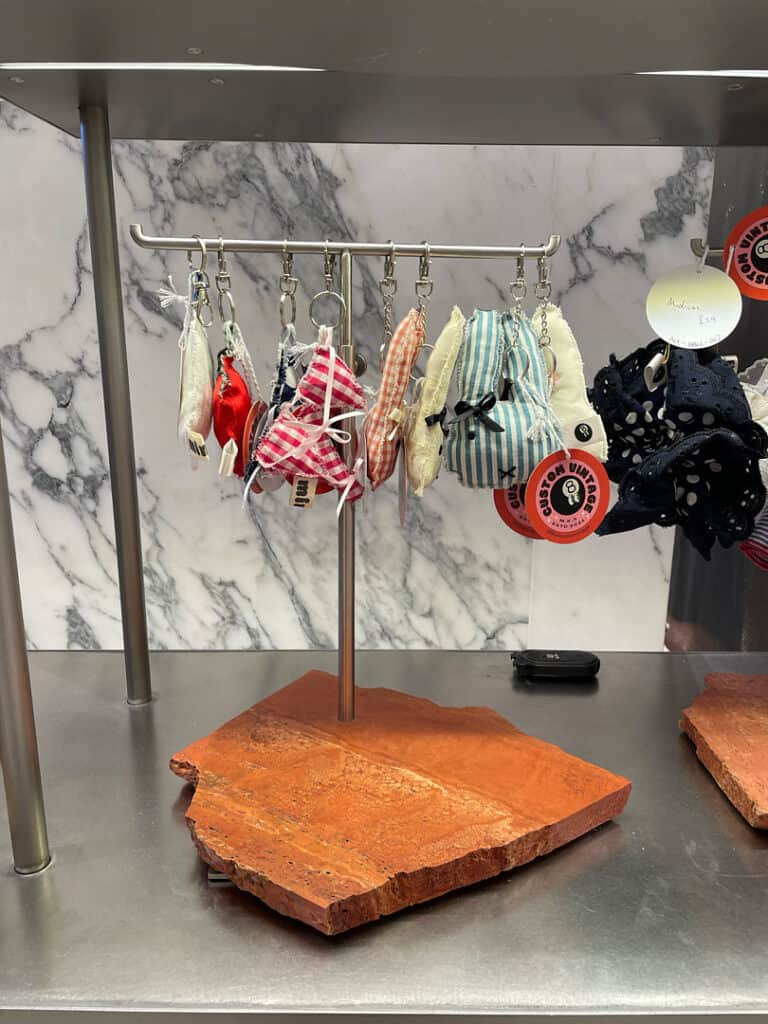
Alterist’s aim isn’t just to showcase new designers – it’s to rewire how fashion works. “Fast fashion has trained people to expect perfection without story,” Hannah says. “We want to remind them that flaws, decisions, hands – those are the most beautiful parts.” With designers like MINKSKI, Material Response, Imogen Fawkes, and KIPPA, the curation spanned serious tailoring to surrealist humour. A keychain in the shape of a bunny. A glove made from hand-embroidered thread. A bag made from a computer keyboard.
“Each piece is a conversation,” says Martina. “And that’s what the fashion industry has lost – the back-and-forth. Now it’s all push, push, push. But when people come to our booth, they talk, they think, they ask questions. That’s where change starts.”

The Selfridges team gave them prime floor space, with each designer being spotlighted over a few days for the live customisations. Martina puts it simply: “Upcycling isn’t just some Pinterest aesthetic. It’s a form of innovation. It’s about imagining new systems from old materials.”
Although I couldn’t make it to the booth in person, my own customised pieces still tell the story. A crisp oversized white shirt, pierced with silver hoops running down the back, collar, and hem, arrived alongside a bubblegum-pink Vans hat covered in metal hardware. Together they felt like the perfect distillation of KABO’s ethos – taking the familiar and making it unruly, subversive, and completely personal. Even from afar, it was proof that the pop-up’s energy travelled beyond Selfridges’ shop floor: a reminder that upcycling is less about watching the process and more about living with the result. The best thing about the Alterist x Selfridges pop-up isn’t just that it happened – it’s that it worked. People queued to customise. They bought stories instead of trends. And they saw, maybe for the first time, how design can feel like dialogue.

As the second-hand movement gains traction – no longer cloaked in shame or irony – Alterist is building something rare: a system that doesn’t just reject the old one, but reimagines it. Less as a glossy machine. More as a gallery, a workshop, a protest, a family.
Upcycling isn’t the future because it’s trendy. It’s the future because it makes sense. It’s not fashion’s fallback. It’s fashion’s reinvention.