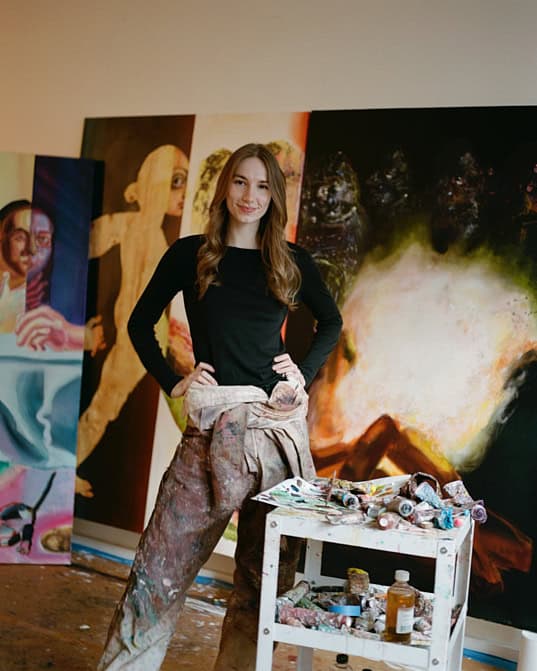
Anna Berghuis is a New York-based visual artist whose work challenges notions of social media-borne “acceptance”, which insidiously seeks to confine us. Her paintings hone in on authenticity in a digital age which continually stifles the very thing we are all subconsciously vying for: the internal muse.
Our economy of phone-screen-tapping and instant gratification has warped the way we interpret who we are. We live in an age of relentless discourse about the sheer fact that many of us do not know what we like, or if what we like was even our idea in the first place (was it you, or the algo?). This new body of work, Dancing With A Former Self, presents us a mirror, begging that we peer into our own contorted reflections.

With the high-speed advancements of social media and the Internet, many wonder about the longer-term ramifications of this type of (dis)connection on our digitised lives. Amidst the tidal wave of hot takes on this very subject, Anna Berghuis meets us in the middle with her debut solo exhibition, initially on display at the Kravets Wehby Gallery in Manhattan, NYC earlier this year.
Anna’s work is disruptive, and rightly so. Demented depictions of humanoid entities reflect out of her works, presenting funhouse-adjacent curations of our individual lives and simultaneous (unforgivingly messy) personhood. Social media demands our continuous “best selves” for fear of belittlement. Positioning embarrassment, or rejection as the dreaded, worst possible fate.
Societally, we watch as generations afflicted by digital dependence bend to “nonchalantness” as religion. Forced to welcome cowardice, refusing to ever risk unearthing the unsightly parts of ourselves. In our apprehension to be anything but perfect online, we simultaneously join the pointing of fingers toward those who fuck up, misstep, or simply fail. Cancel culture threatens the very core of creativity and distorts our otherwise imperfect human realities, into “good” or “bad”, “wrong” or “right”, “art” or “not”. When the human experience is so more complex and nuanced than binary frameworks will ever allow.

Distortion becomes a central element in her paintings, and permeates her practice more generally, as a musing point. Anna utilises techniques which abruptly divorce various images, only to reconverge in new ways across the series. The audience is faced with fluid opportunities to interpret their identities as they reflect off of the works themselves.
Curatorial decisiveness guides a confrontational relationship between the paintings and viewer. Where communication occurs between beholder and beholden. But not only this—the artworks seemingly communicate with one another, guiding the viewer’s attention with a light touch of mystery, which creeps up—as if inescapable. Our unique perspectives suddenly flatten against the surface of each work, leaning toward a wider, much more disjointed central voice. Mobilising strategic obscurity, the artist presents an unanswerable question: “Who do you see staring back at you—have you known them all along, or are you meeting for the first time?”
As she paints, Anna multiplies, layers, and mirrors human-enough—yet entirely alienesque—figures. Caricatures of our humanity are strategically blurred and scraped off canvas, partially dried and pliable, only to be reintegrated elsewhere. The final products materialise through a process of mono-printing.
There is a distinctiveness in which we approach the mirror. But what if it were to flip, twist and contort onto itself, regurgitating a version you’ve yet to acknowledge? Anna’s works lead us inward, via vibrant colourways and outlandish renderings of human likeness. The collection forces us to entertain the harder questions. Not only are we witnessing the paintings, the creatures on the other side witness us. We are viewer, as much as we become an invasive species.
Reverberating movements are slathered across canvas, in cohesive tandem with apparition-like depictions of friend and foe. Flames engulf while ghastly spectres make a home in the empty space. Aching desire to be known materialises, we become human, only to disintegrate again. Numeric forms appear, presenting an opportunity to lean farther into mysticism, becoming angel-number-adjacent. Or otherwise, negative omens of an unstable reality. What you know is flipped and readjusted over and over and over again.
I sat down with Anna to discuss her creative process, what she thinks of social media, and how to comfortably settle into wavering reflections and partially defined realities.

Cold Magazine (CM): Can you give us some insight as to how these juxtapositions of (dis)connection by way of the internet and social media influence your work?
Anna Berghuis (AB): I’m really interested in that tension, this simultaneous hyperconnection and deep alienation. We’re all constantly performing for an audience, whether we acknowledge it or not, and there’s this strange loneliness in that performance. My paintings play with that duality. Figures simultaneously demand attention while also dissolving before our eyes. The relationship between the painting and the viewer is active: you may be looking at the painting, but the painting is also looking at you.
I think a lot about how digital image cultures flatten personalities, creating fragmented versions of the self that circulate endlessly. My work leans into that instability. I use paint to capture an imperfect transfer, like a glitch or an in-between state that never fully resolves. This friction carries into my colour choices as well. Some areas are grounded in the earthy tones of the Zorn palette, while others veer into bright and aggressive digital tones. It’s the same friction between the physical and the screen—trying to exist in two realities at once.
CM: It seems many are ditching touch screens and swapping back to vintage iPods and tactile journals to get away from social media’s blue glow. What is your favourite artefact of “old technology”?
AB: I love all of the early-2000s digital cameras having a moment right now. I actually found—and have been using—the one I brought to sleepaway camp in 2006.
Also, Post-it notes! My work is made in many sittings, so when I finish for the day, I usually leave myself a Post-it with a clear reentry point. But sometimes they get lost and cryptically reappear months later. “Phthalo blue glaze left fingertip” “sienna/ mauve–up/down.” What? Some plans are not meant to be followed through!

CM: You’ve mentioned that your work reveals itself to you as you create—what is your most sought after moment during this process?
AB: There’s a moment when the painting starts to push back, when it’s no longer just an idea I’m imposing on the canvas but something that has its own logic and demands. That’s when I know something interesting is happening. I like to be surprised by the work. If I know exactly how a painting is going to look before I start, I lose interest.
When I was younger, I treated my reference images like blueprints, following them step by step, convinced that if I executed them properly I’d reach some ideal outcome. But ultimately, that approach felt suffocating. The best moments happen when the painting takes the lead, when a form appears that I didn’t plan for, or a color choice disrupts my expectations.
CM: With regard to your commentary on surveillance—specifically in the way onlookers view the pieces only to be gazed upon in reverse—how do you witness these human-like characters as they form on the canvas?
AB: I’m usually so zoned in on the intricate details that I don’t actually see the faces until I step back. There’s something so strange about how our brains process faces. How we’re wired to recognize them instantly, even in abstract forms or in inanimate objects like potholes or burnt toast—this phenomenon is called pareidolia and is well worth the Wikipedia rabbit hole. While painting, that means there’s often a moment where a figure I’ve been constructing in fragments suddenly locks into place, and I can’t unsee it. It’s eerie. Almost like they’ve been assembling themselves in secret, waiting for me to finally notice them.
CM: Do these characters guide you on what brushstrokes will finalise their creation?
AB: This is adjacent to the classic question: How do you know when a painting is done? You just do. Or more accurately, the painting decides for you. Towards the end, it’s less about making choices and more about responding to what’s already there. Every move you’ve made has ruled out a hundred others. The middle of the painting is chaos, a million possible directions pulling at once. But by the time you’re close to the end, the painting has backed you into a corner. You make the last few moves not because you want to, but because they’re the only ones left.

CM: What’s one song you listen to when you’re deep in your creative process?
AB: It’s funny, the paintings are serious but I’m not. I listen to a lot of 2000s songs in the studio, something to keep my heart rate elevated. I have terrible music taste and I can’t pull off pretending otherwise. My studio can sound like a frat house basement at times. That, or the soundtrack from a romcom. Since the work can be intense, my studio environment has to be really lively and unserious to balance it out. This is a very long winded way to say either “Unwritten” by Natasha Beddingfield or “I Love It (feat Charli XCX)” by Icona Pop.
CM: Of all the lives you’ve crossed and people you’ve met, who do you think has most inspired or directly influenced your artistic journey?
AB: I could name artists I admire or mentors and friends who’ve pushed me in crucial ways. But honestly? Probably the people I’ll never see again. The strangers who leave weird, fleeting impressions. Someone on the subway with an expression that sticks in my head, or an overheard conversation that makes no sense but feels important. I think a lot about how brief encounters linger in ways we wouldn’t expect. My paintings lean into that. Figures that feel familiar but just out of reach, like someone you recognize but can’t quite place.