
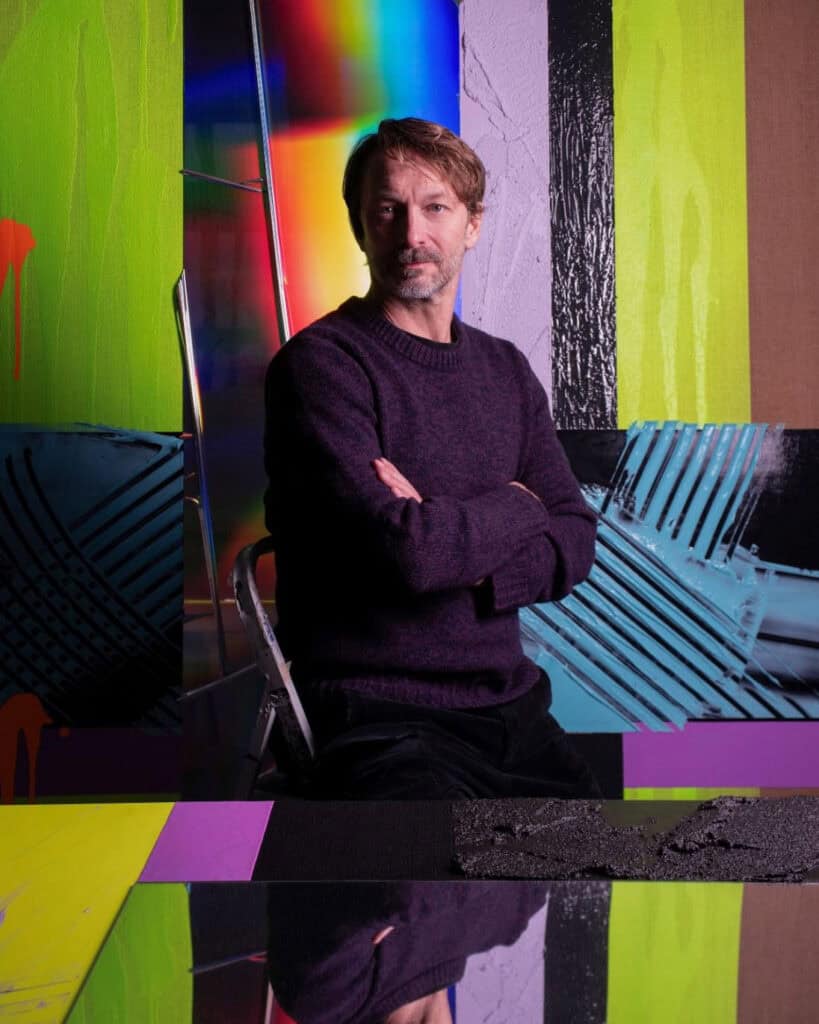
When I spoke with Anselm Reyle during a tour of his solo exhibition at Opera Gallery, his clarity of thought was immediately apparent. While Sunrise Mission — a collection of towering ceramic works, neon sculptures, gestural paintings, and stools crafted in collaboration with Franz West — may feel like a spontaneous outpouring of creativity, Reyle revealed it to be more: a deeply considered commentary on what it means to exist in an art world increasingly shaped by dominant institutional voices.
The Berlin-based artist is certainly no stranger to the establishment. With exhibitions at Tate Modern and Kunsthalle Zürich, a curatorial role at Tick Tack Gallery in Antwerp, and a high-profile collaboration with Dior, he speaks with the fluency of an insider — and in many ways, he is one. Yet, in the tradition of modernists like Warhol and Duchamp, Reyle offers a pointed critique of what we consider art — and who its audience is.
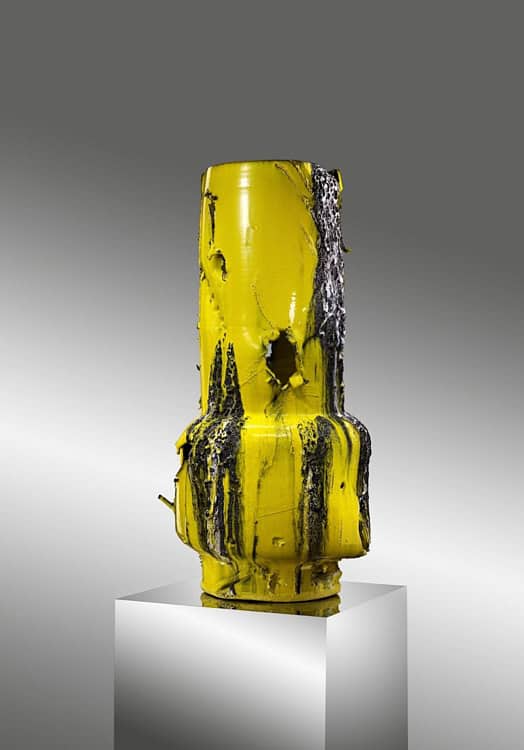
In Sunrise Mission, Reyle returns to his familiar use of found materials, recontextualising urban signifiers such as neon and metal. In a series of vase-like sculptures — sometimes whole, sometimes partially destroyed — he uses a type of ‘fat lava’ ceramic that was widely popular in 1970s West Germany, before its aesthetic fell out of favour. Elsewhere, he explores instinctual movement, simulating a paint splatter using a vinyl sticker. The point? To assert that art is grounded in creative freedom — a freedom that insists there is room in the canon for more than just oil on canvas.
Joshua Beutum(JB): There’s a strong presence of recontextualised and found materials across the pieces in your show – your use of neon beams and silver foil comes to mind. What is your process for sourcing these materials? What kind of value do they bring to your work?
Anselm Reyle(AR): I studied painting in the 1990s. During my studies, I experimented with all sorts of things, but painting only really became interesting for me when I began incorporating found materials and objects into my works – or installing them together in space. These were objects that fascinated me, things I was drawn to intuitively rather than through any strong conceptual framework. I’ve worked with materials like glossy car paint, neon colours, and shards of glass. Some of the first objects I used were fishing nets and wagon wheels – highly decorative items, the kind you’d more likely associate with a restaurant interior than an art academy. At least in the 1990s.
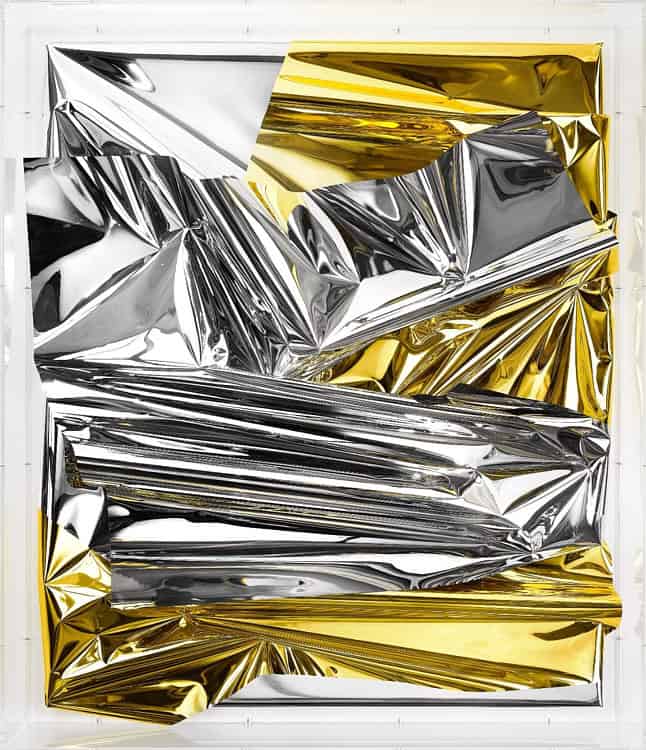
After graduating and moving from southern Germany to Berlin, I started finding more things at flea markets, in clubs, or in shop windows ¬– like the silver foil that eventually became a key element in my work. What struck me at the time was the art world’s deep scepticism, almost fear, of anything decorative. That really intrigued me. Where does that fear come from? Does something decorative automatically exclude content or substance? My materials were, and perhaps still are, seen by some as provocatively decorative. I find that tension productive.
JB: ‘Sunrise Mission’ also represents a shift in your practice from a fixation with technical refinement towards more instinctual, gestural movements. What prompted that return to your intuition? How do you think it changes the way your work is seen or experienced?
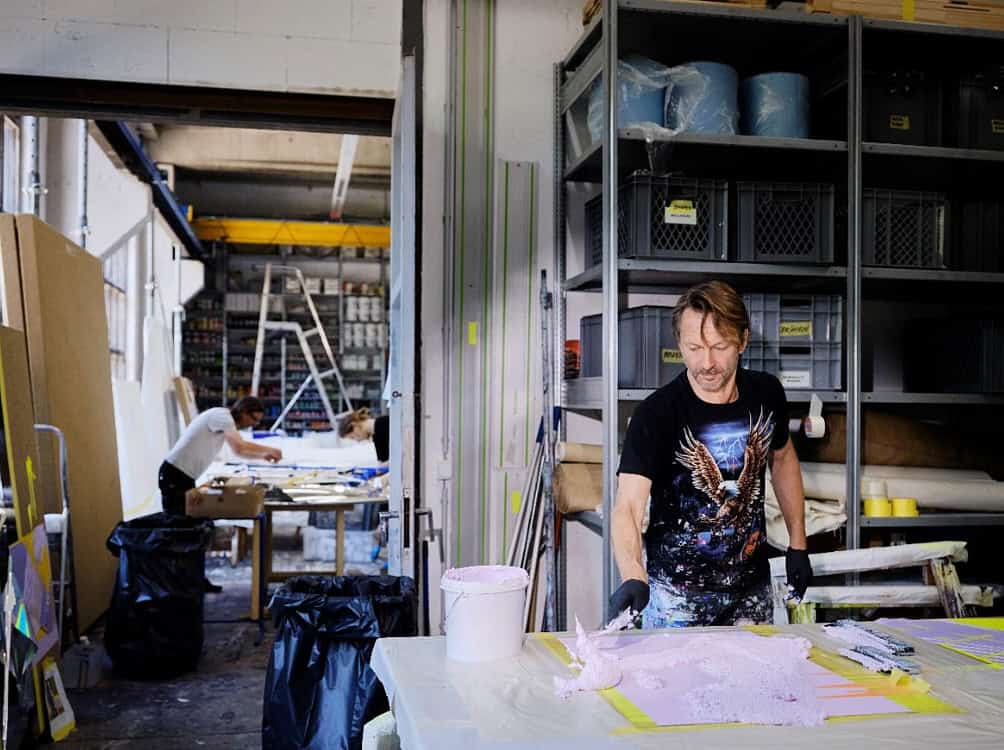
AR: On the one hand, I’ve always found it enriching to collaborate with others – people who often have much more expertise than I do in various areas. This might be in the studio when it comes to craftsmanship, or in the office, particularly around administration and finances. Over time, working with assistants in the studio has almost developed into a technique of its own. It allows me to maintain a certain distance from what’s being created, which in turn helps me evaluate the work more objectively. But this system also led to an increasing level of perfection.
Eventually, I began to feel trapped by it – everything had to meet a certain standard. That became especially clear to me during my collaboration with Franz West, which was the complete opposite. It gave me a new sense of freedom. After deciding to take a longer break from exhibiting, I started working more manually in the studio again. I began using natural materials like clay or jute fabric, contrasting them with some of the more artificial colours and materials I had used before. This hands-on, spontaneous process helped me reconnect with myself on a very direct, physical level.
JB: Of course, the stools you created in collaboration with Franz West are on display as part of ‘Sunrise Mission’. Can you talk me through the process of collaboration?
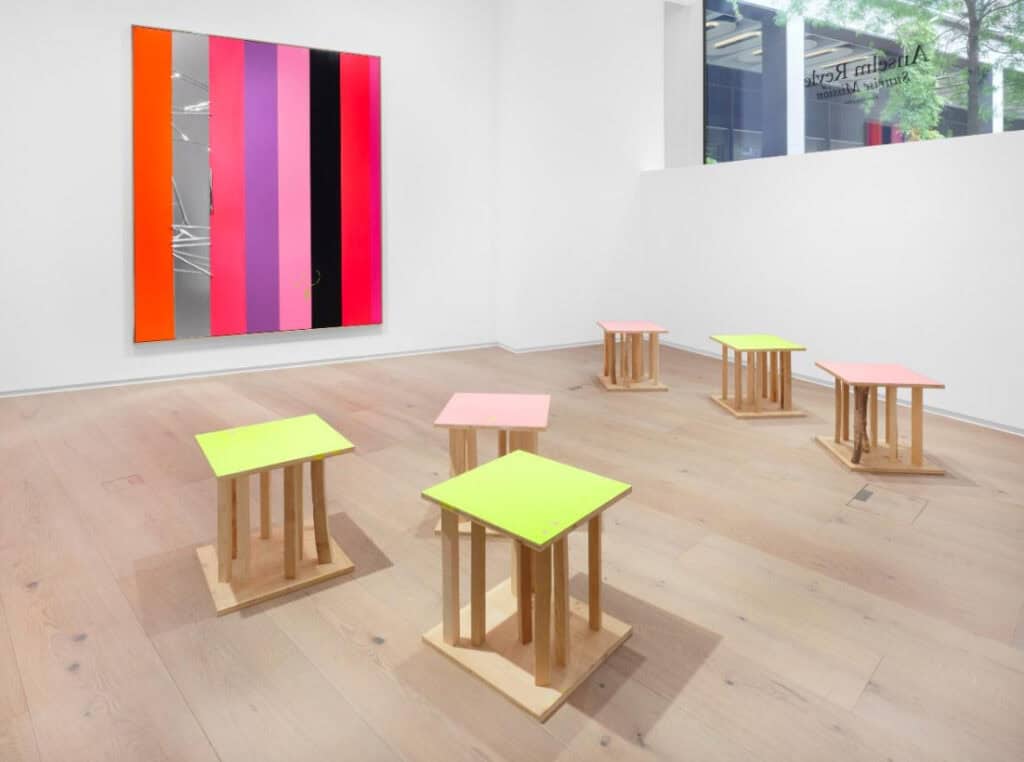
AR: The collaboration with Franz West spanned over three years towards the end of his life. We first met in Venice, and when I later visited him in his studio in Vienna, I noticed that there were some striking parallels in the way we worked. He also worked with a team, and there was a lot of discarded material – pieces he wasn’t satisfied with or just experimental tests. Immediately, I had ideas about how I could continue working with some of it and asked if he might send them to me in Berlin. He liked the idea, and in return, I sent him some of my own leftover pieces – works I wasn’t happy with. That became the basis of our communication: making art. From this exchange, a range of pieces emerged – sculptures, paintings, furniture, editions, and more. In total, we created over thirty works together, which we first showed in Paris and later in the Schinkel Pavillon in Berlin. That collaboration was incredibly important to me. On one hand, it brought me back to my roots – to something spontaneous and raw. But it did so on a different, much more enriching level, thanks to everything Franz brought to the process.
JB: Can you touch a bit more on how you balance this rediscovered spontaneity with what you’ve already described as a touch of your own perfectionism?
AR: Many of my works appear spontaneous, but few are. That spontaneous element often needs to be carefully planned and, in some cases, even pre-produced. For example, when I place chromed brushstrokes on a gestural painting – this kind of process requires a lot of preparation. Developing a new series of paintings can take years. But once I arrive at a result I’m truly satisfied with, it opens the door to creating multiple works within that language. It then becomes a combination of my own fast, gestural actions and the extensive pre- and post-production work carried out by my team.
JB: There’s an interesting juxtaposition between these quick movements and the degree of production involved in creating pieces for ‘Sunrise Mission’. I see this in your ceramics. They embody a striking contrast –between creation and destruction, and between slick, smooth textures and rough, broken surfaces. Can you tell me about these contrasts?
AR: When I first moved to Berlin, I started collecting a certain type of vase often referred to as ‘fat lava ceramics’. They were mass-produced industrial ceramics from the 1970s, which I found at flea markets and second-hand shops. What fascinated me were their exaggerated psychedelic colours and tactile, lava-like surfaces. At some point, these vases fell out of fashion, and you could buy them very cheaply.
Later, I had the idea to create something in that aesthetic but on a sculptural scale. As is often the case, this became a longer process. I first had to find a ceramicist who had the skills to manually produce such large forms – and find a kiln that could actually fire them. Most ceramicists I approached initially rejected the idea. They found this type of low-cost industrial pottery to be in poor taste and they didn’t want to be associated with it. Eventually, I found David Rauer, a ceramic artist himself, who had no problem with the concept. Since then, we’ve been developing this body of work together with great motivation and mutual enthusiasm. Later, I began to destroy the ceramic pieces more and more before the firing process – something I had once seen in traditional Japanese ceramics. I found it particularly interesting that by doing this, the objects lose their function. They’re no longer vases – they become pure sculptures. It’s also a reference to one of my favourite artists, Lucio Fontana.
JB: This perspective clearly draws on the rebellious sensibilities that defined modernism – it’s a refusal to accept institutional limitations on what we consider art. How do you see yourself in relation to modernism?
AR: My visual vocabulary is rooted in modernism. If you look at the history of painting – which for over 40,000 years became increasingly refined and detailed – it’s quite thrilling to consider how, in just a few decades, that trajectory suddenly imploded, culminating in something like Malevich’s ‘Black Square’. I still find that incredibly exciting. Or take Duchamp, who declared everyday objects from department stores to be art. What started as a kind of absurd idea has since become an entire discipline – one that continues to shape and challenge the art world, especially for younger contemporary artists. And then there’s Andy Warhol, who brought shop window aesthetics into the gallery and elevated screen printing to the status of painting. These moments in art history are crucial points of reference for my own work.
JB: Naturally, all these artists – yourself included – comment on the relationship between art, mass production, and consumerism. Can you tell me more about your thoughts on perception and the idea that you are creating work for audiences?
AR: I’ve always felt a certain scepticism toward the hermetic nature of abstract art – that sense of exclusivity where only a select few can truly understand it. By incorporating materials, colours, and surfaces that surround us in everyday life, I try to break through that hermetic barrier. This everyday life includes our world of consumption, mass production, pop culture, and subcultures as well. I want to create art that is accessible – art that speaks to all kinds of people, not just those with a background in art theory or history.
JB: It feels like there’s a link to your work as a curator there. In Pomegranate Flower Cake at the Tick Tack Gallery in Antwerp, you exhibited 13 emerging artists. With your power as a respected figure in the art world, how do you approach supporting new voices?
AR: The exhibition features works by a selection of students from my class at the HFBK Hamburg. I had exhibited there myself about a year earlier, and the gallery has always been very open and interested in new artistic positions. That’s how the idea for this show came about. I’ve been teaching since 2006, and it’s a vital part of my life – both personally and artistically. The longer I teach, the more energy and inspiration I draw from my students and the university environment. We already have plans for more exhibitions together with my students, which I’m very much looking forward to.
JB: And beyond that, what’s next for you?
AR: The first half of the year was quite busy, with four solo exhibitions. Now, I’m glad to have some time to focus on preparing for next year, which is already filling up with exhibition commitments. ‘One of these upcoming projects is a collaboration with
DSC Gallery in Prague, featuring a group show with some of my students alongside a solo exhibition of my own work – something I am very much looking forward to.’