
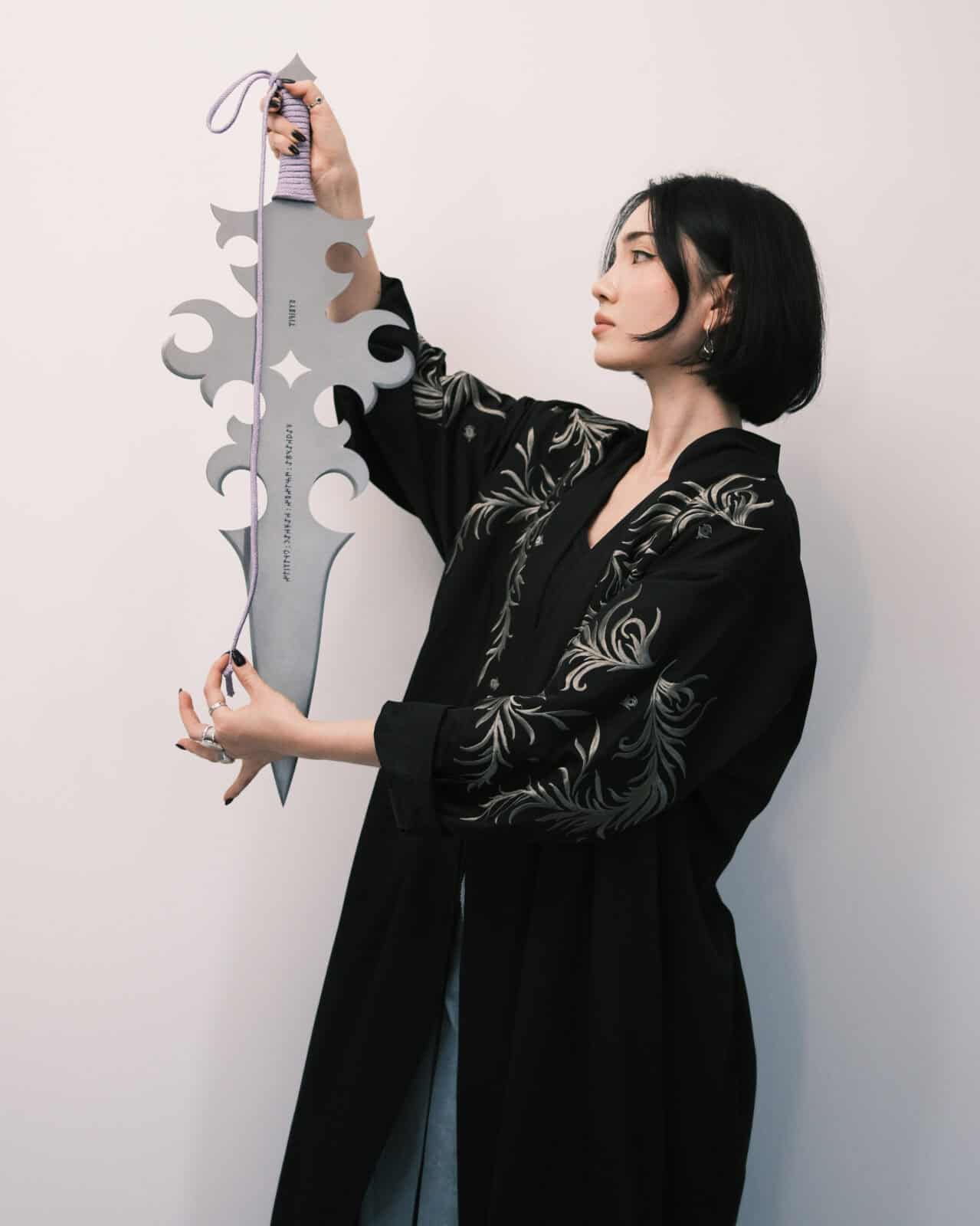
For decades, the Western gaze has largely reduced Central Asia to a geographic buffer zone or a cinematic punchline. But away from those stereotypes, a profound reclamation of Kazakh identity is taking place among a new generation of creators. Aya Shalkar is a Kazakh visual artist working across sculpture, steel, performance and digital media. Born and raised in Almaty, she spent the last decade studying and living between Europe and the US – in Strasbourg, Vienna, Los Angeles, and New York – before returning to base her practice in Kazakhstan.
That decade abroad shapes how she works now. Having seen her culture through the eyes of people who’d never encountered it, she came back with a clearer sense of what was missing from the record, and what she wanted to put there. Her practice, which she calls “future archaeology”, reconstructs a version of Central Asian history that was never properly told: one centered on female warriors, forgotten rituals and myths that were rewritten by the men who recorded them.
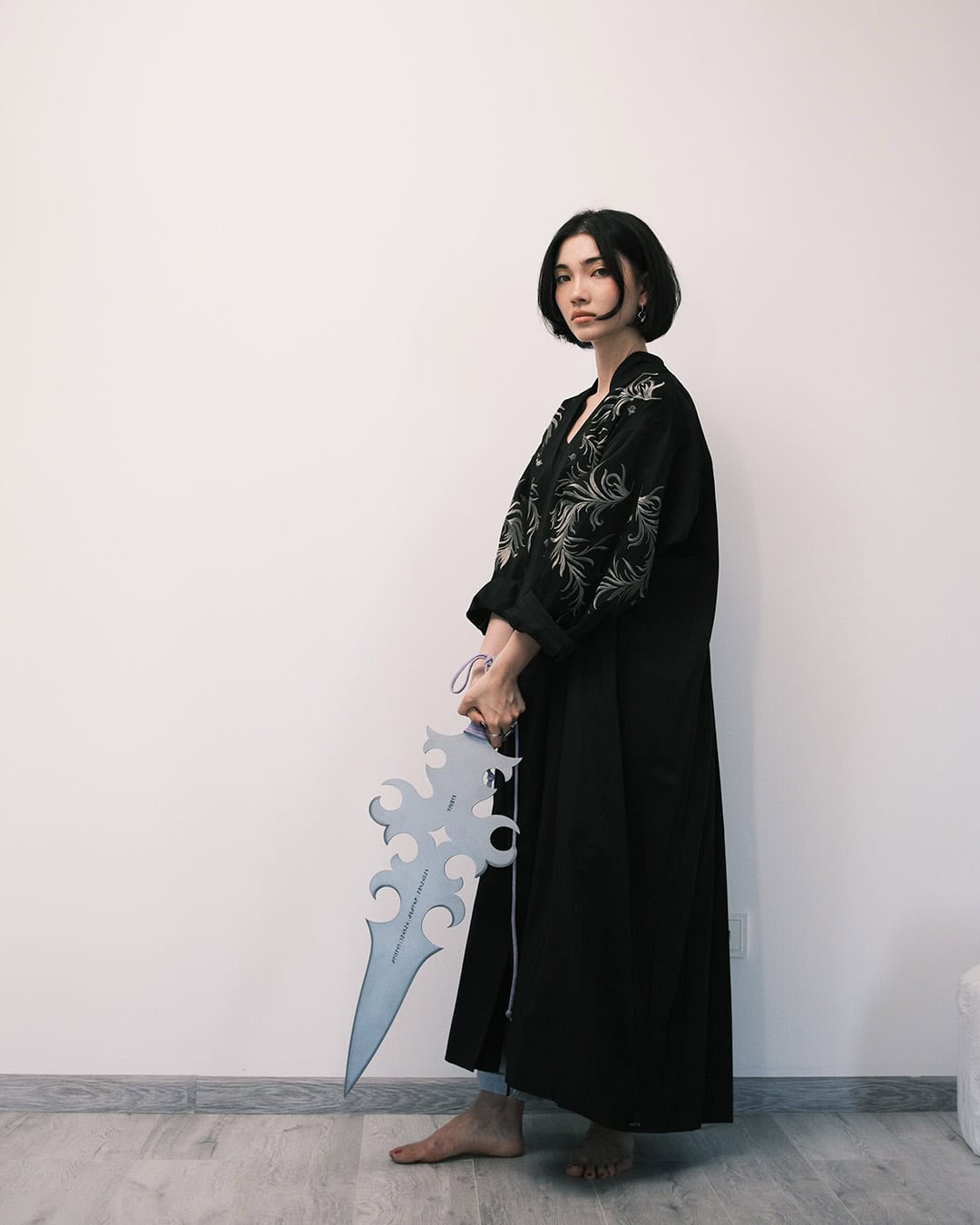
The Cold Magazine (CM): For most people outside the region, Kazakhstan still exists as a punchline – Borat, yurts, somewhere between Russia and China. You worked with Kazakh culture from abroad, and you’ve been featured in i-D and Nowness. Do you feel like you have to explain where you’re from before you can actually say something, and has that pressure itself become part of the work?
Aya Shalkar (AS): The farther west I go, the more necessary it becomes to explain myself and my origins. Lately, I’ve actually been exploring more eastern circles and industries—my features with Nowness and Dazed were both Asia-based, and there’s currently more organic interest in this narrative there than in the West. Although I am represented by a gallery in New York, it was founded by women who are immigrants to the US themselves, so they understand that perspective.
It is always a challenge to contextualise who I am to a person who grew up in Western culture, especially in the US. But I’ve mostly been met with openness and a genuine willingness to learn. I have encountered some of those stereotypical “Borat” tropes, mostly in Los Angeles – less so in New York, which is so international. Funny enough, the deeper west you go into Europe, it can almost feel worse: Europeans are sometimes less exposed to these narratives online, and European audiences respond much more readily to an artist who presents as an activist rather than just a visual creator.
CM: When you tell people abroad that you work with Kazakh mythology and nomadic culture, what’s the usual reaction?
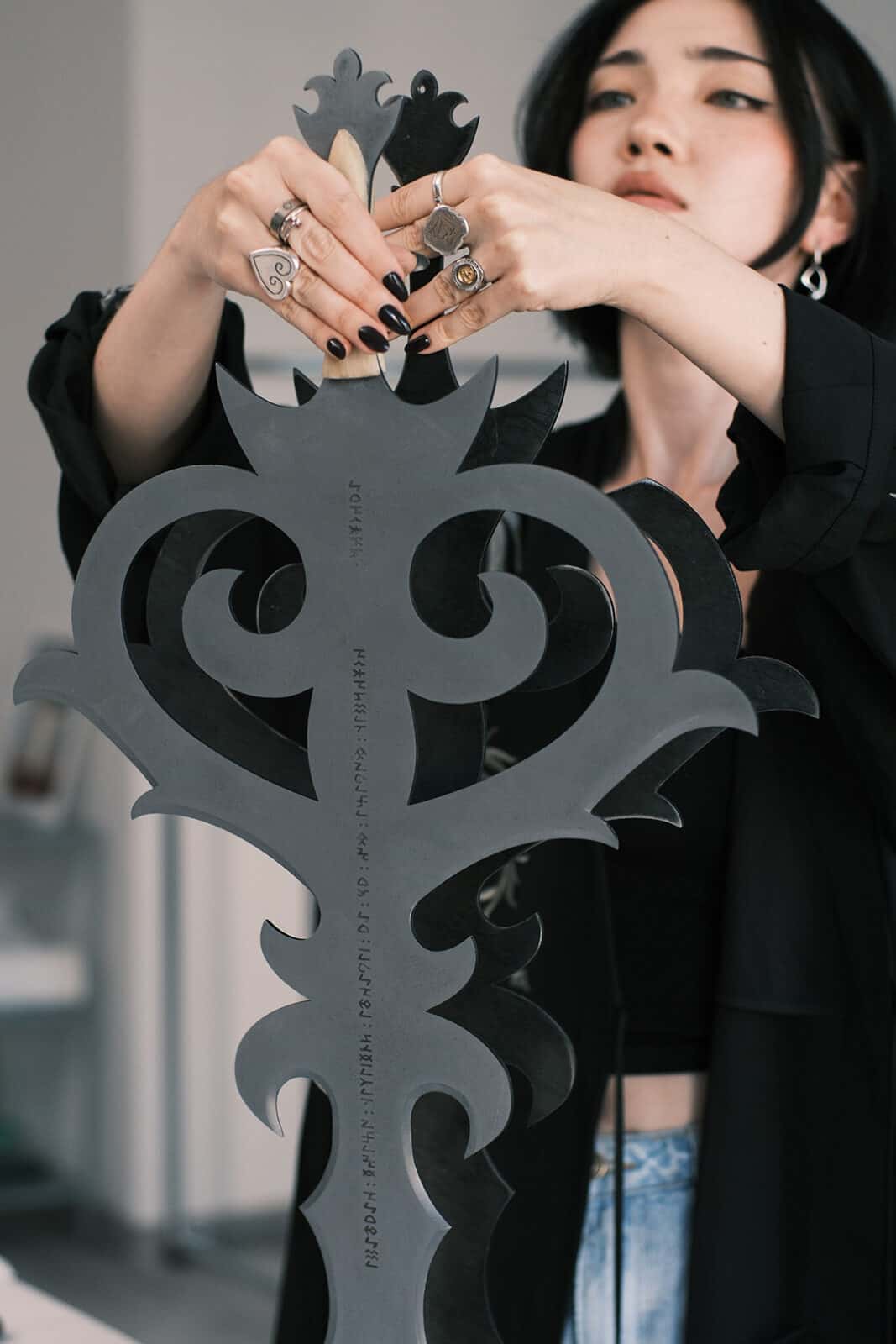
AS: It’s always a “Wow!” reaction. People don’t often meet creators from our region working specifically with mythology, so it attracts a very specific crowd—collectors and institutions oriented toward museums, historical archives, Islamic art, or weapon collectors. In fact, the very first inquiries for my work came from literal armory archives and archaeological organizations. My art falls right on the border between reality and fiction.
Right now, I’m exploring ways to expand into less specific, more legible forms of expression—traditional media like painting and embroidery. Back home, my work wouldn’t necessarily fall into such a rare “collectible” category, because our material heritage is everywhere and many artists work with traditional ornaments. Abroad, it has become a very specialized niche.
CM: You call your practice “future archaeology.” For someone encountering your work for the first time — what does that mean, and why exactly that combination of words?
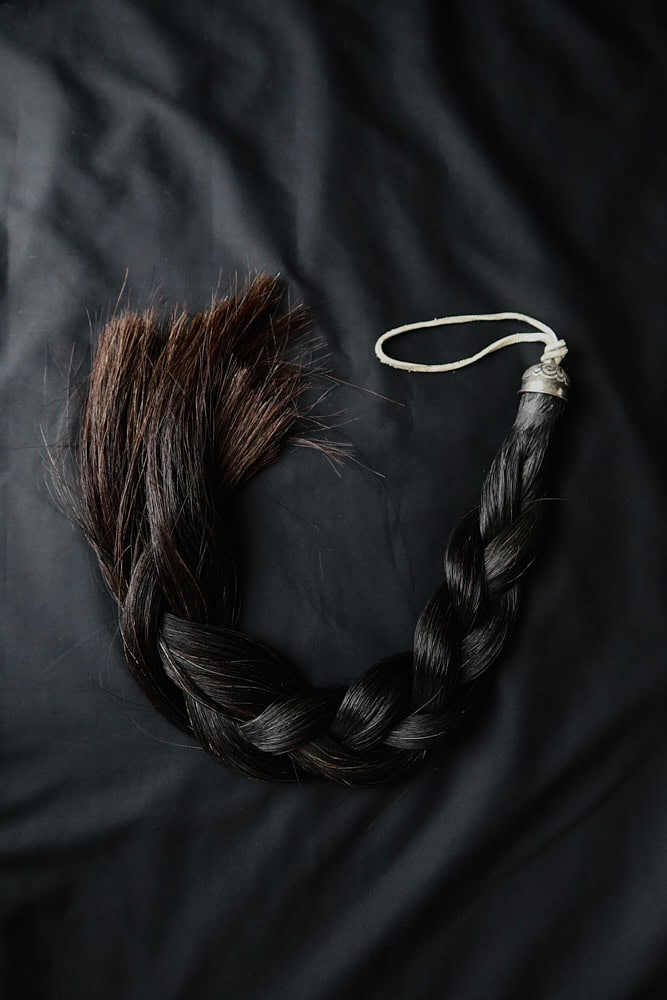
AS: Archaeology as we know it has been largely dominated by the patriarchy. History has historically been told by men, about women, through a distinctly male gaze – and that is especially true in Central Asia. I call my practice “future archaeology” because it is a female-centered approach: an exploration of a female universe told ultimately by a woman artist.
Numerous studies show how much female history in our region was systematically erased or rewritten because it was stigmatised by changing regimes and religious shifts. Excavated figures, like ancient warriors, were often purposefully “regendered” as men by default, even when there wasn’t scientific proof to back it up.
Like many indigenous cultures, Kazakhstan’s pre-religious history was demonized by later belief systems. There was a vast pagan world full of powerful female deities and characters that were manipulated and transformed into monsters or witches. This isn’t unique to Central Asia; globally, female-centered mythologies have often been turned into horror stories. Through “future archaeology,” I am trying to revive those original protagonists and tell the true story of the female figure in myth, stripping away the monster label.
CM: You left Almaty at 17 – Strasbourg, then Vienna, then Los Angeles and New York. And yet all your work is about Kazakh culture, nomads, the history of that land. When did that distance turn from a loss into a tool? When did you realise that leaving was actually what allowed you to see it more clearly?
AS: In the beginning, the distance felt like a loss, a profound longing. But it evolved into a tool driven by intense curiosity. I’ve always been fascinated by our material history because I grew up hearing endless myths and legends. In Kazakhstan, people love to speculate about our past. You’ll hear conflicting arguments: “Kazakh women were fierce warriors,” versus, “No, the warrior woman is a myth you’re using to make yourself feel better; women were oppressed for centuries.” The truth is, because nomadic culture didn’t leave behind written transcripts or massive libraries, a lot of it remains open to interpretation.
As a creator and a consumer, I realised I deeply missed seeing strong female figures from my culture represented in modern media, art, and animation. I didn’t want to adopt Western influences, because as an artist, you have to speak from the soil you grew from. It’s as simple as that.
CM: Does your work come from something connected to a longing for home, or is that too romantic a description for what’s actually closer to anger, research, something else entirely?
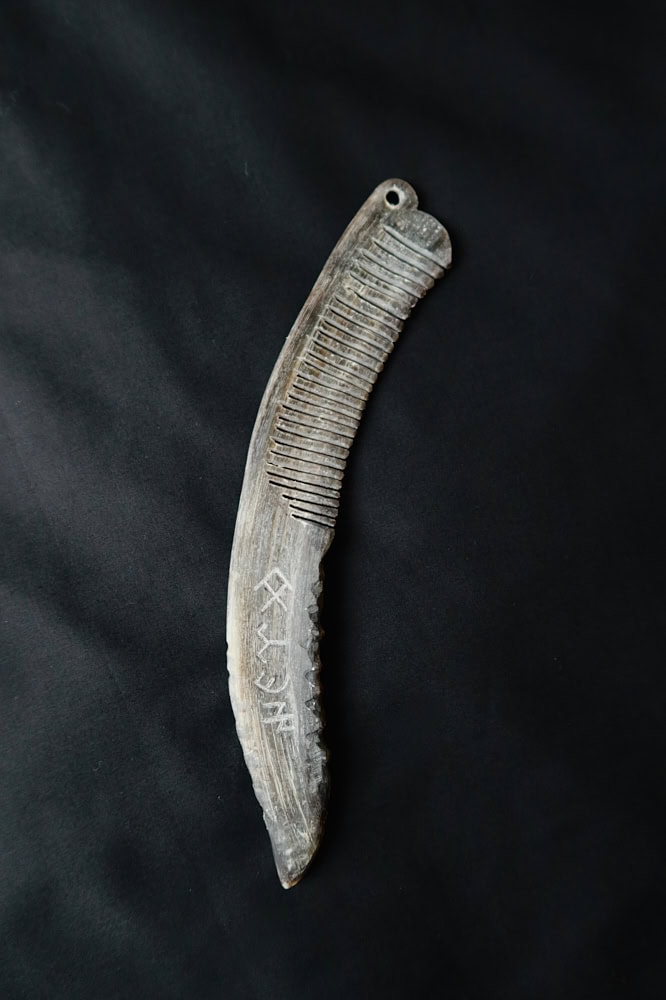
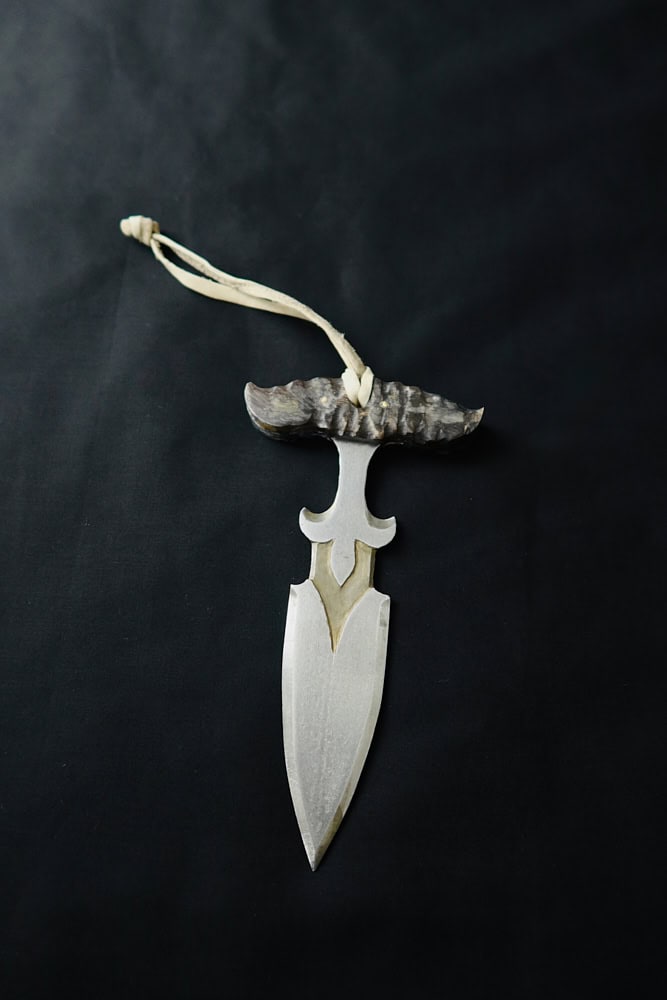
AS: At the very beginning, five years ago, the foundation of my work was definitely centred around rage and anger. That’s why my early pieces were so heavily focused on weapons like knives and swords.
As I’ve evolved as a person, I’ve lost a lot of that initial anger. My practice is drifting away from rage and moving toward exploration, tools, and especially rituals. The concept of rituals is what speaks to me most deeply right now.
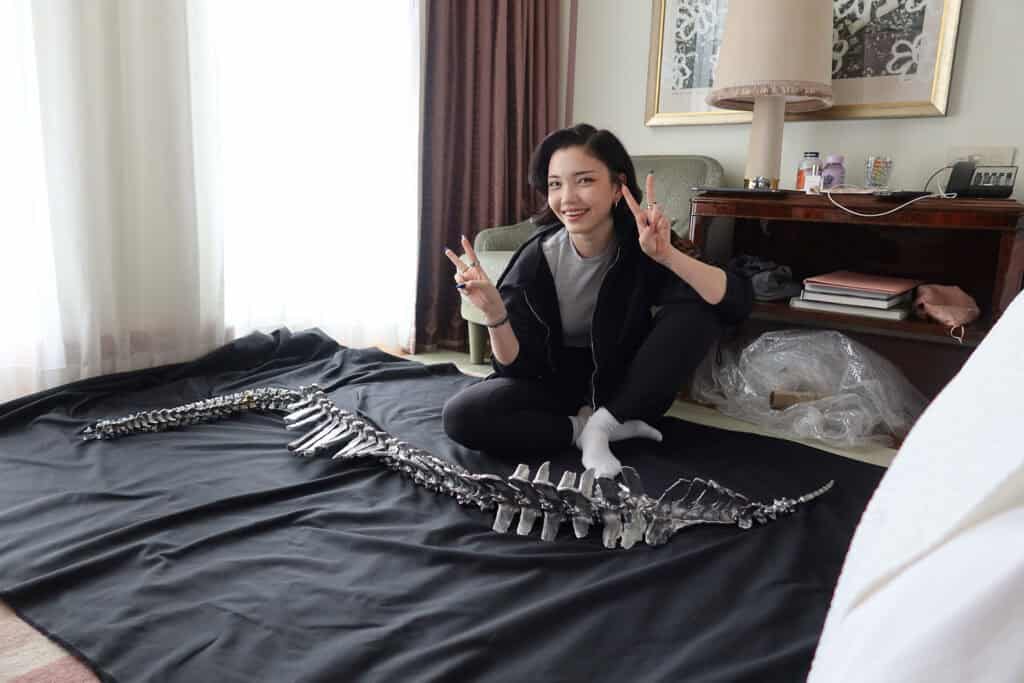
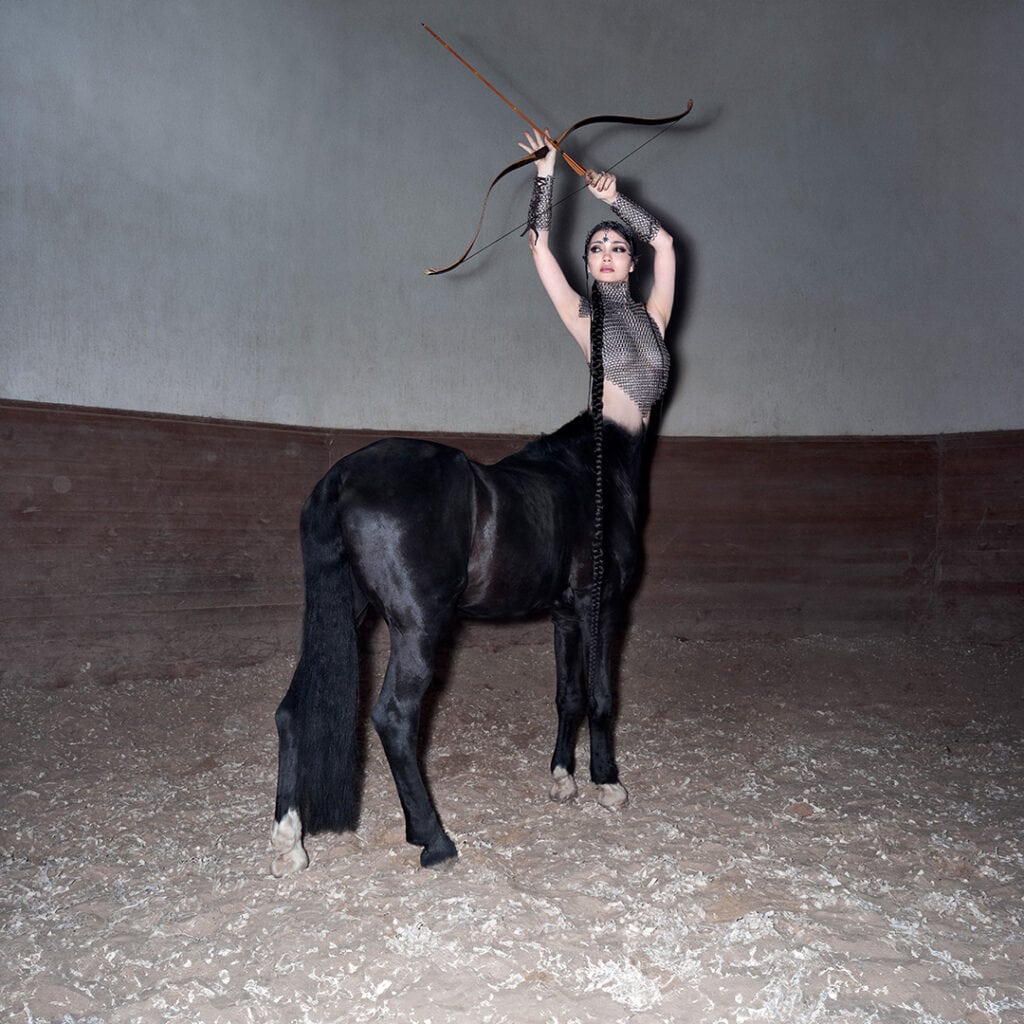
CM: Mergen (meaning “skilled archer” in Kazakh) is not a fictional character. She’s a real warrior whose burial site was discovered in Kazakhstan – with arrows, and with a fracture of the L1 vertebra that killed her. It is also a reference to your own spinal fracture. You didn’t just reconstruct that burial site, you cast that vertebra in silver, and the copper one is your own fracture. How did you arrive at this work, what was the starting point, and how did it grow into what it became?
AS: Mergen marked my first real impulse to drift away from a purely war-centered viewpoint. In my artistic universe, I act like an archaeologist slowly uncovering new burial sites and artifacts, giving these “scary warrior girls” more of an identity by showing how they actually lived.
For this project, I recreated her tomb, and the central spine sculpture was directly inspired by my own spinal injury. Breaking my back shook me deeply, and I felt a visceral need to find an alternative way to feel powerful, so I tapped into her spirit. The process was highly ritualistic. It felt like I was burying my own injury alongside her. In ancient times, people performed similar transfer rituals: taking their misfortune or illness and transferring it into an object, which was then sacrificed or destroyed. I was transferring my physical pain onto this historical entity. She didn’t exist in the present, but to me she felt entirely real, and it worked. I healed remarkably well.
I cast the vertebra in metal, working with a musician/sculptor named Orynkhan, and we ultimately produced the piece in aluminum which was the lightest material to transport to New York for my two-person exhibition with the Kyrgyz artist Altynai Osmoeva.
CM: Is the female warrior in Kazakh culture a historical exception, or a norm that was simply pushed aside and forgotten? And why do you think that archetype stayed invisible for so long?
AS: I believe that defined, rigid gender roles solidified much later, particularly with industrialisation and colonisation. In the nomadic past, survival was the bottom line – anyone able-bodied had to work, herd, and fight. I don’t think life was easy for nomadic women by any means, but it wasn’t easy for anyone. The archetype of the warrior woman wasn’t an exception; it was a reality of survival that was later pushed aside as society changed.
CM: The image of a Kazakh woman that exists in popular culture tends to be passive, domestic, defined by tradition and family. Your work pulls out a completely different figure. Was there a moment when you realised this figure was missing, or did she just appear naturally in your work without you looking for her?
AS: My late teens and early twenties coincided with a pivotal cultural shift in Kazakhstan. Women actively started speaking up about systemic issues; with the rise of social media, topics like domestic abuse were suddenly thrust into the public eye. Being immersed in that atmosphere was the catalyst for me. It wasn’t a case of looking at strong female imagery in Western media and asking, “Why don’t we have that?” It was an acute reaction to the injustice happening right in front of me.
Women in Kazakhstan are the pillars; they hold households together, raise the children, and carry society on their shoulders. Yet historically, the power and credit have gone to men. That dynamic still exists, but it is far more visible and challenged today than it was a decade ago.
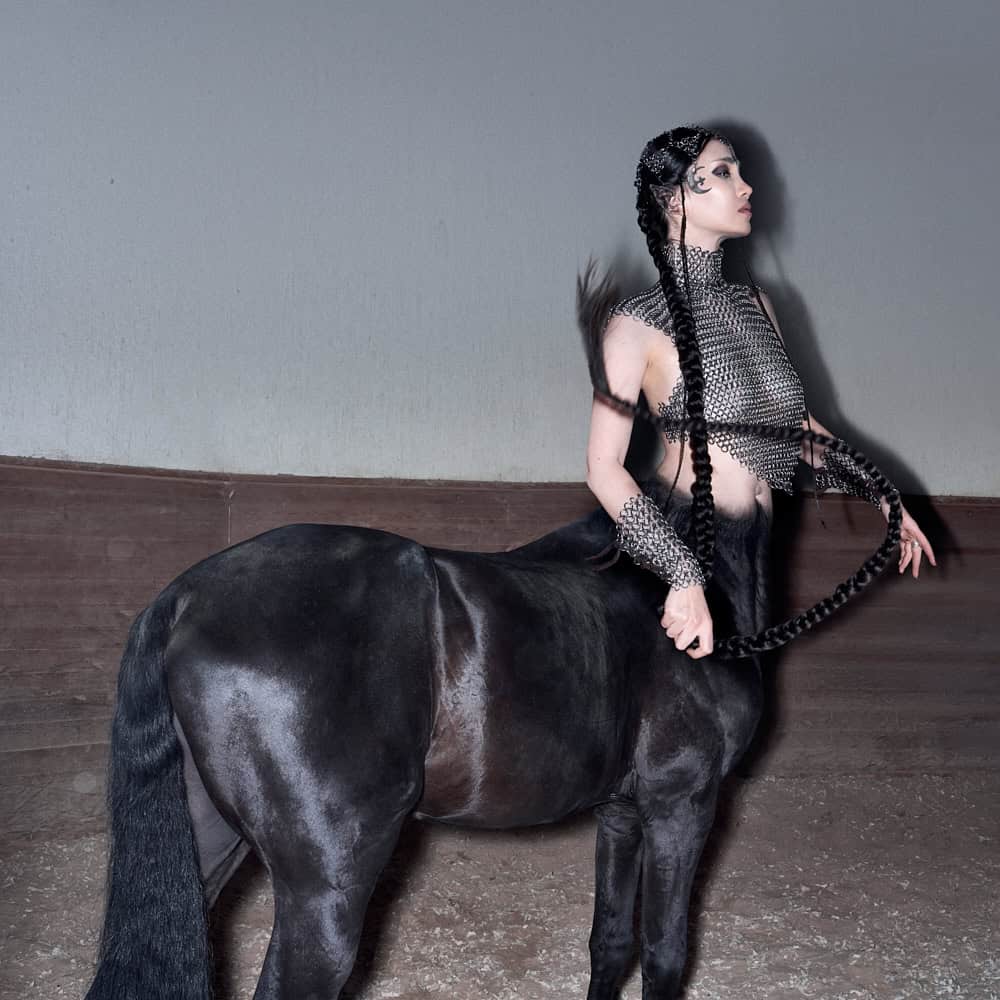
CM: In I Like It When You Are Soft, ornaments that for centuries were associated with domestic female labour become steel blades. You’ve described this as a materialisation of suppressed rage. How did those two poles come together in your own story?
AS: I am no different from any other girl who grew up in a society where women are taught to suppress their anger. You are conditioned to believe you are more desirable if you are calm, and if you express rage, you are deemed “crazy.” That pressure is global, but in our culture it is highly hyperbolised.
Personally, this was something I had to actively work through in therapy for several years. I used to be entirely unable to express anger healthily; whenever I got mad, my only outlet was crying, which I know is the case for so many women. Turning anger into tears is a survival response, so we won’t be accepted, loved, or safe.
Creating those knives was a physical manifestation of the rage I had stored up for twenty years. Around that time I also found traditional archery, which provided the perfect balance – a martial art that is deeply peaceful, a practice of release: you build immense tension, and then you let it go.
CM: Today any subculture, any conceptual idea gets packaged by algorithms into content very quickly. You work with dense ideas and complex objects. How do you protect that depth, and honestly, is it a constant battle or have you found a way to make peace with it?
AS: I’ve essentially given up on the idea of building a purely fine-art presence online. The fine-art world still fundamentally lives and breathes in the physical realm. Once I began working with a gallery professionally, I realised the most substantial parts of that world exist entirely outside of social media.
Social media has increasingly become a space tailored primarily for selling. As a community, artists cannot rely on social media algorithms as their primary platform, because those spaces only reward instant results, whereas fine art is slow, rigorous, and all about the process. Because my practice is multidisciplinary – encompassing acting, modeling, fashion, and commercial projects – I let those aspects live natively on social media, and keep my fine art separate.
CM: When an artist works with national identity, there’s always a risk of being trapped. The Western art world starts expecting a certain set of markers from you: exoticism, activism, the voice of your people. Do you feel that pressure, and how do you work with it without losing sight of why you started doing this in the first place?
AS: This is 100% on point. You can very easily get trapped in the exact narrative you build. The challenging thing about navigating the art market is that it demands extreme repetition. To succeed commercially, you are often expected to tell the same story over and over again until everyone hears it – but as the creator, you get exhausted and sick of it long before then.
I get bored with things very quickly, especially my own past work, so this is easily the number one creative dilemma I am wrestling with right now. I am constantly trying to find a balance where I can maintain my own genuine curiosity and create things that interest me, rather than just catering to the expectations of a Western spectator. It is a real, daily challenge.


