
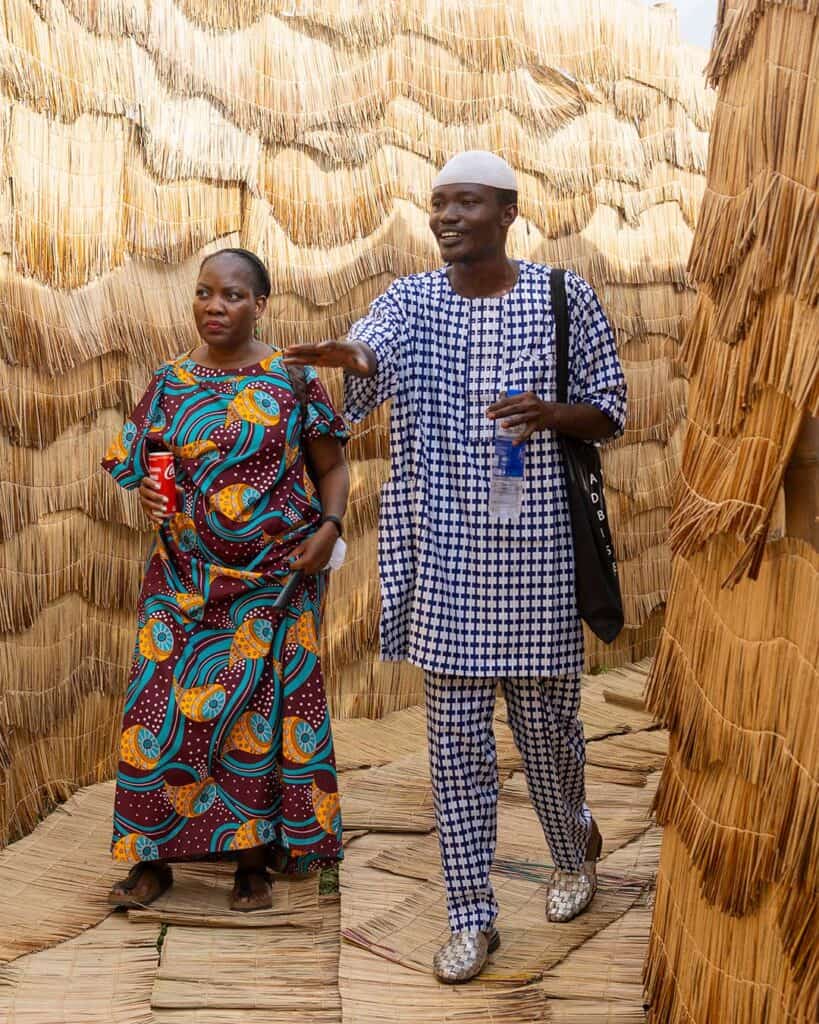
The Black Muse Art Festival in Benin City, Nigeria is a celebration of creativity, cultural traditions and modernity. Created by Victor Ehkhamenor, its title theme Let the Forest Dance explored natural sanctuaries, environmental protection, spirituality in the ancient forests and the power of community. The festival took place from 8-12 November 2025.
Guests could experience a sculpture park, film screenings, poetry, workshops and dances, to name just a few features of the elaborate program. Ehikhamenor highlights that African artists are changing and have not always been acknowledged for the complicated duality of past and present they expertly portray in their work.
Though Victor’s academic background is in literature, he has always had a proclivity for art, despite not attending traditional art school. He has been planning this festival since 2022, but the initial conceptions of this event go all the way back to childhood in his village. The vision of creating a community for artists to convene, without outside influences or inhibitions. This drive to prioritise collaboration between likeminded individuals has led Ehikhamenor to exciting successes throughout his career.
The balance between tradition and modernity have always been present in Ehikhamenor’s life. He speaks about his experience being raised Catholic and going to church, all the while coming home to his grandfather practicing traditional African spirituality. These two identities have influenced much of the art in his career.
Victor spends his time between Lagos and the US, but is originally from Benin City, Nigeria. During our interview, he says he feels as if “metaphorically he’s never left”. The surrounding nature of the village, and the elders who protected these holy places have influenced the way he thinks about passing down traditions in a modern world.
Cold Magazine (CM): How does it feel to host this festival in Benin City?
Victor Ehikhamenor (VE): How does that feel emotionally? I mean, people consider certain things as homecoming, but I’ve never left home in that sense, metaphorically. So it’s just a matter of now amplifying what one has been doing and where a lot of my artworks come from. A lot of my ideas, my formative years, and what I have been telling the world.
CM: You were saying that you metaphorically feel like you have never left home, just the people that you stay in contact with – community members. Is that why you wanted to have the festival in Benin City?
VE: The thing is, we have built an artist residency there that can take about 15 people. So it’s been an infrastructural development first. It’s all encompassing in the sense that we’ve started building infrastructure since 2022. I started in Lagos, to actually create an artist residency where it’s artist-led and we can do what we feel like doing without much red tape.
In 22, I decided to expand that to Benin by actually building infrastructures where artists can just take things into their hands, create things. Architects are able to contribute to the building, writers can contribute to the building, local artisans and artists and traditional art makers. I want to create that synergy between what we consider contemporary or what we consider classroom art and the community that makes art.
I think in our rush to create modern works, we tend to leave them behind or not add them to the narrative, which was also why in 2017, my installation at Venice Biennale when I represented Nigeria was a Biography of the Forgotten. I always like to know where are we coming from.
I studied everything else, but I didn’t study art. I’m a writer. I have an MFA in creative writing, fiction, but I never went to art school. I wanted to go to art school, but it didn’t happen, so I studied other things. And I’m a big green lover, as you can see, my face [Victor gestures to the halo of green leaves all around his background].
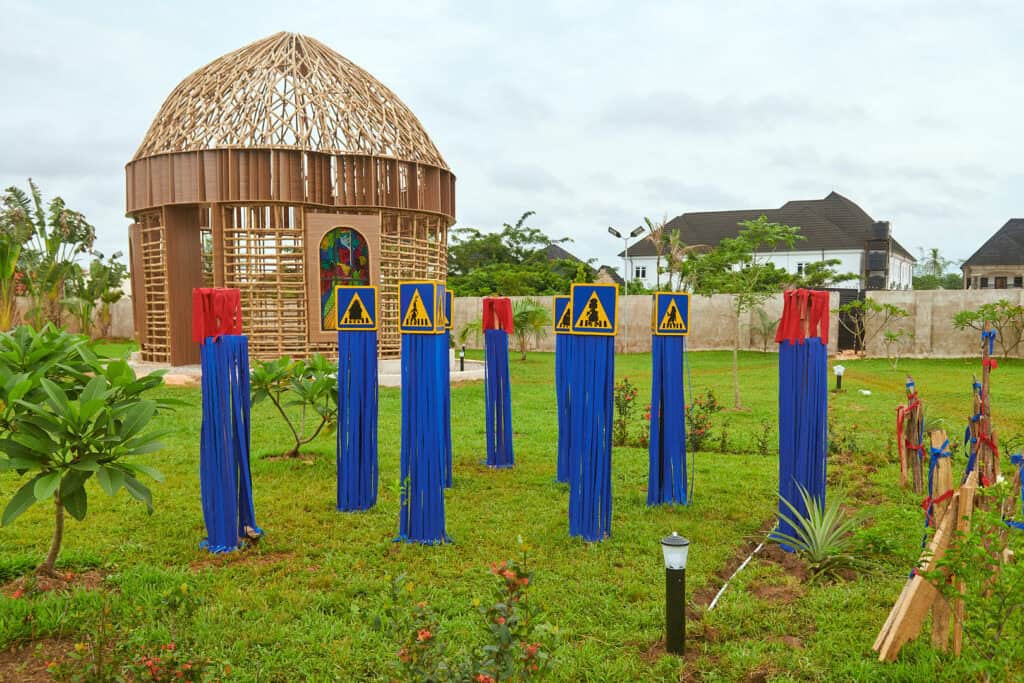
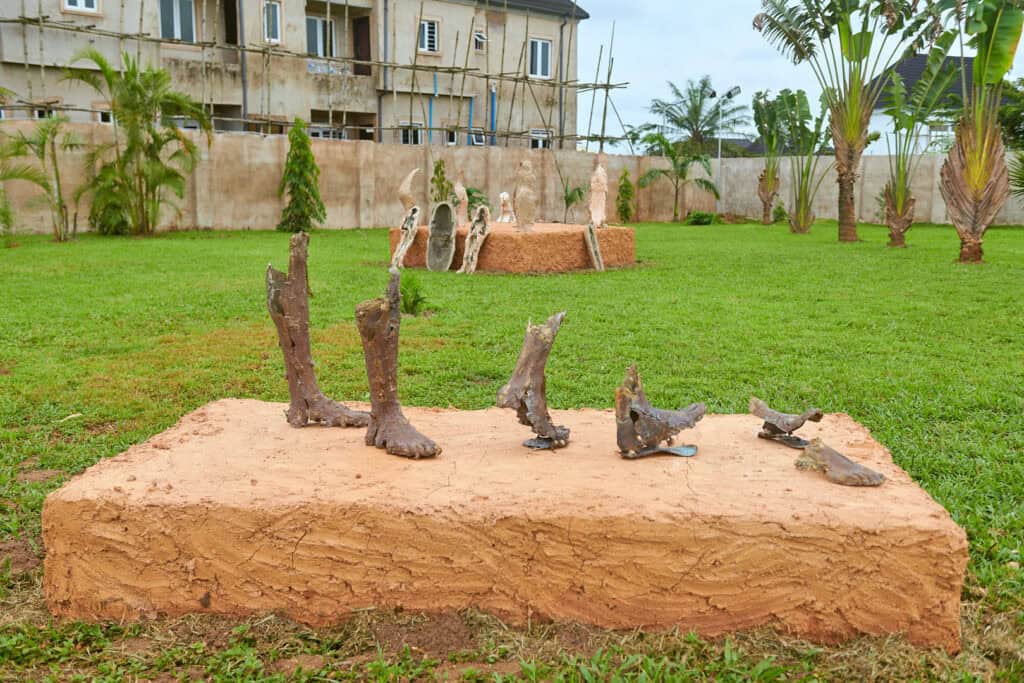
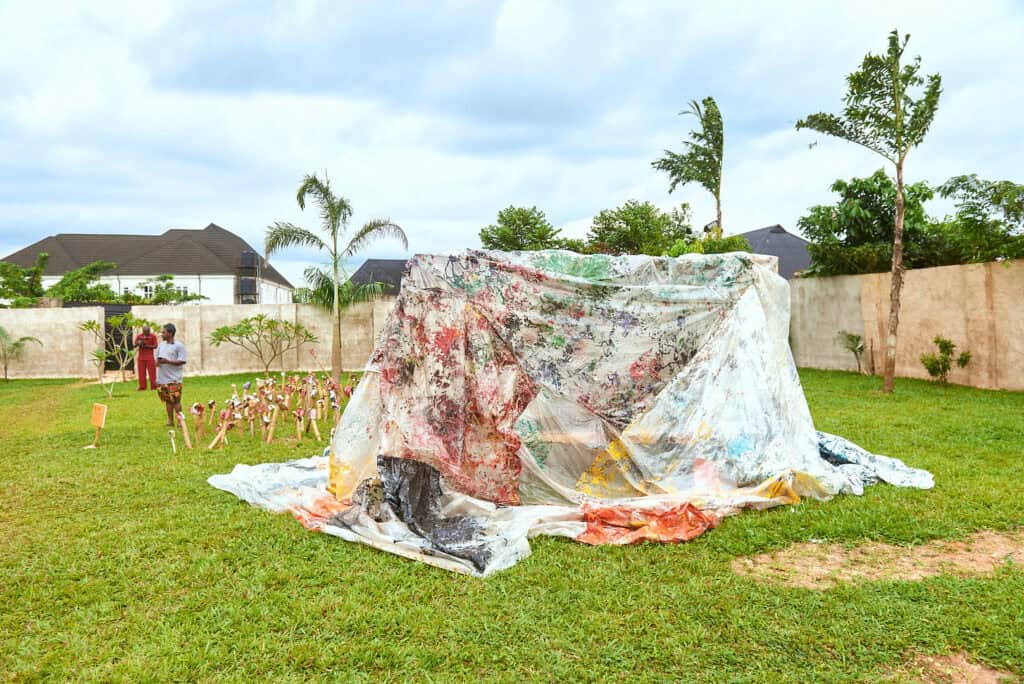
I decided to start working to make sure that we start planting, grassing the area, then it evolved to being a sculptural garden where we invited about seven artists and a curator to curate the art.
Then it morphed into a festival that then brought in everybody, literature, art, dance. So it’s a festival for everybody. Now the community opens the gates for people to engage with art and have meaningful conversation with the art that is coming out from that place, but also the art that is coming into that place.
CM: There are so many moving parts. How complicated was organizing everything, getting everyone—all the artists, the literature, the film, the poets, the dancers? How did you get it to come together in time?
VE: I would say that I have an amazing team. It’s a very small team that I work with. The program director, the manager for my studio, and other staff. But what I’ve done in this first edition is reach out to friends that have been in the ecosystem. Friends that are doing great stuff. I say, “this is what we are doing. It’s self-funded. You know, please come in and you can add to all of that.” You know, it’s artist-led. So again, what does it mean to have an artist-led space?
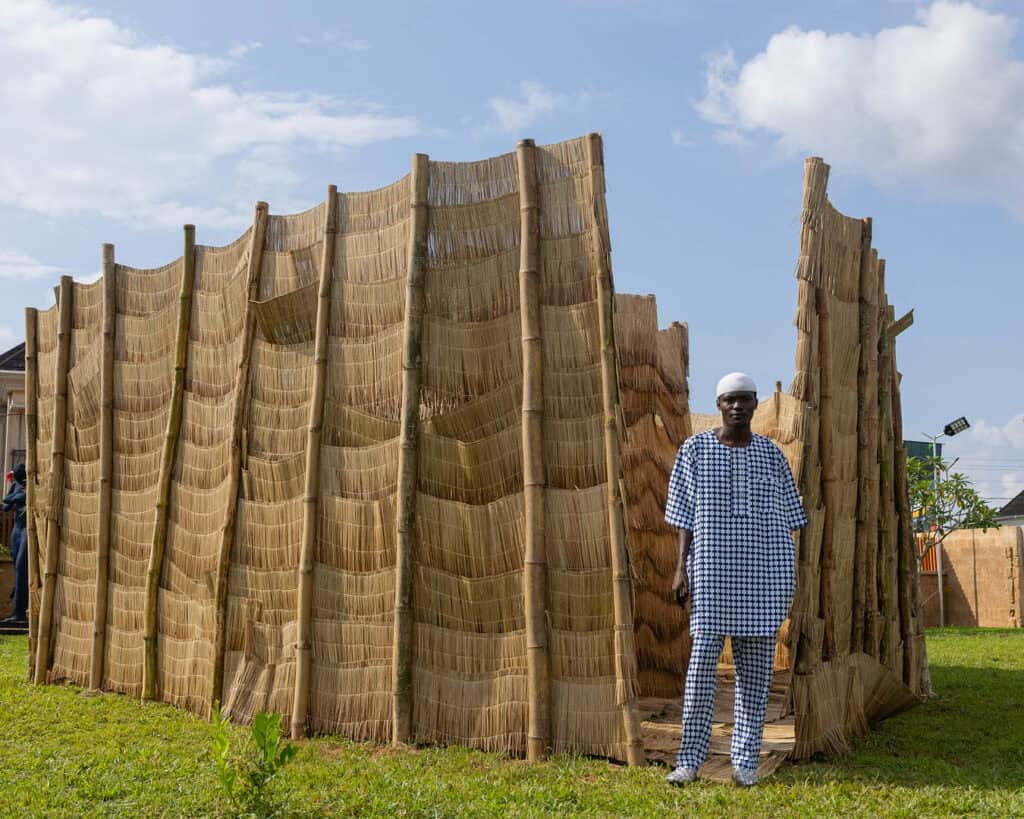
So you reach out to the artists and they buy into the dreams, reach out to the architect that is commissioned to create a pavilion, they buy into the dream. I reached out to the curator Renee, whom I’ve known now for a few years, you know, she flew in. I wouldn’t say it’s a walk in the park, no pun intended there, you know. It’s tense, it’s heavy.
CM: The theme, Let the Forest Dance, focuses on community and culture and conservation of the natural world. How can the themes from the festival be applied to everyday life? What do you want people to take away?
VE: When I keep thinking about it, because I mean, first of all, the idea of Black Muse Festival is to make sure that we are cognizant of literature, visual arts, and sculpture, right? I’m coming from a big literary background, you know. A writer, as well as a Nigerian writer. So each of the festivals, we always have a departure point from African literature. So this one is taken from Waleshoinka.
Then you are looking at where this sculptural park is actually located. It is historically the forest, you know, that has been deforested, urbanized. So when we say “let the forest dance again”, it’s a situation whereby the people can easily relate. Dance is an everyday part of life. Whether you have an art background, or not. Whether you go to a disco hall, a club or a traditional dance – you can relate to it.
And there will be music, again, it’s a festival to celebrate, to dance again. When you say something to dance, which means there was a moment in time when there was a pause in that kind of dance that we are trying to bring back now. Number one, it is speaking to the botanical aspect of things, to the archaeological aspect of things, to cultural preservation aspect of things, to ecological preservation.
We are doing a lot of tree planting—I want people to imagine the forest dancing. What does it mean for the forest to dance? It’s like there’s a gentle breeze, the trees are swaying, and people can dance to that movement and all of that. It’s an open affair. You don’t have to buy a ticket to come in. It’s like a carnival, but in a contained place. So that way, everybody is welcome with good intentions.
CM: What helped establish your passion for the environment, protecting culture and celebrating Nigeria and the community?
VE: I grew up in the village. My grandfather is a big landowner. I grew up in a place where nature was very close to me as a kid. You know, so I can go into the forest and bring things and make art. I’ve always made art as a kid. There are certain patches of land, certain trees that are respected, that are not touchable. So in that sense, my community as a kid has always given me the inspiration that there are places set aside as holy—where the trees are allowed to grow.
Then I started documenting, I started coming back when I was living in the U.S. I realized that when those elders that I grew up with, that had maintained these sacred spaces had passed on. There is no communication to retain these things. And a certain level of half-baked Christianity and Episcopalism came in and started destroying the trees—saying that the trees are where witches or wizards gather.
When you also look at all the modernists, we are now moving from village to what we call city. Modernist art is embodied by somebody like Demas Nwoko, who is one of the artists, who is also about 90 years old now. He has also created spaces like this, his village, to make sure that certain things are preserved, certain vernacular architecture is preserved. So those are my inspiration because when you look at a lot of the modernists—all the artists and writers that are in their 80s and 90s now, there’s a lot of reference to nature.
CM: Many of the installations seem to focus on balancing tradition and innovation together, old and new. How do you view space for creating between these states of being? Where in between modernity and tradition do you like to create? What do you see there?
VE: So, growing up, I’ve always had that duality, right? I was born and raised Catholic. I went to Catholic school. But my grandfather was a traditional chief. So I go to school, go to church, then come back home, and I’m experiencing what you call an African way of belief system, playing out.
Over the years, I’ve carried that along. When you look at some of my rosary pieces now, even though it started in 2017. I’ve always worked with Christian iconography, measuring it with African iconography. I like breaking down duality. When I look at old books, modern art, or contemporary art—all of a sudden, as time passes, you realize that we are not talking about contemporary art. Whereas we are doing almost exactly the same thing that they had done before, but it was just time that has passed. So when you look at that, I use time to bring the past to the present, and then in the future, it’s going to be a past again that would be relatable to the present.
That is the mindset that I bring to both sides. We can’t always be in a hurry not to look at where we are coming from. So when I bring certain things from the past, I create that relationship, I create that juxtaposition to see what we consider ancient is still very relatable. Whether cosmologically, historically, or even physically. Yes, things have changed. Previously, this interview probably would have been faxed. Or over email. Or you fly to Nigeria, we sit down, you press record back and forth, then you go and translate, and all of that. So as time passes, we have to say we are evolving.
So my whole thing is to let people know that the African artist is also evolving. Even though we are looking at the past, I have to guide your eyes to create a bridge to say, we are evolving and this is where we are coming from.