The shock of walking into a room and discovering yourself between two parallel mirrors, each reflecting infinite lines of yourself and receding into the soft-green haze of infinity, is perhaps the closest analogy to Mircea Cărtărescu’s writing of a life.
You enter Cărtărescu’s ‘dream-memoir’ Blinding and suddenly to your left is something akin to your past: “a long, uninterrupted line of dead bodies, a tunnel of bodies dying one into the next” and to your right impossible futures: “an immense line of Russian dolls buried one in the next, each one pregnant with its predecessor, but still being born from it”. You are a slice of body caught between two phantasmagoric flights of fancy. Through your body rush your futures, dying somewhere to your left.
How then to write about your past when your whole life is this constantly shifting metamorphosis?
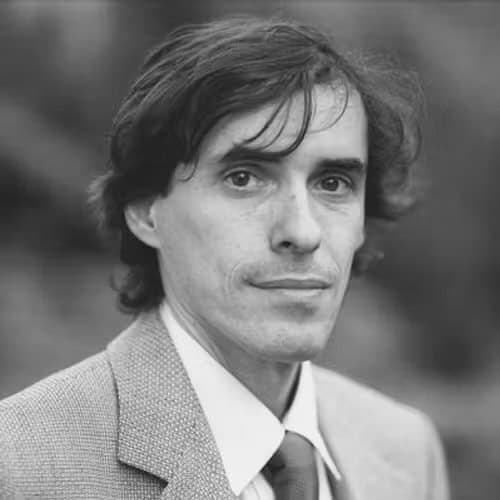
Mircea Cărtărescu was born in Bucharest in 1956 and is often considered the defining literary voice of post-Soviet Romania. In the UK he is best known for his novel Nostalgia, which received a re-issue from Penguin in 2021 and found success in the post-covid world with its depiction of a strange, yearning city where reality seems to have decayed into magic. Again and again, Cărtărescu’s work returns to memory and nostalgia, obsessing over its logic and sensations to the point of hallucination as his novels incorporate alternate modes of reality, from magical realism to fractal mathematics. For an author so driven by questions of memory, it makes sense that Cărtărescu’s attempt to write his biography is far from conventional.
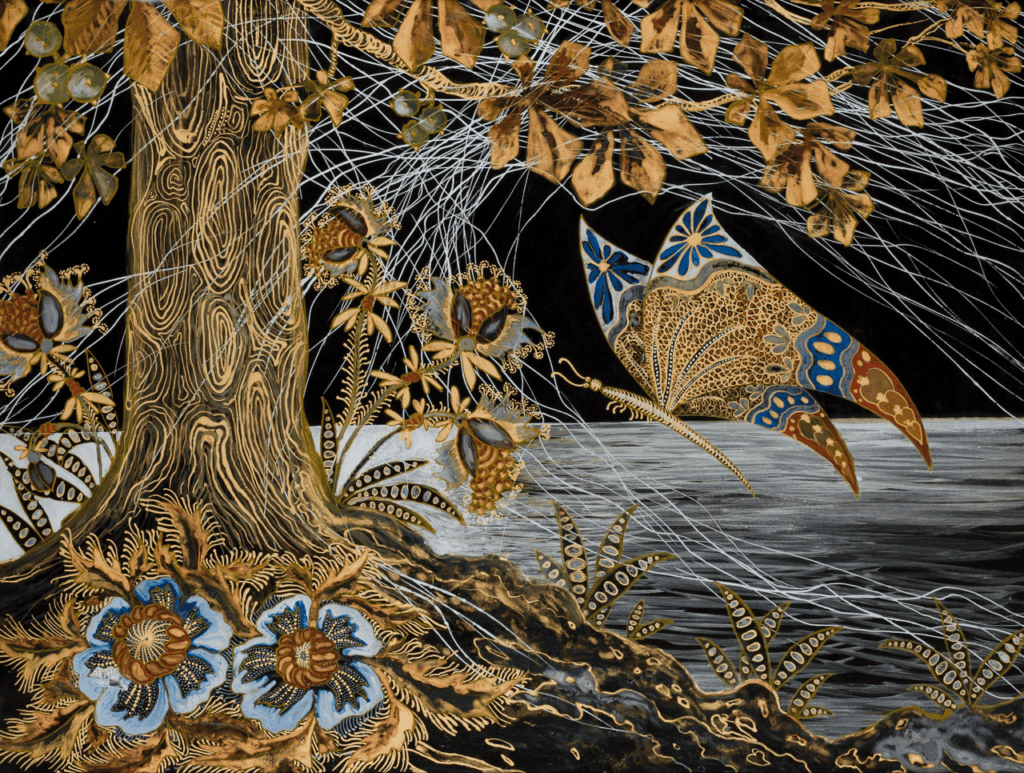
His highly stylised auto-fiction trilogy, Blinding, totals nearly 1500 pages across its three volumes, with each book modelled on a different anatomical part of a butterfly. First with The Left Wing, then The Body and The Right Wing. The Left Wing was first published by non-profit press Archipelago Books in 2013 and was re-issued by Penguin in November 2025. The re-issue is partly a response to the anglophone world’s recent ‘discovery’ of Cărtărescu (his novel Solenoid was longlisted for the International Booker Prize in 2025) and the desire to formalise him in the canon of eastern european literature.
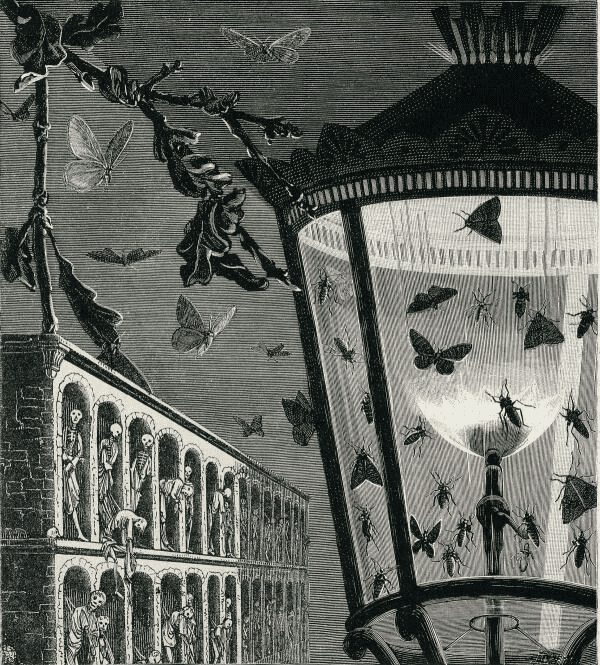
Cărtărescu wrote the three manuscripts entirely by hand over a period of fourteen years, with minimal edits and revision. Recalling his life from the cities of Amsterdam, Berlin, Budapest and Stuttgart, The Left Wing deals with the author’s past and the complicated alchemy of memory and nostalgia. It opens with the narrator, ostensibly Cărtărescu, sitting with his feet on a radiator, looking out of his childhood bedroom window at the scene of Bucharest. From here the narrator slowly maps the city, layering dreams, memories, imaginings, and experience over the grey streets. He recounts the history of his mother’s family, his first sexual encounter, and his long experience of hospitalisation as a child. But this is not so much a chronicle of Cărtărescu’s childhood or his time in Bucharest, as a complex network of myths, dreams, revelations, objects and metaphors. In its pages zombies fight against the archangels of heaven, Bucharest’s statues copulate in the night, there are jazz clubs, and underground temples, girls with tattooed heads that depict the universe. There are also hordes of butterflies. They are frozen in rivers and devoured by the narrator’s opium-addict ancestors, birthed by ghosts who operate elevators to nowhere; they’re carved on rings made of Mammoth ivories and crawl out the bodies of circus performers.
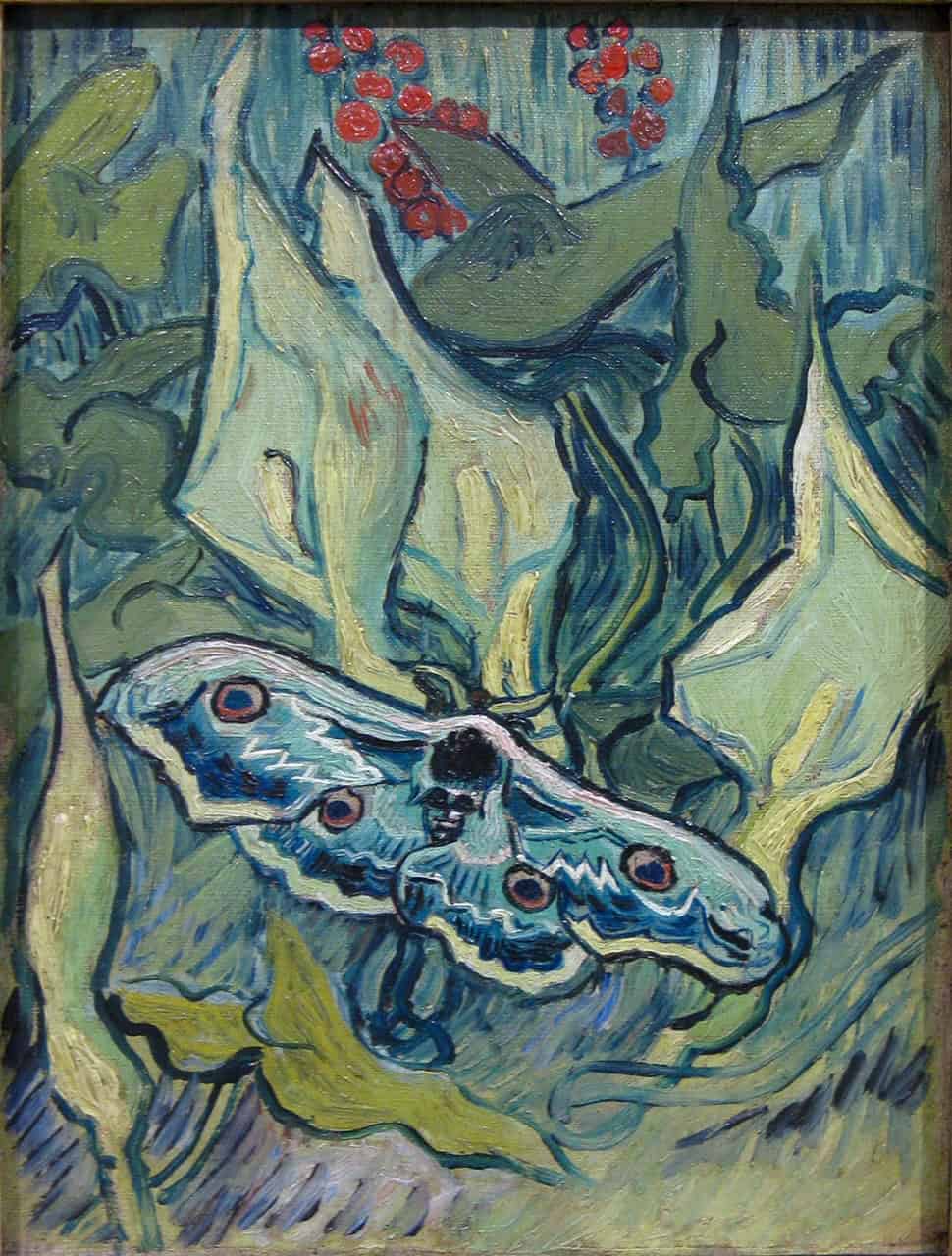
In a 2024 interview with Claudia Cavallin, Cărtărescu stated that “We live our lives on Earth as hairy, egotistic, and voracious caterpillars, but we dream that in our next life, freeing ourselves from the chrysalid of our coffin, we will emerge as winged, wonderful, colorful, gracious butterflies.” To Cărtărescu, the metamorphosis of butterflies embodies our dreams for immortality. In what is the microcosmic thesis of The Left Wing, Cărtărescu writes that “we exist between the past and future like the vermiform body of a butterfly, in between its two wings. We use one wing to fly … But how can we fly with one wing?” We only ever have the past to move us forward. The novel is in many ways an experiment in flying with one wing, attempting to circumvent the unknowability of the future with a fantastic vision of a complete, understood past. By searching through the past the narrator hopes to “see our target in the mirror”, the left wing envisioned as the mirror image of the futuristic right. Mirroring happens throughout The Left Wing, building a sense of cohesion and completeness into Cărtărescu’s streams of consciousness. The narrator’s parent’s first kiss occurs in front of a statue of a soldier missing a hand. A hundred pages earlier, the narrator’s mother, just after a disorientating lesbian encounter, passes a disembodied hand in the bombed-out rubble. The narrator’s maternal ancestors devour a huge butterfly trapped in ice and the narrator discovers his mother’s butterfly birthmark is the same colour as the gums of her false teeth. These repeated motifs, recurring figures, and returned-to sites all convulse through different arrangements to project an illusion of wholeness and inevitability. Calls are answered hundreds of pages apart, people who have never met share the same thoughts, the same dream carries across the city.
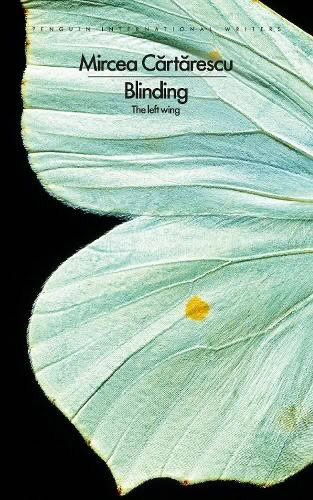
Cărtărescu has said that as a child he had wanted to be a lepidopterist, to study butterflies. It’s a fascination he’s carried with him to adulthood: his favourite butterfly is the monarch butterfly and in 2014 he was able to see Nabokov’s butterfly collection at Harvard. Perhaps then his choice of the butterfly as a model for life and memory is not simply for its anatomical shape but based on an understanding of how this shape moves. Butterflies’ wings move in a figure of eight, or infinity symbol, when they fly, in a movement more akin to swimming through the air. It is telling, then, that Cărtărescu chooses these wings as the symbol of our finite pasts and futures. We hope, even flying with just the one wing, that we can gesture towards infinity.
About halfway through the book the narrator reflects “there was so much emptiness and melancholy in my life, so much inability to imagine not only my future, but also the present moment that my mind … sucked a weird marrow from the thin bones of my memory.” It’s well-established that this is the era of nostalgia, that everything must copy from, or evoke, the past or else risk losing its relevance. Like the narrator of Blinding, this is seen as symptomatic of the current emptiness of the present and future. We are told that this endless recreation of the past will tell us something about our future. Blinding: The Left Wing embodies the end point of this obsession with nostalgia, not longed-for infinity or transcendence but disorientation. It is full of the “weird marrow” of memory that crowds the page and the empty present but, despite its aspirations, gives nothing away about the future.