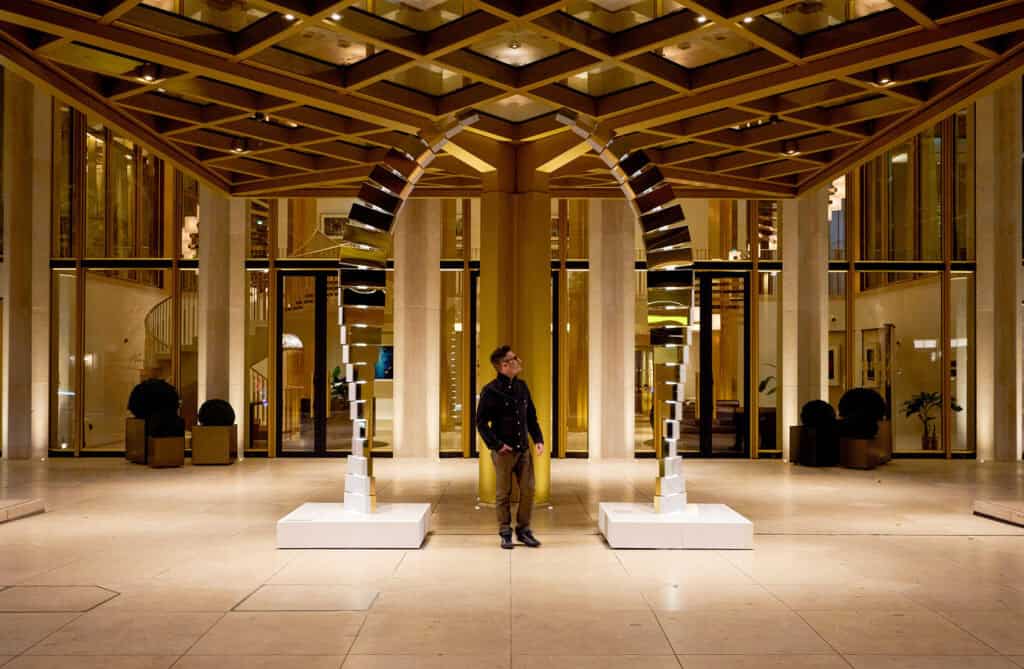
Artist Andrew Zolty, known professionally as BREAKFAST, blends live ecological data into kinetic circuitry art, and sculptural installations all over the world. Many of them feature an interactive component. In his Brooklyn based studio, he has spent the last 15 years expanding the boundaries of technology, art, advocacy, and playfulness.
In our interview with Zolty, we spoke about his love of combining engineering and art to facilitate conversations about climate change, sustainability, and one of the most valuable resources: the public’s attention. As the scale of his works are often quite large—viewers are encouraged to get up close and personal with the various data on display.
Directly interacting with the art creates a unique sense of play that furthers the success and approachability of BREAKFAST’s innovative designs. People may be initially intrigued by the piece’s hypnotising movements, but find themselves staying for the deeper meanings they uncover.
How can visual entertainment of moving art be used to raise awareness and empathy for our changing world? Zolty’s art allows a pathway for viewers to think deeper about the media and data they consume, further insisting that nothing exists in a vacuum. His works blur the line between the digital and physical, cultivating a tangible connection between mediums and perspectives.
Many of BREAKFAST’s works are located in large office buildings across major global cities, most recently at The Chancery Rosewood during Frieze London 2025. Read below for an exclusive interview with Zolty to better understand his love of kinetic art, circuitry, and how his practise has evolved to what it is today.
Cold Magazine (CM): People often think they already know what “digital art” means. What do you think they’re missing?
BREAKFAST (B): I think the world hasn’t yet seen the full potential of what “digital art” can be. The word carries baggage—people tend to imagine screens in homes, NFTs, or immersive rooms of projection. But there’s an entire frontier of digital work that exists beyond screens. Artists like myself are using data, code, and mechanics to create pieces that live physically in the world—works that move, breathe, and respond to people and the environment around them. Because they’re tangible, they meet collectors and audiences where they’re most comfortable, yet they’re still on the cutting edge of what’s possible. I’d love for people to open their eyes to this side of digital art—the part that’s quietly redefining what it means to be both digital and human.
CM: Do you remember the first circuit board you ever built?
B: I’ve been hacking and soldering electronics since I was very young—mostly just experimenting to see what would happen if I moved a wire here or there. My serious start in proper electronics came in 2007, but the first circuit board I designed entirely myself—from scratch, etching the copper in my tiny studio—was right at the start of working under the moniker BREAKFAST in 2009. It wasn’t pretty. It probably didn’t follow many “rules.” But it worked—and it let me present to the world the first proper BREAKFAST piece.
CM: How and when did your love of engineering combine with art?
B: As far back as I can remember—say four or five years old—I was both drawing and tinkering. Every toy with wires got opened up. I’d try to modify it, make it do something else. Then computers entered my life a few years later, and I never stopped combining art and technology. In that sense, I’ve been doing this for over forty years—just continuing to evolve what that combination looks like.
CM: How much does the location of the installation influence the design of a piece? Both the physical shape of the room as well as the city itself.
B: Location is everything. Every new work begins with three questions: Where is it going? What are the stories of that place? What is the budget? (because constraints often shape innovation). By “where,” I mean the city or country, the building or site, the aesthetics of the space, and the context of the piece—whether it’s suspended, on a wall, or freestanding. I design so the artwork meets its surroundings on multiple levels—visually, conceptually, and historically—so it means something to the people who see it. For me, it’s never “drop a piece here.” It’s always “make this piece emerge from this place.”
CM: In a media-obsessed culture, the line between spreading useful information and entertainment for views is blurry. How do you tackle this through your art that shares real-time ecological data?
B: This question really hits the core of what I do. Today, attention is the scarcest resource—feeds are endless, visuals are amazing, but substance is harder to get through. So I begin with spectacle: a physically moving artwork that looks like nothing people have seen before, with the piece responding to their movements. That motion and interaction pull viewers in. Once they’re present, I can introduce the deeper story—how its behavior corresponds to live climate or water data, shifting in real time. The placard might explain the data source and meaning, but if I hadn’t found a way to draw people in physically, most wouldn’t even glance. It’s an odd method, but it works every time: you excite someone, you earn their attention, and only then can you share the story—and they’re far more receptive because of how they arrived.
CM: You’ve mentioned that social media is the enemy of creativity, that it can be a crutch for inspiration… What are the ways you combat this when sharing your work online and amidst creating new work?
B: I’ve watched creativity increasingly crumble over the past ten years as more people draw from the same places—Instagram, TikTok, Pinterest. The result is iteration, imitation, and an acceptance that “copy” is okay. It wasn’t always this way—I know creatives who used to sit in cafés for days, pushing their brains to find something truly unique. They still exist, but they’re fewer. My guardrails are: no following trends, no chasing algorithmic “likes,” and always returning to the first principles of art + technology + physicality. I choose substance over virality. When I do share online, it’s to hint at depth, not to replace the experience of the work.
CM: What are new sustainable materials you have been experimenting with and excited to try?
B: Sustainability for me isn’t just about “new” materials. It’s about durability, longevity—creating pieces that can survive generations and never end up in the landfill. Aluminum is a major preference for that reason—it’s one of the most recyclable metals. But if using a less recyclable material means the artwork will last 100 years, I’ll use it. To me, the greenest object is one you never have to replace. So yes, we experiment—but always with an eye toward maintenance, lifespan, and legacy.
CM: What is your go-to combination to entertain yourself on a long flight?
B: Flights are one of the rare times I can put headphones on and get into deep work mode. Many of my pieces have started mid-air—catching up on email, sketching ideas, refining concepts. I rarely watch movies. If I do, it’s usually a documentary, often about a band (music’s still my first love), playing in the background while I work. Mostly though: music, sketches, and the hum of the cabin.
CM: What are some stops in London you make sure to hit each time you visit?
B: I actually began my transition from screen-based digital work to physical-digital work when I lived in London around 2008. I always try to return to East London where it all began. But the most important thing is reconnecting with old friends—collaborators, makers I started alongside, the community of that era. A pint together. A walk through Shoreditch. A reminder of where the foundation was laid.