
We’ve all felt the strain, haven’t we?
The symptoms are common to most of us by now: notification pileups, repeated conversations about giving it all up, endless deletion and redownload of apps, advertisements for phones that do almost nothing, keyboards that only type, entire holiday retreats in which the tech gets locked away.
Our aspirations to do better, to be more alive, more present, hang above us all, albeit just beyond our reach. The glowing ideal of an inaccessible past becomes our new faith, a remote and disguised saviour, birthed of a Silicon Valley manger.
In such moments of despair, music is my (and many others’) refuge of choice. I tend to go for something acoustic, recorded simply; a sound I can see happening in my mind as it plays. Listening is a meditative process, and it reassures me. I take a kind of comfort in the sound of old recordings, the fuzzy incompetences of outdated technology. Back then it was a little like us, it warbled and sometimes failed completely.
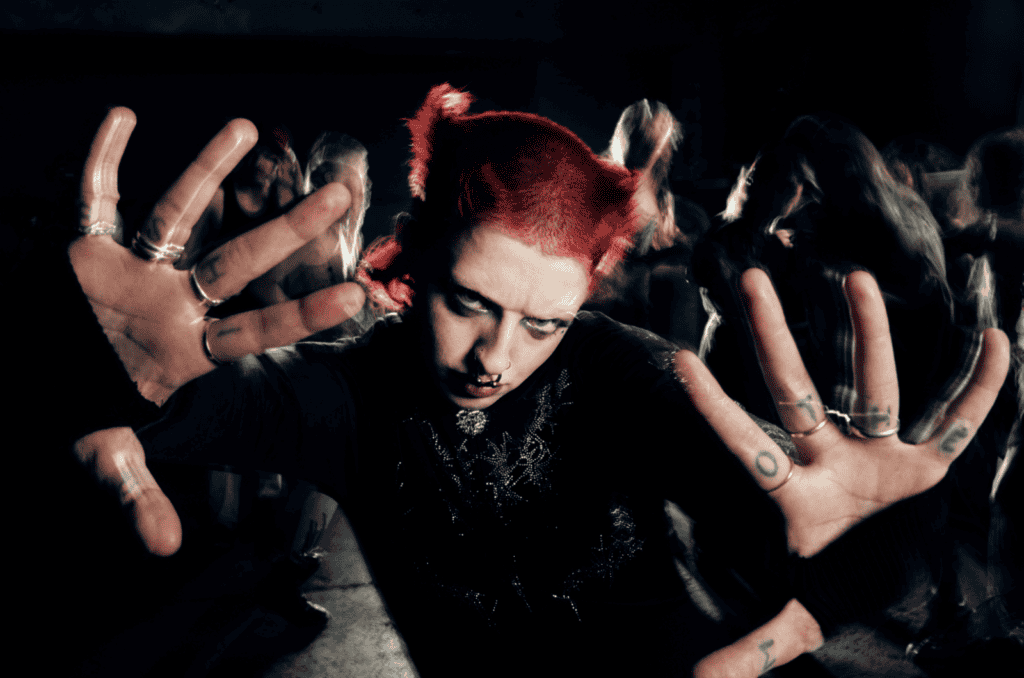
When I spoke to Cody Frost, a musician and tattoo artist from Burnley, whose back catalogue offers a genre-melding fusion of hyperpop, punk, rock, emo, and industrial music, I didn’t expect to begin with a critique of modern tech culture.
Frost’s music is ardently contemporary. The most senior of their influences, at least to my ear, being 90s emo and metal. Even these are bit-crushed, glitched and distorted into a raging neon cacophony.
In MECHAEVAL, their 2025 EP, Frost has turned the machine on itself. Alternating between deeply personal reflections and existential fury – often within the same song – MECHAEVAL is the sound of a person trying to make sense of a world that might not any longer be designed for them. “I wish I didn’t know what a handful of silver gripping ‘round my throat felt like,” they sing in the EP’s title track, “but I do, but I do”.
Despite that depressingly relatable sentiment, Frost does not go down without a fight. The rage and defiance of MECHAEVAL are central to the EP’s sound. In tandem with producer Dan Weller (Enter Shikari, Young Guns), Frost has created a sonic world which is every bit as confronting as the reality it reflects.

We stepped into that world, below:
Cold Magazine (CM): There’s a lot going on in MECHAEVAL, from metal to dubstep and pop-punk. It’s a broad church, sonically. What does the project mean to you, and what were the inspirations behind it?
Cody Frost (CF): I just got housing stability after a long, long time, so I felt happy in that area of my life, which allowed me to research things outside of my inner bubble. I got locked in with politics, which happens to me sometimes. I think I wanted to write about the stuff that I had only recently developed the brain space to accommodate. But simultaneously, as I was writing MECHAEVAL, everything felt like it was collapsing societally.
It’s not all politics, but the title track is really about the rise of technofascism and the fact nobody’s really talking about how much the internet has messed up Gen Z. Meanwhile, we’re putting all this funding into technological advances while neglecting the core issues, which are homelessness, mental health issues, stuff like that.
MECHAEVAL is part my own emotional turmoil and mental illnesses and part having a bit more headspace to talk about politics.
CM: Your image is a really central component of the project. Considering your technological scepticism, how do you balance the pressures of a digital, aesthetic presence while having your own creative life and staying well?
CF: Like a lot of Gen Zs, I’m starting to be a bit more offline. I think it’s becoming a trend – a lot of my friends are not online anymore. They are just not participating, which I think is amazing. The internet has become less fun, and we’ve watched it happen. Like, I didn’t have the internet when I was under 10 years old, so I’ve seen what it was like before, but then I’ve also seen it come up and get into everyone’s hands and everyday lives.
As a teenager, I was so internet absorbed. I was on Tumblr, and I think you know what Tumblr people are like; we are really into being on the internet. But, over time, my timeline just started getting darker, it became all ads. I balance it by going outside and touching some grass. I understand that not everybody can do that and not everybody is at that point yet, but I do think it helps. It actually does, and I hate to say it…
Don’t get me wrong, I am still on my phone, but I can feel a shift away from technology that is not just my own.
CM: Does your musical output and work as a tattoo artist feel like a counterbalance to digital overwhelm?
CF: Yeah, I always describe music as being very addictive. For me, it works in a similar fashion to an addiction, at least – you crave attention, or you crave to be seen – whereas tattooing is calm and meditative, and just involves talking to someone and drawing something on them. Some of the people that I tattoo don’t even know that I do music. I like that it’s just scribbling on people, watching TV, listening to podcasts.
I can feel myself wanting to shift between the two all the time. When music is too intense, I want to tattoo. When tattooing gets boring, I want to do music. It’s a cycle, and I have to do both. I don’t like picking one or the other.
CM: I read that you’ve been diagnosed with ADHD. Music can be a difficult industry for people with ADHD because of the necessity for self-organization. How’s your journey been with that?
CF: Half of me wants chaos and the other half just wants some kind of structure. I definitely find it difficult, being at home and giving myself some kind of structure. My organisation skills are bad. I always think I have it down with my neurodivergence and then it plateaus, and I have to switch it up.
I just switched my meds, and when you switch your medication, it can really affect your capacity to do certain things. I think being offline is kind of helping me a little bit. I think I need to go outside and do things to make my brain work better, somehow.

CM: You mentioned the existential scope of the album, but I also noticed some intensely personal moments. “SOMETIMESICANTFEELATHING” seemed, to me, to be about medication or self-medication, and the struggle to locate yourself at the centre of that process. Given the boldness of your image, I was almost surprised to hear that you struggle with identity. Do you tend to write from a personal space, or do you prefer the role of an observant writer?
CF: Both. Basically, at the time I was, and I still am, on a lot of different medications. I couldn’t feel anything. I think people often have this idea that I know who I am. But I only know who I am visually, not internally. I think the only thing I know about me is that I have red hair and that I like to be alternative. I think I am a very existential person in general and I am constantly re-evaluating. I don’t believe that anything is set in stone or black and white. But that is difficult to come to terms with when you are neurodivergent.
In the earlier days, I would sometimes write from other people’s perspectives, but I realised that I can’t do that, and I don’t actually know what other people are thinking at all. I’ll take painting as an example: when I first started painting, I just drew myself because I didn’t want to offend anybody. I got into drawing little characters of myself, and I was like, you know what? This is easier than facing the rejection of somebody telling me I’m wrong about them.
I think it’s the same about writing music sometimes. I can only really write from my own experience. Occasionally I am inspired by my friends and their lives, and if I do write from a friend’s perspective, I will ask for their consent. I write quite literally, and I make lots of lists of things that I’ve noticed, but a lot of it is just me being like ‘nothing is real, I don’t know who I am.’
CM: It sounds like everything’s pointing towards touching more grass.
CF: Literally. Let’s all go outside! I say this, but I have definitely struggled with agoraphobia in my life. That’s why I’m craving change. I’m craving progression because I’ve been stuck in a loop for my whole life. The background I come from was very against everything I wanted to be when I grew up, so I had to be very strong minded.
CM: What did your background represent to you?
CF: I come from Burnley in the Northwest. I don’t want to be that guy that’s like, ‘I hate this town’, but I certainly had to teach myself what I know about politics and morality. I had to teach myself my own moral compass. In that sense, the internet was kind of a good influence, but yeah… I don’t think people realise what it’s like to live in these small, secluded areas that are kind of just like echo chambers, they are little bubbles. They are also underfunded, and people are angry because they are not getting what they need.
CM: It sounds like you’re following your own sense of direction to positive places. Where is that path taking you next?
CF: Right now, I’m writing the next project. It’s looking like it’s not going to be as on the nose, politically, but that’s because I’ve been going through a lot of emotional changes, and I feel like I need to talk about my brain a little bit now. I think it’s going to be a bit more emo though. I think it’s going to be even darker.
I’m currently doing the sketches for the cover art, and I’m really excited about those. I don’t ever want my cover art to be an actual picture of me. But also, I think there’s merit right now in creating artwork with your hands. I don’t think my style can be replicated by AI because I do dot-work and etch-work and I know that is really difficult for AI to emulate. I might even hand draw it.
I’ve also got festivals coming up. I’m doing a gig on the 31st of January in Clitheroe, which is going to be fun because it’s near my home, and then we’re playing 2000Trees festival. I’m just hoping to go out and play more shows, see the world a bit!


