
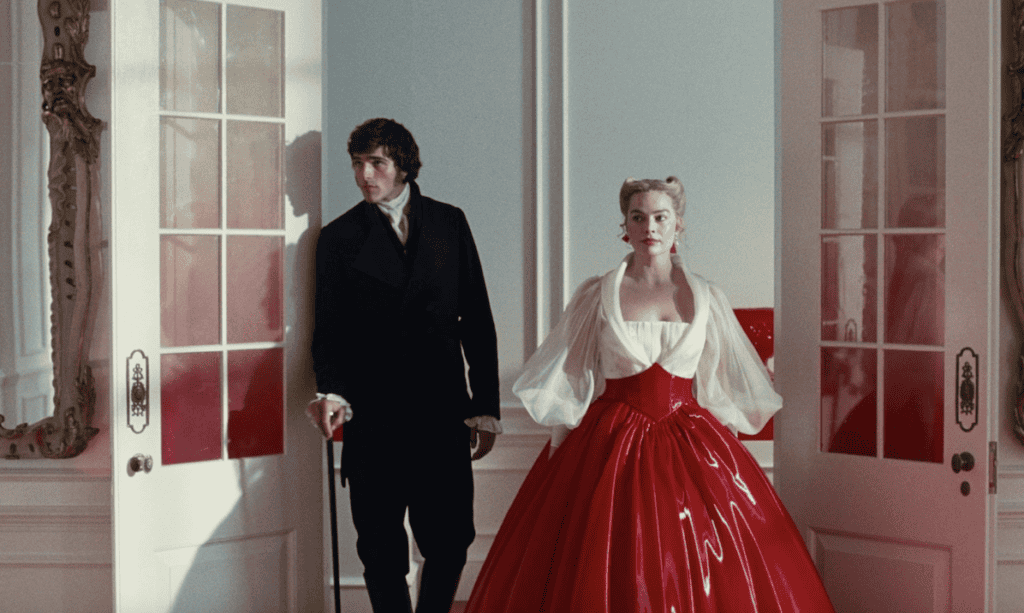
Well, dear reader, we’ve seen the film. And if you’ve been online at all since Valentine’s Day, you’ll know which film we mean. Emerald Fennel’s adaptation of “Wuthering Heights” (emphasis on the quotation marks here) hit theatres on 14 February, and its sexed up take on Emily Bronte’s 1847 novel has divided audiences, to say the least. Some viewers have praised the film’s anachronistic costume design and Tim Burton-esque visuals, highlighting how Fennell has taken a radically different approach to a classic tale – this time putting female sexual fantasy at the forefront.
However, many others walked out of the theatre, at worst, raging, and at best, simply bored. With such a divided reaction, the question remains, how will 2026’s Wuthering Heights be remembered? As a cult classic? Or an embarrassing relic of our time (the Dubai chocolate of cinema).
To get to the bottom of this conundrum, Cold’s Literature Editor, Lexi Covalsen, and Film Editor, Valeria Berghinz, sat down to chat all things Bronte – tongues, aesthetics, and the power of a good PR campaign.
Valeria: Let’s just get right to it. What did you think?
Lexi: I hated it, I really didn’t like the movie. I was so bored the whole time, which surprised me. I love classic literature, and Wuthering Heights in particular, so a lot of my friends were teasing me, saying that I was ragebaiting myself by buying a ticket, but I genuinely had an open mind going into the cinema.
I love Baz Luhrmann’s Romeo and Juliet (1996). I like when adaptations get weird, but halfway through, I looked at my friend and I was just like, do you know how long this movie is?
Valeria: I had the same reaction. I must admit I read the book a couple years ago and really loved it, so I’m not coming at this conversation uniquely from a film perspective. But I’m also not precious about adaptations in general.
Mostly, I was expecting a bad movie, but a good time.
Lexi: Yes.
Valeria: And it was not, it was just boring. It was long, surprisingly tame and not very entertaining, which was the opposite of what I expected from it.
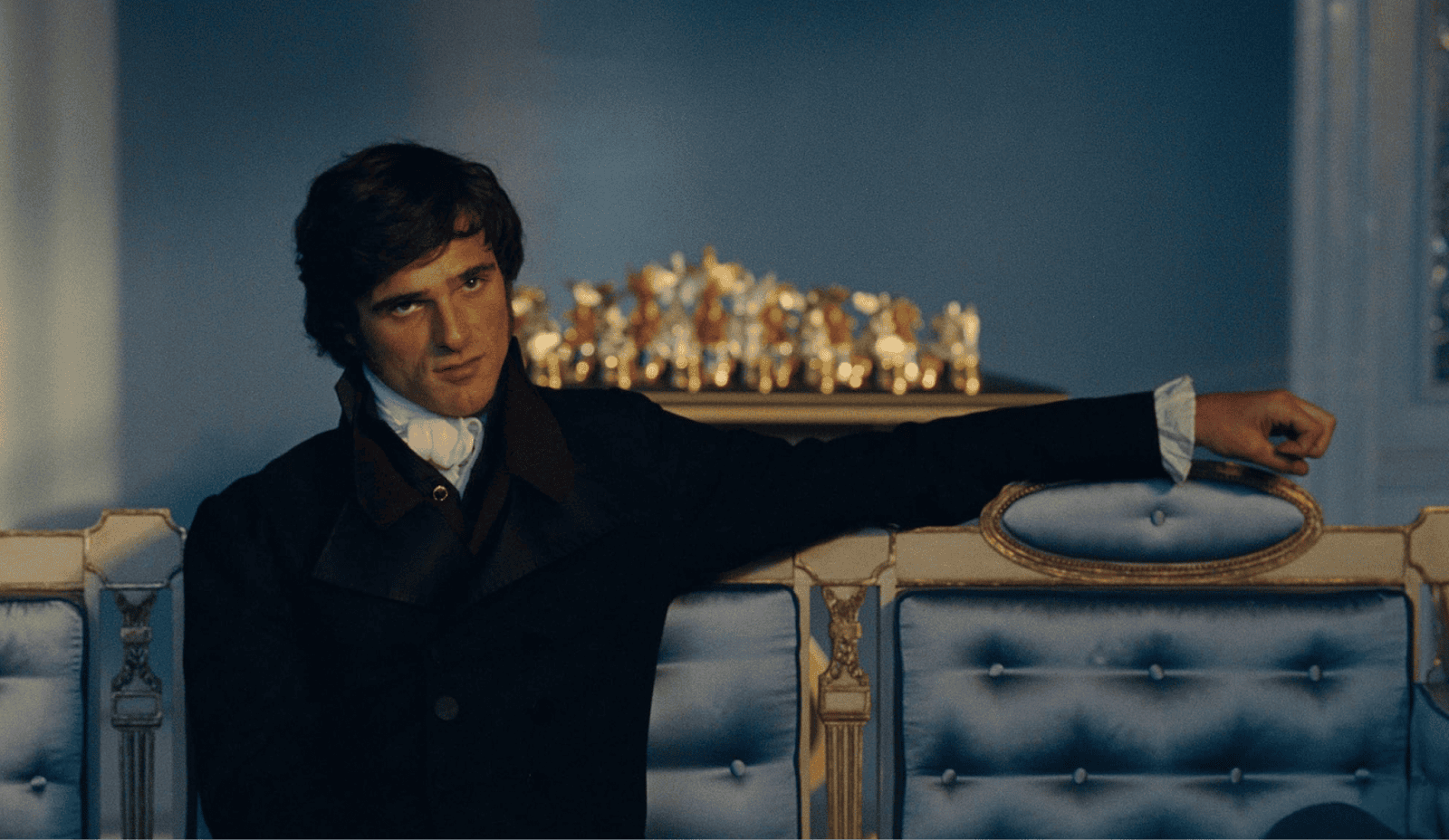
Lexi: I mean, with Saltburn (2023), I felt like it was quite shallow, but it was still fun. The kind of movie you can invite your friends over, put on, and have a good time. So I didn’t think it’d be a good adaptation of the book, but I thought it would be a fun, sexy, shocking experience, like you said.
Valeria: I will say about the adaptation question, many people approach the film thinking that it’s a sin that Fennel would even adapt Wuthering Heights in the first place, and I don’t think that’s a fair criticism.
Lexi: I agree, I don’t think the idea was doomed from the start. But it might have been doomed from the moment of casting, to be honest.
And I know it’s a really popular thing to ask – why a white Heathcliff?
But the more I think about it, and I look back at the book, it’s infuriating how much taking race out of the story defangs the whole thing.
Valeria: I completely agree – but at the same time, as I was watching the film, I kept thinking to myself how much worse it could have been if Fennel had actually tackled race. If she wanted a sexy shot of Heathcliff’s sweaty, muscly back with whip marks on it… I don’t think the film had the capacity to handle that thematic dimension.
And I agree that this decision took away so many layers that make the original story as insane and complex as it is. At the same time, I think we can all kind of breathe a sigh of relief that she didn’t even attempt to handle the implications of what a non-white Heathcliff would’ve meant.
Lexi: Yeah, that’s very fair – I don’t think Fennell is the person to tell this story of racial otherness and revenge. But at the same time, in today’s political climate, it feels like such a missed opportunity.
I feel like all of the trickier and darker parts of Wuthering Heights, like Heathcliff’s ambiguous race, the abuse, the insinuation of incest, the horrendous treatment of Isabella…
all of these dark aspects that we might flinch at on first instict, are actually why the book made such a big splash when it was first published, and what has made it stick so strongly within our culture consciousness.
So if you want to dumb it down, then I just keep thinking – why do Wuthering Heights?
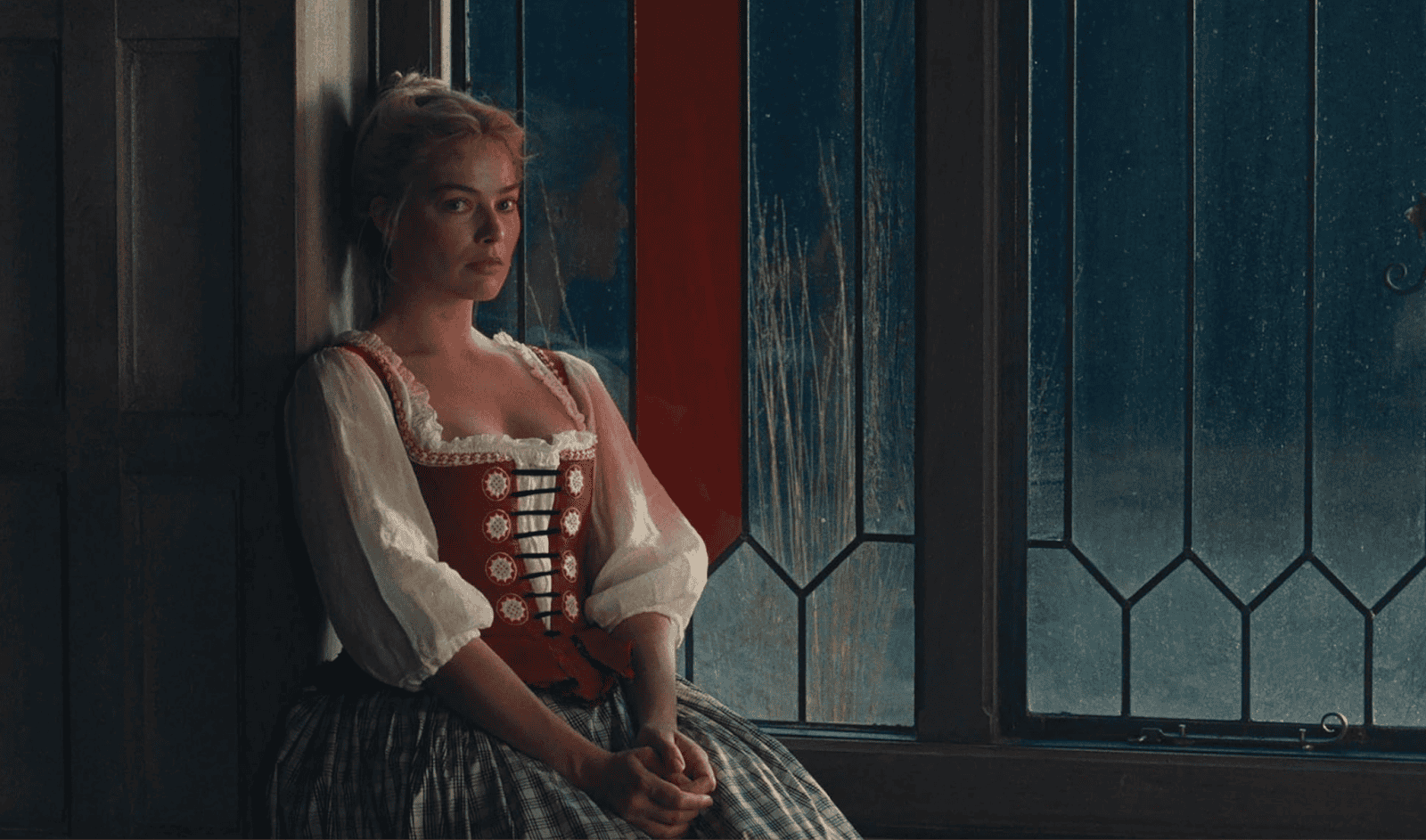
Valeria: I think we’re in a moment right now so saturated with Gothic adaptations in cinema, including Frankenstein (2025) and Nosferatu (2024).
I find it fascinating because the thing about Gothic literature – which I love – is that it’s ultimately about living in a time of scientific progress, so the future lies ahead but it may not be as bright as you’d think… There’s something monstrous lying in wait, and we’re afraid of losing our humanity with this development. At the same time, the past spreads behind you, and it’s this mysterious, scary thing – literally, the sins of the past are coming back to haunt you.
So in Gothic literature, you’re caught between the future and the past. And how incredibly attuned is that to 2026?
AI and Climate Change ahead of us, and the terrible things humanity has done in the past, already haunting us in this insane political moment.
All of these gothic adaptations are perfectly suited to speak to that, but they don’t. Instead, they’re almost solely interested in the individual. With Wuthering Heights it’s the couple, the love story, and you forget about the themes of generational violence and colonial trauma. With Frankenstein it’s about the misunderstood monster, and with Nosferatu it’s the story of the maiden and death. These are all integral parts of the novels, but what the adaptations cut out would also be relevant to us.
And I don’t think this trend in adaptation is intrinsically wrong, but it’s definitely interesting. I think it shows that we’re in a place where the individual is placed above everything else.
Lexi: Yeah, I totally agree with that.
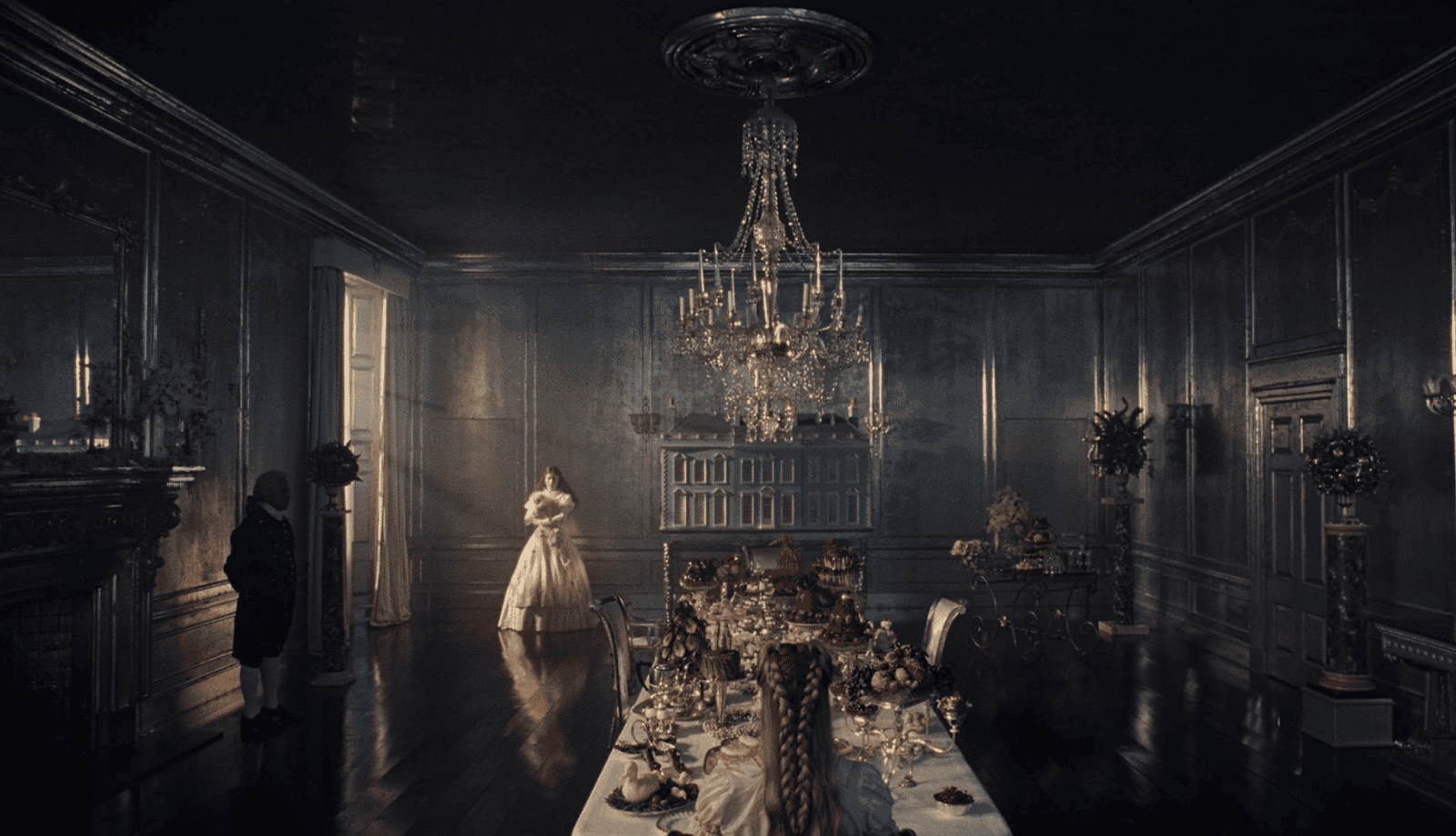
And I think the issue isn’t just that we’re obsessed with the individual, but that we’re also obsessed with the visual, the aesthetics of it all. A big part of these Gothic reimaginings or readaptations is so much about set design and costume design, especially here in Wuthering Heights. Again, it’s not inherently wrong. These are art forms with their own languages that help filmmakers tell their stories… but there’s such an obsession with beautiful cinematography at the moment and I can’t help but wonder, at least with Wuthering Heights, what did it add in the end?
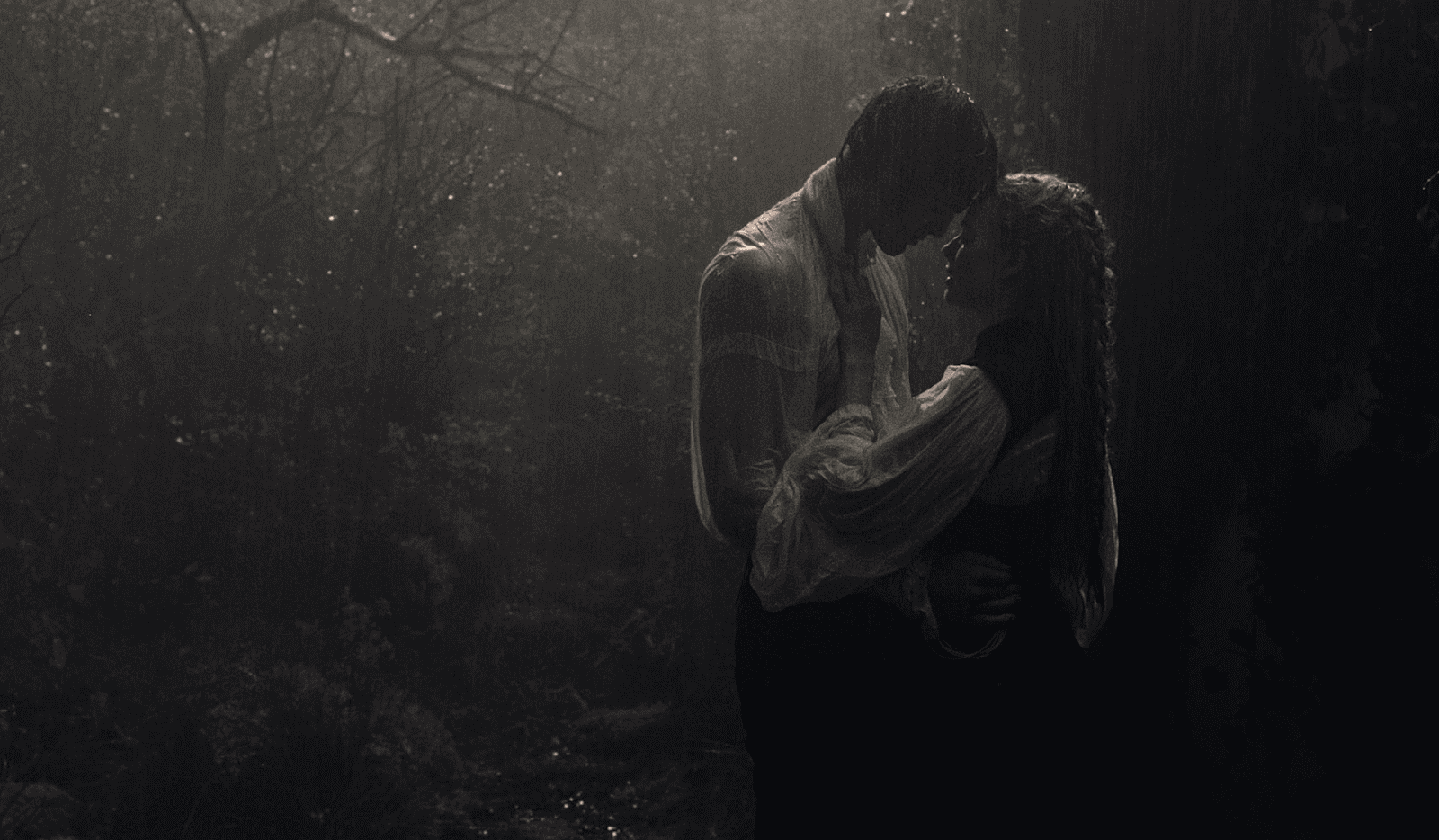
Valeria: Wuthering Heights felt so pastiche, almost like you’re stitching up elements of classic literature, bodice rippers, fantasy, etc. Some people pointed towards aesthetic comparisons with Gone With the Wind (1939) – so all these elements are stuck together, but it does feel like it’s ultimately for the sake of the aesthetic.
Lexi: And there are definitely films where these strong visuals benefit the story and are very much a package deal. But with this adaptation, it’s like they taped a funky aesthetic onto it and that was that.
Valeria: What do you think about cutting off the second part of the novel, which I know a lot of adaptations do in any case?
Lexi: I’m not really offended by that. It’s very much in the cinematic tradition of the novel to only focus on the Catherine and Heathcliff love story, but I wonder if even a hint of the second generation could have made this adaptation more interesting. Because, really, what Wuthering Heights is is a story of generational trauma. It’s not “the greatest love story ever told” as the film’s tagline suggests.
Valeria: Yeah, I agree. I also felt that, with the children’s portion of the film – the father was obviously awful, but somehow it all lacked the terrible severity of the book, the kind of psychological trauma which would turn Catherine and Heathcliff into the awful people they become. And that’s another thing – in the film Heathcliff was cheeky and Catherine was mean, where they should really both be awful people for this to work.
Maybe it’s because the setting didn’t feel so isolating.
I wish we got less of the sets and more time in the stretches of the moors. It should show how gutterally alone they are in this abusive household.
Lexi: I feel that one of the big missteps in the adaptation is taking away the character of Henley, who is Catherine’s brother. In the book, Catherine’s father is quite loving to child Heathcliff and sees him as a son, even though he exists on the outskirts of the household. And it’s only when the father dies that then Henley inherits the estate and begins to mistreat Heathcliff as a servant, even a slave.
That’s when the alcoholism and abuse come in. I think you need that scaffolding to understand why Heathcliff grows up seeking revenge.
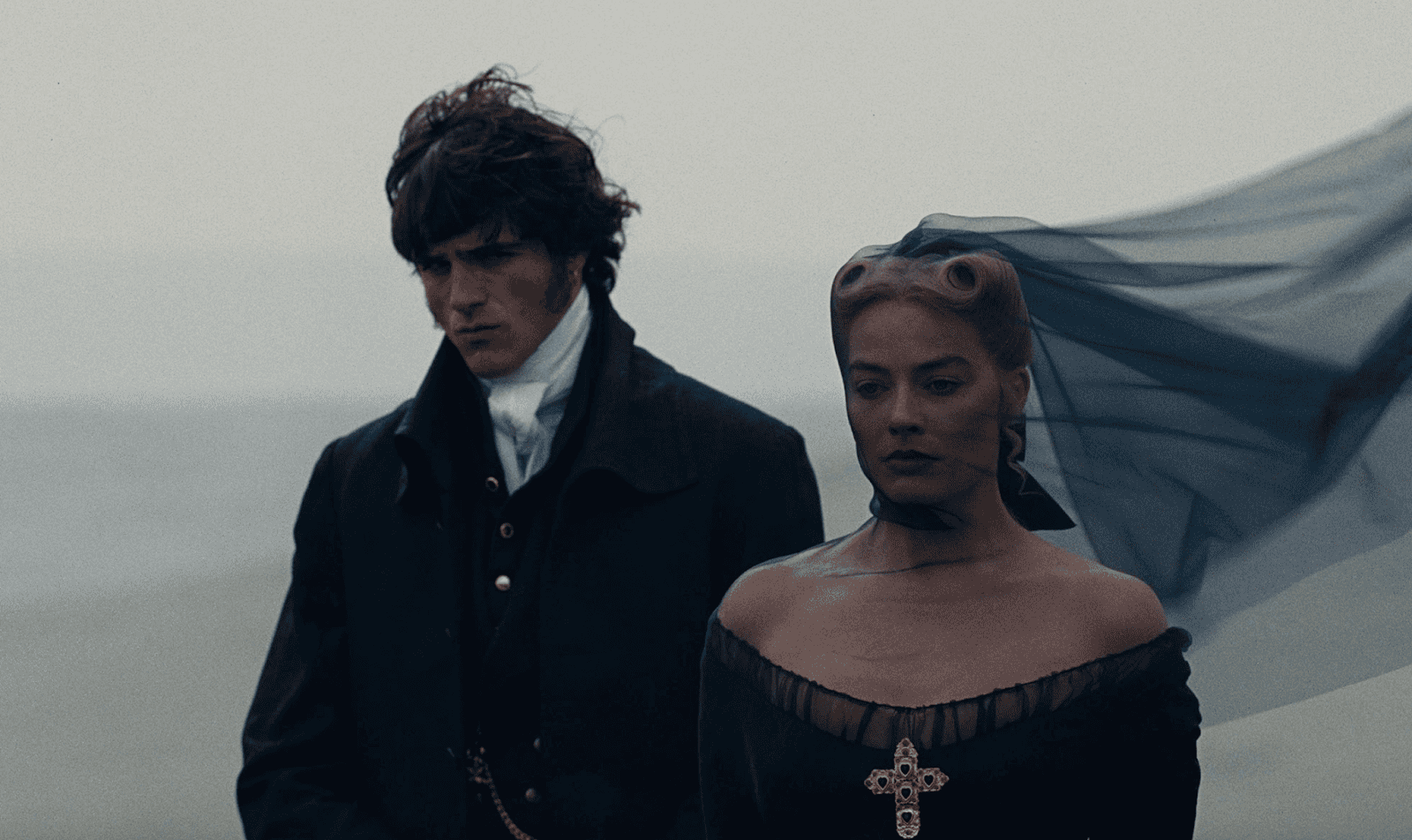
Valeria: What did you think about Nellie?
Lexi: I wasn’t too angry about Nellie’s changes. I liked her becoming a bit of a villain, it gave her more texture in the context of the film. But also, I felt that it was a cool idea that didn’t really go anywhere.
Valeria: I was surprised when I first heard people refer to Nellie as a villain. I guess she comes between the lovers, but her actions were so reasonable in the film that I didn’t realise she was supposed to be villainous.
But I agree – she has these interesting impulses and you wish they would take her somewhere. Or that there would be some kind of reckoning or catharsis at the end of the film for her. I get that Fennel wanted to end with the “haunt me” speech, but still…
Lexi: I feel like the bits of Nellie I really enjoyed were the bits that were most Heathcliff coded, if that makes sense.
They set her up as Catherine’s companion, and they were the best friends running across the moors. But then she’s ignored in favour of Heathcliff. That’s similar to how Heathcliff’s story plays out in the book, where he’s a beloved member of the family who is then reminded of his otherness, reminded of his class and his race, and then relegated to sleeping in the stables.
So maybe being reminded of that story with Nellie is why I enjoyed her scenes more.
Valeria: I have to say, though, I did read that sales of Wuthering Heights have spiked like crazy. So that’s something to say in favor of an adaptation that gets this much attention – it inevitably brings people back to the source material.
Lexi: Yeah, that’s true. I don’t think it’s a total net loss. Even though I’m not the biggest fan of Fennell, I saw the box office numbers and headlines saying that she’s now in the running for being the one of highest-grossing female directors, so I’m glad we have a female director succeeding in that way. I’m glad people are buying Wuthering Heights.
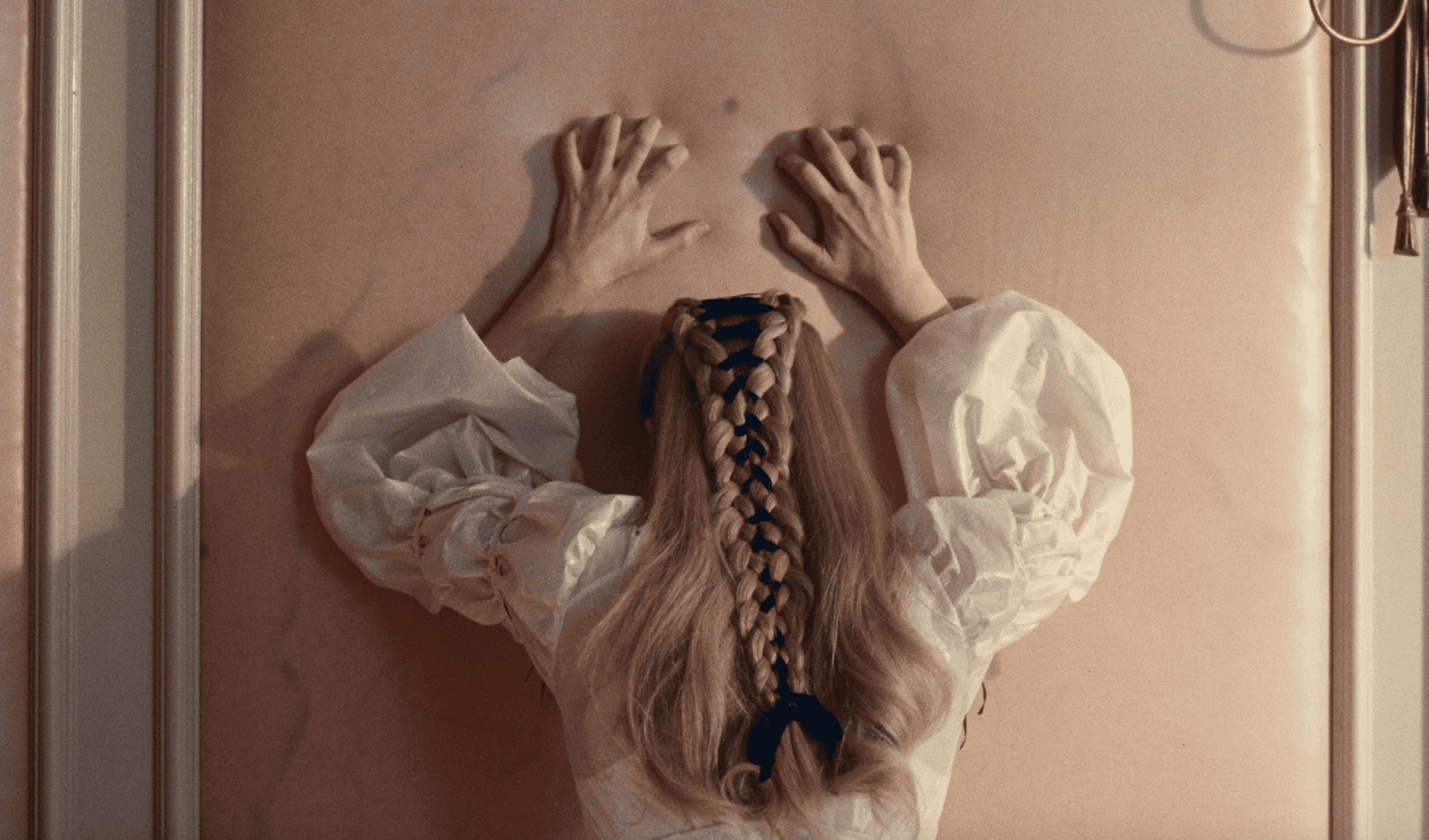
Valeria: And I will say, something that’s annoyed a lot of people this year — starting maybe with Wicked and going on to Marty Supreme – is the insane marketing strategies we’ve seen. I don’t think people always realize that’s what’s happening.
With this one, you had so many Margot Robbie quotes like, “I was watching it with my friends and they were feral for Jacob Elordi,” and so many sexual innuendos in interviews. I’ve heard a lot of people annoyed by how oversaturated the film felt in the market. The same thing happened with Timothée Chalamet, and obviously Wicked: For Good (2025) was everywhere.
Marketing can be annoying, but cinemas are struggling. If people are in theaters because of that push, I don’t necessarily see it as a negative.
Lexi: Yeah. How did you perceive the Wuthering Heights PR campaign? Because with Marty Supreme (2025), I was charmed. Chalamet seemed in on the joke. It felt smart, very self-aware. Whereas with Wuthering Heights, it felt different. I don’t know, what did you think?
Valeria: I felt the same about Marty Supreme, though I’ve had friends who were really annoyed by it. With Wuthering Heights, I kind of feel like… whatever. But I’ve had people say, “Do you know Margot Robbie is married?” And it’s like… yeah. This is PR. She’s not actually fucking Jacob Elordi. Even if she were, why should I care?
I recently got an Instagram ad that said, “You can’t get climax without IMAX. Watch it in IMAX theaters.” And I did laugh. It clearly stuck with me. I just feel like we take these PR campaigns too personally.
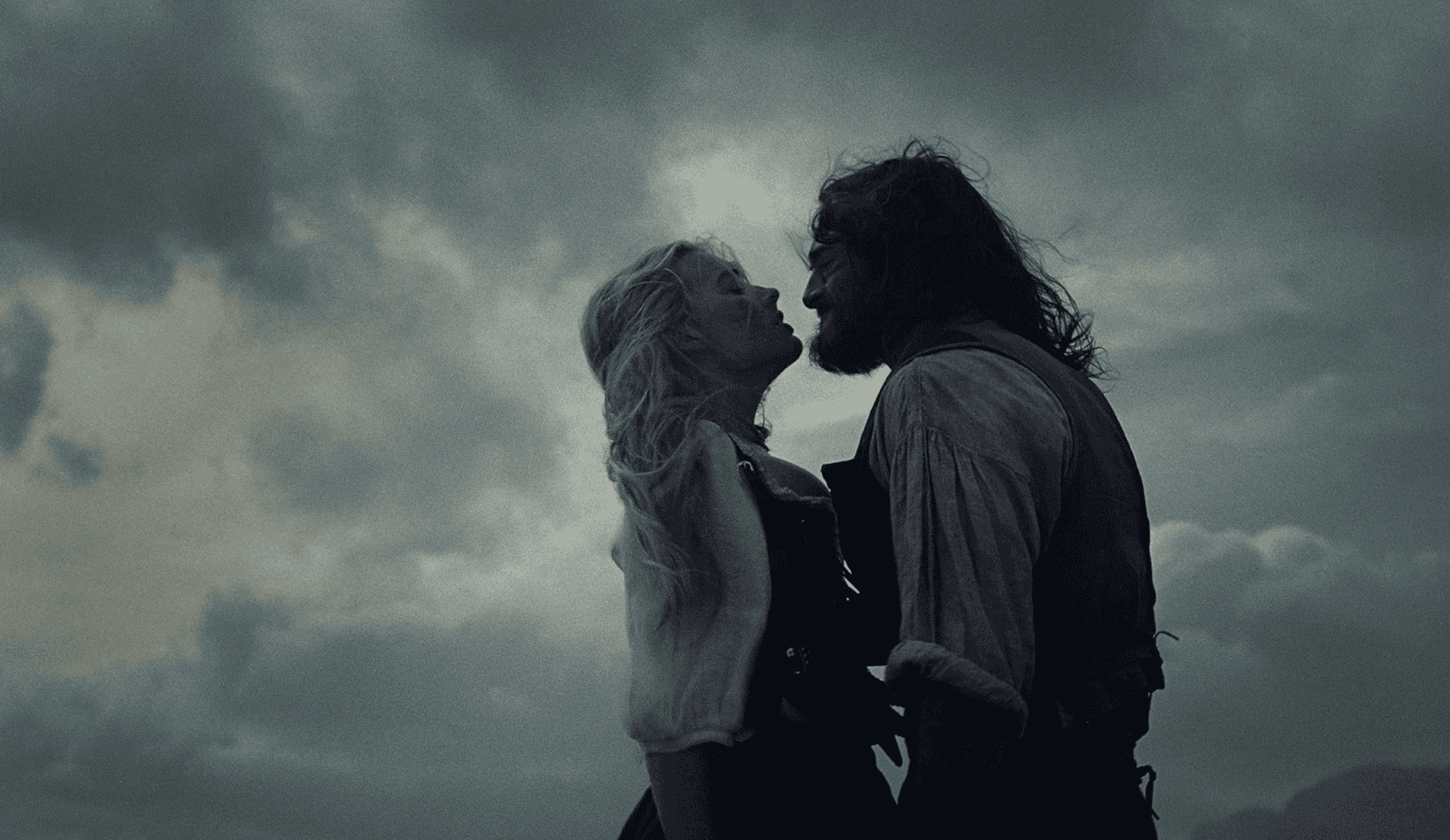
Lexi: I wonder if it’s also an audience issue. Maybe with Wuthering Heights we’re just the wrong audience, too online or too pretentious for it. I wonder if readers of Colleen Hoover, for example, are genuinely enjoying it.
Valeria: I’ve seen trends of women putting on corsets and asking their husbands to lift them up by them. Maybe those audiences are having fun with it. Who are we to say that’s wrong?
Lexi: Yeah, maybe because it’s Wuthering Heights – a piece of classic literature – that was the misstep. If she’d adapted something without that academic prestige, maybe it would have drawn a different audience and hit better with the intended one.
Valeria: What’s funny is that by attracting audiences who know how dark and transgressive the novel actually is, you end up with people watching the film and thinking, you didn’t even skim the surface of how messed up this story is.
Lexi: And another net positive is that people are going back to look at Emily Brontë and her life. As someone who studied literature from that period, I’ve enjoyed that.
People are scrutinizing Emerald Fennell as an artist, and that’s also led to renewed interest in Emily Brontë as this singular female creator. That literary-historical conversation is cool to see.
Valeria: The same goes for Frankenstein: it’s great to highlight these amazing female writers from the past and remind people that horror has always had women at its core.
Lexi: Did you have a character in the movie that worked for you? Someone where you thought, “Okay, I see what they’re doing”?
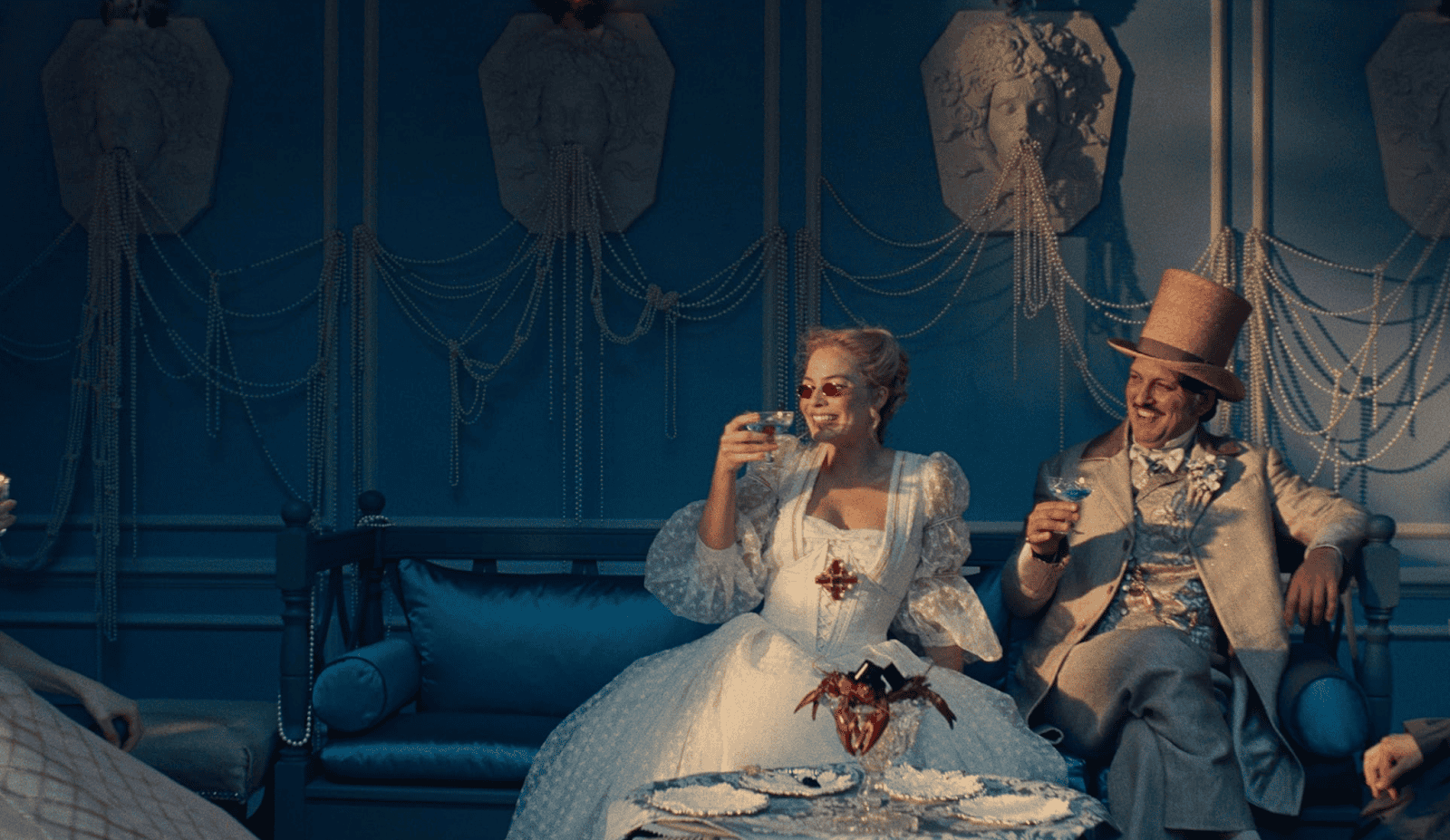
Valeria: Not really. I will say the actress who played Isabella was strong. Even though there’s a lot to say about what they did with her character, she really committed. The audience was laughing every time she had one of her moments.
But the puppy-play storyline…
Lexi: I agree. I loved the actress, she was amazing. But the puppy-play scene was the one moment that genuinely made me angry.
For most of the film I was bored, but that scene actually pissed me off. I was like, in this climate, is that really what we want to be putting out there? That visual of a young woman on a chain, being sexually humiliated in that way?
Valeria: Yeah. Given that Heathcliff couldn’t be monstrous in this version, because we have to be charmed by him, I guess that’s what we got instead. I’ve seen people argue it gave Isabella agency, which I don’t really agree with. She was fun, but come on.
And the scene where he says, “I’ll marry you, but I won’t love you, do you agree?” It was so heavy-handed. There wasn’t even space for ambiguity.
There could have been an interesting theme about isolation: that even if you think you’re protecting someone, if you isolate a girl from the world she won’t recognise what’s bad for her. That could have been compelling without having to make Heathcliff an outright monster. But instead it turned into something else entirely.
Lexi: I’m not opposed to making Heathcliff and Isabella’s relationship more mutual or complex, but visually – seeing a woman chained like a dog while we’re meant to desire the man who has chained her – that just didn’t sit right with me. It felt regressive.
The whole movie felt male-obsessed in the end, and that rubbed me the wrong way.
Valeria: I’ve also heard, and I don’t quite remember this from my reading of the book, that Nellie’s narration had homoerotic subtext that was removed in the adaptation.
Lexi: I don’t remember that clearly, but now I want to reread it!
Valeria: Same. So again, positives. We love books!
Lexi: If I had to wrap this up, I’d say the movie was worse than I expected. I knew it wouldn’t be a faithful adaptation, but I thought it would at least be fun: visually spectacular, sexy, funny. I thought I’d have a good time. It failed on both counts. It was not only an atrocious adaptation, but also boring and surface-level. It felt like a collage of beautiful costumes and sets without heart or a clear message. Hollow.
Valeria: I agree. I went in separating it from the adaptation question. If she wanted to make a porno version of Wuthering Heights, so be it. But it was tame and dull!
You can adapt something and change it, stripping it of its original themes – that’s fine. But you then have to replace them with new ones. And there wasn’t a message here. If the message was supposed to be “love,” it didn’t really have much to say.