
Gok Wan’s desert island luxury was lip balm. Cornelia Parker’s was a solar-powered vibrator. Kate Moss and Marina Abramovic both chose cashmere blankets. Mine might well be the contents of Contemporary Wardrobe, the clothing archive founded by Roger K. Burton in 1978.
Roger, or Rog, as he is affectionately referred to by archivists Liberty and Sofia, started the archive by accident. A snappy dresser and heralded mod, Rog was approached by the makers of the 1978 cult-classic Quadrophenia and asked if he’d provide the wardrobe. His career in costume became an extension of his passion for dressing up and soon he was loaning his expanding collection of Teddy Boy suits and gogo dresses out for shoots, videos and film.
Being friends with Viviene Westwood and Malcom McLaren helped – Rog had designed their shops World’s End (1979) and Nostalgia of Mud (1982-1983) and amassed a small fortune of items from the SEX and Seditionaries era – but his collection was mostly made up of items that spoke to him rather than designer pieces. As word got out about Rog’s capacities as a stylist, more films followed, including another cult-classic, Hackers, in 1995. Unlike most costume designers, Rog kept everything – there’s a constant stream of fans trying to buy Angelina Jolie’s iconic Quicksilver rash guard and her Suzuki leather jacket worn in Hackers. The archive absorbed not just pieces he collected professionally, but hand-me-downs from everyone Rog knew: his sister’s riding coat, his mother-in-law’s evening dresses, a pair of Lee Bowery suits sourced by a mutual friend, clothes bought on his extensive travels in Japan and California, as well as bits from H&M, auctions, house clearances, Ebay, markets… Rog’s archive had grown to include over 20,000 pieces by the time of his death last year.
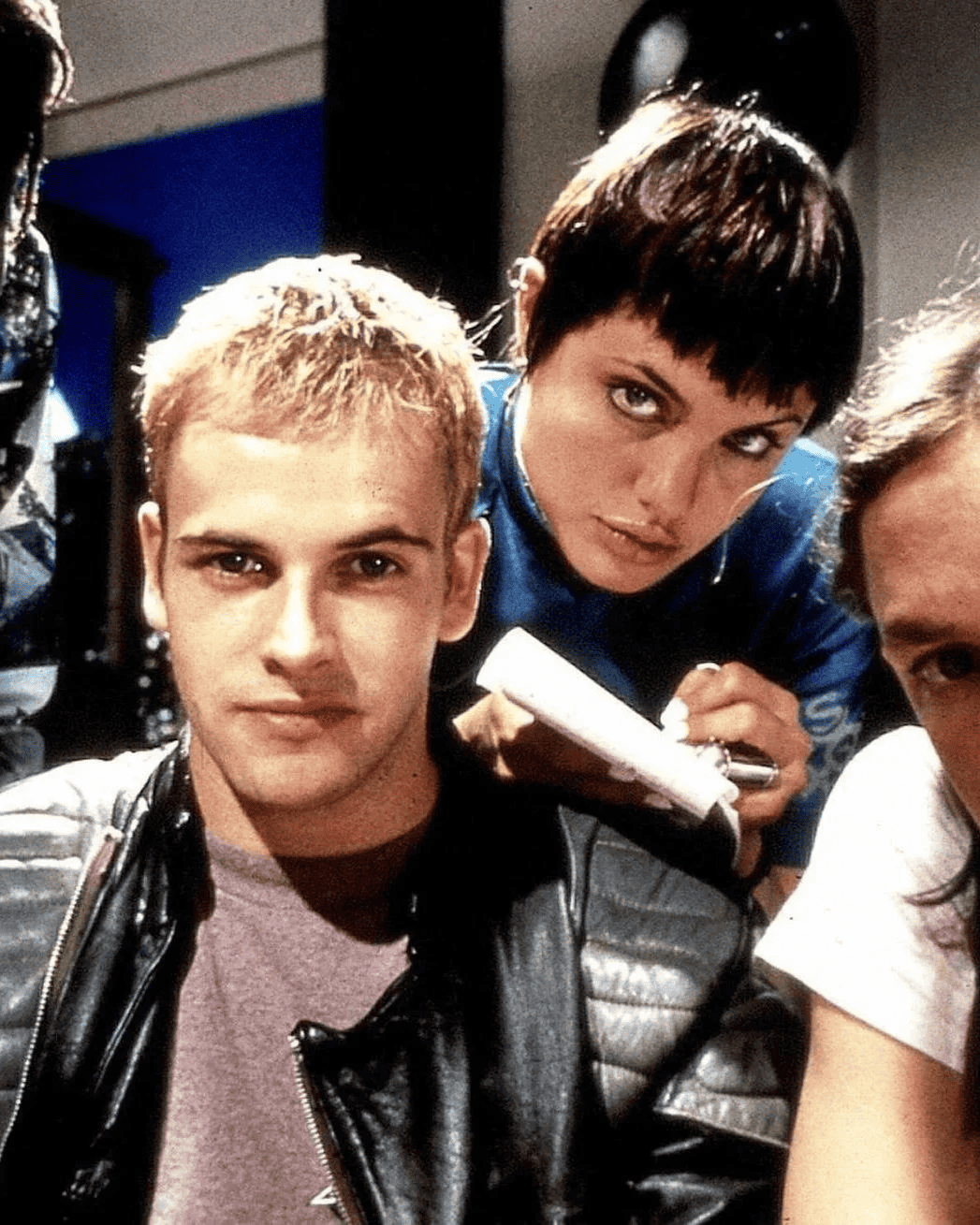
Johnny Lee Miller and Angelina Jolie in Hackers
Contemporary Wardrobe is the perfect outcome for a would-be-hoarder. In high demand from stylists for film, music videos and editorial shoots, the unparalleled collection of street fashion and youth style is not only a thriving business, but also a valuably accessible resource for researchers and the culturally curious.
When I arrive at the archive in Bloomsbury, it smells like musk, dust and good times, but it looks immaculate. Housed in an upstairs room of the Horse Hospital, they’ve recently completed a rehang and thorough nit-picking of the collection, removing freewheeling Primark vests that have snuck in from shoots over the years. Four double-height rails of clothes fill the space floor to ceiling. May sunshine filters down to the aisles of leather hotpants, mohair jumpsuits, soiled bondage trousers and static slip dresses, dappling the odd poster and film prop here and there.
Presiding over it all are the archivists, Liberty and Sofia. Liberty, in an enviable Chopova Lowena skirt, is seated in a comically large magistrate’s chair embossed with Elizabeth II’s monogram. She and Sofia both studied Fashion History at CSM and, to be honest, have the dream job.
Sofia (S): I’ve worked in places where you’re preserving the clothes and they’re being put away in boxes and you handle things with little white gloves. Here, it’s completely different. It’s an archive of clothing that is used. It’s constantly going out. So that preservation aspect isn’t here, which is unique. We mend, yes, but it’s not like the Valentino Archive. They’ve got boxes and the clothes are folded away and you can’t see things.
Liberty (L): At the V&A, if they acquire something, no one will ever wear it again. It’s like they don’t want it to degrade any further. But here, pieces are being worn all the time.
Cold Magazine (CM): Do you think everything here gets worn, or are there some pieces that no one ever pulls out?
S: There are some things that are less used. There’re some real favourites, things that are used by different people but that are constantly going out.
They tell me that the military jackets are especially hot right now. Trend snob that I am, I’m glad I didn’t wear mine.
S: We don’t have much designer stuff. We have some for sure, obviously with punk, we’ve got a lot of Vivienne Westwood and Malcom McLaren stuff. But here it’s a lot of subcultural clothing. Things that people actually wore. That’s what Rog was interested in with youth culture.
L: It’s subcultural pieces and a lot of brands that are now defunct but which are really fab and interesting. We have a lot of Mr Freedom, a lot of Biba, Mary Quant… brands which aren’t around any more. And then we have these special collections, like this artist Sebastian Horsley. We have several suits of his and some shirts. He had really great taste. There’s some really beautiful Saville Row.
S: He had things tailored to what he wanted, very elongated, with pointed collars, extended cuffs.
They’ve pulled out a selection of collection highlights to show me, including a tailored blazer that once belonged to Horsley. Formerly tweed, it’s now decorated with a Pollock’s worth of red and black paint. Incidentally, I’ve just started reading Horsley’s controversial memoir, Dandy in the Underworld, which is a riot of inappropriate language, addiction and dressing up as Marc Bolan, and he’s only just turned twelve.
L: This piece is really unique because of the paint, it has a literal history on it, [Horsley’s] practice is reflected in it. He was also a heroin addict and we have a lot of shirts of his that have tears in the arm. It’s quite shocking, but it’s also quite moving.
S: We always tell people if they’re trying to hire it out that that’s why it’s ripped.
It’s a dark story, but it’s the personal, anecdotal aspects of the collection that make it so unique. One of the other great collections is the bespoke couture worn by Michael Hochong, a 1970s Soho character and restauranteur of whom there’s very little record besides his flamboyant wardrobe, bought up by Rog and kept here. His is the slinky black jumpsuit, freckled with diamanté and black feathers curling at the flared hems. Then there’s a Lee Bowery suit, emerald green and lightly pinstriped, fringed with his signature bobby pins: a disarmingly couture outfit for a club kid. Next to it hangs an equally verdant dress by Bowery’s friend, Rachel Auburn, donned by FKA Twigs for the Jealousy music video a couple of years ago. I’m surprised to find out that a SEX hangman’s jumper is quite literally knitted out of string. Insights like these remind you why digital reproductions can only bring you so close to fashion. How often does Pinterest show you a 1960s Courrèges minidress with a cigarette burn in the back? Or let you feel the weight of Jolie’s biker jacket from Hackers? Some of the pieces are looking very much ‘pre-loved’, but I’m assured nothing of cultural significance will be thrown away, even things Rog got for a pittance.
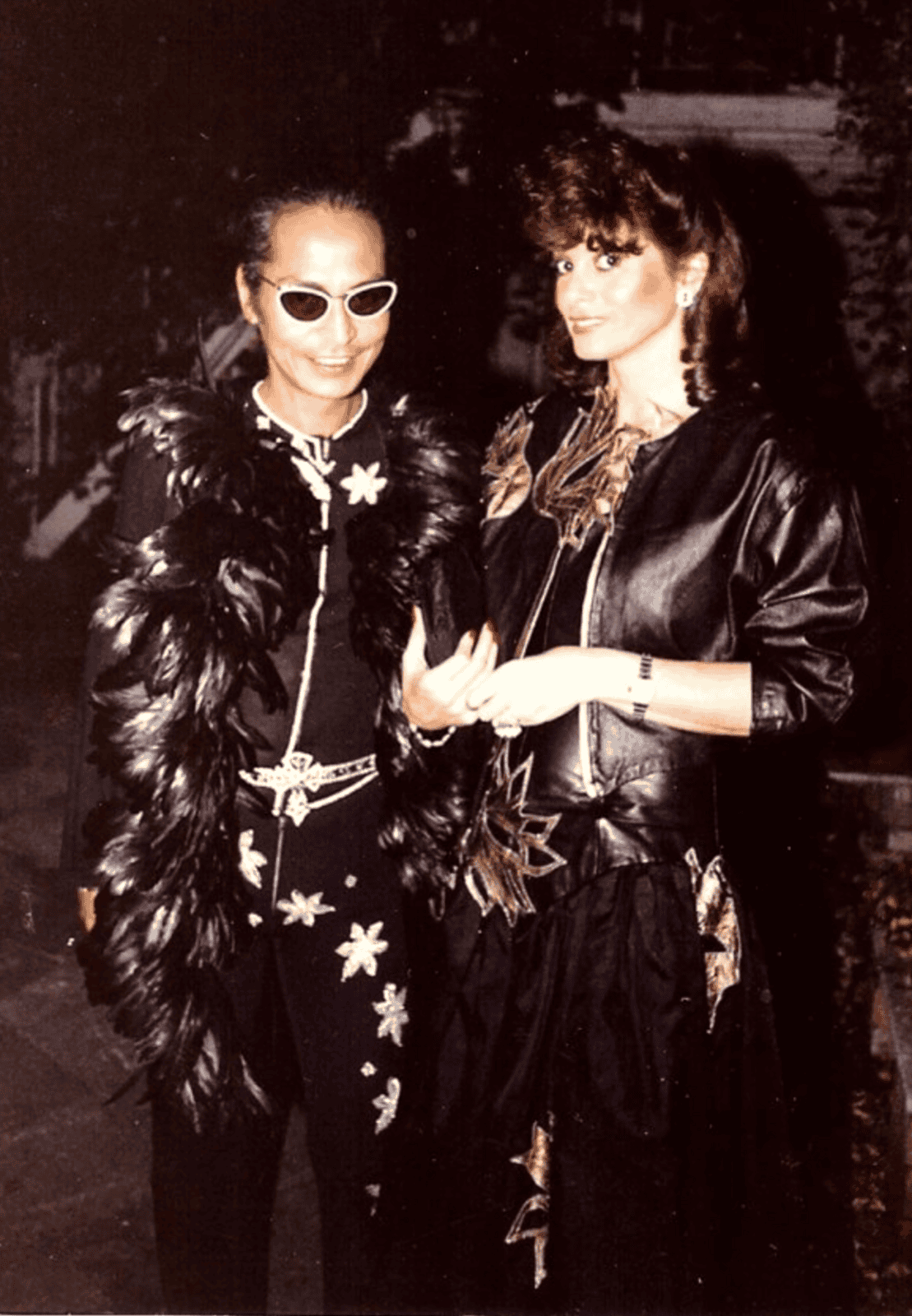
Michael Hochong in his jumpsuit.
CM: How was Rog sourcing his pieces? Did he ever buy things new?
L: He did buy highstreet stuff if he thought that there was an interesting thing about it – a silhouette or something. But collecting vintage, when he started doing it, it wasn’t a big market. It wasn’t like nowadays when everyone uses eBay and Depop. He said you could get boxes of Victorian shirts and people would say ‘I’m not going to use these, no-one’s going to wear these again. They’re going.’ The landscape of buying vintage has really changed. Nowadays, it’s stuff from Topshop from twelve years ago which is now really valuable to some people.
We all find it funny that Effie from Skins is the arbiter of taste once again.
CM: What was Rog’s rationale behind what he collected? Was he concerned by balancing different styles, or was he guided by personal taste?
L: I don’t think when Rog was building the archive he thought about it in a structured way, I think it was more things that he liked, and projects he was working on.
S: You can really see some of his interests within the archive. He loved women’s shoes. Although we probably have a little bit more menswear, we have so many women’s shoes, more women’s than men’s, because he just loved different styles. He was fascinated by shoes, heels particularly.
L: And we have a lot of western stuff, another one of his interests.
S: Americana he loved. We have a lot of these toys back here that he picked up around California. Working on music videos, you just accumulate so many things, because he’d buy stuff for them and keep it. Some people get rid of it and try to sell it, he’d keep it to then be used again. From all those projects you end up with a bill of all these characters and all these people, within this archive.
Given how obsessively nostalgic current codes of dress are, it’s refreshing to see pieces which don’t fall easily into an established subculture, clothes where deeply personal passions are written all over the fabric. My favourite piece is a hand-knitted vest of Lou Reed’s album Transformer. Thinking of the hours it took to create makes it as touching as it is desirable. Sandy Powell used it in How to Talk to Girls at Parties and wore it herself for a few weeks afterwards, hoping it wouldn’t be missed.
Many of the items here are quite literally unique, a reminder of how limitless the stories we can tell through clothes are. And yet, somehow, the collection at Contemporary Archive feels complete. Bar the odd donation, they’ve stopped acquiring pieces and are instead focusing on opening up what they already have. It doesn’t signal the end of youth culture by any means, but a chance to share this cornucopia of 20th century fashion with those of us not living through it.
CM: What’s next for the archive?
L: The next phase now that we’ve done the refurbishment and the relaunch is to have a digital archive. We want to have a system where everything can be accounted for and everything has its place. We have all these magazines with our credits, and we’d love to digitise those to join the dots up, so then we could say ‘This piece was shot by Jurgen Teller’. There’re a lot of stories within the clothes. Because we don’t necessarily always know the backstory behind pieces, a lot of people will see something and just think it’s cool. But some people come in for research: a girl wanted to research a specific 60s brand, and we have a leather jacket by them. Other people wouldn’t know where it was from and they just see a cool jacket. There are a lot of different ways to approach it. That’s why we want to make it more accessible to people, whether you’re coming with more expertise, from a more academic background or from a styling one. There’s room for all those approaches.
Contemporary Wardrobe is available for appointments Monday – Friday. Details at contemporarywardrobe.com