
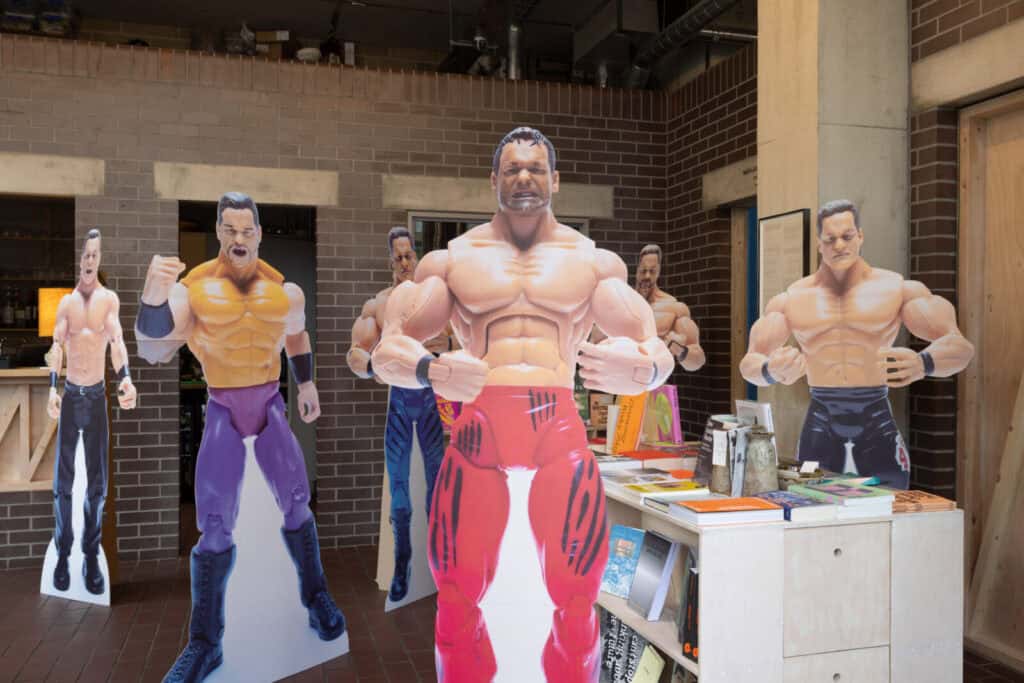
Dandy Day became interested in wrestling because she had to. Growing up in Langley, Slough and the youngest of five siblings, the current Royal Academy student spent much of her childhood following her older brothers around. WWE and wrestling was a constant feature of family life, and being thrown around and roughened up was part of the fun.
The world of professional wrestling is the subject of her second solo exhibition, Ruthless Aggression, on show at TACO! gallery until July 26th. Day’s recreation of a childhood bedroom – ambivalently theirs and nobody’s, a liminal every-room that fades into itself – also ponders the limits of nostalgia. Is it escape? Or is it a distortion? Is nostalgia happy? Or is it melancholic? Having lost their mother when she were 19, these questions hang heavily in their work, which deals with themes of memory and fandom – including at the ongoing Holy Pop! exhibition at Somerset House.
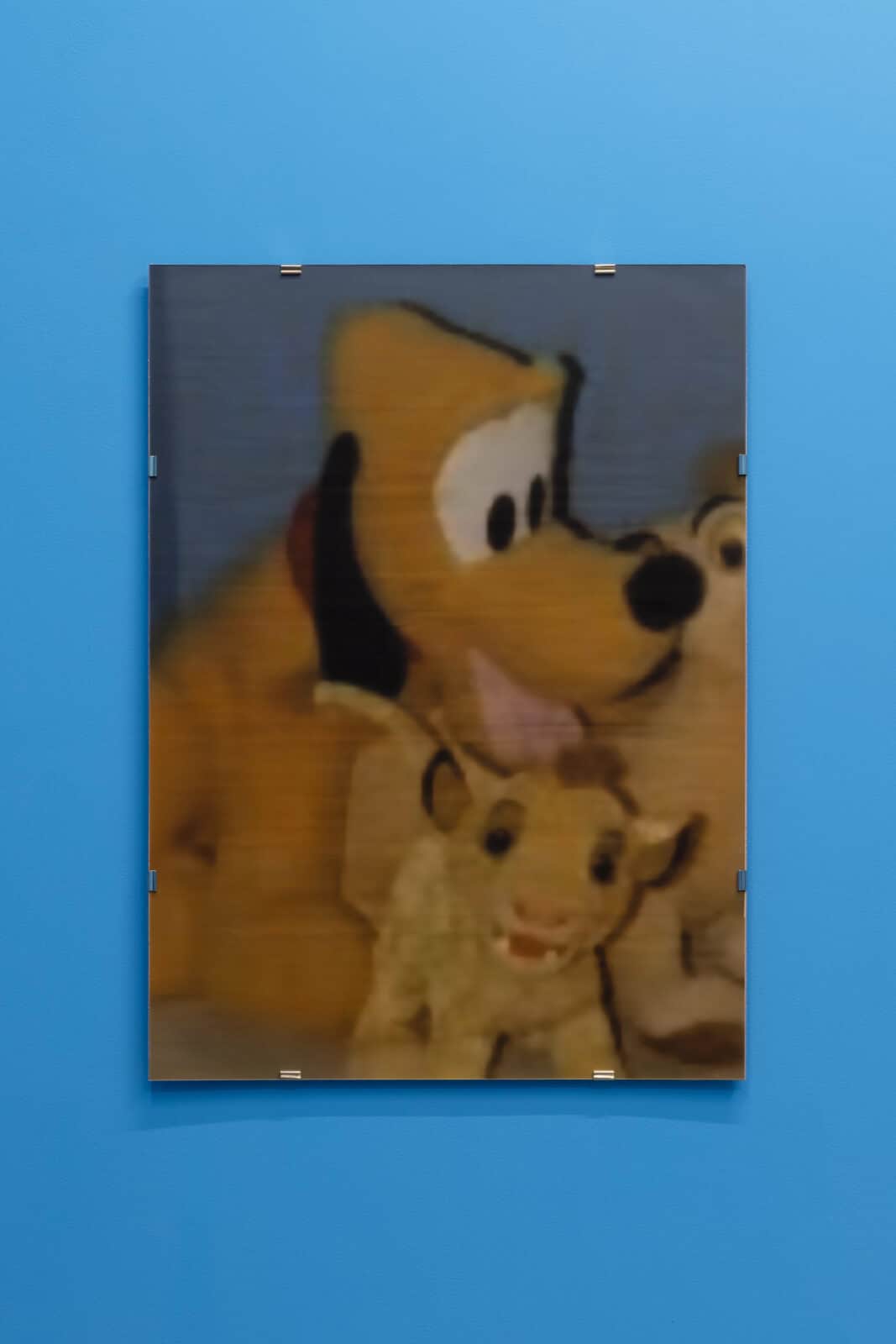
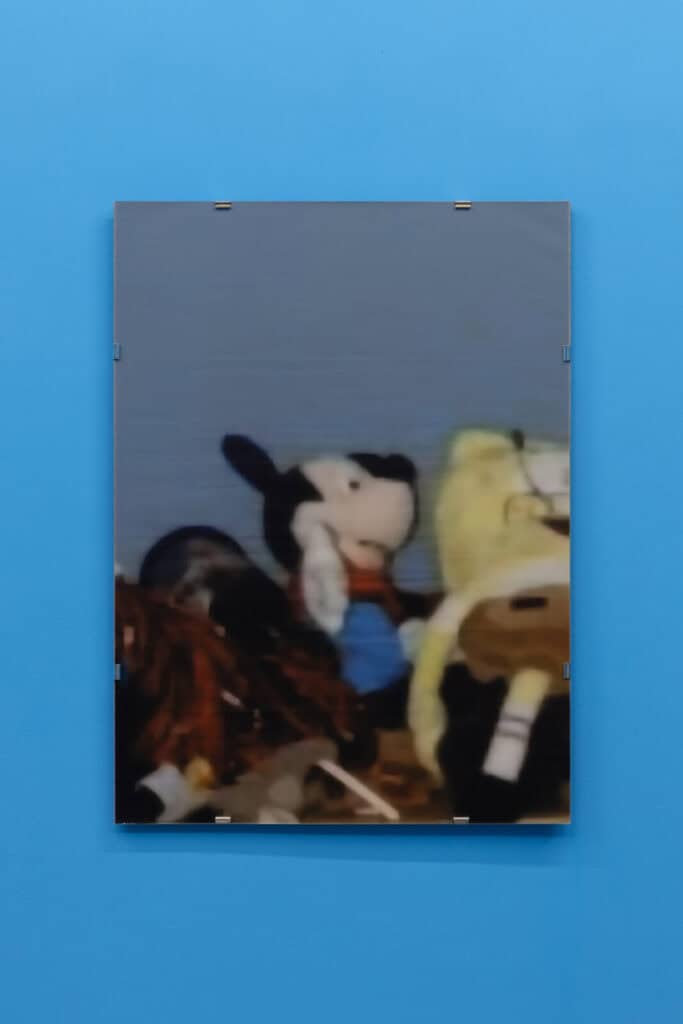
“Nostalgia is mourning,” they say. It’s a profound statement, only half drowned out by the comic excess of the cardboard cutouts of wrestling figurines that guard the exhibition’s entry.
The Cold Magazine (CM): Did you grow up watching WWE? What’s your favourite memory of the show?
Dandy Day (DD): I watched WWE because my brothers did. As the youngest sibling, I just liked what my brothers liked. We liked beating each other up and created our own wrestling show: DBW (Day’s Backyard Wrestling). We all had our own characters that we developed with in depth story lines. My character was killed by my ‘twin brother’, to which I later came back from the dead to reap my revenge. I actually only later on realised that all our character names were named after beers. We had Cobra, John Smith, I’m sure I was called Stella?
CM: Who was your favourite wrestler growing up?
DD: As a kid it was definitely The Undertaker. But mainly because of his entrance. You knew he was coming when the lights suddenly went out, the stadium now in pure darkness, a loud gong echoing through the crowd. With slight embarrassment, it still gives me chills thinking about it now. He had the most theatrical of entrances, scary but exhilarating. I got to see him live when I was about seven and his entrance has stuck with me ever since.
CM: Why were you attracted to WWE as an artistic subject?
DD: Wrestling covers all the big hitting themes. As Paul A. Cantor notes in his essay about professional wrestling, “All the elements are there: sibling rivalry, disputed parentage, child neglect and abuse, domestic violence, family revenge.” WWE allows me to talk about all these things without having to say a word about my own experiences.
Another huge influence on me was Andy Kaufman, who changed the face of professional wrestling. He challenged expectations by mixing reality and fiction until it became difficult to tell where the performance ends and real life begins. Kaufman made the fans ask “was that supposed to happen?” and WWE knew they would profit from it. That’s what fascinates me. I love it.
CM: Your artwork deals heavily with themes of childhood, youth and nostalgia. Why are these such attractive subjects, both for yourself and culturally in general?
DD: For me nostalgia is grief. I always find myself returning to things of my childhood in an attempt to return home and ultimately return to my mum, who died when I was 19.
Before this series, I made work about The Beatles, who for me embody my mum. Fandom, for me, is a way of keeping us connected to our pasts and to people we may have lost. I like that my work can be labeled nostalgic because that perception acts as a cute, squeaky clean mask, obscuring the darker themes that may lie underneath.
CM: Filmmaker Werner Herzog – who, remarkably is a fan of WWE – once described it as, “a very raw, primitive form of new drama is being born, as primitive and crude as it must have been in the earlier Greek times before Sophocles and before Euripides, when something like this emerged for the public eye.” What do you think wrestling, and the adoration of it, can reveal about our subconscious, our hidden desires?
DD: In Roland Barthes’ Mythologies he writes “The World of Wrestling”, where he describes wrestling to resemble a religious drama. There are clear distinctions between good and evil (or, in wrestling terms, a baby face and a heel). Fans simply want to see justice being had so that moral order is restored. Wrestlers like Hulk Hogan represented America, so when he won, America won. Pretty simple.
CM: Professional wrestling’s on-stage drama also bleeds into real-life drama. In this show, you decided to include the wrestler Chris Benoit, who murdered his wife and son in 2007 before committing suicide, an act that has been linked to cranial trauma he sustained in the ring. Why was it important to include his story?
DD: Chris Benoit’s story represents the point where the mythology of professional wrestling catastrophically collides with reality. I adopted Benoit’s story to disrupt the framework of WWE. I’m interested in the spectacle of wrestling which masks this bleed through into real-life. I focused on the son’s bedroom rather than the crime itself because I wanted to shift attention away from the spectacle and toward its human consequences. By zooming in on the scene of crime, traces of childhood and domestic life expose what those myths often conceal.
The work is not an attempt to explain or redeem Benoit, but to examine the tension between the fictional narratives we as fans engage in and the reality beyond them. Benoit’s story became a tool for me to think about performance, domestic abuse, masculinity, hero worship, and the fragility of the mythic image.
And it’s interesting, I walk past the monumental Hercules cast, exhibited at the Royal Academy, everyday as I enter the studio. Hercules exists within the realm of myth. He is the embodiment of exceptional physical strength whose fate also resulted in violence against his own family. Hercules functions symbolically to establish moral value – like Hulk Hogan did in the WWE heyday – yet Benoit was a real life phoney. Chris Benoit, the wrestler and the story, flew too close to the sun and the power of the WWE trickery turned his story into a real-life tragedy.
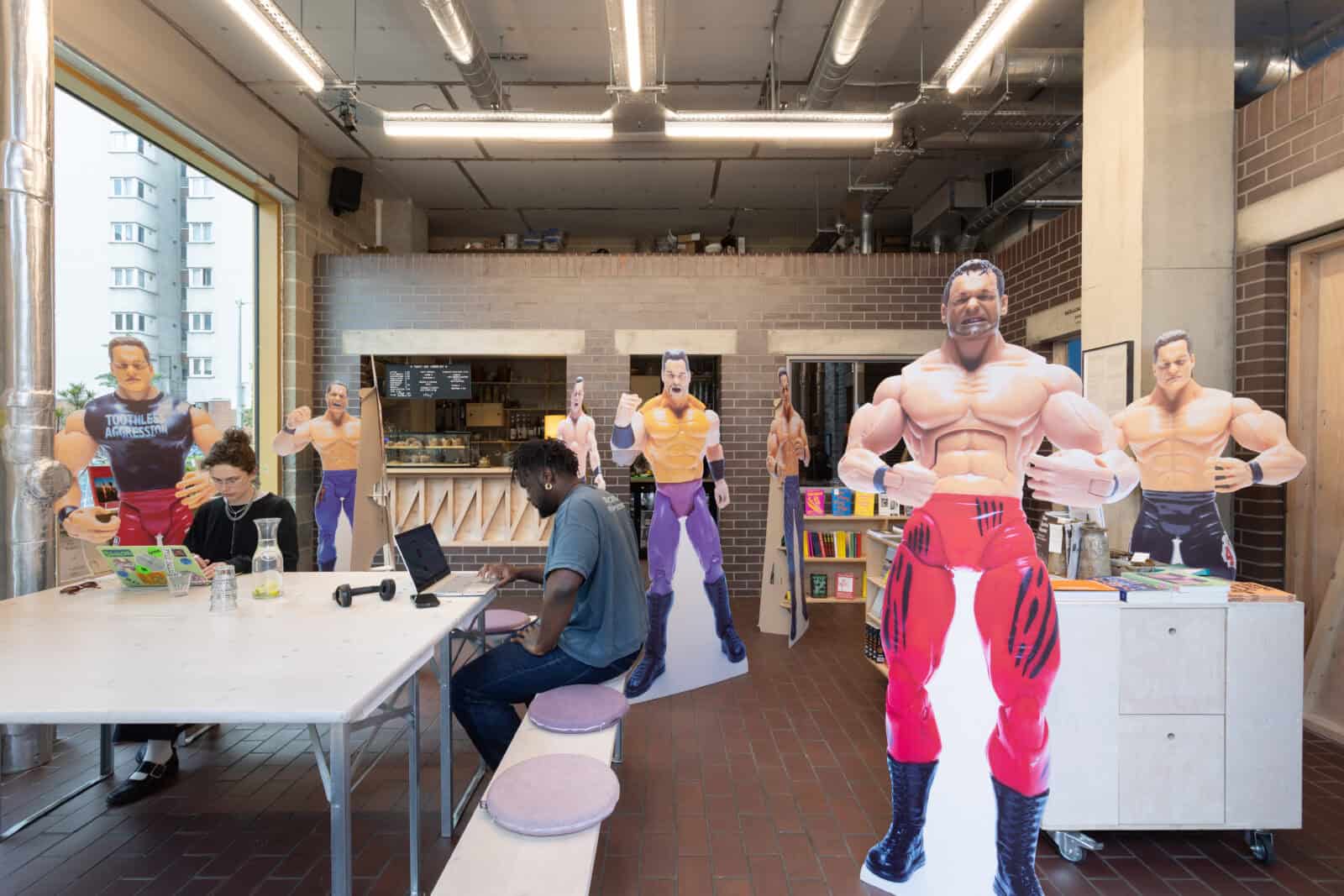
CM: There’s also a tongue-in-cheek element to this show: the campness of professional wrestling and fandom, the dramatic posing of tiny toy figurines, blown up as cardboard cutouts. What role does comedy play in this exhibition’s narrative?
DD: WWE is hilarious. It’s ridiculous. It’s a pantomime. As a fan it’s harmless fun. However, while wrestling begins as entertainment, it slowly reveals itself as a training ground for understanding power, celebrity, masculinity and politics.
When Donald Trump first appeared in WWE, entering the ring as part of a storyline, it felt absurd and comedic. Looking back now that he is President of the United States, that appearance seems less like a joke and more like a glimpse of how entertainment and politics had already begun to merge.
Similarly, Vince McMahon was forced to retire from his position as the chairman of the WWE after multiple allegations of extreme sexual misconduct. Before that, he would appear on-screen playing Mr McMahon, a power-hungry sex pest. This “character” would make female wrestlers get on their knees and act like dogs or take off their clothes. The real man turned out to be the same. Now, his wife, Linda, is Trump’s secretary of education.
I’m interested in the moment when something that appears comic or ridiculous begins to reveal a darker truth. In my practice comedy is often my entry point into these subjects. I use humour as a coping mechanism, a distraction, and a way of approaching difficult material. It creates a space where viewers can laugh, but also question why they are laughing and what lies beneath the spectacle.


