
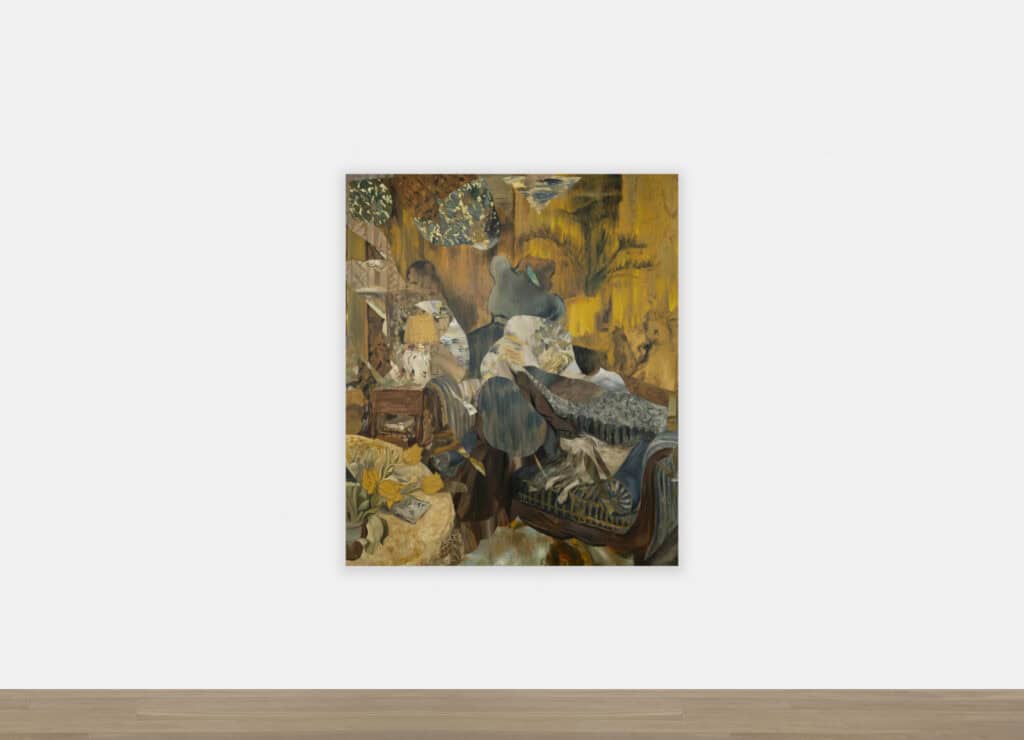
Walking the line between figuration and abstraction, artist Dean Fox seamlessly constructs a patchwork of encounters across his art practice. Each work holds its own distinct tension between what is seen and what is otherwise merely sensed.
I was immediately drawn to the exhibition’s title, Keeping the Books on the Shelf. At first, it seemed to suggest a meditation on the objecthood of books – highlighting the considered meeting point between form and content. But Fox’s practice as a whole stretches far beyond that. I’ve long been fascinated by personal libraries: the ways collections accumulate, the books placed on a shelf, oftentimes never to be touched again. Or on the other side of this, the literature endlessly flicked through until the pages begin to wilt and soften from repeated use.
There is beauty in both states, and Fox’s work elevates this duality into a deeper reflection. The exhibition opens into a space of uncertainty that each of Fox’s absorbing works seem to breathe alongside. A book on a shelf – or on the floor, the table, in a hand – can simply exist without needing to be returned to its ‘proper’ place. Fox articulates this deftly in our interview, drawing on the symbolism of a Buddhist Zen myth to express the quiet freedom within that idea. Keeping the Books on the Shelf becomes less a title than an invitation to observe without interference, allow without rearranging, and recognise the subtle beauty of something falling out of place.
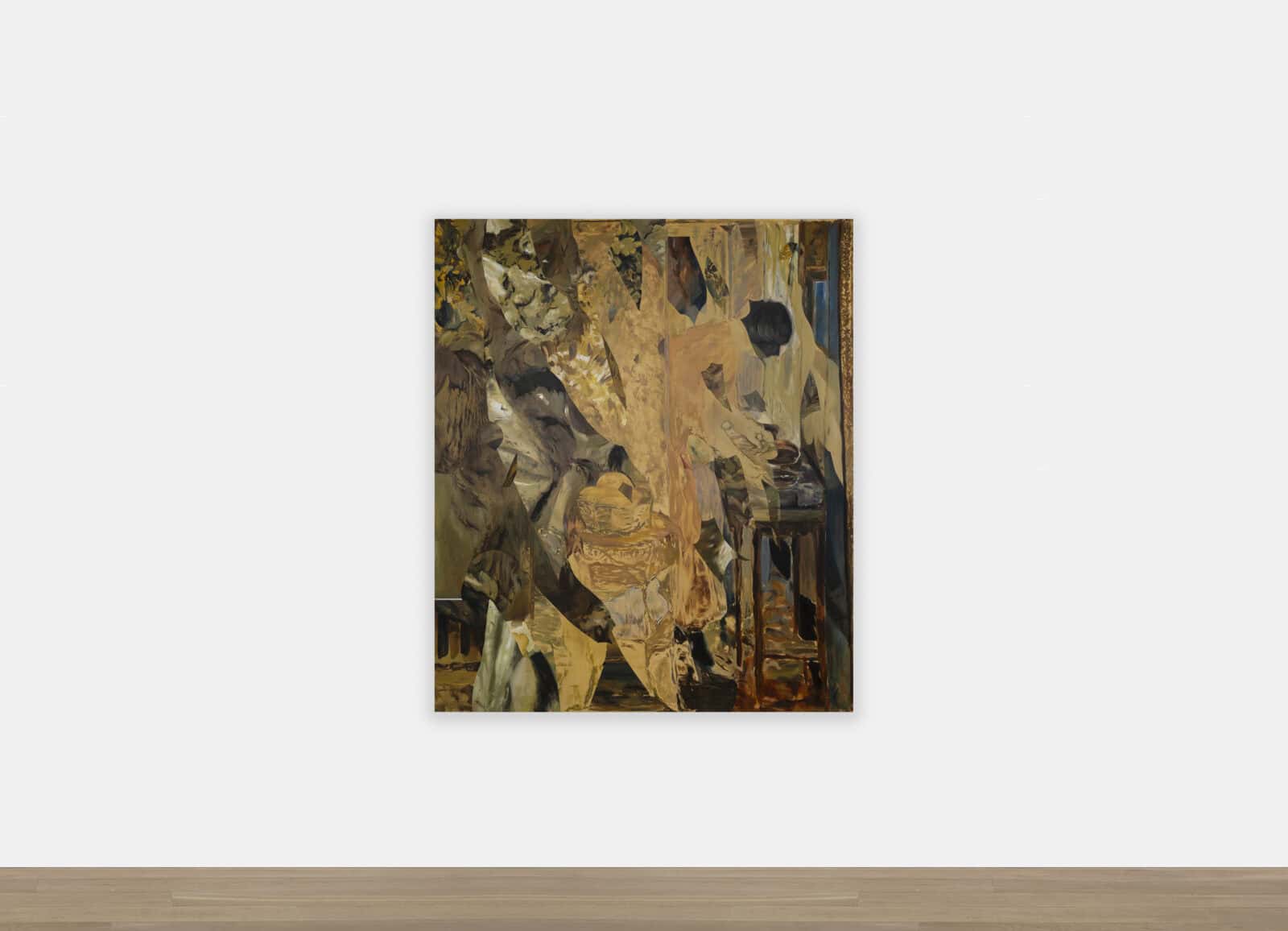
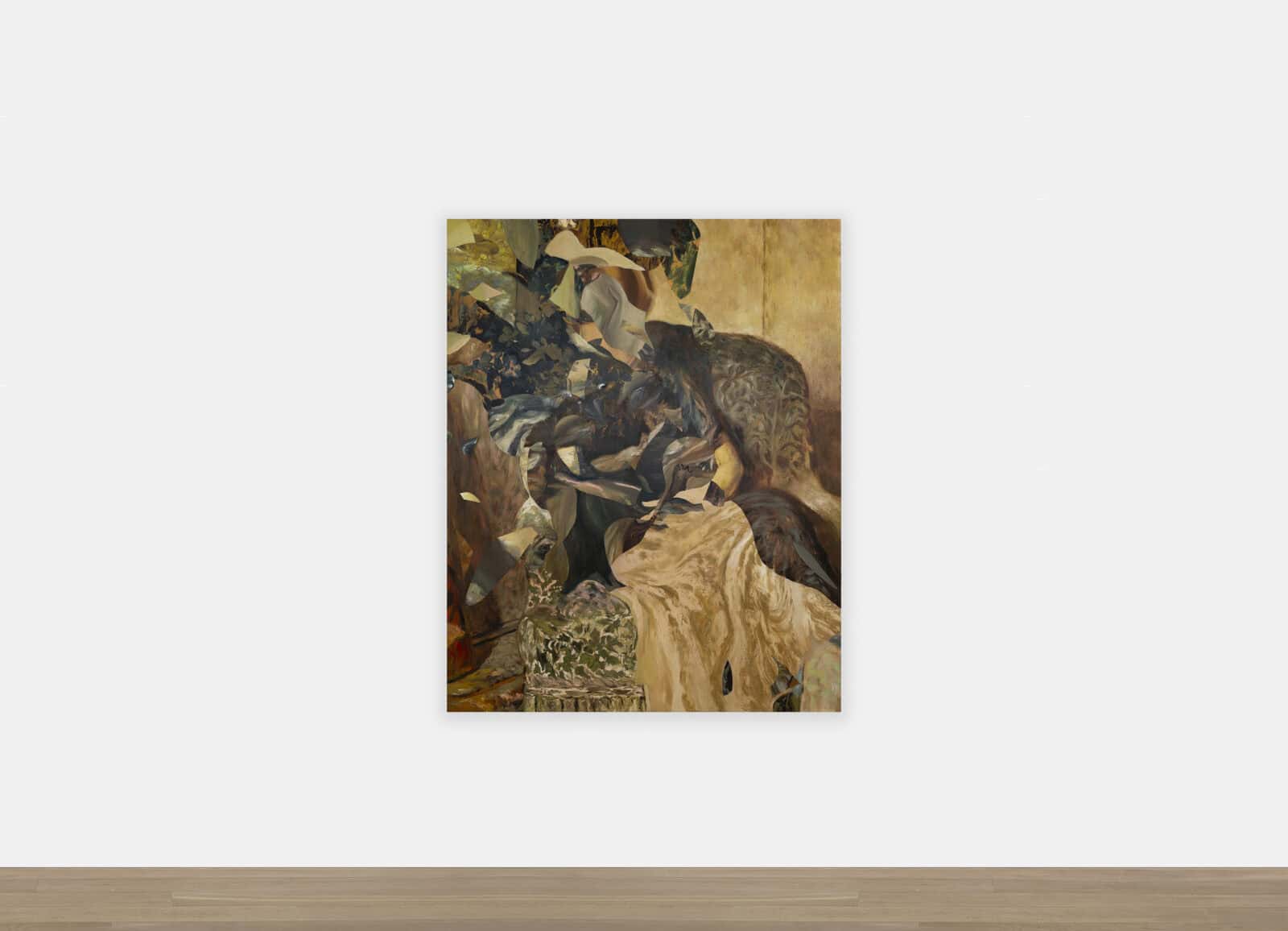
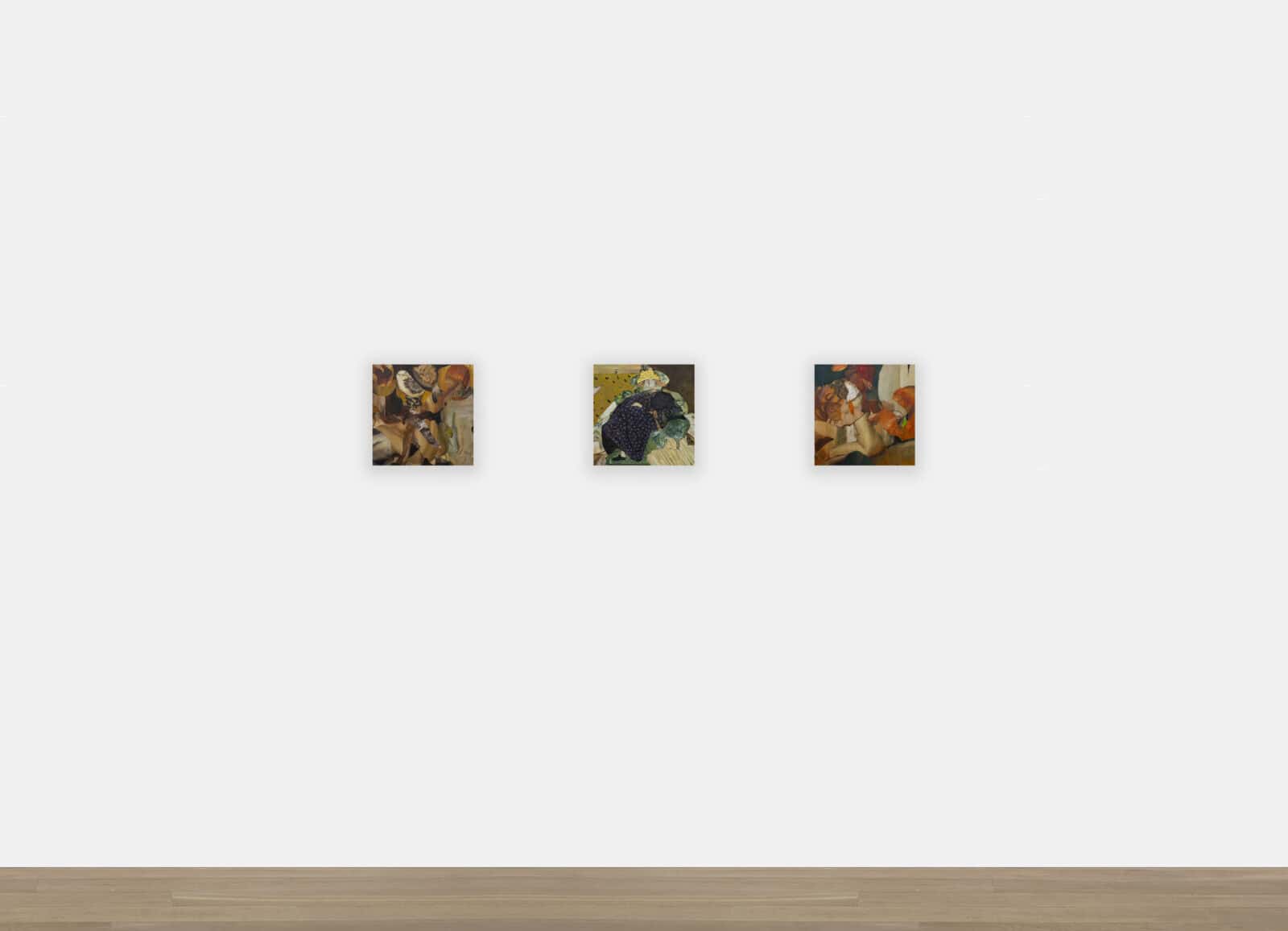
Dean Fox’s show with Matt Carey‑Williams presents eight large canvases, followed by three significantly smaller panels, and three charcoal works on paper. The two canvases entitled Keeping the Books on the Shelf I (2025) and Keeping the Books on the Shelf II (2025) form a central hinge in the exhibition. Both depict obstructed views of a living room – fragmented angles of a sofa, glimpses of familiar domestic textures – yet each constructs a distinct emotional atmosphere.
The first painting unfolds in a subdued, sepia‑toned palette cooled by blues and greens. The mood is weighted and introspective; as the eye moves through its layered architecture, the space feels dense. The viewer wades through shadows, sensing the strain between the recognisable and the abstract.
In the second work, the same foundational sepia is warmed by touches of pink and red. This version lifts the scene into a gentler register: forms begin to clarify, the figure settles into view, and the composition seems more willing to reveal itself. Where the first canvas leans into opacity, the second opens up, offering a sense of ease within the lingering disorder.
Across both works, Fox encourages viewership to oscillate between orientation and drift. As the eyes search for something familiar, you grow equally comfortable in the abstraction of everyday objects. Breaks in the composition become small vignettes, windows into alternate scenes or subtly reconfigured realities, inviting the viewer to consider how the domestic can be both known and perpetually reimagined. He tests the limits of composition, using negative space as both a structural device and a philosophical question. Fox’s refusal to ‘put the books back on the shelf’ translates into an openness across the entire exhibition. Forms expand and collapse, colours push toward stillness.
Prior to the opening of the show, COLD spoke with Fox about his process of dissolving recognizable forms into abstraction, and the non‑dual philosophy that informs the exhibition’s title.
The COLD Magazine (CM): Your work walks a fine line between figuration and abstraction. How do you navigate that boundary?
Dean Fox (DF): As an artist, I try to blur the lines between the seen and unseen elements of existence. The body is dependent on the empty space just as the empty space is dependent on the body. It begs the question: is the body and mind observing or is it the space that is the seer? What is the known and what is the knower of experience?
I want to form correlations by permitting structure—something so clearly defined—to be dismantled, set aside, or allowed to blur between its lines. These complimentary
dialogues inform and relate to one another in a continuous stream. I begin with a tangible form and gradually deconstruct, distort, or simplify it until its initial clarity softens and it develops a unique character. In my process, abstraction emerges through the way I blend complementary elements, revealing how form and abstraction can coexist within the same experience.
CM: Can you talk about your background as an artist?
DF: I studied fine art at Central Saint Martins and later went on to freelance in the commercial sector, working within the conceptual art world and visualisation within advertising. This led me into honing my skills as a craftsman and developing a strong sense of composition while working within tight deadlines. These experiences influenced my works in a way that made composition key, alongside giving me the skills to look at the task ahead and approach it in the most direct manner.
CM: What are your key artistic inspirations for this body of work?
DF: My key artistic inspirations for my work have developed rapidly over the last few years and have led me into seeing the canvas in a completely new manner. I am drawn to impressionist and post impressionist masters such as Vuillard, Monet and Degas. The fundamental textures of these works and the feel for life and its beauty deeply resonates with me and has become something I feel is increasingly important to reflect in my work.
CM: How does your life experience shape the subjects or gestures in these works?
DF: I often feel that my life has involved a gradual subtraction of the self—whether as a figure within my creative process or simply through the way I move through the world. Therefore, I try to remove anything I feel conditioned in my creativity. I do not want the work to intentionally be unique to me but rather intrinsic to something greater, or even beyond that. I feel we live from our past, yet have the ability to take influence from it, use what resonates and reject what doesn’t and create ourselves new in this moment, without an idea of judgment and fears of tomorrow.
CM: The exhibition is titled Keeping the Books on the Shelf. What is the symbolism behind that title?
DF: Keeping the Books on the Shelf reflects the journey of life and the unfolding of the heart as it begins to recognise our true nature. In this analogy, we find ourselves in a room—the mind—where books, representing thoughts, constantly fall off the shelf. Society often teaches us to maintain a tidy inner space by endlessly putting the books back.
Non‑dual understanding, however, points out that—without realising it—we don’t actually need to keep rearranging the books at all. We can simply leave them where they fall, rather than keeping the mind busy managing thoughts and unknowingly trapping ourselves in that mental room.
The image comes from an old Zen story about a monk who lived in a small village. Each day, he found meditation in the simple act of raking the stones in his courtyard. As he worked, he forgot himself; the world fell away, and he slipped naturally into a state of peaceful detachment. Word of the monk’s quiet descent into nirvana eventually reached the Devil—symbolising the restless mind—who refused to allow such freedom.
So the Devil sent his minions to observe the monk. One day, while the monk was raking, a gentle breeze carried a single leaf from a nearby tree, letting it fall onto the perfectly raked stones. The monk reacted instantly, almost in panic, rushing to remove it. ‘Ah!’ said the minions, delighted, and they reported this weakness back to the Devil. Seeing his chance, the Devil unleashed a great gust of wind, shaking the entire tree and covering the courtyard with leaves. Suddenly overwhelmed, the monk lost his peace and was pulled back from the edge of nirvana.
CM: Your show is described as treating art history as a ‘system to be tested’. Are you testing it in order to critique it, to better understand it, or perhaps to reaffirm parts of it?
DF: All art is influenced. I think true creativity is taking what resonates, rejecting what doesn’t and then creating your own path. I feel as though I am just celebrating the familiarity of the past while rejoicing in what that can bring to the present.
CM: Your paintings contain moments of blankness that are simultaneously full. What is your relationship with negative space (or its absence)?
DF: Composition is ultimately just the relationship between the empty space and the form within it. I feel that it is the artist’s duty to experiment with the endless opportunities within that. By nature we are all form and formless. I think it is our disposition to identify what is greater to us and reflect that in whichever way feels natural and sincere, knowingly or unknowingly.
CM: Colour in these works feels thick, compressed, almost sculptural. How do you develop your palette?
DF: My palette is never fixed, although I often desaturate works to reflect the idea of the past, which heavily contrasts or compliments the contemporary nature of abstraction and the compositions within the works. I often create some kind of middle ground, rather than move towards one end of a spectrum of value. This, however, will always depend on what artist I am looking at and whatever feels right in the moment.
CM: Your work spans different scales. How does this shape your approach to painting?
DF: I’ve always been comfortable creating larger works, but the real challenge was learning how to translate patterns, textures, and abstractions onto a smaller canvas. That process pushed me to loosen up—to let the paint take over at times and lead the way. This shift has added real value to how I approach any canvas. The small pieces remind me to stay relaxed when working on the larger ones, while the large works highlight the importance of composition when I return to the smaller canvases.
Dean Fox’s Keeping the Books on the Shelf is on view from 26 March – 8 May 2026, at Matt Carey-Williams.


