
Punk, famously, was born from boredom. From post-industrial grey-scapes and conservative English suburbs. The Stranglers, raised in idle Surrey, complained of “suburban boys and girls in a suburban town / bored out of their minds.” Johnny Rotten, speaking to NME in 1977, surmised the Sex Pistols’ ethos as such: “We just wanted to do something different.”
But what happens when boredom is no longer a possibility? What happens in an age of electronic overstimulation, when we can access an ether of endless algorithmic information, satiation, and pacification through something as simple as reaching into our pockets?
Maybe you get something like Drain Gang and the dissociative mumble rap of the 2010s – ambient, Internet-native soundscapes that float through hypnagogic, ketamine-conjured, and strangely liberatory cosmoses. Or maybe you end up somewhere like today’s brain-boggling maximalist electroclash of 2hollis and Snow Strippers, figures who have made themselves the enigmatic acolytes for a new online generation.
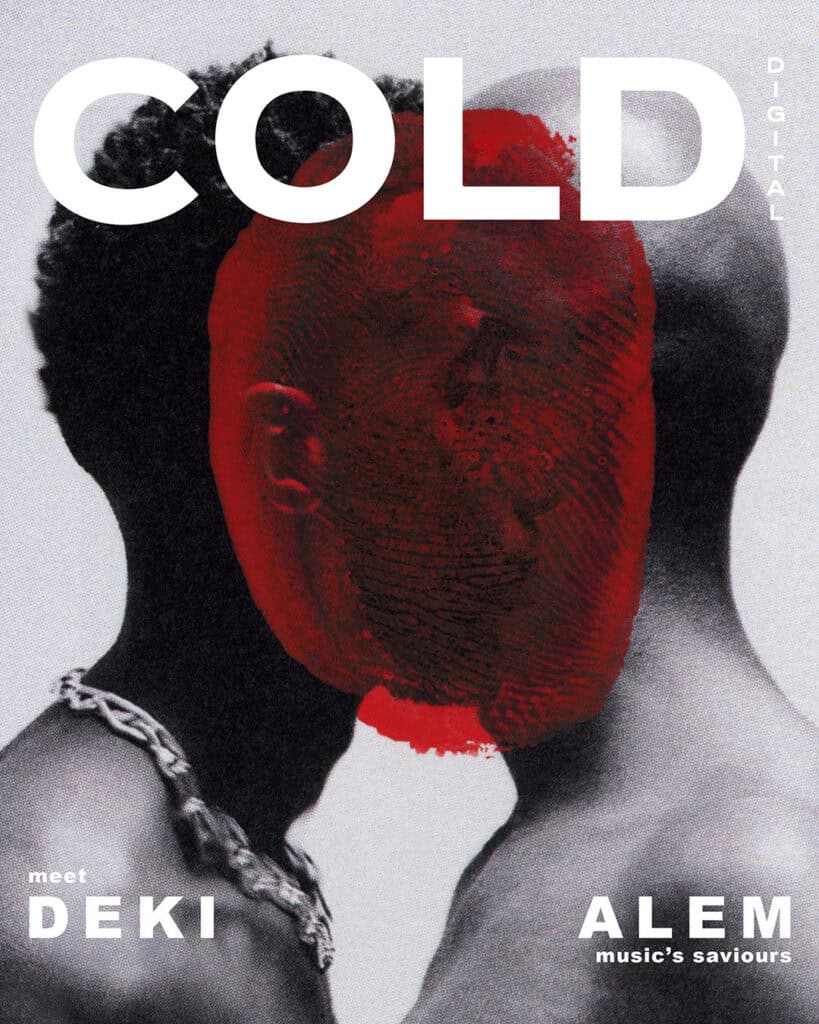
Or maybe, just maybe, you get to Deki Alem, the Swedish band who stand simultaneously in- and out-side this roughly strewn diagram. Composed of twin MC’s and songwriters Johnny and Sammy Bennett, as well as behind-the-scenes producers and songwriters Richard Zastenker and Johannes Klahr, the group carry with them both that anarchic, guerilla essence of punk – the grittiness, the loudness, the sweat – and those pulsating traces of its electronic afterlives – the eclecticism, the quiet charisma, the refusal to be contained by genre. Pundits have appealed to everything from hip hop, trip hop, drum and bass, grime, acid jazz, indietronica, 90s rave and neo-soul to try box them in. None of these taglines, though, can truly do Deki Alem justice.
Either way, the sound is heady, hedonistic, and home-speaker-at-a-basement-party ready. “Fun”, the aptly-named first single from their upcoming album Forget in Mass, is brooding and sinister, nearly anxiety-inducing (a mood it replicates perfectly in its disorienting, drug-fuelled, and Kubrickian music video, created by the band and Broken Int). “House Fire”, the album’s second, is dark yet danceable, like something from The Fat of the Land or Dean Blunt on uppers.
So, ahead of the album drop and their upcoming EU tour – which promises to be a blowout – The Cold Magazine caught up with our July digital cover stars to chat about the lost art of boredom, Anthony Bourdain, ABBA, and God.

The Cold Magazine (CM): For the uninitiated, how would you describe Deki Alem in three words?
Johnny Bennett (JB): Three words is hard to get around…
Sammy Bennett (SB): Powerful. Experimental. And fun…
JB: I like that.
SB: …Powerful when we’re on stage, a lot of energy. Experimental in the studio. And just having fun trying to bring new ideas to life. Not trying to be… shit, I only have the word in Swedish… not be too rigid with how we do music. Trying to have an almost childish approach to how we create.
CM: Is there anybody you could compare your sound to? Who are your musical inspirations?
JB: I couldn’t point a finger at a specific band. We’re heavily inspired by the various music and worlds that came out of the golden age of MTV during the ’90s and early ’00s. That, together with being big hip-hop heads since birth, is the reason we were drawn into this to begin with I’d say.
CM: I found a TikTok crediting you guys with “single handedly saving Swedish music from boredom.” Do you guys see yourself as saviours of any kind?
SB: That’s crazy!
JB: Haha, maybe [the saviours] of valuing integrity, of digging, finding what we wholeheartedly enjoy at the moment and putting that out instead of catering to a sound or narrative in exchange for XYZ. Even though I’m chasing XYZ as well.
CM: “Fun”, one of your album singles (and one of my favourites), is a song about rejecting this restrictive self-improvement culture that has rooted into society and embracing desire and libido and messiness – the grittier sides of “authenticity.” Is this a philosophy you guys follow in your lives?
JB: Yeah, we’re trying to cater to our instincts, especially in the studio. We want to create from a space that’s unhindered. We bring our knowledge with us, of course, and it comes into play at certain stages, but it’s also important to just be loose. You know, we want to make sure what we’re making is digestible, something our people can live with over time, but we also want it to be primal. It’s a balance we’re always trying to tread.
CM: What do you make of how self-improvement culture has reshaped society. I hear all this chat about younger generations drinking less, partying less, having less sex than previous ones – being more puritanical and “cleaner,” clean-girl aesthetic and all that. Why have people stopped having fun?
SB: I think a lot of people are hooked on self-improvement and being the best version of themselves. That’s not necessarily a bad thing – but people can get hooked on it. There are so many self-help books and TikToks telling people you should do this and that and everything is just too much sometimes. It’ll be interesting to watch how this makes us evolve and where we’re going as a humankind when we’re pushing to be the best versions of ourselves all the time. There’s something beautiful about just being yourself, to not trying to be this superhuman. Sometimes it’s refreshing to fall short and see that the world keeps spinning.
CM: This attitude has especially taken off in digital spaces and is targeting young men now, whereas I feel like it has historically been women who that tyrannical self-improvement culture has been oriented towards…
JB: Being on socials, everybody’s trying to teach you something, teaching you how to cook that dish, you save a thousand recipes that you never make, a thousand pieces of advice you never take. It’s a lot of information. I think people should be out experiencing more, myself included. And falling short, like Sammy said.
SB: I think we’re trying to battle time to become as effective as possible. But that’s dangerous – shit takes time. And it is boring and it is dull, but I think it’s important to experience that. We’re part of a generation that got to experience “classic boredom.” It’s so easy today to escape it and block out the silence with random noise. I catch myself doing that too every now and then.
CM: That idea of “shit taking time” is especially true with music – it does take time, and it does take boredom. People see artists break through all of a sudden online and, because they’re new to them, will call them industry plants or think they’ve just started without realising that it has taken them decades and decades of work.
SB: Making music has taught me so much – about patience, about self-discipline. I think it’s healthy for a kid, for a young adult, to have their own project to work on. It doesn’t even have to be music. Just something that puts you on a path to experience the full spectrum of being human: failing, succeeding, struggling, waiting, hearing yes, hearing no. All of it.

CM: Do you guys have a first memory of making music?
JB: Yeah, but performing live for the first time is a memory that sticks with me the most. We started off making music in Swedish in our hometown of Gothenburg. We were at a friend of ours, Parham’s, release party at a bar called Eli’s Corner, in an area called Majorna. After he’d had his little celebration, he invited us to play together with him. He just handed us two wired mics from behind the bar counter, we grabbed them and started spitting our unreleased stuff. I was freaking out, but remember it feeling super natural at the same time. That’s like ten years ago now, you remember that, Sam?
SB: Yeah… But I actually started rapping out of boredom, to go back to that point. I was living in a town called Malmo in southern Sweden and remember being by myself – I was trying to become an occupational therapist back then – and I would come home from school and remember just being so fucking bored. And Johnny was living in London back then, also studying, and I called him on Skype and started rapping, freestyling through the webcam with some beats. I remember it bringing me so much joy.
CM: Live performance and experiencing what you do is such a big part of what you do as Deki Alem. The sweaty togetherness of being in a crowd, jumping around, moshing. I was recently reading a book called On Mysticism: The Experience of Ecstasy by a guy called Simon Critchley, a philosopher and music writer, who argues that in our spiritually sterile, post-religious society, the closest we can get to ecstatic, spiritual experience is through live music, through being in a crowd. What do you guys make of that?
SB: Yeah, I totally agree. I’ve always said there are two things that can bring anybody together, and that’s good food and good music. I really believe that live music is the one thing that can bring together people of all different colours, ethnicities, cultures, religions, politics, everything – everybody knows what a good song is…
JB: Hm some people…
SB: Yeah, some people know what a good song is, hahaha. But yeah, that’s the best part of being an artist I think. I couldn’t care less about the number game, it’s about the people showing up at the shows, and seeing them letting go. In day-to-day life they might not agree with each other on certain questions but they’re all together right here right now, and that’s a fucking superpower. That’s what it’s all about, the experience and bringing people together with our music as the backdrop.
CM: What’s the craziest live show you remember?
JB: I still hold the show we did at Debaser Strand in 2022 very high. It was our first headline show on home turf and the exchange with the audience was magical. It felt like everybody was one. Tight venue, humid, smiles, family, friends, mosh pits, chants…
SB: That was really the first time I felt like, this is really happening right now. Prior to that, I wasn’t really convinced that we had a movement in Stockholm, but also as a band. But that night changed things. It was fucking crazy.
CM: Do you guys have any personal experiences you might describe as spiritual?
SB: We have a religious background – and I’m very close to God. When it comes to religion – whether that be Christianity, Islam, anything – I feel like I grew away from that concept. I’m just trying to nurture my relationship just to God and that works for me.
JB: For me, it’s not only about specific moments or experiences. There obviously are moments where you might feel more connected to God than normal, but I’m in touch with God around the clock. That relationship to God isn’t like one profound moment, it’s more nuanced than that.
CM: Having watched all your music videos, you guys also have a very strong visual aesthetic which references lots of films and projects. Where does that side of things come from?
JB: Yeah, shouts to our friend and director Broken Int, who has been a steady collaborator from the start. We just speak to him about how we see the music, and then he puts his lens on it. Everybody close to this project comes from totally different angles and walks of life, but shares similar values when it comes to our creative expressions. That’s what gives the character to the things we put out.
CM: What are your guys’ favourite films?
JB: In life?
CM: Yeah, in life.
JB: Taxi Driver. That’s my favourite movie. I love the scoring as well. I used to listen to that score walking around when I wanted to feel like a lone wolf and just roam. But there’s something about that movie that gets me, the way he’s kinda pure but alone at the beginning, and how he wants to contribute to the world and to society. Then his isolation becomes this toxic experience that flips him over into becoming a villain and a saviour at the same time. I just think the narrative is super hard.
SB: Shit, I don’t actually know. I wish that I be watching more movies than I actually do, but I don’t do that. Series too. I’m a YouTube addict. I been knowing about Anthony Bourdain before, but I recently discovered his travelling programme and I’ve been hooked on it. His personality was so effortless – nowadays when you see people travelling programmes everybody’s like oh wow!! that’s amazing!! oh shit!! and everything is so extra. But the way he’s just experiencing and interacting with people of other cultures – he’s just so regular, you know. So I enjoy that show.

CM: Sweden is a disproportionate heavy-hitter when it comes to music, and across every conceivable genre: from ABBA’s pop earworms to Avicii’s Ibiza anthems to Yung Lean’s xaned-out Cloud rap. What do you think it is about Sweden that churns out so much musical talent, and why’s it so all over the place?
JB: Disproportionate heavy hitter is a hard! That’s a hard phrase haha! We actually got asked this question like a week ago when we were out at a gig. We figured out that we didn’t even know ourselves. Sammy, what did we land on afterwards?
SB: We landed on that the seasons are very harsh – summer is very short, autumn is very short, and then we got this big ass winter of just darkness and cold where we kinda get forced to just work on our craft a lot. But I also think Swedes are very humble and we focus on quality and care. We just care a lot about our products, not even just music. Swedish life just has a certain quality to it, and that goes for music as well. Everything might not be super unique all the time, but the quality is always high. So I think we just care a lot. And we’ve got a fucking big ass winter of darkness.
CM: Kiss, marry, kill: ABBA, Avicii, Yung Lean.
SB: I’ll make ABBA make out and let me watch, I’ll put a ring on Lean and bring back Avicii.
CM: I mean, yeah I can fuck with that. OK and, finally, what should we expect next from Deki Alem? What’s coming now?
JB: Look out for Forget In Mass dropping August 8th and our headline tour kicking off on October 29th.
SB: It’s going to be a very compact album. It’s eight tracks that we’ve been carving out for some time and I feel like the album is a very dense, quality project. Every song is a world of its own. I’m excited to just see how that resonates with the world and our listeners.