
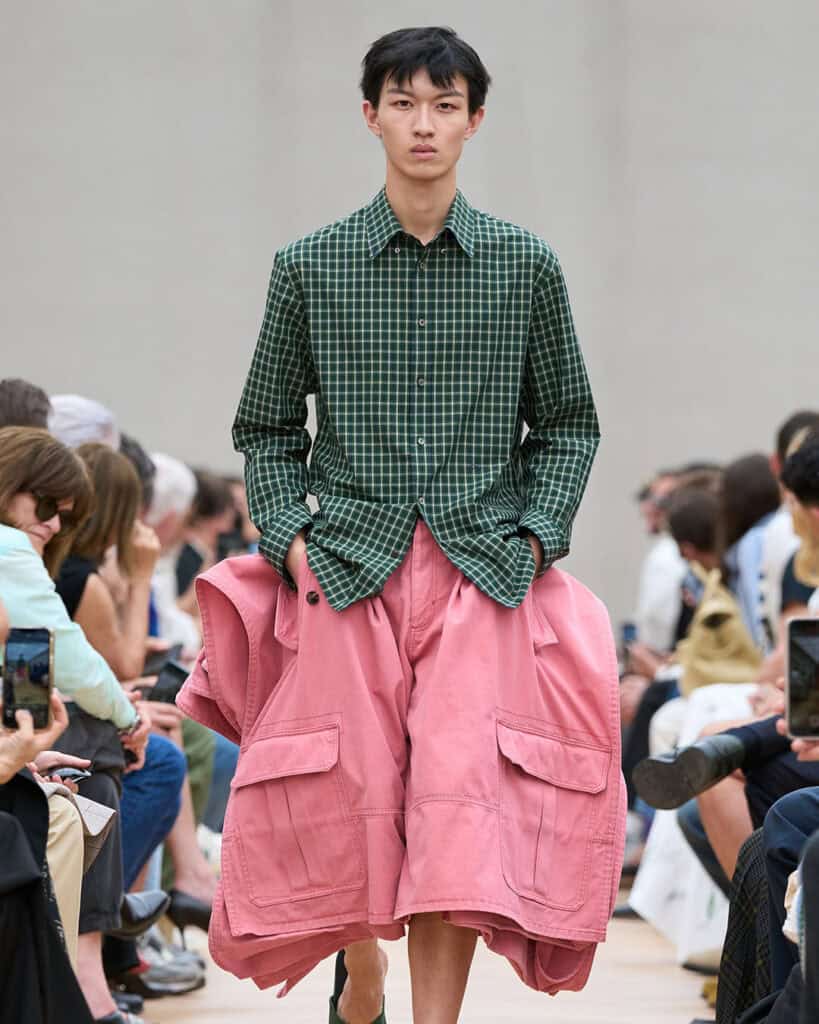
Jonathan Anderson’s long awaited Dior debut fused French excellence with contemporary styles. Life imitated art in a space curated to imitate a gallery, including two works by Jean Siméon Chardin: Basket of Wild Strawberries (1761), borrowed from the Louvre, and Still Life, Flowers in a Vase (c. 1760-63), held at the Scottish National Gallery, Edinburgh.
A collection that felt distinctly Jonathan Anderson – from the eclectic layering reminiscent of his work at Loewe to the polished eccentricity that has defined his own brand. The runway was filled with beautifully constructed bowties, pastel waist coats and velvet blazers contrasted by loosely done up sneakers, blue jeans, striped ties and chinos. The juxtaposition between 16th century coats and loosely fitted cotton trousers showcased the inspiration he drew from American painter Romaine Brooks, who specialized in portraiture.

Anderson signaled his creative direction for Dior by incorporating Andy Warhol’s portraits of Jean-Michel Basquiat and Lee Radziwill, using their contrasting backgrounds and shared cultural influence to reflect the eclectic, boundary-blurring spirit he aimed to bring to the brand. The collection was an introduction into what a world breaching the gap between fashion and fine art could look like. The range of artistic references, from Chardin’s intimate still lifes to Brooks’ moody portraiture and Warhol’s pop culture provocations, reflected Anderson’s fascination with bridging contrasting visual worlds. Chardin’s work invoked Dior’s historical ties to classic French artistry, while Brooks’ restrained elegance aligned with the tailored silhouettes. Warhol and Basquiat, meanwhile, introduced a new creative dialogue to the collection, reflecting Anderson’s mission to blend heritage with modernity.

Already a revolutionary designer from his work at Loewe to his own eponymous brand, Anderson has proved his adaptability over the past decade. Coming in with a blank slate at Loewe and turning it into the creative masterpiece that it is today gave him the time and space to experiment with different styles before joining one of the top luxury fashion houses. Even the show’s invitation, a porcelain egg inspired by archive crockery, hinted at Anderson’s research into Dior’s heritage. Subtle references to Monsieur Dior’s love for the decorative arts, as well as the influence of British aristocratic codes and private school uniforms, were embedded in the collection’s tailored blazers, crested buttons, and structured silhouettes.

Even for those not seated front row, Anderson’s debut had a palpable presence in Paris. We watched the show from a packed bar in Les Grands Boulevards, where a watch party organized by influencer Lyas brought the fashion crowd together in celebration. ‘Bravo Anderson’ overlapped with whoops and excited chatter as the finale ended. The fashion industry, especially fashion week, has become very exclusive and has a tendency to work in a hierarchical manner, but in this local bar in the middle of the street everyone was there for the same reason; to watch the collection, to drink from the open bar, and to show off their best fashion fits.

While expectations were high following Chiuri’s departure, Anderson’s debut made it clear that he isn’t here to simply maintain Dior’s legacy – he’s here to reinterpret it. His vision feels both respectful of the past and daringly optimistic. If this show was any indication, Dior’s future is in capable hands. Succeeding Maria Grazia Chiuri is no easy feat, even for a designer as accomplished as Anderson. Yet he enters this next chapter making history, becoming the first since Christian Dior himself to oversee all three of the house’s lines: women’s, men’s, and couture.
