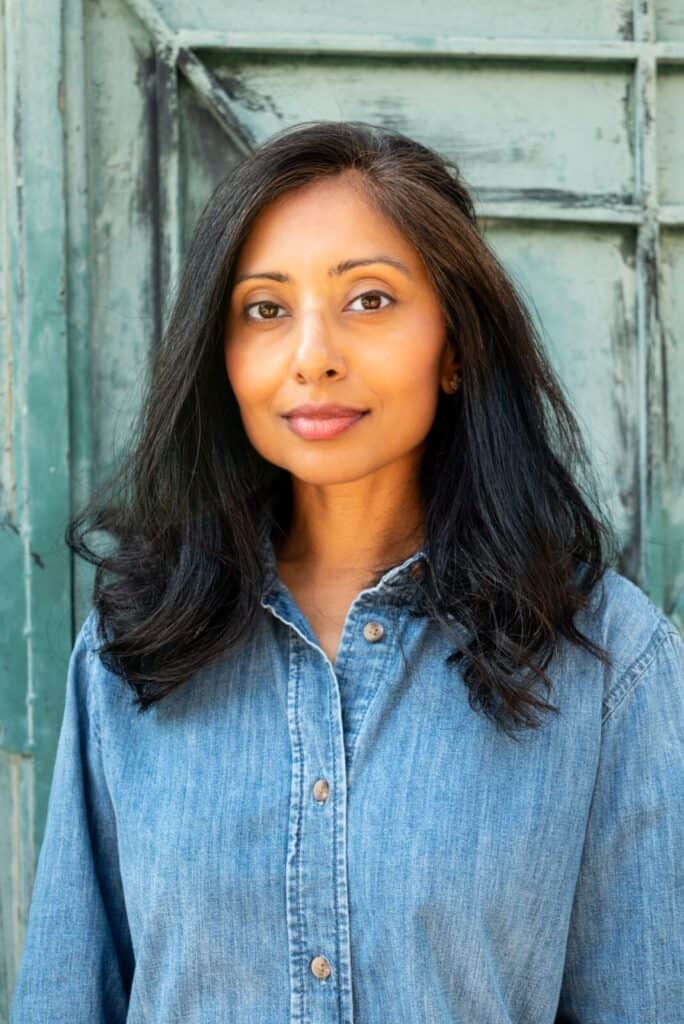
Avni Doshi is interested in unhappy families. The Booker Prize-shortlisted author of Burnt Sugar (2020) is back with a new novel, The First House, a catalogue of the breakdown of a marriage and an exploration of what happens to one woman when the myth of domestic bliss shatters.
The First House begins with a rupture: A woman’s husband walks into a room and announces that he wants a divorce. What follows is a story of abandonment, and, ultimately, a reckoning. The woman who has been left behind moves through her grief, anger, and bewilderment, coming undone over the course of a single summer.
Like Burnt Sugar, Doshi’s follow-up novel is rich with startling imagery and metaphors that linger long after you’ve turned the page. The Cold Magazine sat down with Avni to speak about her new book and unpack the role money, dreams, and memory all play in marriage.
The Cold Magazine (CM): This is the story of a midlife moment. What inspired you to write about this particular stage in life?
Avni Doshi (AD): I’m also at this midlife moment. I think that at different times in your life, you notice certain things in yourself and in the people around you. What I was noticing was that pretty much everyone I know who’s at this stage of life was facing some kind of crisis. Whether it’s ageing parents, the end of a marriage, issues with children, financial realisations, or a health problem – whatever form these crises take – I noticed that people’s lives seemed to take on a mythic dimension.
CM: Speaking of mythic dimensions, the narrator of The First House moves between domestic realism, dreams, and folklore. How did you balance the two registers – the real and the unreal?
AD: I’ve been very interested for a long time in the writing of Carl Gustav Jung. I’ve also done many years of dream work myself. I’m an avid lover of mythology. In college, I minored in religion.
I was fascinated by the fact that so many cultures come up with very similar stories. Jung talks about this too: all the mythologies of the world contain these interlinked symbols, or archetypes, that keep emerging. When I started writing, I had this idea: what if we take it as a given that we’re not really born as a blank slate? What if, without questioning it, we assume there are certain structures – psychological, mental, and emotional structures – that we’re born with?
CM: How did you know you were ready to write a divorce novel?
AD: For most of my life, I felt that my experiences were completely individual and specific to me, and that no one really understood what I was going through. Then I reached this moment where something in my perception changed.
I started to feel that my inner experiences were actually being reflected in everything around me. I think that was the starting point: that awareness I had in myself. It really fed into the [narrator] character.
In the case of the woman at the centre of The First House, she’s trying to make sense of what happens to her and trying to draw connections between her inner landscape and the external world. I think she finds answers in astrology and in mythology, but also in nature. She begins to notice these cycles emerging in the natural world, and suddenly realises that nature is experiencing similar cycles too.
CM: The novel returns repeatedly to the question of female interiority. Do you see your protagonist’s interest in astrology and mythology as a form of escape, or as a way of arriving at a deeper truth about herself?
AD: The narrator in The First House is also a writer, and I think that, for some writers, there is this particular focus on interiority. Perhaps it’s simply the way some creative people experience the world.
It’s interesting because we can imagine certain kinds of lives for particular kinds of women. We might think of a woman who is a mother occupying a specific set of roles – wife, mother, perhaps not engaged in a career outside the home. We can imagine that her life revolves primarily around the domestic sphere. And I think there’s a tendency to assume that the domestic sphere automatically offers a natural and seamless route into interiority.
But the other side of that is that there are so many demands placed upon a woman in that position. This particular character is constantly negotiating with the external world and its requirements. In that context, her interest in astrology, her writing practice, and all the subjects she studies – the various obsessions she develops – I don’t see them so much as forms of escape. They feel more like a necessary counterbalance to all of those external demands.

CM: The novel avoids neat emotional categories. No one emerges entirely innocent or entirely cruel. Was it important to you to preserve that uncertainty?
AD: The way the media operates, the way propaganda unfolds, is very different, right? There, it’s often very clear: we have the good guys and the bad guys, the villains and the heroes. I don’t believe real life operates so simply.
When I’m writing, I like to remember that there isn’t some continuous moral arc that a character follows. Every step we take is a negotiation between so many different forces: desire, envy, greed, people-pleasing, wanting to appear a certain way in the world. All of these characters are negotiating those forces with every decision they make, continually falling on one side of the line or the other.
I also like to remember, as I move through a scene, that at the end of the day there is this desire for self-preservation. To a certain degree, the narrator in The First House has to believe that she is good and that she is right in order to survive. But I’m always interested in asking: to what extent is she also capable of self-reflection? How willing is she to examine herself and her actions?
CM: What novels inspired you to write The First House?
AD: One novel that has been enormously influential to me is A Heart So White by Javier Marías. It has one of the most incredible opening sentences – and opening scenes – I’ve encountered in fiction. One of the central ideas in that book is that every family has its own mythology. There’s a kind of implicit requirement that, if you’re going to belong to a family, there are certain rules you abide by. And there are also certain blind spots you have to maintain.
In a way, what does it mean to be a family? Maybe it means sharing those blind spots – sharing the things you simply do not look at. That’s really what The First House is about. After I read it, that idea haunted me. I had never thought about family in those terms before.
It’s not necessarily our shared values that keep us together. Sometimes it’s the things we are unwilling to see that bind us to one another. That idea has been a very important influence on all of my writing, but particularly on this book.
CM: Cicadas become an unusually rich metaphor in the novel. Did you purposefully write your narrator’s journey as a kind of moulting process?
AD: I think so. It certainly wound up being that way. At the beginning of The First House, the idea of cicadas kept surfacing very strongly. They were present to me as an image because I grew up in New Jersey, and we would have cicada seasons from time to time. It was always a particularly awful summer when they appeared. I remember them as unpleasant, flying around in these swarms. They were terrifying. Some of them are quite enormous. So, the image was already there, but alongside it there was also a desire to understand them.
As I started researching them, it happened to be 2024, the year of the cicada convergence – a phenomenon that hadn’t occurred in more than 220 years. Two different broods were emerging at the same time. Around the same period, I came across an astrological convergence discussed in the Hindu tradition.
Once I got into the research, I found it endlessly fascinating. When we think about metamorphosis, we tend to think of the butterfly. It’s magical. It’s aesthetically beautiful. There’s something deeply pleasing about it. What a joy, after all, to look out into your garden and see butterflies. But what if the process of transformation is ugly? What if it’s horrific? I think it’s easy to imagine ourselves as caterpillars becoming sublime butterflies. But what if change is more brutal than that?

CM: Talk to me about the role marriage plays in the novel. Were you more interested in writing about marriage as a system of belief than a relationship between two people?
AD: I think you’re right. I was very interested in the structural and institutional framework of marriage. I’m deeply interested in myths and fairy tales, and when we read those stories growing up, we’re in some sense inculcated into a mythology of marriage. She believed marriage was going to be a kind of fairy tale.
In The First House, questions of financial dependence and power in marriage emerge. It’s interesting because we don’t really like to talk about those things. We tend to think of money simply as something we have to manage in order to live in the world. But conversations about money and power often sit at the heart of our most intimate relationships. That’s precisely where we become reluctant to examine them. We tend to consign those issues to the private sphere rather than bringing them into public discourse.
You could argue that part of the feminist project has been to make those conversations more visible and more openly discussed. If we go back to the origins of marriage, it was, in many respects, a financial contract. It was a mechanism through which property, resources, and alliances were exchanged between families. Historically, women themselves were often treated as part of that exchange. That’s one reason why systems such as dowries developed and persisted in many societies, including in India, where they continue to exist in various forms today.
So, I wanted to think about marriage in those terms as well. Yes, it is a relationship between two people, and there is the mythology that surrounds that relationship. But there is also a structural reality to marriage, and there is its economic dimension. I was interested in holding all of those things together at once.
CM: The narrator frequently interprets her life through patterns such as myths, astrological charts, recurring symbols. Do you think the novel ultimately endorses that search for hidden order, or remains sceptical of it?
AD: I’m not sure myself, to be honest. It’s a great question. I think the narrator certainly sees symbols and recurring patterns. But part of the project of introducing these vast narratives – mythology, planetary convergences, cicada cycles – was perhaps to gesture toward the idea that a human life is too short to fully understand the entirety of its own story.
There are limits to what we can see. My characters are always trying to tell the story of their lives. That was true in Burnt Sugar as well. In that novel, the narrator is also attempting to understand the story of her own life. You could argue that the novel is, in some sense, a conflict of storytelling between a mother and a daughter. There is always the possibility of arriving at an understanding of the story, and yet there is also the possibility of continually falling short of it.
I think that tension interests me: the desire to make meaning of our lives and the recognition that we may never achieve a complete or perfectly satisfying understanding. There’s always something that remains beyond our grasp.
CM: Finally, one of the most unsettling aspects of the book is the husband’s emotional opacity: his sense that the marriage had ended long before he announced it. Were you interested in the asymmetry of perception within intimate relationships – the idea that two people can inhabit entirely different versions of the same marriage?
AD: Absolutely. I think that’s where the idea of memory remains very important to me as a writer. With Burnt Sugar, one of the central concerns was memory itself. The novel explores the idea that memory is not purely individual. We have shared memories, collective memories. In many ways, we remember together as a society.
What’s fascinating is that if you have one version of a memory and I have another, and I repeat my version to you again and again, studies have shown that your memory can eventually begin to shift toward mine. If there is an asymmetrical power dynamic between us, one person’s memory can effectively overwrite another’s. We can become colonised by other people’s memories. That can happen on many levels: personal, national, even global.
In The First House, though, I found myself interested in almost the opposite question. What happens when you share a life with someone, and yet your stories of that life are fundamentally incompatible? What if there is no collective memory? What if your recollections remain permanently at odds with one another? In order to remain in the marriage – to maintain a sense of stability and a desire to stay – the narrator has to construct a narrative around certain realities while ignoring others. She has to privilege some truths and push others out of view.
Then her husband turns around and says, “I’m not happy. I don’t want to be together anymore.” In that moment, all of the things that existed in her blind spot – the things she wouldn’t allow herself to know – suddenly became available to her again.
You could even see the husband’s departure as a kind of gift. It creates the conditions for her to reclaim parts of her own history that she had been unable, or unwilling, to confront. Those are truths she couldn’t fully acknowledge while remaining inside the marriage. Only once the marriage ends can she begin to look at them directly.
Avni Doshi’s The First House, published by Penguin, will be released in the UK on 16 July 2026.