
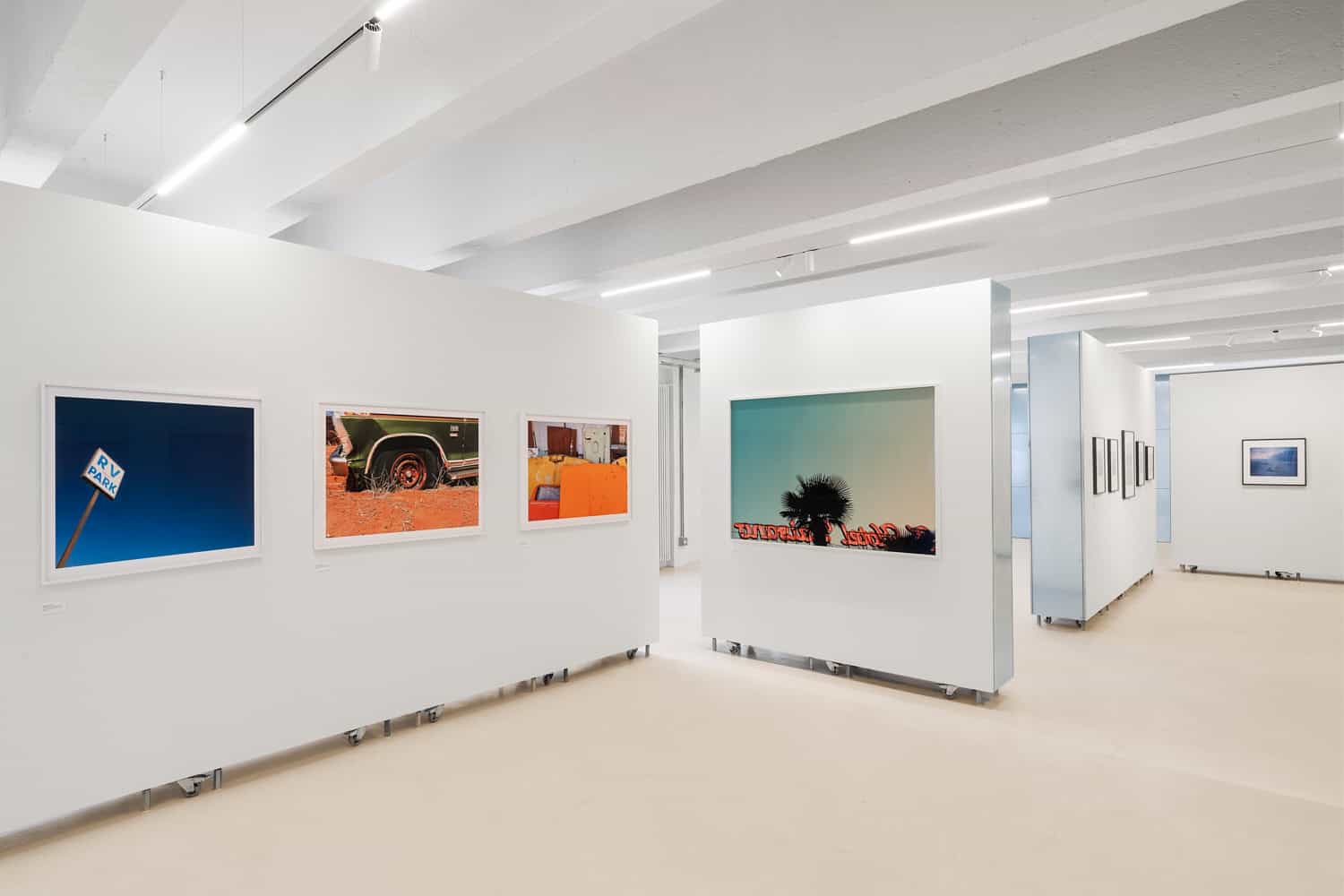
The New American West: Photography in Conversation brings together historical photographs and contemporary works to reconsider the image of the American West. At 10·Corso·Como, the photographs of Maryam Eisler and Alexei Riboud, developed from a shared journey through Texas, New Mexico, Arizona and Utah in 2024, offer two very different ways of looking at the same landscape. Eisler’s images are intuitive, cinematic, and charged with psychological tension; Riboud’s are more restrained, architectural, and contemplative. Witnessed together, their works suggest that the West is never a fixed image, but a place continuously shaped by memory, history, and representation.

The interview begins here. In conversation, Eisler and Riboud reflect on their different visual approaches and on what it means to photograph a landscape so saturated with meaning.
Maryam Eisler
The Cold Magazine (CM): In your work on the American West, a cinematic tension emerges. When you photograph, do you begin from a real place or from a mental scene?
Maryam Eisler (ME): I’d say it’s a bit of both. When I photograph the American West, I absolutely begin with a real place — the sheer vastness of the land, the spirit of the space and place — that’s what initially takes hold of me. But at the same time, I’m a storyteller at heart. I want to transport people into a kind of voyage, one that’s not just about what you see, but about the psychology of place and the sentimentality of that landscape.
I was so taken by the expansiveness of the West that I started using a wide-angle lens and shooting upward, almost as if I were indulging in a kind of visual gluttony, trying to take it all in. It’s that blend of reality and mental scene that shapes the final image.
CM: You travelled through the same territories as Alexei Riboud without comparing your images. What were you trying to protect in that space of autonomy?
ME: Part of that autonomy was really about honouring our individual interests and the different themes we each wanted to explore. For me, a huge part of photographing the American West was delving into human stories, spirituality, and the connection that Indigenous peoples have to the land. I was also drawn to big art and big ideas, while Alexei had his own set of interests, entirely different from mine, such as border psychology, among other themes.
Naturally, we approached these topics from our own angles, and each perspective was photographed in a very personal way. That’s why we ended up with results that are so different aesthetically, yet beautifully complementary. In my eyes, it’s like putting together a puzzle: two very individual perspectives that come together to form a larger, richer story. And that’s the beauty of our humanity — we each see and experience the same journey in our own unique way, and together it becomes something greater.

CM: Your gaze is described as intuitive and charged with psychological tension. Do you recognise yourself in this reading? And how do you work to bring out that tension without making it overly didactic?
ME: Yes, I do recognise myself in that reading, because my work has always been guided first and foremost by intuition. I don’t arrive with a fixed thesis or a didactic intention; I arrive with a sensitivity to atmosphere, to what is unspoken, to what lingers beneath the surface of a place. That’s where the psychological tension begins for me: in that space between what is visible and what is felt.
I think of myself as a storyteller, but not in a literal sense. I’m not trying to explain or impose meaning. Rather, I’m trying to evoke and create an emotional and psychological resonance that invites the viewer in. The tension comes from that ambiguity, from allowing things to remain unresolved, slightly elusive.
In the American West especially, I was very aware of the layers of history, mythology, and human presence embedded in the land. There’s a kind of quiet intensity there, a vastness that holds both beauty and unease. I try to respond to that instinctively, through framing, light, and composition — without over-articulating it.
For me, it’s about trusting the image to carry its own emotional weight. The moment it becomes too explanatory, too certain, it loses that tension. So I hold back. I leave space for interpretation, and for projection, so that the viewer can enter the image and complete it with their own inner world and personal intuition.

CM: Among mechanical ruins, ghost towns, interiors, and motels, the West you photograph often appears as an inner landscape. How much do memory, desire, and projection shape the construction of your images?
ME: I do see myself in that description. My gaze is intuitive, and I think the psychological tension comes precisely from that blend of memory and projection. When I was photographing the West, I was not just looking at what was there; I was also engaging with the romantic notions we’ve all inherited from Western films, from the stories of people chasing freedom and golden opportunities.
In places like Marfa’s Paisano Hotel, where the cast of Giant once stayed, there’s this lingering echo of the past — rooms that have seen so many iconic lives and stories. It’s as if the walls themselves hold memories of that romanticised past. And in ghost towns like Shafter, you feel the presence of those who came searching, whether for literal gold or symbolic freedom.
All of that seeps into the images. I try to let those layers of history and that sense of longing remain open, poetic, so that the viewer can step in and feel that mixture of past and present. It’s never just about the physical landscape; it’s about the layers of memory and desire that shape how we see it.
CM: The exhibition suggests that the American West is less a place than a recurring question. What question did this journey leave open for you?
ME: I think the journey left me with a question that is both very simple and impossibly vast: what are we really searching for?
The American West has always been mythologised as a place of promise — of freedom, reinvention, and gold, both literal and symbolic. As I travelled through it, I became very aware of how deeply that narrative is embedded in the land, in its histories, in its silences. Generations of people moved through these territories in search of something: hope, opportunity, escape, belonging. Whether they found it or not is something the landscape doesn’t quite answer.
For me, the West became less of a destination and more of a mirror. It reflects back our desires, our projections, our restlessness. It asks: is freedom a place? Or is it a state of mind? Is it something we arrive at, or something we carry within us?
I don’t think I came away with answers. If anything, I came away with a deeper sense of the complexity of that question, and a quiet awareness that perhaps the act of searching itself is what defines us.

Alexei Riboud
The Cold Magazine (CM): Your gaze is often described as essential, architectural, and contemplative. In your practice, how much weight does spatial structure carry in relation to narrative?
Alexei Riboud (AR): Spatial structure is where the photographer meets the viewer. That’s where you first enter an image. The geometry or composition of the photograph determines how you enter the image and start building what you call a narrative.
In most of my photographs from the American West shown here, I don’t tell a story or depict a scene. I simply open a space for others to fill with stories. That’s probably why it feels essential or contemplative. The architectural aspect probably comes both from my formative years at SVA in graphic design and from my interest in The Poetics of Space, the book about architecture by French philosopher Gaston Bachelard, which I highly recommend.
CM: You photographed the same territories as Maryam Eisler, yet arrived at very different results. When working within a landscape so saturated with imagery, how do you avoid illustrating it and instead rethink it?
AR: What struck me most during the first days of this trip was a form of fossilisation of the landscape. I decided to convey that feeling using the aesthetics of the vernacular and the derelict, in order to find some truth of what the West is today.
I looked for images that stimulate the imagination — traces of human activity within vast settings — without imposing any form of romanticisation. Rethinking the overexposed is mostly about finding your own visual grammar and not dissolving into the sentimentality I repudiate.
CM: Within the exhibition, the West appears as a space of thought, reflection, and threshold. For you, is it still a physical territory, or has it become primarily a mental construct?
AR: There is no doubt that the West has become a mental construct based on myths, movies, and photographs that helped define it. But it seems that there is a correlation between the exhaustion of the land, having been used and abused by humans, and the overwhelming amount of narratives about it. It’s a threshold of destruction and creation. Something to meditate on.
CM: Ghost Ranch, Marfa, The Hill, Native communities: along this route, you encountered places that have already been extensively represented. How did you create distance from existing images?
AR: I approach every project differently in terms of visual structure. I don’t have a consistent frame of reference. I could decide to do only portraits if the context required it. It’s about finding the right personal grammar in order to avoid being illustrative. I never think about existing images as too close, as they were necessarily made in a different context.
CM: Alongside the major figures from the Howard Greenberg archive, your images do not function as nostalgic homage but as a reactivation of the present. How did you approach this dialogue between photographic history and a contemporary gaze?
AR: There is no room for nostalgia when you stick to the truth of what the West is now.
Not long ago, I was going through a recently published book about the works of photographers Robert Frank and Todd Webb, who travelled through the West not together, but around the same time, in 1956, and in similar conditions, with the support of the Guggenheim Foundation. There was an image of a small isolated town with wooden buildings, shops, buoyant human activity, and, in the distance, an open-air train station with a train standing there.
When I looked closer, I noticed a tiny detail on one freight wagon with the inscription: “Santa Fe All The Way.” The irony was that, during this trip to the West, I had photographed the very same single old freight wagon, now derelict in the desert near Presidio, Texas. As a relic from the past, it was probably the only thing that still existed from the old photograph.


