
In recent years, a curious strain of corporate romanticism has seeped into fashion’s bloodstream. Where ‘girlhood’ once reigned, womanhood (or the performance of it) took the stage. The figure of the “office siren” emerged: a woman at her desk in pencil skirts and unbuttoned blouses, channeling Gisele Bündchen’s feline detachment in The Devil Wears Prada. The image spread from the online ether to the runways, with Kim Kardashian posing in beige cubicles for Skims, Sandy Liang trading in her signature babydoll dresses for skirt suits, and Calvin Klein’s AW25 show at New York Fashion Week reviving the sharp-shouldered etiquette of ‘90s power dressing.
The look promised empowerment through professionalism (a sort of post-Barbie fantasy of control) yet it was always built on irony: a fetishised vision of female authority that still played out under patriarchy’s incandescent force. But this pipe dream proved short-lived. As the economy faltered and layoffs loomed, the siren’s stiletto softened into something safer: monochrome uniforms, turtlenecks, muted tones… corporate glamour stripped of introspection, curdled into something greyer, more exhausted – the heel giving way for the safety shoe. It’s against this backdrop that Ella Douglas’s work emerges.
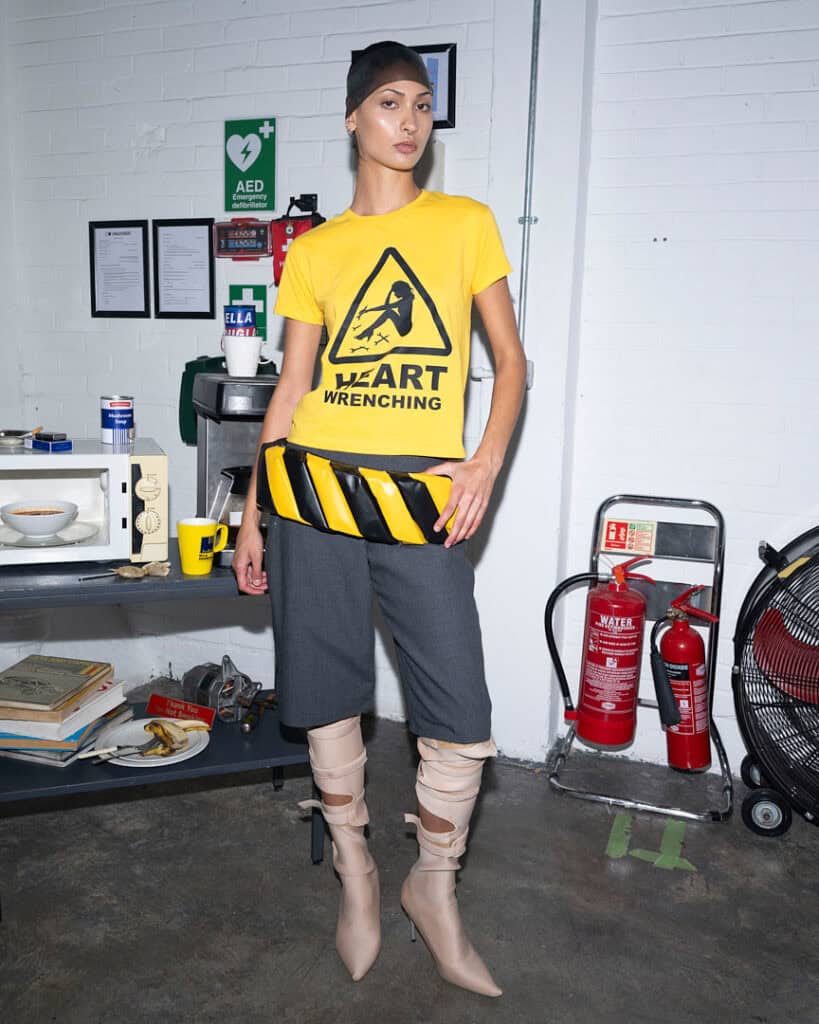
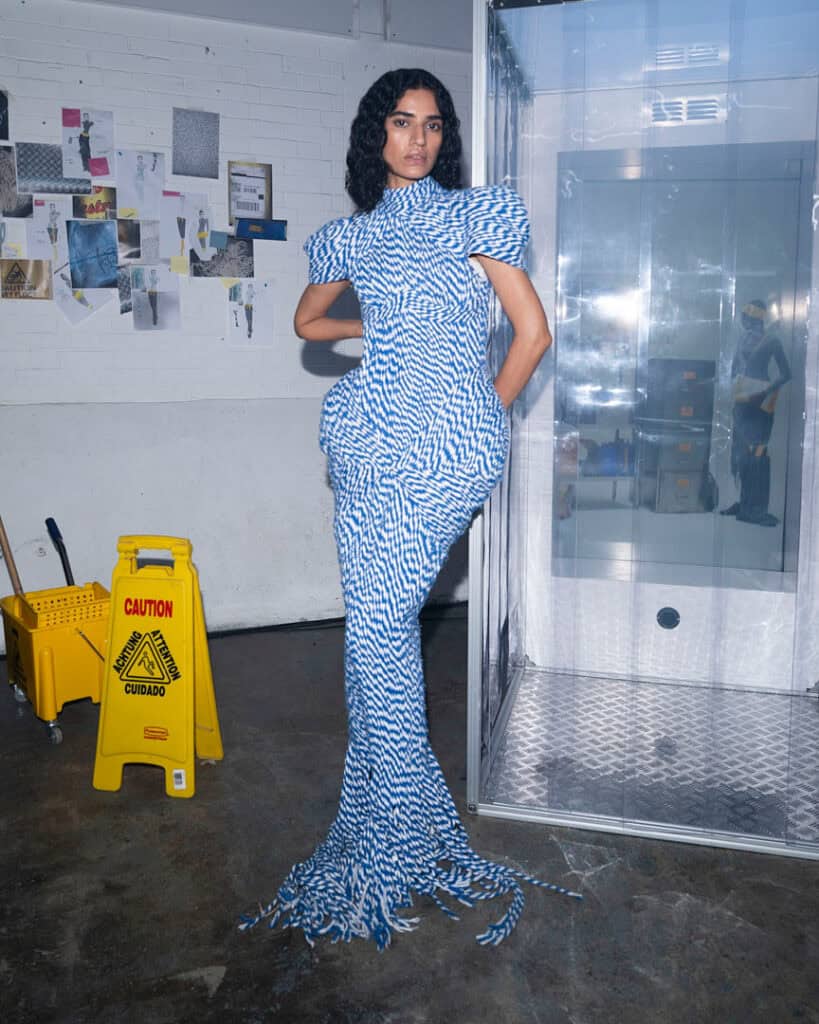
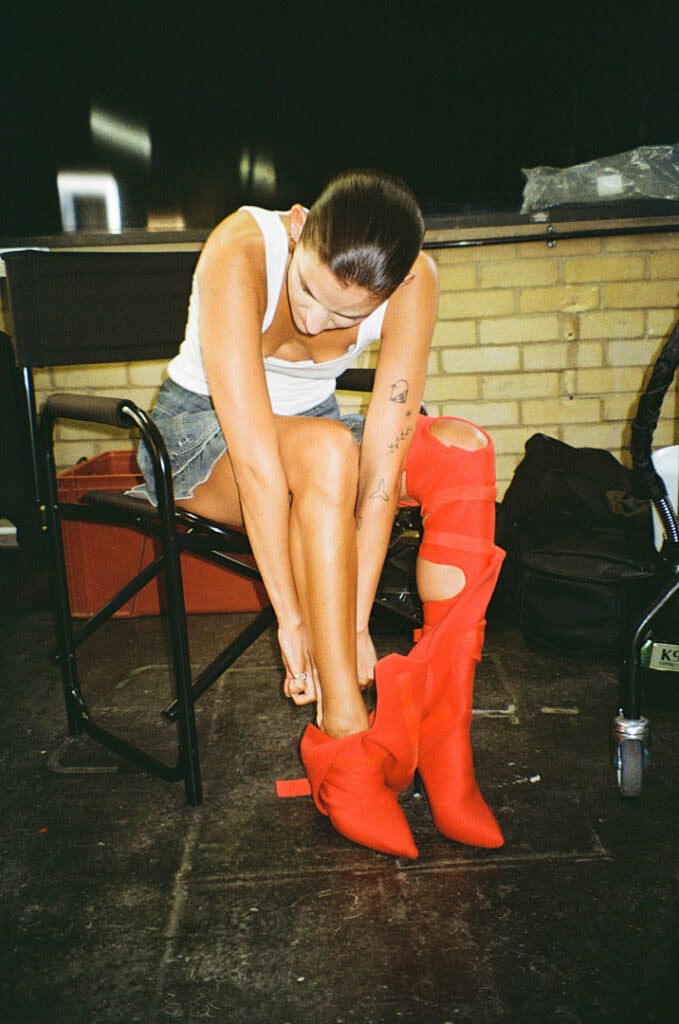
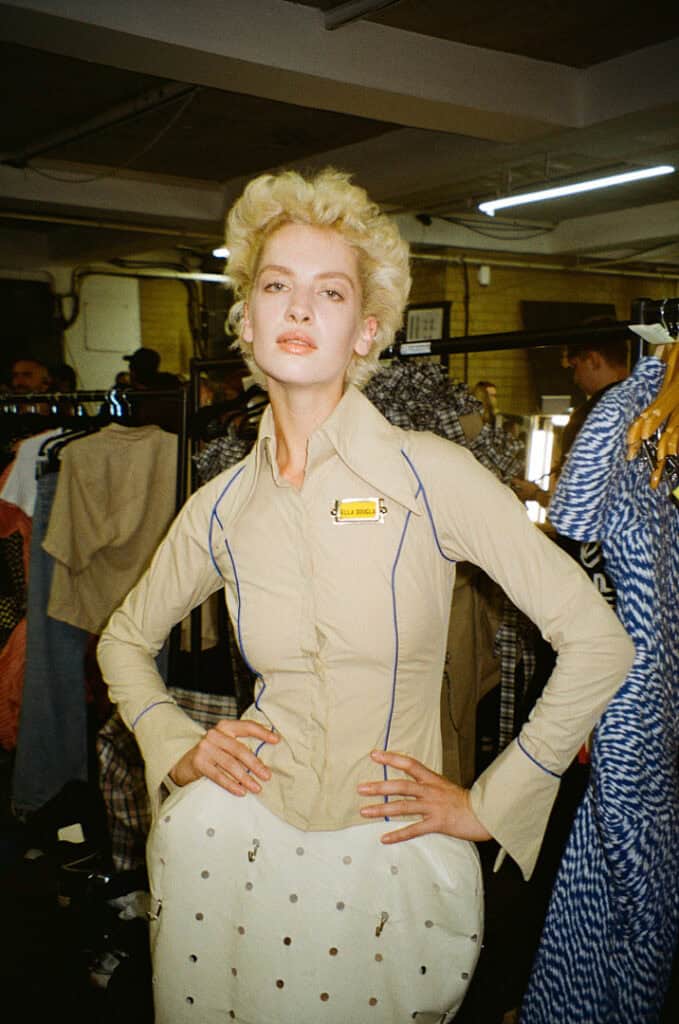
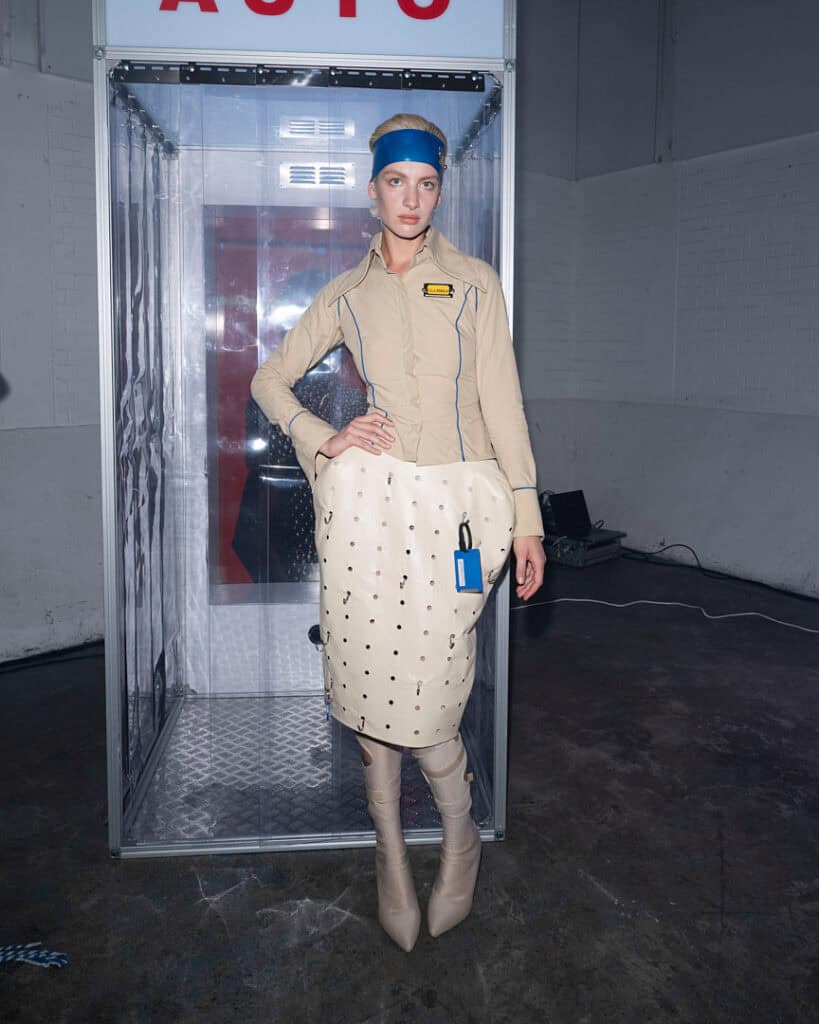
Presented through Hi:Fi London, a non-profit platform supporting emerging creative talent, her latest collection unfolds inside an office in a lesbian-owned garage: a space humming with drills, microwaves, and fluorescent, if slightly flickering, light. Here, tread metal flooring, hook boards, the yellow stripes of safety paint, even mops, became her muses. Knitted grey dresses draped with cascading mop fringe brushed the floor, while warning stripes curved around hips and hems in sharp yellow and black. One look paired a T-shirt stamped “HEART WRENCHING” with a patent hazard-belt skirt. Red thigh-high boots cut through the greys. Accessories were borrowed from logistics culture; padded parcel clutches and folded-mail pouches flirted with the iconography of delivery work. But unlike Jeff Bezos’s sterile capitalist universe, this one felt human: handmade and intimate. The result was a new species of workwear, one that finds beauty in the banality of labour. “There’s nothing there that screams fashion,” she mentions. “And I see that as a challenge – to look at it through a fashion lens.”
A recent first-class graduate of Central Saint Martins, Douglas has already earned industry attention for her bold reimaginings of labour and identity. Her graduate collection, inspired by transgender and lesbian truck drivers, featured 17,000 hand-applied spikes and industrial textiles that caught the eyes of major publications and even Björk herself. With this new chapter, Douglas trades the open road for the office; in a moment when fashion is sanitising its fantasies of work, she brings the workplace back down to earth: queer, raw, and defiantly real.
CM: The setting that you created was “an office in a lesbian-owned garage,” as you put it – what inspired that and the collection as a whole?
ED: It was kind of inspired by something very uninspiring. I came out of university and worked in an office in an industrial estate: not a corporate office, just a room in a loading bay. It was so mundane. I became fascinated by how you can be influenced by everyday surroundings. The only people we saw were postmen or lorry drivers, so it was about that strange overlap between 9–5 work and where you actually found yourself. I’m a very texture-based person, so a lot of looks came from the materials around me: mops, hook boards, tread metal flooring, and the yellow you see everywhere in industrial estates. It’s the colour of safety and hazard, and in that beige office, it was the only thing that stood out. That contrast became a big part of the collection.
CM: I was going to mention the mops as well – the mop dress was one of my favourite looks. What was the process of making that look in particular?
ED: It was hard, because I wanted to use mops, but where do you even buy mops from? I ended up liaising with factories and pretending I was a mop manufacturer because you could only buy premade ones, and the length was tiny. I had to contact a mop factory directly, and they sent me four huge spools, enough to make thousands of mops, it’s insane. We had it all on a roll, so we embroidered it, laying it on the fabric and hand-sewing over every bit of the white to build texture. Now I’m stuck with loads of mops, and the factory keeps messaging me like, “We’ve got new colours!” It was surprisingly cool though, they had so many colourways and mixtures. The blue-and-white one, when layered, almost looked like it was moving, creating an optical illusion that tied into the theme of motion and hazards. I think the mop dress is actually my favourite look.
CM: You’ve been working with some unconventional materials – did that make you want to experiment further? What’s another mundane object from an office or another space you’d love to turn into clothing?
ED: Ooh! Probably notepads or post-it notes. You could do a really cool print, or maybe something from hole-punched ring-bound notebooks. You’ve got the spiral, the lines, the holes… maybe that. Very boring. A notebook or memo pad or something.
CM: I mean, that’s a classic office object.
ED: Yeah, exactly. I actually wanted to do something with office chairs for this collection but had to scale back. I even reached out to a chair manufacturer about their fabrics. Maybe next time. Or bus seats. There’s this factory that makes all the Underground seats, and you can get custom prints. Kinda cool, right? Maybe for a future one.
CM: In terms of reshaping ideas of business casual and workplace dressing, how do you feel your collection does that?
ED: For me, it came from the feeling of working in an office. It was just me and my friend. We were the only women there and every day, no matter what we wore, someone would comment: “Ooh, look at you dressing up!” or “You’ve dressed down today!” Constantly. So I wanted to take that and create looks that were really out there: big shoulders, big hips, showing power. I was looking at the 80s power suit and how strength is expressed through structure, around the hips, the shoulders, even the face. I didn’t want it to be literal, like “this is an office outfit,” but the silhouettes still nod to that. When you wear them, and when I tried them myself, you feel this confidence. That’s where it came from, channeling office aesthetics. And again, it wasn’t a typical office. Everyone wore trackies, so if someone wore a shirt it was like, “They’re trying so hard!” It’s that strange mix.
CM: When I was reading about your graduate collection, I saw that you explored queer truck drivers. Now it’s an office. These seem to be quite distinctive, industrial, and often masculine-coded spaces…
ED: That’s what I find myself drawn to. I graduated last year, so I’m still figuring out who I am as a designer and what my brand ethos and aesthetic are. It is those masculine-coded, industrial spaces, because even for my next one, it’s things that inspire me or situations I find myself in. Not that I’m in them all the time, but they definitely influence me. I like being inspired by something that has no direct link to fashion or art. There’s nothing there that screams “fashion,” and I see that as a challenge, to look at it through a fashion lens. The industry is often so couture and elegant; I want to create those outcomes but from concepts that aren’t elegant. I like the idea that if you really look into these spaces, there’s art there too – textures, prints, inspiration – even within industrial estates.
CM: When it comes to the research process, how do you go about building a collection from start to finish? Do you immerse yourself in the subcultures you’re exploring?
ED: For me, it always starts with firsthand research. When I did my graduate collection, I went to this huge festival full of truck drivers. Everyone just parked their trucks and I walked around taking photos. It was such an interesting environment. I got to meet and interview the drivers and really submerge myself in that world I’m not part of. For this collection, it was more of a living experience, but I still did research outside of it. I always begin with sampling. I’ll research a bit, then start translating that into textiles to see where it goes. I never start with drawing; I start with textures, then visualise them on the body. I go to the place, take textures from it, rework them in my own way, and build from there. For my next collection, I’m planning a research trip in my hometown. I just need to go there and see it. Seeing something through a screen doesn’t do much. With textures, you have to see them in person; they’re flat otherwise. Immersing myself in the environment is always the best way to find inspiration.
CM: And where is your hometown?
ED: Oxford. Beautiful (but boring) Oxford. It’s where the Mini factory is.
CM: My mom loves her Mini.
ED: I just need to learn to drive, but I want one too. As a child, I’d always drive past that factory – it was huge, and it still is to me. It’s kind of inspiring. I want to go on a tour and see what I can find. It might do nothing, but I might as well try.
CM: As an emerging designer in London, what are some of the biggest challenges you face?
ED: Cash flow, definitely. Everything I’m doing is self-funded, and I find myself comparing my work to other designers because I want to push myself, but I’m physically restrained. There’s only so much I can do. Each collection depends on how well the last one sells or if I can get more work. It’s not like, “Okay, next collection I’ll do this…” It’s more, “Can I even do it?” And halfway through I’m asking, “Can I afford to add another look?” It takes away a bit of the inspiration because you’re stuck on what’s financially possible, but that’s part of the creative struggle, you just hope something comes from it. Finding a studio is another issue. I had one, but it shut down – I moved out last week. It literally closed three days after my show. The prices in London are insane; it makes everything feel elitist and hard to sustain. But there’s also this sense that everyone’s in it together, fighting to make it work, which gives you drive even though it’s exhausting. That’s why the opportunity with HI:FI meant so much. I couldn’t have done a show without them. They gave me a real stepping stone into the industry and made me believe I can do it. I’m so grateful. There is help out there, it’s just daunting to find.
CM: Looking ahead – you’ve mentioned going back to Oxford for research – do you see industrial aesthetics staying central to your work, or do you want to expand into other subcultural landscapes?
ED: I think it’s part of who I am, but I don’t want to be too closed off. For now, it’s what inspires me, but I don’t want to box myself in. Maybe in five years I’ll be doing something completely different. That’s exciting. My aesthetic is me; the concept is me as a designer, and hopefully that continues no matter what I’m exploring. Right now, I find a lot of inspiration in mundane, masculine-coded industries, but I’d love to mix that with something completely opposite to see my work take a new route. Maybe there’s a design I’d never reach if I just stayed in my box. We’ll see how it goes.
CM: What’s next for you – cash flow aside (hoping that’s steady!)?
ED: Hopefully another collection with hi:fi. We still need to confirm, but that would be really exciting. I’m also trying to get pieces from my last collection into production and into shops, because my favourite thing is making clothes for people to wear. That’s what I want, to see people actually wearing what I’ve made. I want to build an audience, create full looks – hats, tops, and eventually shoes – and develop a clear brand identity. I’ve always wanted to have a shop and sell directly; that’s something I really want to push, and it obviously helps with the cash problem too. Seeing people wear your work is the most exciting part. I’m still new and I want to learn, to get mentorship and understand how to grow both the business and design sides. I want to expand my brand and become a household name. That’s the dream: regular shows, lots of sales, and putting my name out there.
CM: Lastly, what excites you most about the London fashion scene?
ED: I love London Fashion Week. It’s one of the only fashion weeks that truly supports younger designers. London embraces unusual creativity instead of sticking to the norms. I love the mix between fashion, art, and installation. It feels fresh and exciting, always looking for something new. It’s not afraid of change, and that’s where I see myself.