
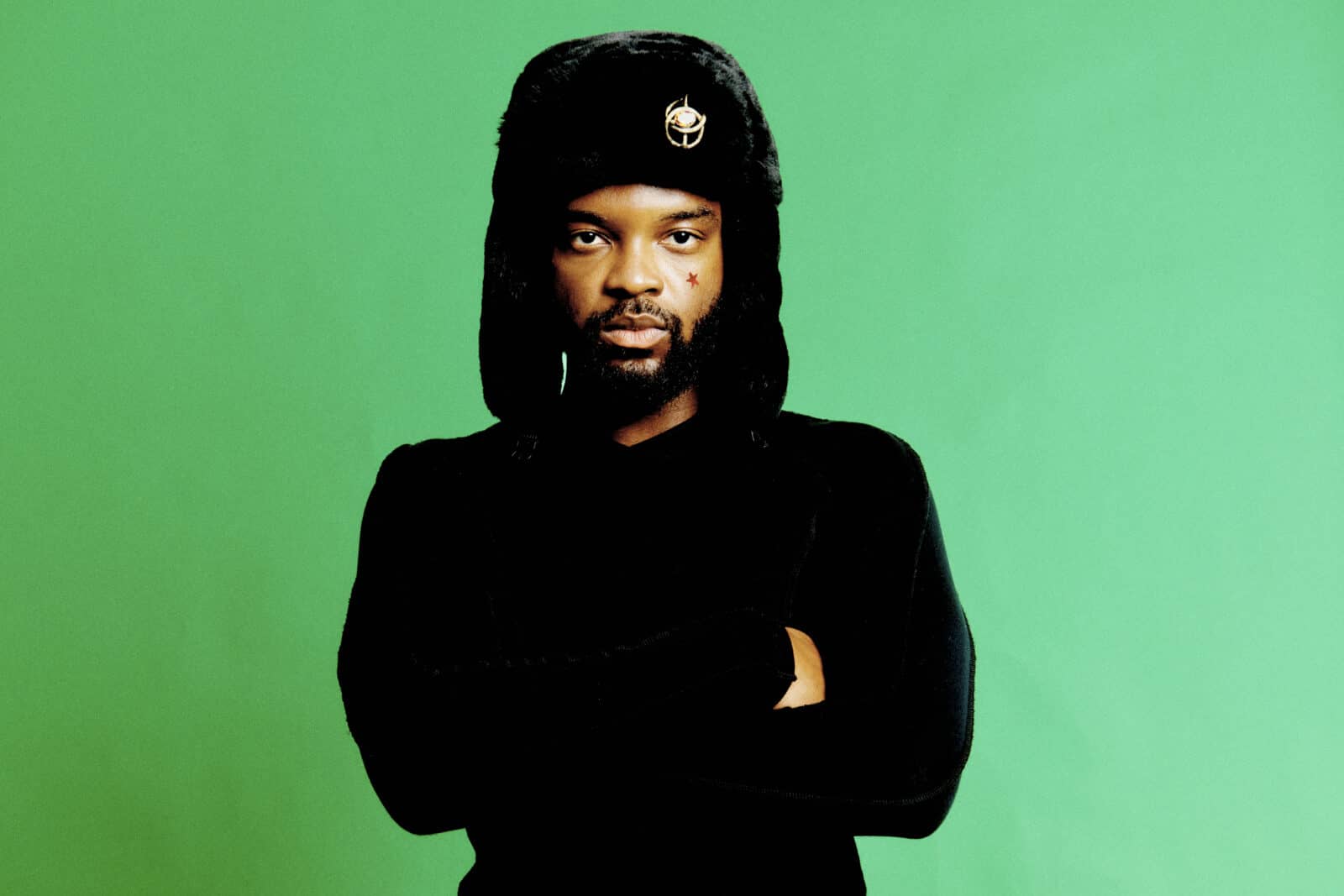
Genesis Owusu doesn’t want his newest album to be nuanced. Normally, an artist hopes that their work will exist in a spectrum of shades: open to an individual’s exegesis, capable of stirring subjective interpretations special to each beholder. But Owusu wants his music to exist only in a synaesthetic explosion of bright, furious red. Now, he explains, isn’t the time for shades. “I wanted to make an album that was as direct as possible. I want this album to be the soundtrack to somebody’s rebellion.”

Give Redstar Wu & The Worldwide Scourge even a passing spin and you’ll hear this mission swing into frenetic life. Within just the first track, Owusu, né Kofi Owusu-Ansah, has swung pugnacious hooks at Elon Musk (“a fuckin’ weirdo”), incels, a certain “toupee’d totalitarian” and his former idol, Kanye West (“I was a Kanye stan,” he tells me. “But it gets to a point. Nazism was definitely the point”) over equally pugnacious beats. Does he have a preferred political allegiance? “I haven’t really found a title,” he admits, “but I’m definitely of the left. Somewhere on the left.”
Owusu-Ansah was born in Koforidua, Ghana in 1998, a market town in the country’s east. When he was two years old, his parents immigrated to Canberra, Australia. Growing up, he found the whiteness of the city alienating. He describes himself as having always been political as a result, but only because growing up as part of a minoritised group forces politics onto you from the cradle. He recounts telling a classmate in high school about an experience of racism he’d had. “Why do you have to make everything political?”, his peer quipped. “I was like, I don’t even know what that [political] means. I’m just talking about life, you know?”
Those experiences were rhapsodised into his first album, 2021’s Smiling With No Teeth, an independently-released, avant-funk fire-starter which allegorised the psychological scars of racism as a “black dog”, Winston Churchill’s sobriquet for his own depressive demons. The project won him a worldwide fanbase and an ARIA – Australia’s most prestigious music prize – for Album of the Year, the first hip-hop album to bag the award. Two years later he did it again with Struggler, which imagined Owusu-Ansah as a cockroach fighting a pyrrhic, Kafkaesque struggle against God. Its message was one of nihilistic perseverance: no matter the circumstances, you just have to accept your lot and carry on.

Redstar does away with both the heady metaphors of these earlier stabs and their weary resignations. Taking thematic cues from punk – a genre Owusu-Ansah has dabbled in before, covering Sex Pistols’ ‘Anarchy in the UK’ for triple J’s Like a Version in 2021 – Owusu-Ansah calls for the entire ecosystems of fascism and capitalism to be razed to the ground in his latest work. “I wouldn’t say it’s literally punk in terms of sonics,” he says, ever agnostic to genres and their arbitrary, constricting borders. “But I think the album is definitely spiritually punk.” He reiterates: “I want this to be the soundtrack to somebody’s rebellion.”
In the interregnum between Struggler and Redstar, he says his philosophy evolved. Whereas the former was a “don’t get crushed, don’t die” album, Redstar asks the questions: “Are we just living to survive? Or are we living to make something better of our environment and our communities?”
Music, of course, is a pathway toward such betterment. Early promo for the album saw Owusu-Ansah perform three nights at Sydney Opera House, where he could see people face-to-face and “cultivate community”. But he doesn’t want his mission to stall there. “I don’t want to stop at music. There’s so many problems in the world and I want to do something about that. I’m still trying to figure out what exactly that is.”
Speaking truth to power is his step one. He describes the mission of Redstar as “journalistic” (Owusu-Ansah spent three years from 2018 to 2021 studying journalism at the University of Canberra), as a documentation of the reality we’re living through: “climate change, trillionaire corporations, an existential threat to our survival, exacerbated by media entities pointing to immigrants and trans people as thinly-veiled distractions.” But the album is also trying to ignite response, transform musical solidarity into IRL, headphones-off change.
Owusu-Ansah’s Ghanaian heritage swirls into this ethos. In 1957, Ghana became the first country in sub-Saharan Africa to claim its sovereignty from colonial occupiers and a founding power in the Non-Aligned Movement, which sought to dismantle imperialism on a global scale. During the struggle for independence, music turned into a powerful instrument for anti-colonial mobilisation, condensing political slogans and solidarity into charismatic folk grooves and ear-worm lyricism. Kolomashi, one genre of joyous, drum-based music popularised during the period, even took its name from a Ga phrase meaning “colonists must leave”.

When Ghana did declare independence, the country’s government, led by freedom fighter Kwame Nkrumah, also announced a competition to design the new nation’s flag. The winning entry was by a 35-year-old schoolteacher and artist named Theodosia Okoh, featuring three stripes of red, gold and green to represent, respectively, the blood of those who fought for the country’s freedom, the mineral wealth of Ghana (once known as the Gold Coast) and its tropical vegetation; and a five-pointed star in its centre as a lodestar symbol of African emancipation.
It is from this national iconography that Owusu-Ansah, who returned to Ghana for the first time in 11 years while recording the album, settled on the idea of naming the project Redstar. Red for the blood of those spilled trying to fight the oppressive systems we are ensnared in today, and the star as an icon of rebellion, a glowing image to lead the way into a better tomorrow.“It wasn’t actually the plan to film in Ghana at the start,” he says. “In Ghana, everything felt so foreign, but it also felt like coming home. And it felt right [to film there]. Because the problems I’m talking about aren’t only issues happening in the West, or to people inhabiting the West. This is an album about the whole world.”


