
Braids, Boots, and Bonds: Decoding the Feminine Tension in HAIR FUCK
Written by Lily-Rose Morris-Zumin
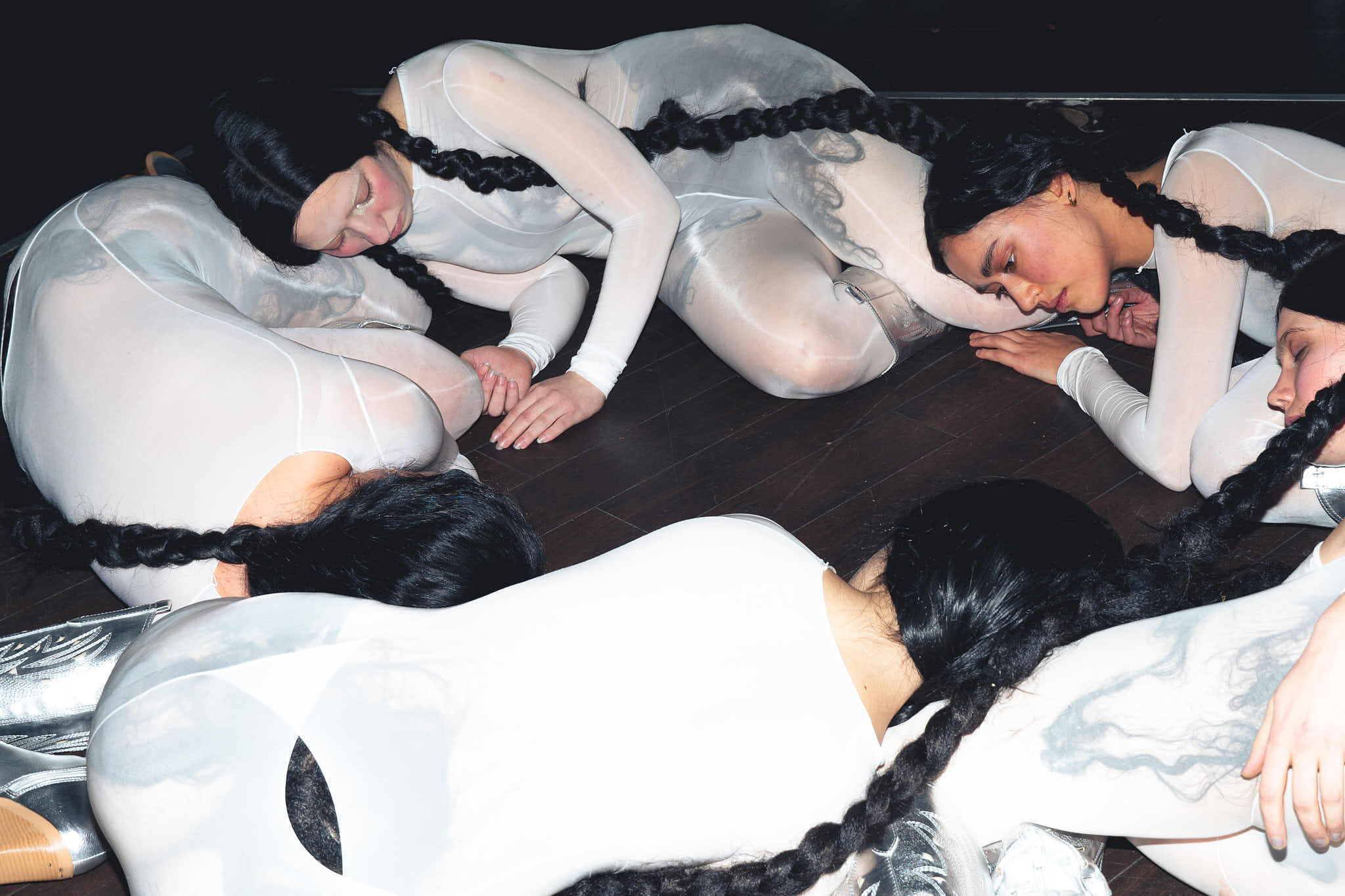
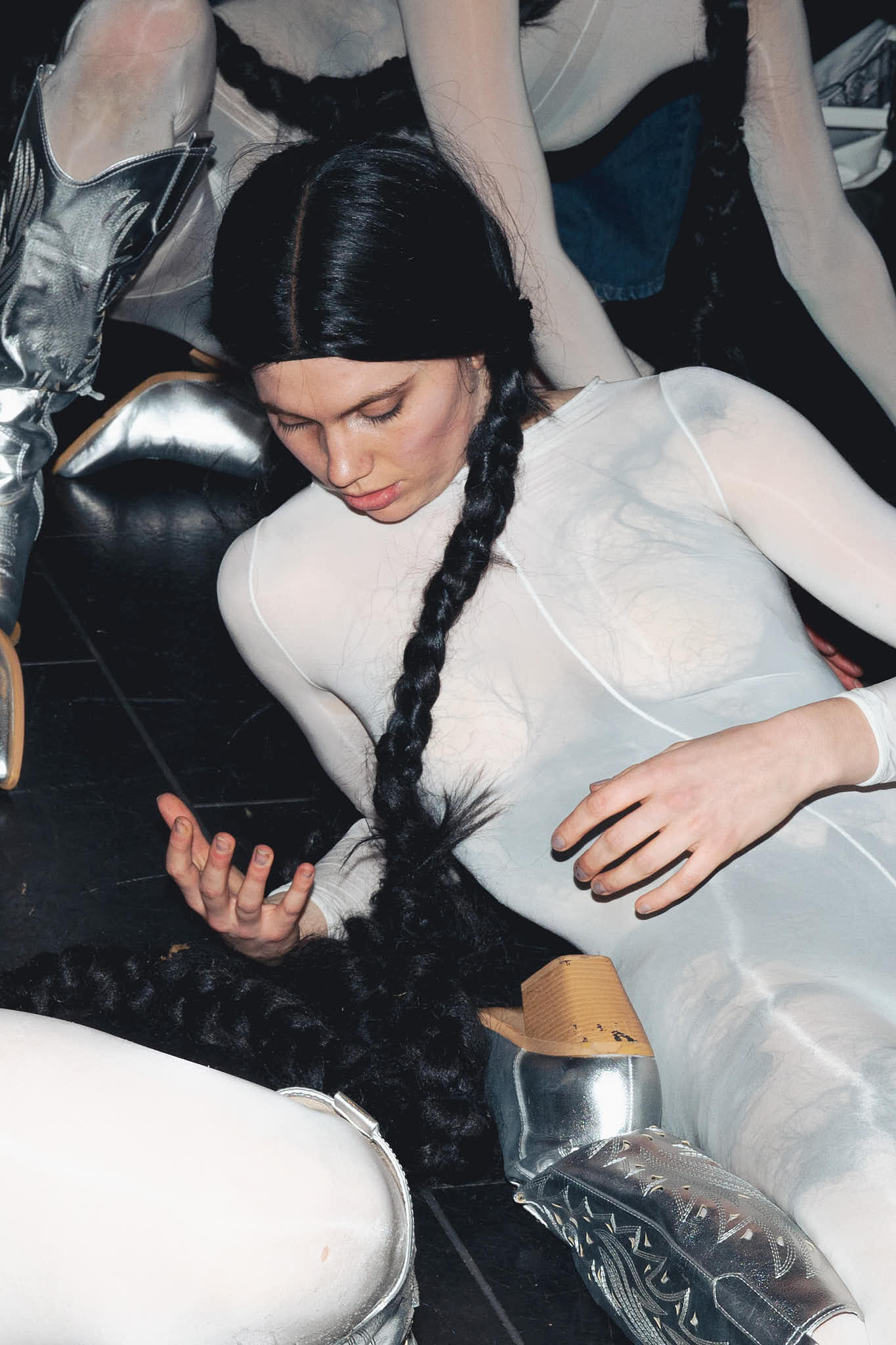
In a dimly lit performance space, tucked away in Old Street, HAIRFUCK by artist Vittoria Penalosa unfolded as a visceral confrontation with the pressures imposed on women. Originally a film, the work was reimagined as a performance art piece for the MENG x The COLD Magazine launch, where five figures—bound by a single braid of hair—embodied the tensions and enforced competition born from unattainable beauty standards. The braid, representing youth, fertility, and femininity, became both a literal and metaphorical thread—a tether and a restraint, symbolizing the societal forces that bind and define them
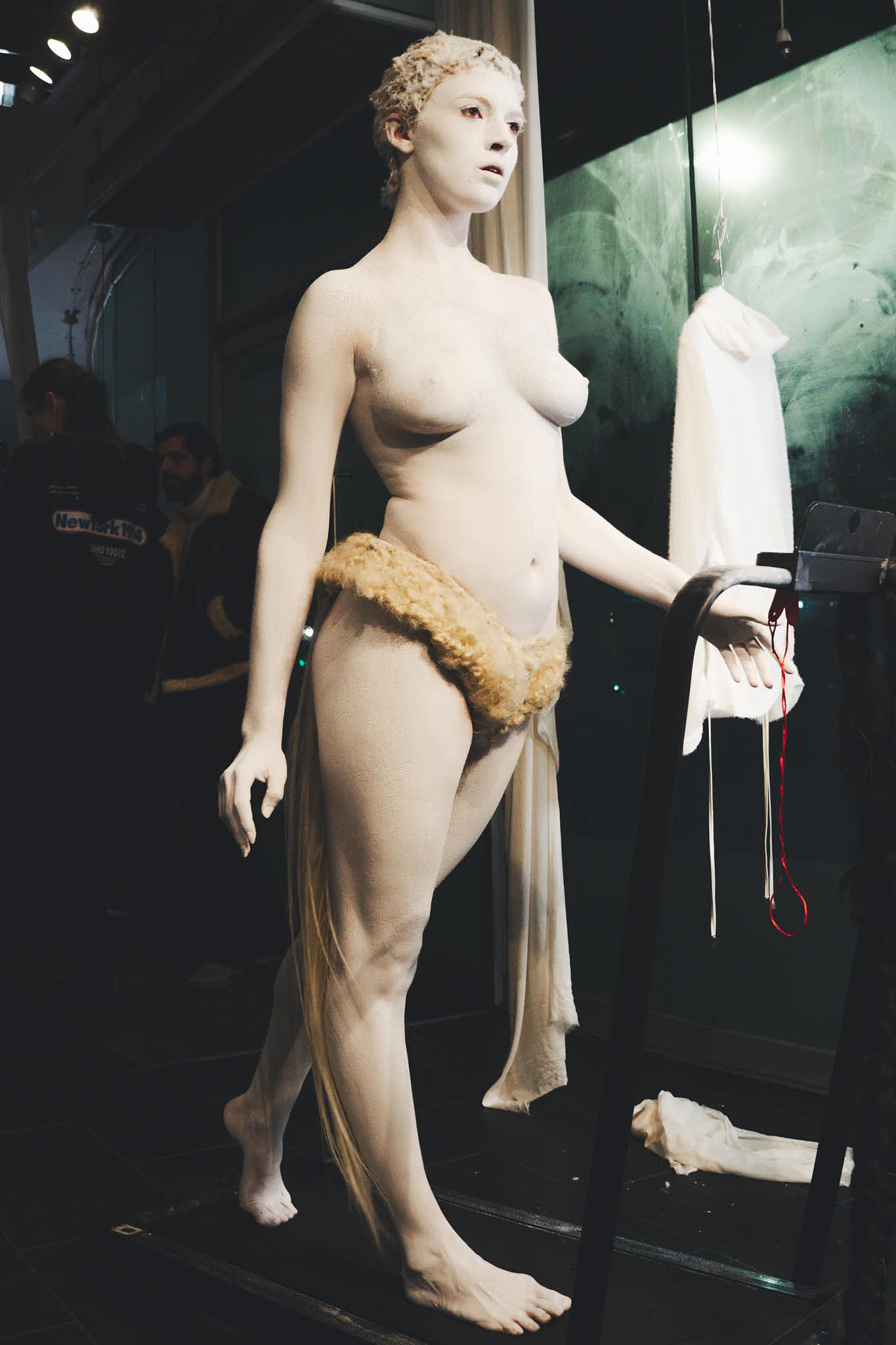
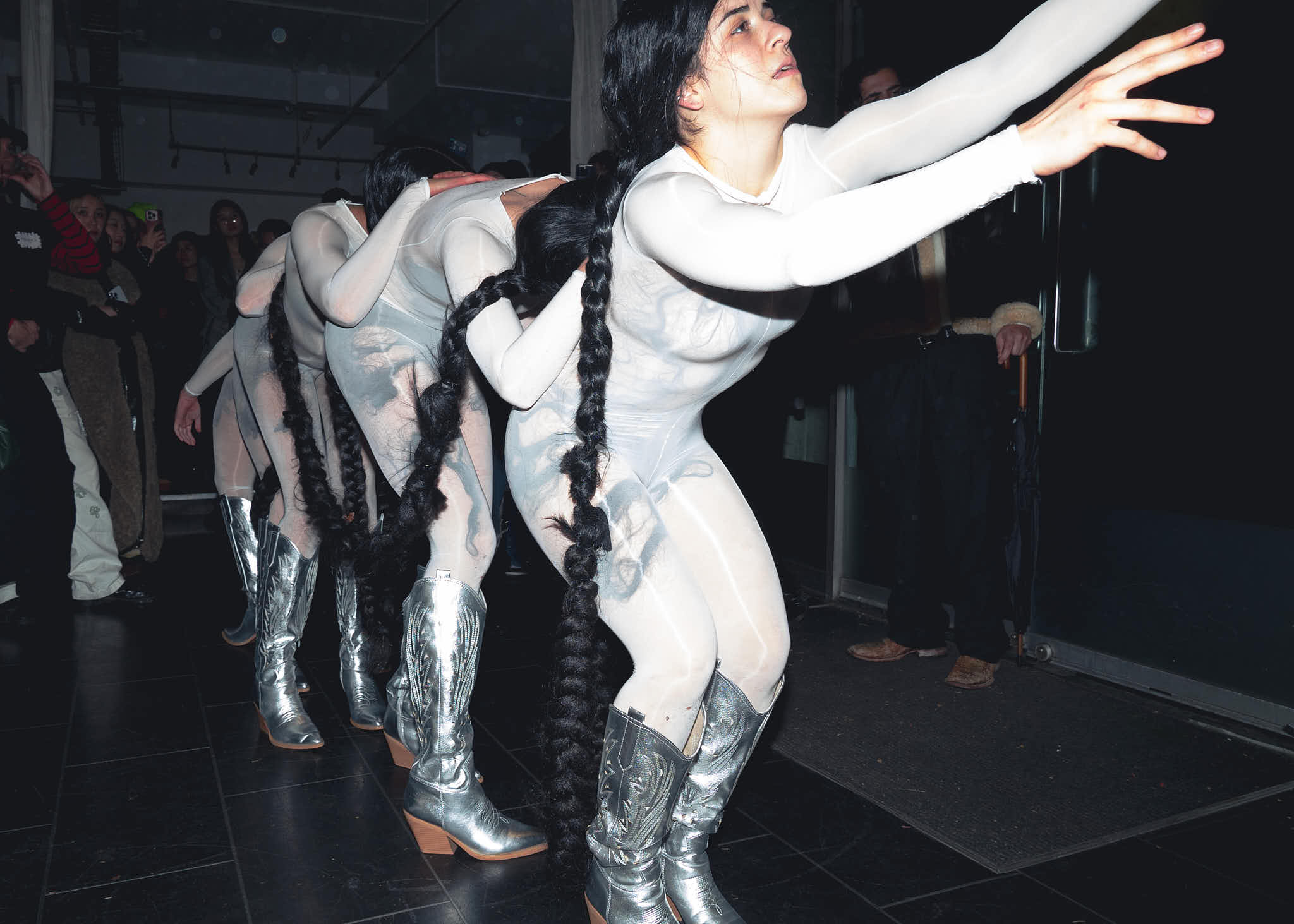
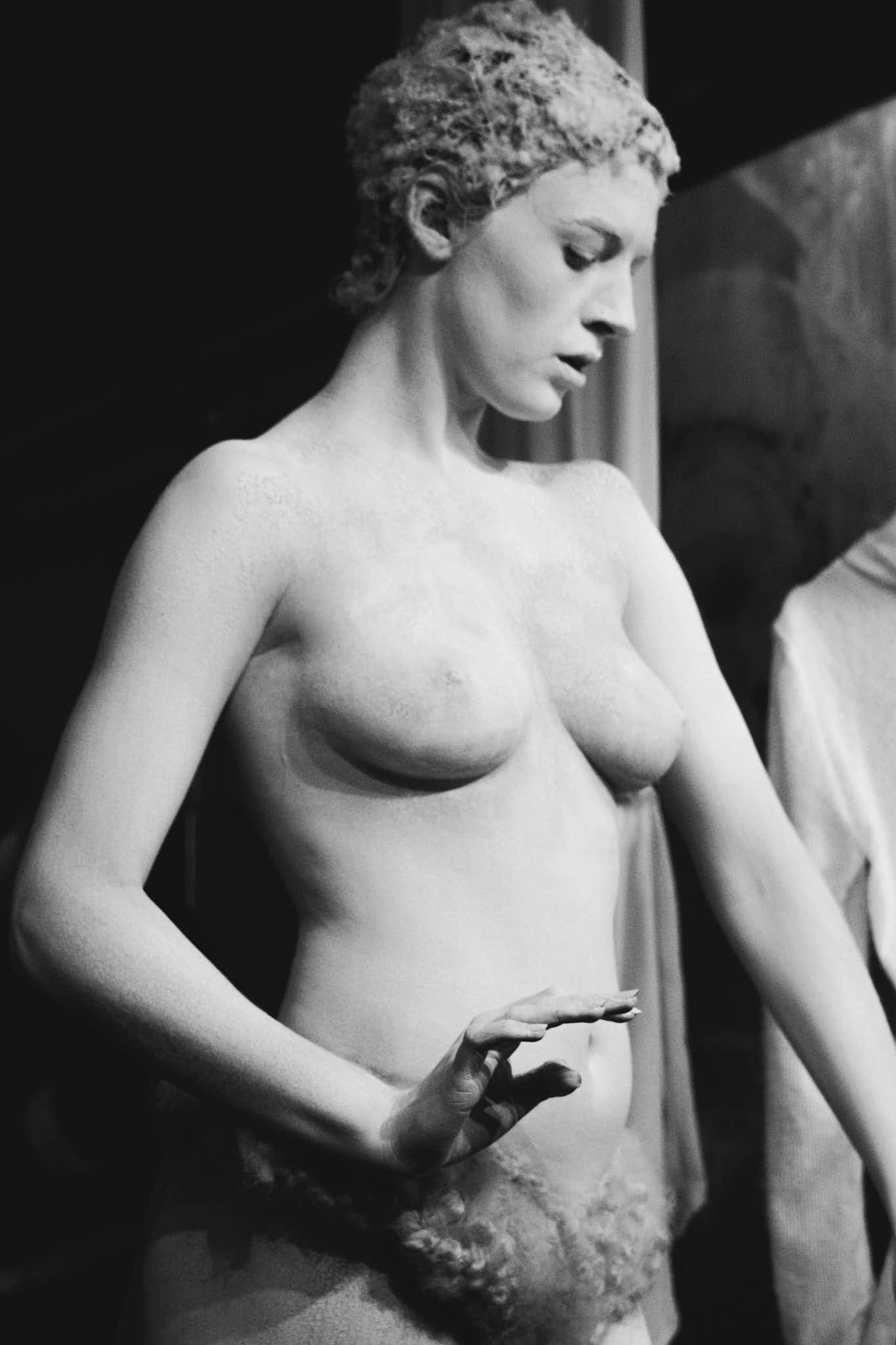
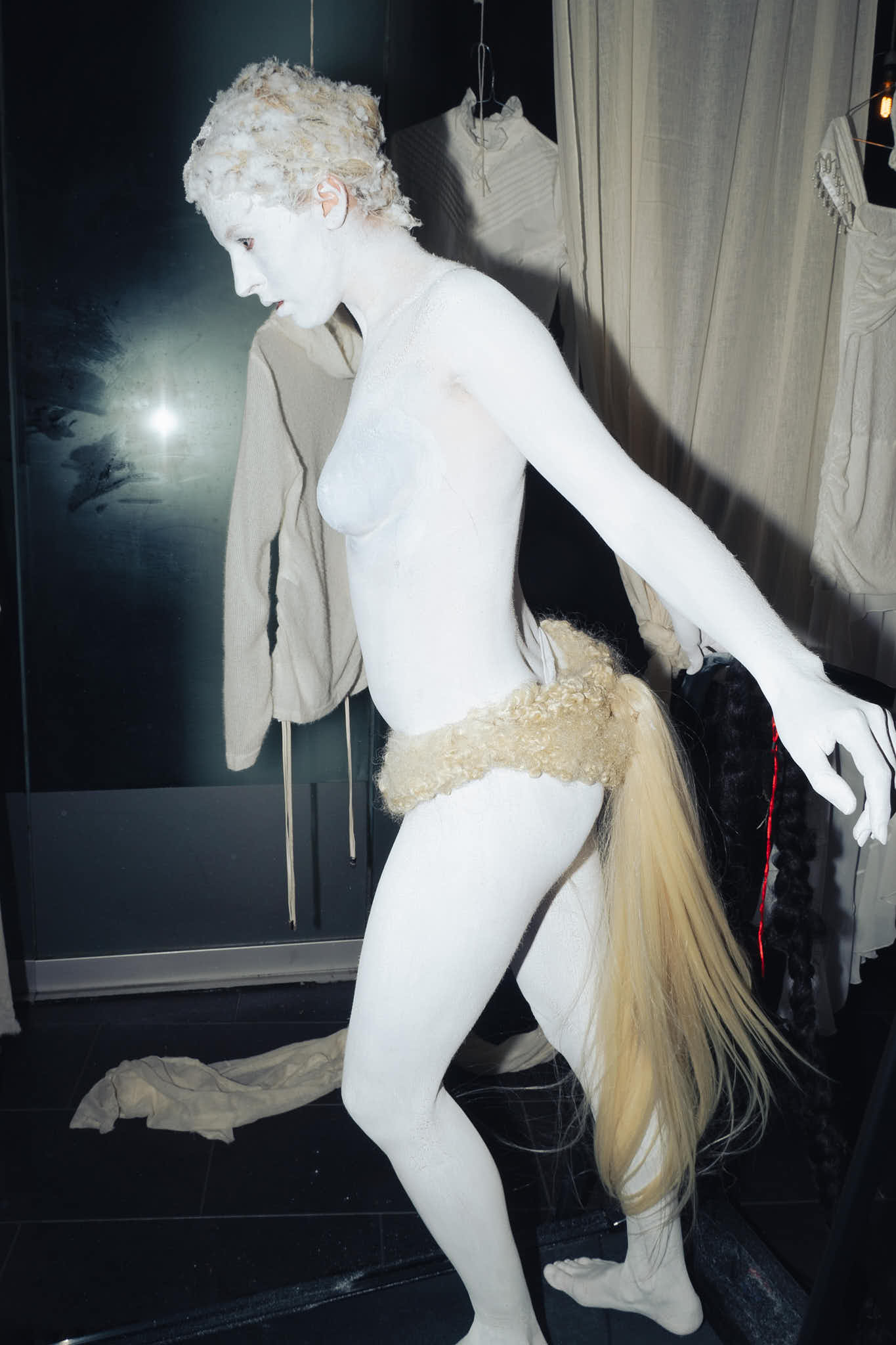
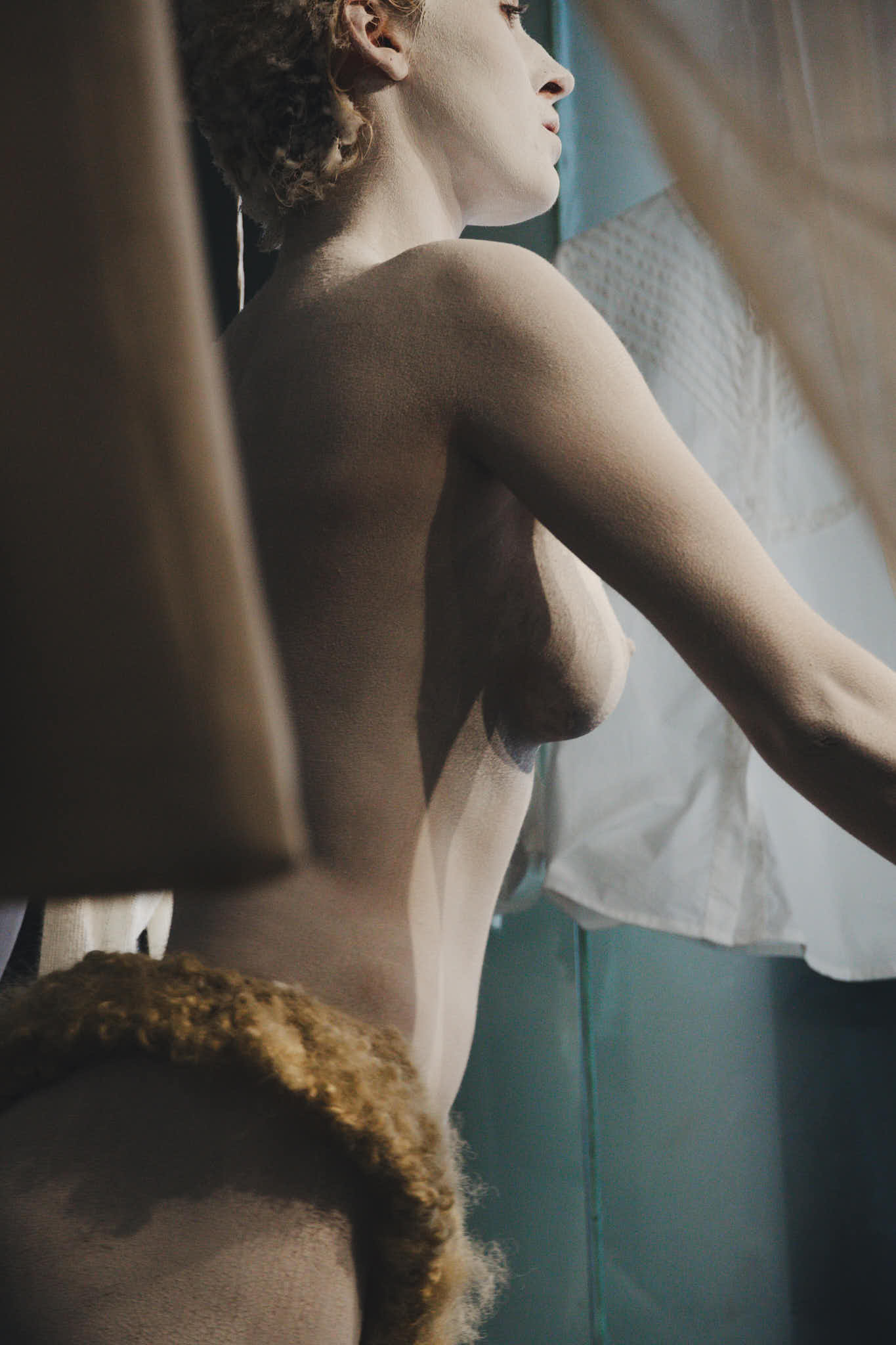
The piece took its form in a group of women, seemingly naked except for a layer of black pubic-like hair running beneath their second nylon skin, moving as one—bound together. They crawl toward the figure Rizzardi terms the ‘Wild Woman,’ like a mass of premature growths desperately reaching for their mother. The Wild Woman, an alabaster figure, appears as a Greek statue breathed into animation. Her mechanical strides on a treadmill gradually shed their rigidity, becoming fluid, human—free. As the bound women reach towards her, straining against the braid that holds them together, their struggle becomes a depiction of the tension between constraint and liberation.
Which woman are you? Is the question this performance posed, drawing us into a quiet war—against ourselves, against each other, against the confronting parallels we recognize in our own lives. Is the Wild Woman’s emancipation attainable, or merely a dream we’ve been fed? I spoke with Vittoria to uncover the truth behind this elusive ideal.
Cold Magazine (CM): Why the title HAIR FUCK?
Vittoria Peñalosa (VP): The title HAIR FUCK is essentially a play on the concept of a ‘mind fuck.’ It reflects the irony of striving to be a feminist while simultaneously controlling and competing with one another—capturing the paradox within the female experience. The piece explores the invisible tension among women, encapsulated by the braid, which symbolizes the intertwined complexities of control and freedom. The length of the hair symbolizes youth and fertility, reflecting how societal beauty standards often equate appearance with these qualities.
CM: The ‘Wild Woman’ is central to the piece—a figure seemingly free from societal expectations. Is she a symbol of attainable liberation, or merely an illusion? Her treadmill strides suggest forward movement, yet she remains stationary. Do you believe it’s possible for women to reach her state, or are we forever striving but failing?
VP: Both interpretations of the Wild Woman—whether as an unattainable dream of freedom from expectation or as a state to which we can aspire—are valid. Personally, I believe it’s possible to reach a place where individuals, particularly women, can live freely, untethered by societal expectations. I’ve witnessed certain influences in my life who embody this freedom. Despite knowing these people since childhood and growing alongside them, I haven’t been able to fully access that state myself. I don’t understand how they can exist in a way that rejects external perception and fully embraces freedom. So, while I do believe it’s achievable, I think it requires an internal transformation, rather than seeking something external to the self.
That is definitely the point I am trying to make with this piece and the nature of the movement within the performance. As the women move toward the Wild Woman, their actions are constrained by the braid. Their attempts to reach her are hindered, as the expectations that bind them pull them back. This struggle is both physical and metaphorical, as they tug at each other in the process, while the Wild Woman moves freely, fully emancipated.
Although I believe this state is attainable, as I have seen it firsthand, the Wild Woman still feels like an unachievable ideal of womanhood that I have yet to experience. Your explanation perfectly captures how I feel—she represents an idealized state of mind, rather than something I can claim as a lived experience. My perspective comes from observing the women tied together, and reaching out, and I realize that if I am to grasp that freedom, it will require an internal change.
CM: Could you tell me a little about your background as an artist and what led you to performance art as a medium?
VP: My background is in film, and my first creative impulses were in audiovisual storytelling. I find it difficult to commit to just one medium, as I prioritize the concept over the form. I don’t necessarily think when I make a film, ‘okay let me come up with an idea’, it’s more like the idea comes to me and then I consider whether it’s best suited for video art, a narrative film, or a dance-led music piece. That’s how my process works!
I really love performance art as an audience member, particularly the work of Marina Abramović. However, it’s Candela Capitan’s films and art that resonate with me most, especially in exploring the female experience and the complex relationship between self-identity and the imposed identities that shape us.
Originally, my idea was centered around an image of a woman trying to live her life with six-meter-long hair. It was meant to be a faux documentary about a woman navigating her life in this way, but I felt it lacked authenticity and depth. It needed something more—a bridge from the image to a deeper meaning that would resonate with the audience.
Then, luckily, I was invited to an art exhibition where my first performance piece was shown alongside a Shibari performance, which I had never seen in person before. I found it incredibly beautiful, and it became the catalyst for a new idea: a woman wrapped in a knot of her own hair. I followed that image instinctively.
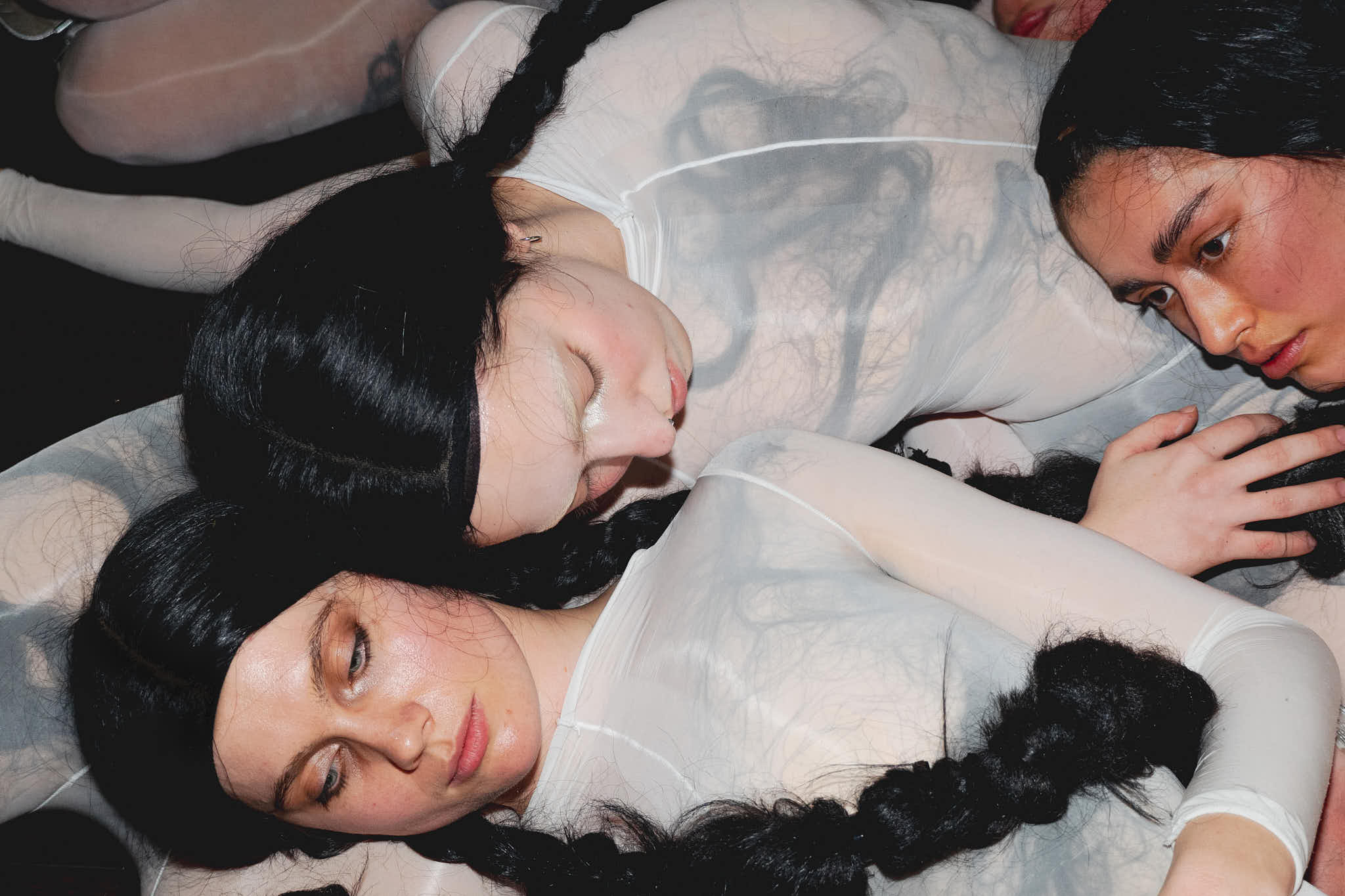
My approach to creating the video art was almost like filming a performance art piece—unconsciously so—because I wanted the artists to enter a ritualistic trance, performing repetitive movements as they struggled with the constraint of the braid. Their reactions to the limitations I imposed on them became part of the performance itself.
What unfolded in front of me was performance art without me realizing it, which ultimately led me to create an actual live performance piece.
CM: Did you need to adjust the work for its live performance, and were there any challenges in doing so?
VP: Oh yes! There were a lot of changes to be made. In the original film piece, the Wild Woman was included in the Shibari. The women were attempting to restrain this free woman, who had liberated herself from the braid, and bind her into a Shibari knot. She embodied a sense of freedom, appearing more primal, animalistic, and horse-like.
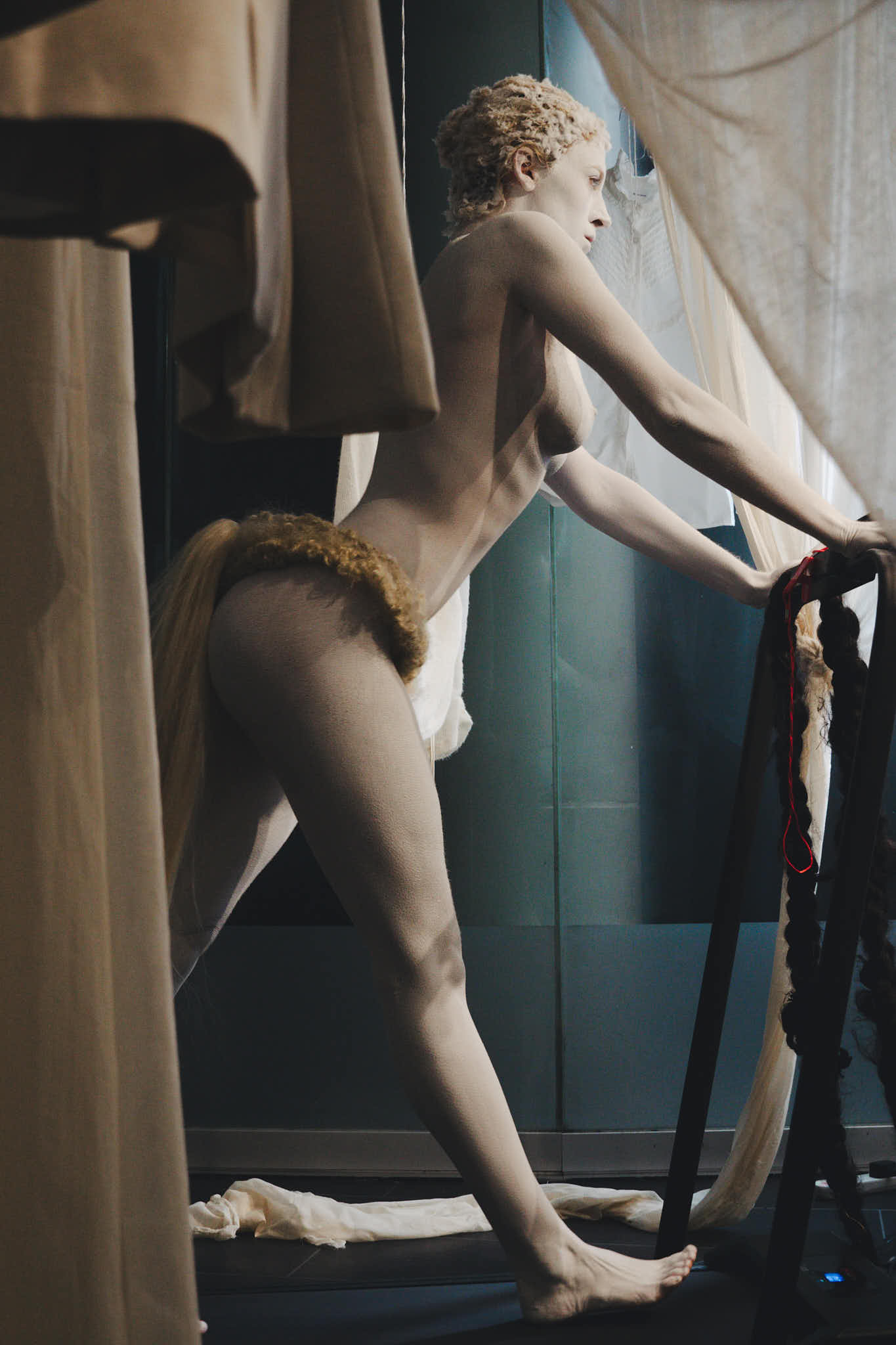
For the performance art piece, incorporating Shibari felt too complicated, and I wanted to explore something different. The idea I developed, which you saw, was to present the Wild Woman as a combination of a statuesque figure and a horse-like being. The statue element symbolizes beauty, akin to a Grecian statue—the epitome of beauty as perceived by other women. However, she does not embody beauty for the male gaze but rather a higher, classical form of beauty. The central concept is that the statue begins to move, ultimately freeing itself from the constraints of that beauty. The white horse element stems from my experiences in the horse-riding world when I was younger. I always found it fascinating—being a young girl who, for so many reasons, felt a lack of control over her life. Attempting to tame the wild animal I was riding gave me a sense of control that I couldn’t find in other areas of my life.
This is how we approached the concept of the Wild Woman. We placed her on a treadmill, partly to make use of the space available and to merge classical references with something distinctly modern. The treadmill symbolizes progress and moving into the future—the Wild Woman advancing forward while the other women attempt to reach her but remain unable to. She always stays just out of reach, embodying an untamed and elusive force.
CM: The use of space worked really well in this piece. I particularly appreciated the elongated silences and the raw, human movements of the performers during these moments. In the opening, there was a long stretch where we were simply observing the women. When we finally became aware of another figure—the ‘Wild Woman’—on the other side of the room, everyone rushed over. It was incredibly exciting to be part of the audience, all leaning in to catch a glimpse of her.
VP: This was one of those ‘happy mistakes’ that happen in live performances. There are always unplanned moments, and until I saw the space, I hadn’t intended to do this. But when I saw that it was more elongated than square, I decided to have the action begin in two separate areas before coming together. Instead of having a single space where the audience simply watches as voyeurs, I wanted everyone to travel with the action.
CM: I suppose this also aligns with the concept. As you mentioned at the beginning, there’s a certain comfort in the feeling that everyone is trapped, unable to reach the emancipated state of the ‘Wild Woman.’ After observing the other figures for such a long time, we, as the audience, became increasingly captivated by the Wild Woman. She was the more exciting presence on stage.
VP: Exactly. I also liked how the audience trapped the women at the beginning of the piece. The whole point was for them to break free from that trap, which ties back to the central meaning of the performance—being trapped by society. It was fascinating to see how the audience got very close to the women, yet no one dared get quite as close to the ‘Wild Woman,’ as she exuded an almost intimidating strength.
CM: Yes I noticed that too! There was more respect from the audience when watching the wild woman.
VP: The performer, Ciara Martina Holter, was such a blessing to work with on this piece. The combination of my direction and her own response to the task was incredible. The way she moved, coupled with her nudity, had an unsettling quality—she was both elegant and confident while in a vulnerable position. She embodied strength while remaining exposed.
CM: The figures had this fascinating quality, with almost naked skin and long hair connecting them, making them seem both childlike and consciously fully formed, with dark pubic-like hair running beneath their second skin.
VP: The figures embody a mix of femininity and childlike innocence, acting as a bridge between the transition from girl to woman. This transition haunts you, particularly during the years when you shift from being a girl to becoming a woman. The change is influenced by the circumstances around you, shifting from a softer, more rounded femininity to something more childlike yet edged with the complexities of adulthood.
CM: They were also very natural female forms, but wore these juxtaposing silver cowboy boots. Could you unpack your decisions here a bit?
VP: At the end of the day, these are women who are trying to fit in. I was making a commentary on society, specifically focusing on women—though, of course, this can apply to men too. It’s a comment on a trend that initially seems unique and different, but eventually, everyone adopts it, making it lose its individuality. The silver boots, which are bold and attention-grabbing, were chosen to stand out, but ultimately, everyone ends up wearing them, becoming the same. It reflects the pursuit of individuality, only to end up conforming. The trend appears absurd and stands out, but in its ‘commonness,’ it becomes ironically predictable.
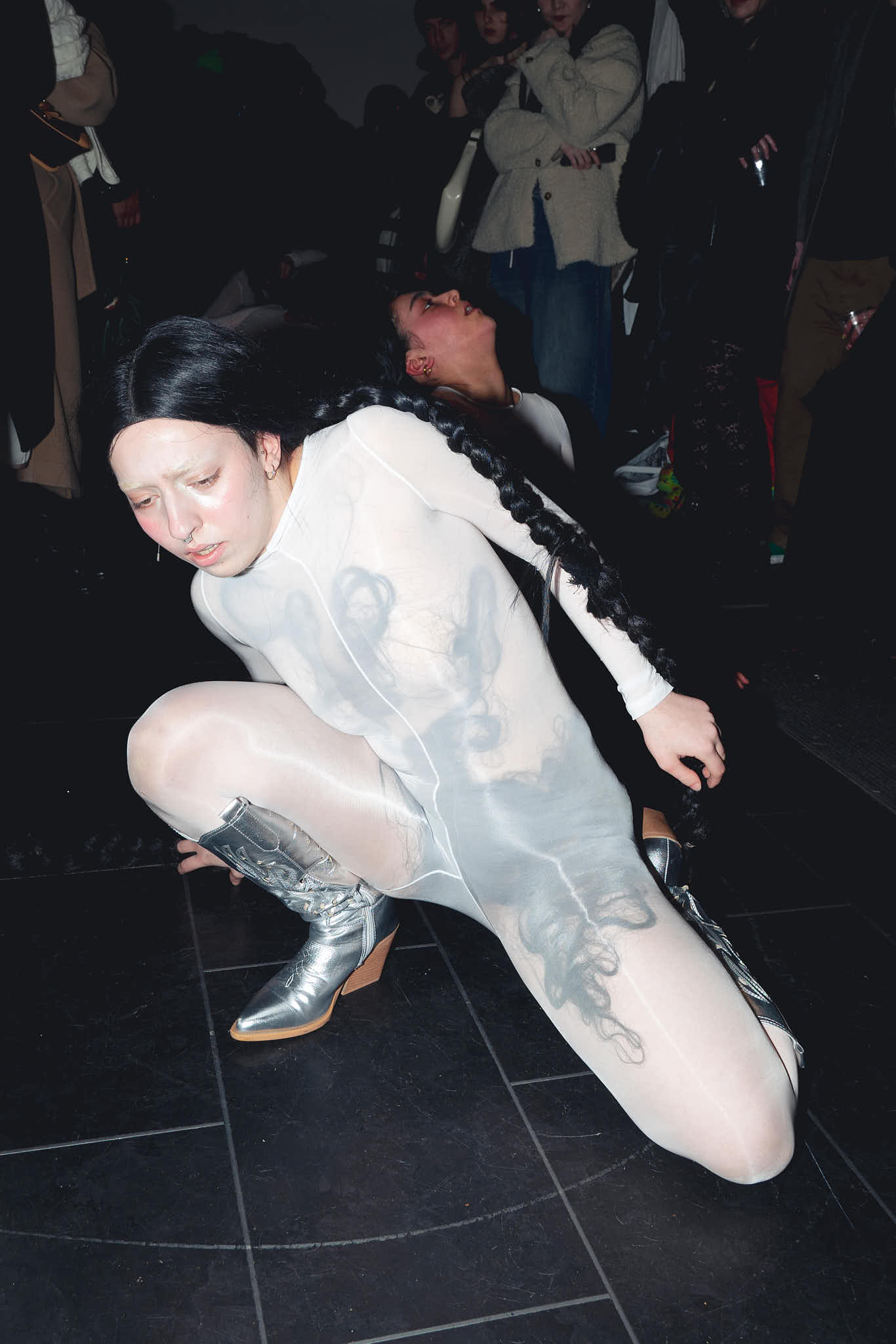
CM: It’s ironic how a cowboy, someone who would tame an animal like a horse, parallels the ‘Wild Woman’ they are trying to reach. Aesthetically, the boots align with the concept in this way as well.
VP: Yes, that’s exactly it! Even if the Wild Woman morphs and changes in future performances, the essence of a cowboy remains someone who seeks to tame what is wild and free. It’s also interesting how, while we often complain about patriarchy, women can sometimes be the first to enforce these standards upon other women. These ideologies are so deeply entrenched that the women who uphold them become the tamers of the emancipated women.
CM: The dancers’ movements reminded me of Japanese Butoh dance, which aimed to throw off the constraints of Western dance and the rigidity of highly codified Japanese traditional forms. Did you draw inspiration for this piece from other forms of dance or artistic work?
VP: When Angelia, the movement director, asked if Butoh was something I wanted to achieve in the performance, I realized—after some research—that it was exactly what I had been aiming for. Initially, I wasn’t given specific references in terms of choreography; my focus was on capturing the right feeling. It wasn’t about adhering to a particular style but about ensuring the movement resonated with an authentic emotional core.
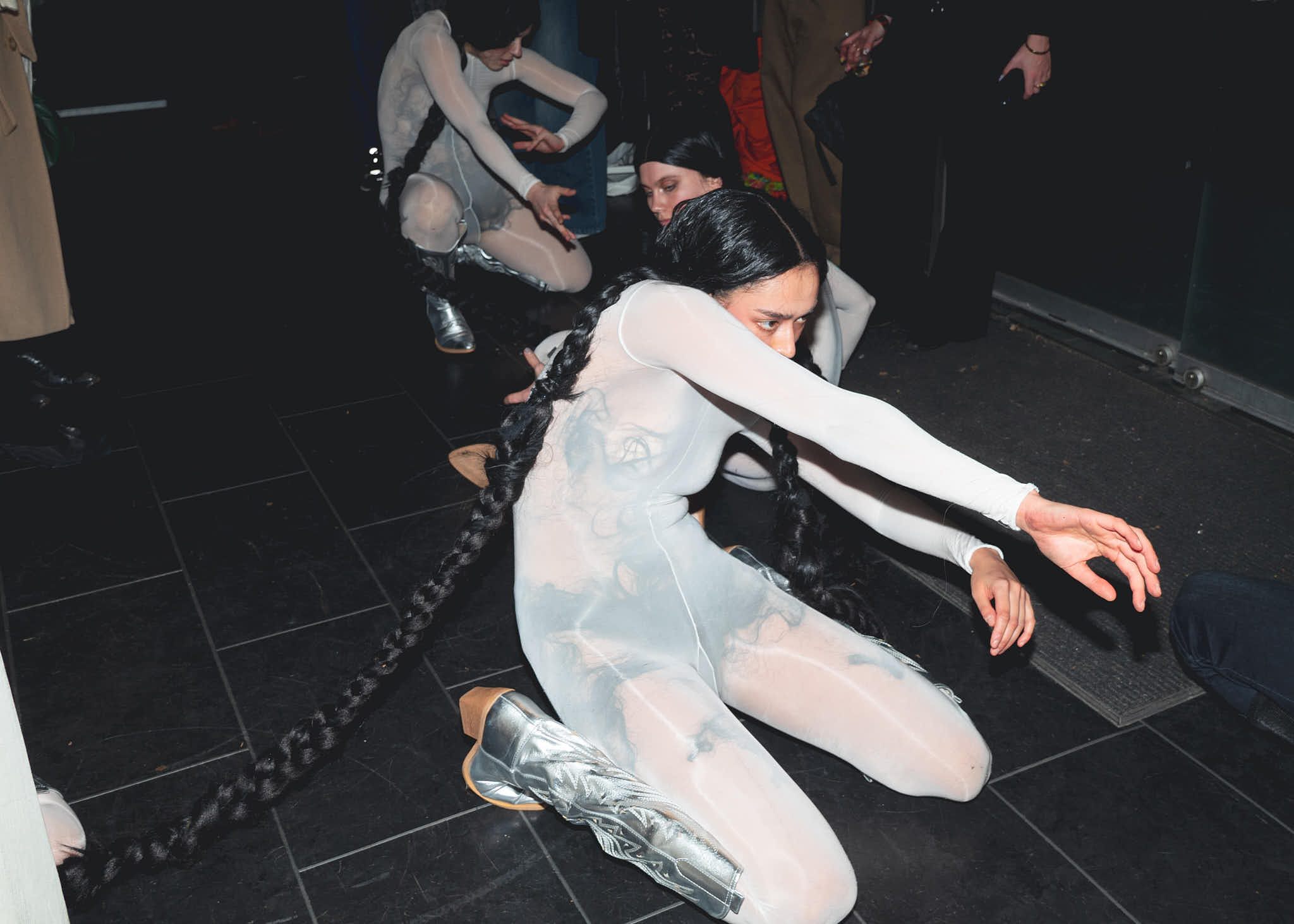
My priority was for the movement to break free from the constraints of being appealing. I didn’t want it to be entertaining in the traditional sense. That’s what I kept emphasizing to the dancers: you’re not performing to entertain; you are simply experiencing the feeling and allowing the movement to emerge from that experience. Whenever moments of unison appeared—naturally more visually appealing to an audience due to their cohesion—we embraced them, but only if they arose organically from the movement itself rather than being pre-planned.
There was also an intentional blend in how the dancers embodied both feminine qualities and childlike characteristics. This created a bridge between the transition from girlhood to womanhood—those haunting years where identity shifts. That transformation is not linear; it’s shaped by circumstances that pull one between rounded, traditionally feminine movements and more angular, childlike expressions. The tension between these states reflects the fluidity and complexity of growing into oneself, an essence we sought to capture in the performance.
CM: You mentioned that you were considering adapting this piece into different forms so that the ‘Wild Woman’ continues to change and evolve. What’s next for you and your work?
VP: In this specific piece, I want to bring it to more and more spaces, whether that’s museums, galleries, or performance art festivals. I want it to be something that evolves with me, not something that ends here. The video art piece is being shown at an art fair in Rome in February with Lucan Art Magazine. My general intention is to continue presenting it in new spaces, keeping it fresh and dynamic, particularly by evolving the Wild Woman.
In general, I am working on a number of long-form projects for cinema, which will hopefully be shot next year. A large portion of my time is currently dedicated to these projects, which are very much women-led. One features a cast of women and explores similar themes of love, jealousy, and attempts to control one another. It feels almost like an extension of the same concept—one I am deeply passionate about. The second is a coming-of-age story about a teenage girl coming to terms with her identity. So, two female-led pieces, both longer-form cinema works.
CM: That’s great, it feels like different chapters in the same concept.
VP: Overall, I think I am trying to follow what I want to express. As I mentioned earlier, I am delving deeper into exploring the female experience, in whatever form that may take, without limiting myself to a specific art form.
Credits:
Conceptualized and directed by Vittoria Penalosa
Dancers: Chiara Martina Halter, Vivian Guyrá, Maria Apostolidou, Monique Murphy, Ruby Abbas, Serra Kösebay
Support with the movement direction Dance Film Performance by Angelina Gorgaeva
Music composed live by AM sin
Wigs by Maria Pelò
Hair styling by Marco Coluccio
Assisted by Marco Crispino
MUA & body paint by Jo Merola
Assisted by Sophia Marie Davison
Styling support by Alice Secchi
Garments provided by Ruby Hung
Videography by Nana Nabi and Billy Daisley
Edit by Nana Nabi
Photography by Rossella Damiani
Special thanks to You You Zhou