
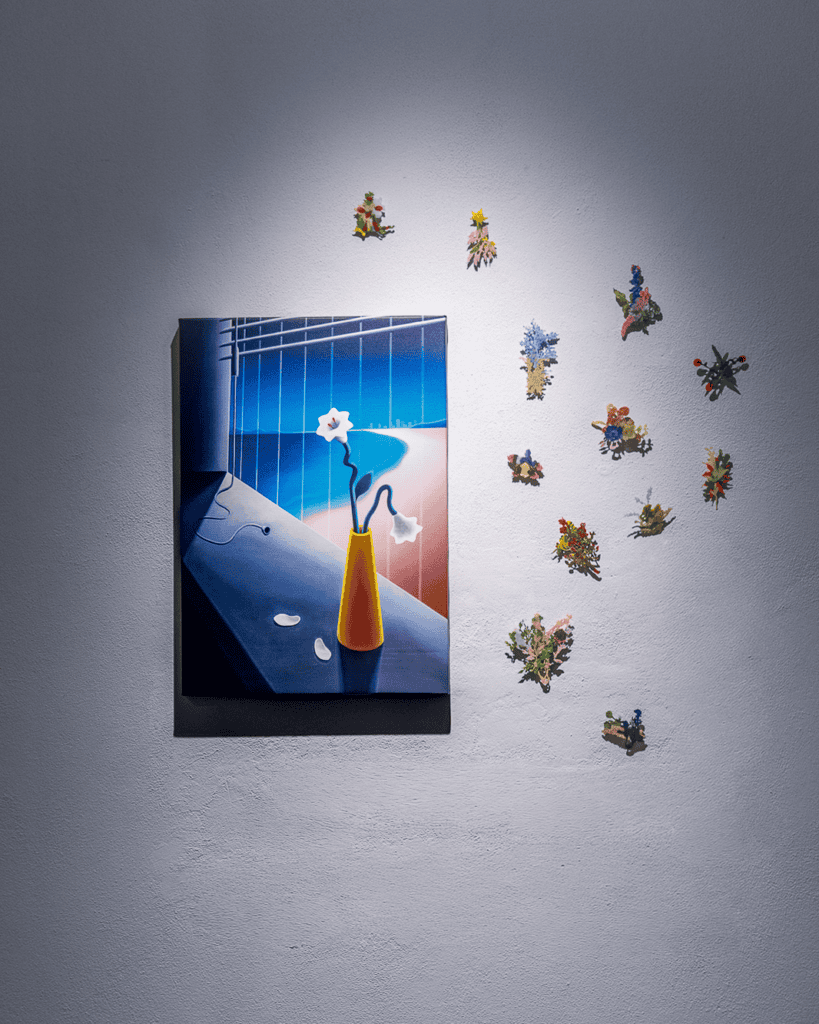
Presented at Galleria n.51, the Project Room unfolds as a hushed, immersive setting shaped by Hiroki Yagi’s visual sensibility. Designed as a space for deceleration, the exhibition weaves together painting, sound, scent, and spatial design, encouraging visitors to linger within a moment held in suspension. Based in Tokyo – Yagi works across digital painting on iPad and oil on canvas, allowing the two mediums to inform and disrupt one another.
From this dialogue emerges his Exploration of Melancomic Painting Expression: an ongoing investigation into contrast – light and shadow, structure and softness, the digital and the tactile. Rooted in close observations of everyday life, his works isolate seemingly insignificant details, revealing a subdued yet resonant emotional charge. The result is an intimate visual landscape that invites viewers to slow their pace and drift inward.
Upon entering the Project Room, the atmosphere feels quiet and restrained, evoking a sense of post-work unwinding.
There are no right or wrong answers – feel free to respond in a free, intuitive or even stream-of-consciousness way.
What state of mind did you want the space to hold, and what personal experiences does it draw from?
People sometimes tell me that my work feels calm or soothing. It’s not an effect I intentionally aim for, but I think the coexistence of positivity and negativity in what I call my melancomic approach to painting, and music may play a key role. Rather than pushing the viewer’s emotions to one extreme, this balance seems to create a sense of calm. I will describe my personal experiences related to this in the next part.

The three new paintings focus on ordinary scenes and seemingly minor details. What draws you to these everyday moments, and how do they become emotionally charged in your work?
The piece that led me to start painting everyday scenes the way I do now was a work I made in 2021 called 担当者不在 “Person in Charge Absent”. At the time, I was living alone, and I found myself drawn to a certain sadness in an unattended kitchen. What especially caught my attention was the contrast between that feeling and the freely arranged forms of everyday objects, dishes, empty cans, left behind, almost at random. It wasn’t a visually striking or “beautiful” scene, but I couldn’t stop looking at it. It put me in a state of mind that was hard to describe, neither clearly positive nor negative, and that experience became an important starting point for my work.
I think what continues to attract me is the gap between how ordinary these scenes are and how unexpectedly they can move us. Because they are moments almost everyone has seen before, they feel familiar, and that familiarity allows the work to connect with people in a broader, more intuitive way.
When I translate these scenes into paintings, I try to include different kinds of contrasts, light and shadow, cool and warm colors, straight lines and curves, so that both positive and negative feelings can exist at the same time. Rather than pushing the image in one emotional direction, I’m interested in letting that in-between state remain.

Your paintings seem to balance clarity and ambiguity. How much do you want the viewer to recognize what they see, and how much do you prefer to leave open or unresolved?
For example, with motifs like flowers, which often play a central role in my work, I place a kind of duality between light and shadow in the contrast between blooming flowers and fallen petals. In that sense, I do want viewers to clearly recognize whether something is “in bloom” or “falling.”
On the other hand, elements like the outlines of mountains or the lines of windows don’t carry a specific symbolic meaning for me.
What matters more are their primitive qualities, the curved lines of a mountain or the straight lines of a window, and how those elements can suggest a contrast between light and dark. In those cases, I don’t necessarily expect viewers to identify something concrete in what they see. Instead, I’m happy if they simply take in their own impressions through the shapes of the lines, the colors, and the overall feeling.
Tokyo is present in the exhibition in subtle ways, through sound and scent rather than direct representation. How does the city influence your way of seeing and painting?
It might be a little different from Tokyo as a city, but I’ve always been interested in fashion. Around ten to fifteen years ago, I used to take street fashion snapshots in places like Shibuya and Harajuku area in Tokyo. Rather than focusing on one specific style, I was drawn to mixing different influences, contemporary, vintage, street, and I enjoyed experimenting with various combinations myself. The sensibility I developed through street fashion at that time has become a strong foundation for my work. Even now, when I’m making paintings, I feel that those experiences influenced the way I think about colour, composition, and overall balance.
Your practice moves between digital painting and oil on canvas, bringing together precision and emotional depth. At what point does an image stop being digital and start becoming a painting for you?
For me, it’s the moment when the flat, calculated qualities of digital imagery and the physical depth and unpredictability of oil painting click together in just the right way. That said, I still feel like this is something I’m continuing to explore and figure out for myself.
You describe your work as an exploration of “melancomic” painting. Where do melancholy and lightness meet in the works shown here?
In terms of my intention, I place elements that carry both melancholic and comical impressions on different levels. On one level, there are the more primitive aspects of painting – light and shadow, straight and curved lines, cool and warm colors. On another, there are the more semantic elements that come from motifs and situations. By allowing both melancholy as a shadow and comical as a lightness to exist within each of these layers, and by letting them coexist within a single work, I try to create what I think of as a melancomic world.
Alongside the paintings, the exhibition includes a limited edition of hand-painted T-shirts. What happens to an image when it leaves the wall and enters everyday life?
“Melancomic” can be worked as an adjective, it describes a certain kind of impression rather than a fixed object. Because of that, it can modify many different things. Ideally, I’d like the idea to extend beyond the artworks themselves. For example, if someone wears a melancomic T-shirt, that person might carry a melancomic feeling as well. I’m interested in expanding this world beyond individual works and into everyday life.
The exhibition is conceived as a space to be inhabited rather than simply observed. What do you hope visitors take with them after leaving the Project Room?
I would be happy if guests could come away with that kind of feeling, that not only artworks, but life and the world itself, are compelling precisely because they hold both positive and negative sides.


