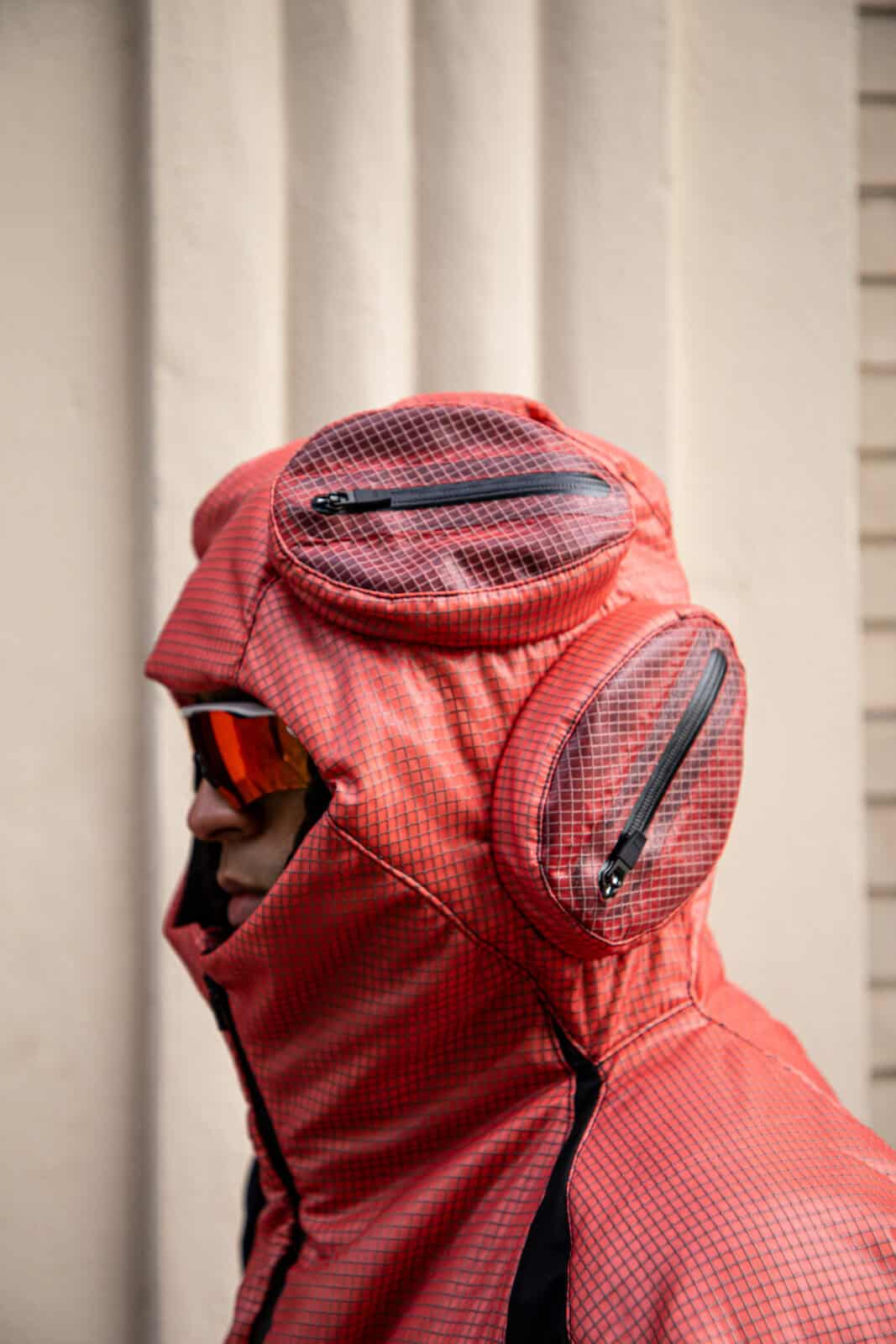
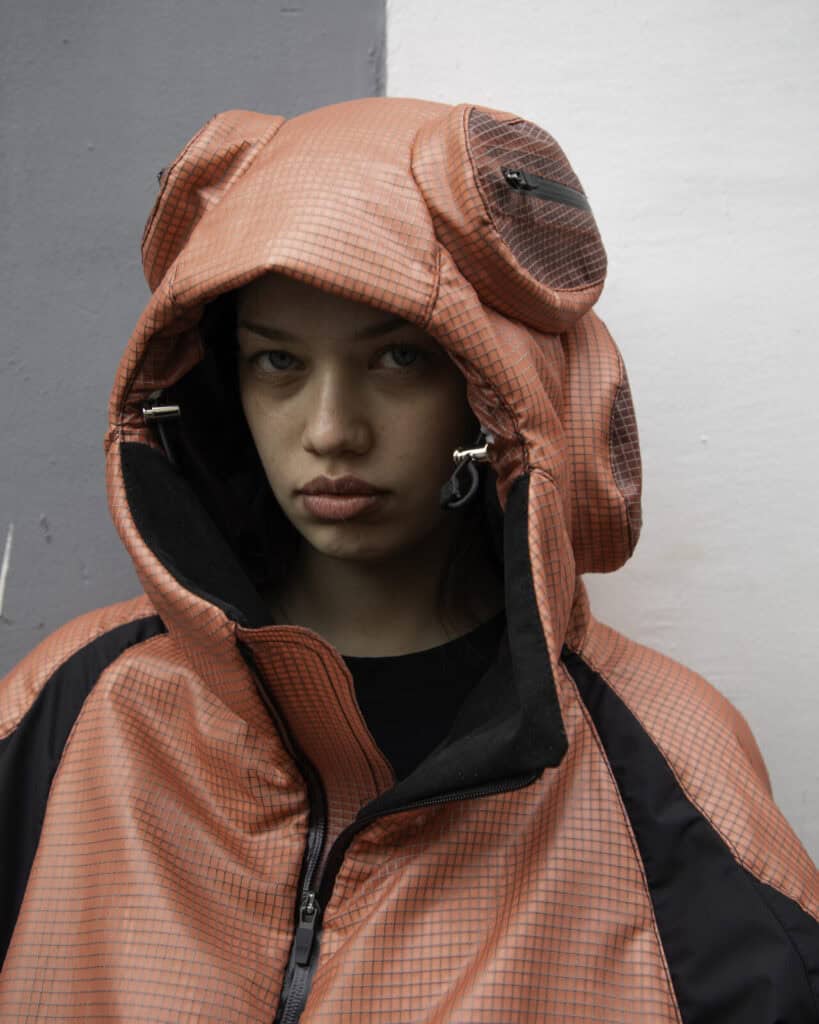
Have you ever heard of designer pieces inspired by extraterrestrial themes that also function as performance wear? Hooded, a young, Milan-based brand, caters for the unexpected. Their pieces are designed for the nomadic customer – someone who could find themselves on a mountain trek, the red carpet or even another planet at any given moment. Everything intentionally crafted to protect you from unknown environments.
While the industry is plagued by uniformity, Hooded creates escapism through Apollo-esque, astronaut inspired silhouettes. When founder Andrea Cella first launched the project alongside Davide (Dave) Moro in 2020, they made simple hoodies and crew necks. A stark contrast to their more recent creations, Cella, Moro and Richie Lucas, relaunched the brand in March 2025 hoping to conquer global audiences.
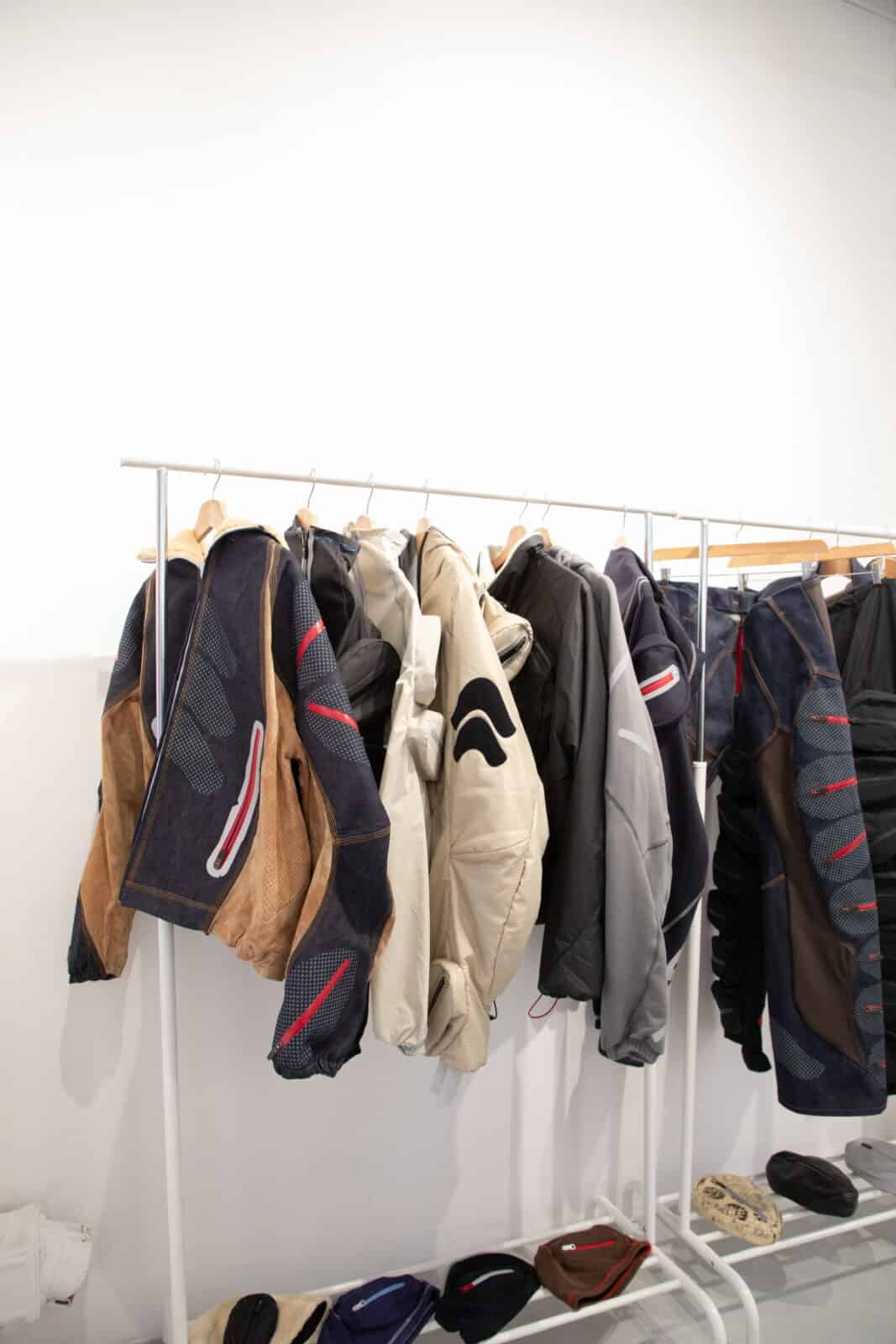
After a successful pop up at Paris Fashion Week, they’ve set their sights on London. This March, the team will make their London debut in collaboration with local designers, MEDMO and MURA STUDIO, brands whose work is also centred around a certain alien flair.
Hooded doesn’t label itself strictly as performance wear or high fashion, instead preferring to view their designs as living embodiments of the concept of evolution – a perfect fit for the city’s ever-changing fashion scene.
The trio sat with me to speak about Hooded’s unique design process and their plans for the upcoming year.
The Cold Magazine (CM): How did you all get involved with Hooded?
Andrea Cella (AC): I founded Hooded [in 2020] but we did our rebrand in 2024. We’re a small brand here in Milan and we create products that are in between performance wear and design clothes. We use technical fabrics and try to implement as many technical elements as we can into production. We have a small lab here, where we produce all of our stuff [but] we’re really focused on outerwear.
Davide Moro (DM): I worked with Andrea a long time ago, and then after the rebrand, he asked me to work with him again. I’m more focused on the management part because I studied economics but I really like the fashion work because in the beginning I didn’t know much about it.
Richie Lucas (RL): I met Andrea probably about a year ago now. I was there for Milan Fashion Week, just a week prior and I met Andrea at an event. We stayed in contact and it was October of last year where I went over to Milan to shoot a campaign and then from that point onwards, our relationship grew and I became more involved in Hooded.
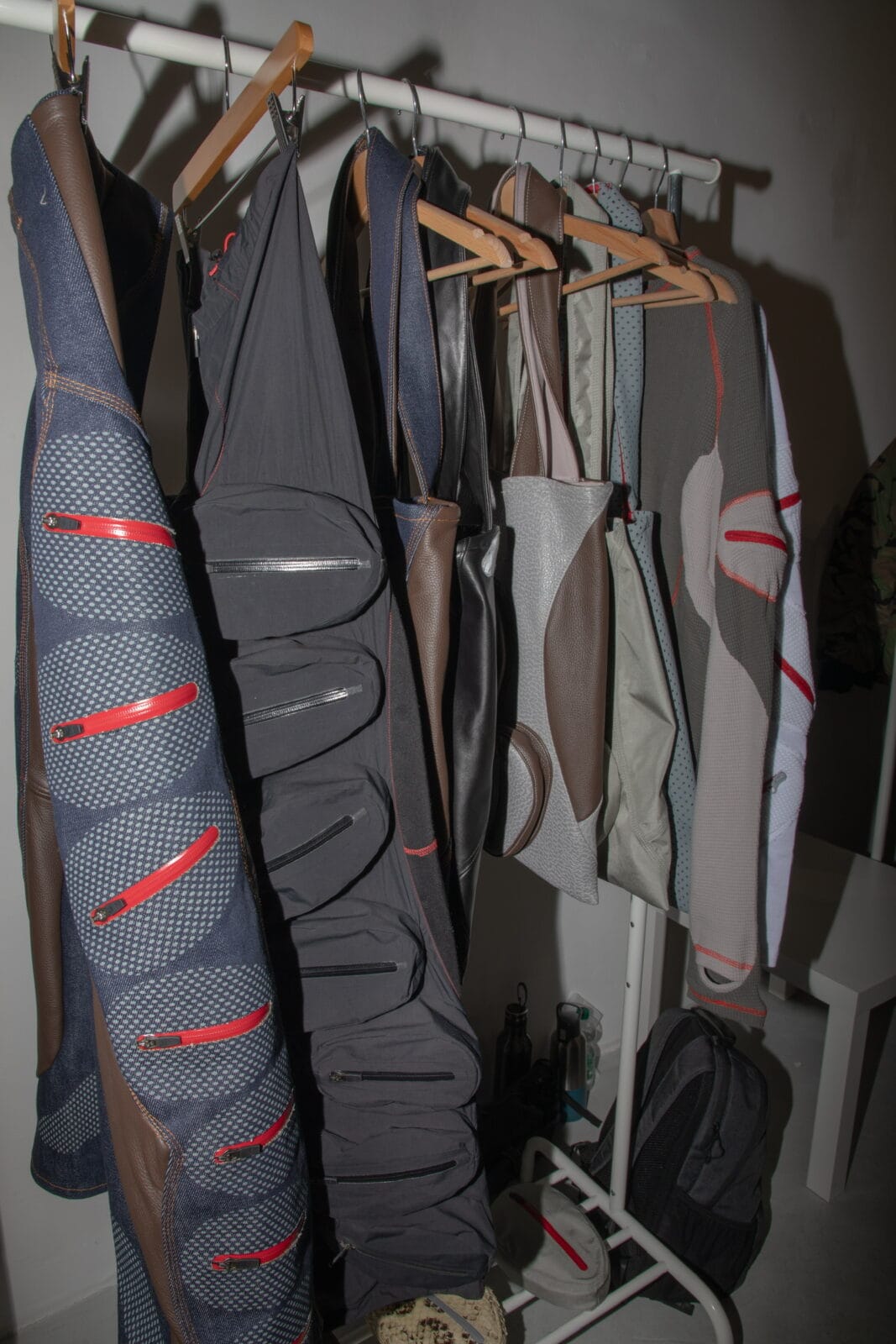
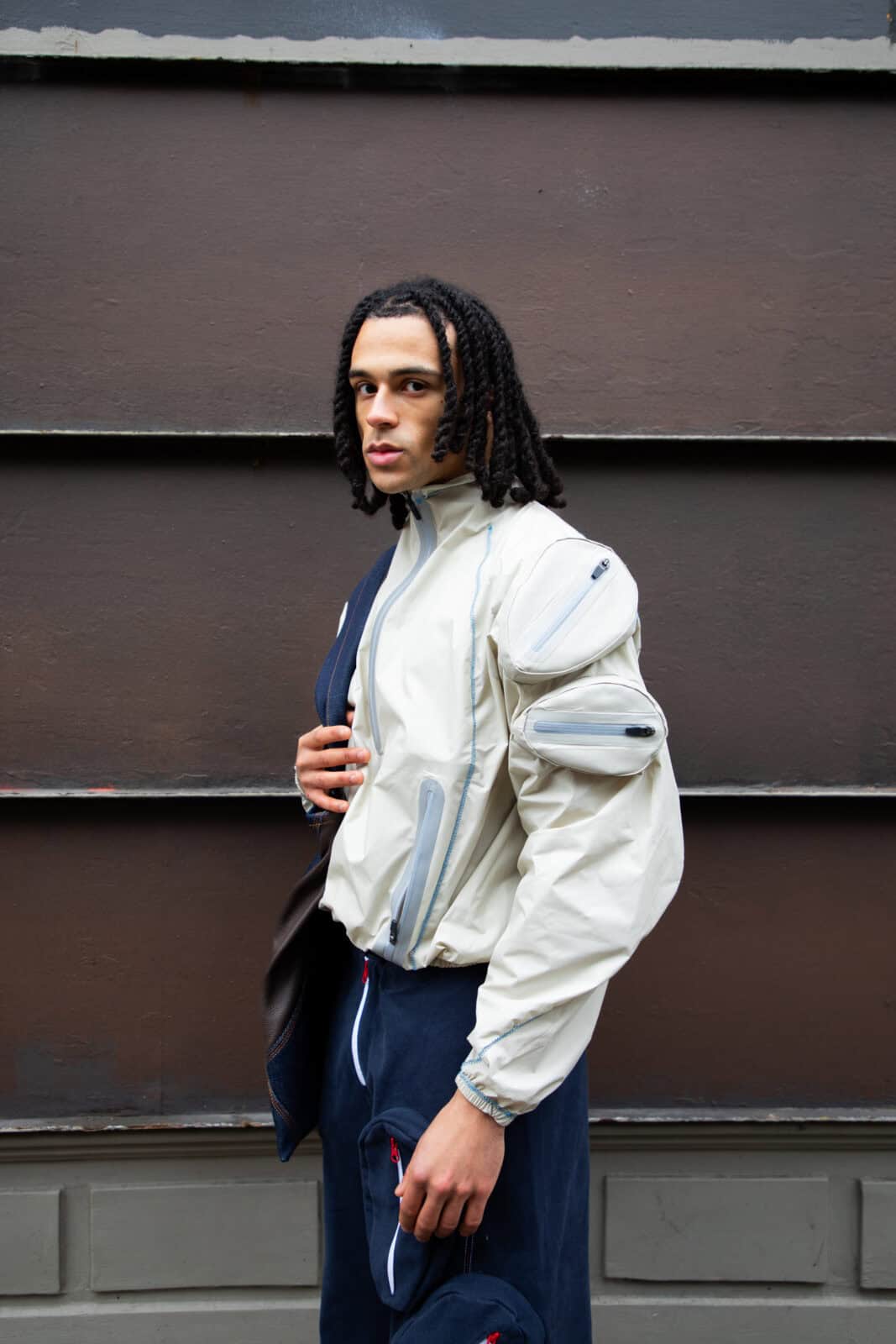
To describe what Hooded means to me, it’s creating a world which is so distant from the reality that we’re in and we’re doing that through the designs of the jackets. The appeal that we want to give is that we’re almost preparing whoever’s wearing these jackets to step into unknown terrains. These unknown terrains have such harsh, uncomfortable, and unreliable environments that you need such pieces to be able to survive. That’s why you see adaptations like these pockets popping out of the chest or across the arms – almost to give the effect that the pieces of clothing are quietly alive.
CM: What do you mean by the term ‘quietly alive’?
RL: Looking at the jacket, it’s designed in such a way that there’s almost an anatomy to it. If you were to look at one of our extreme jackets, for example, you’ll see how exaggerated the silhouette is and how you can have however many pockets running down a sleeve. It’s almost like having a human step onto a different planet through natural adaptation.
We have these disfigurements and these different aspects of growth on the jacket itself which shapes and changes the silhouette because such a person has been thrown into a new environment. It’s almost like this natural adaptation and I think the aspect of being ‘quietly alive’ is reflective of that because the jacket is changing as the person is changing environment.
CM: What do you hope new customers take away from Hooded and its storytelling?
AC: We offer a garment that can protect you and can actually help you go through your day [as well as the] design components. We’re offering a sort of blend between those two components – the design and the performance. Sometimes they don’t go together very well but what we’re trying to do is to fill in this gap – mixing performance with a clear aesthetic where every element is put in place for a functional reason. They need to co-exist.
RL: It’s so important to strike a balance. Our extreme jackets can brace the cold up until -10°C so there’s a clear functionality there. But at the same time, [we’re] able to present it in a way which correlates really well with the theme of terrains and stepping into the unknown.
For me, when it comes to a customer’s perception of the brand, I think we want to create this world where it can appeal to the high fashion industry as well. I think that’s why I’ve put so much emphasis on this otherworldly feel that we want to portray to an audience because I think the brand is really capable of doing both. Showing both the practicality of the products but also creating this world that people haven’t seen before in the high fashion industry.
CM: What kind of techniques and fabrics do you use? What does your design process look like considering the technical aspects in each of your pieces?
AC: We’re lucky because we work with a couple of partners that are based here in Northern Italy, in Lombardia. So we have access to either sample fabrics or leftovers from big productions. So we have an aspect of sustainability. We don’t waste anything.
We also introduced the full traceability of every garment using NFC, a digital label where you can actually see where we get the fabric, where we get the padding, where we get the zippers. You can see where it’s manufactured, that is basically here in our studio. We put a lot of effort into it. We try to reduce as much waste as possible but sometimes it’s difficult. Especially when you make technical clothes – using different materials with different components. You expect the products to last a long time because they will be difficult to recycle, so we try to get the best materials we can.
CM: What can you tell me about Hooded’s colour palette and the way it plays into the brand’s storytelling?
AC: We have just one [colour] that is representative of us, that is the red. We always try to use it because the concept of the red is a very important little touch of colour, that is usually used in sportswear and performance wear from the ‘90s. That is a big inspiration to us. Of course, we try to use black, white, plain colours but we also like to experiment. Sometimes the colour that we use is dictated from the materials that we find. So we don’t have strict rules on colour palette. I find it a little bit restrictive sometimes, so it’s good to experiment and our identity is based on that.
RL: Let’s talk hypothetically – a staple of ours is a red extreme jacket. In my mind it blends really well with this Mars-esque terrain we situate the brand in. A high-dust environment where you have this contrast of colours between a piercing bright orange to a really musty dark red environment. We can almost sculpt stories from the jacket and I think colours play a role in the creation of these environments. The impression and the feel that the design and the colour of the jacket gives, [allows] us more leeway to create a new terrain and continues to help build these different worlds and the story behind the brand.
CM: One of the stand out elements of Hooded’s pieces are the 3D pockets. What led to making them such a focus?
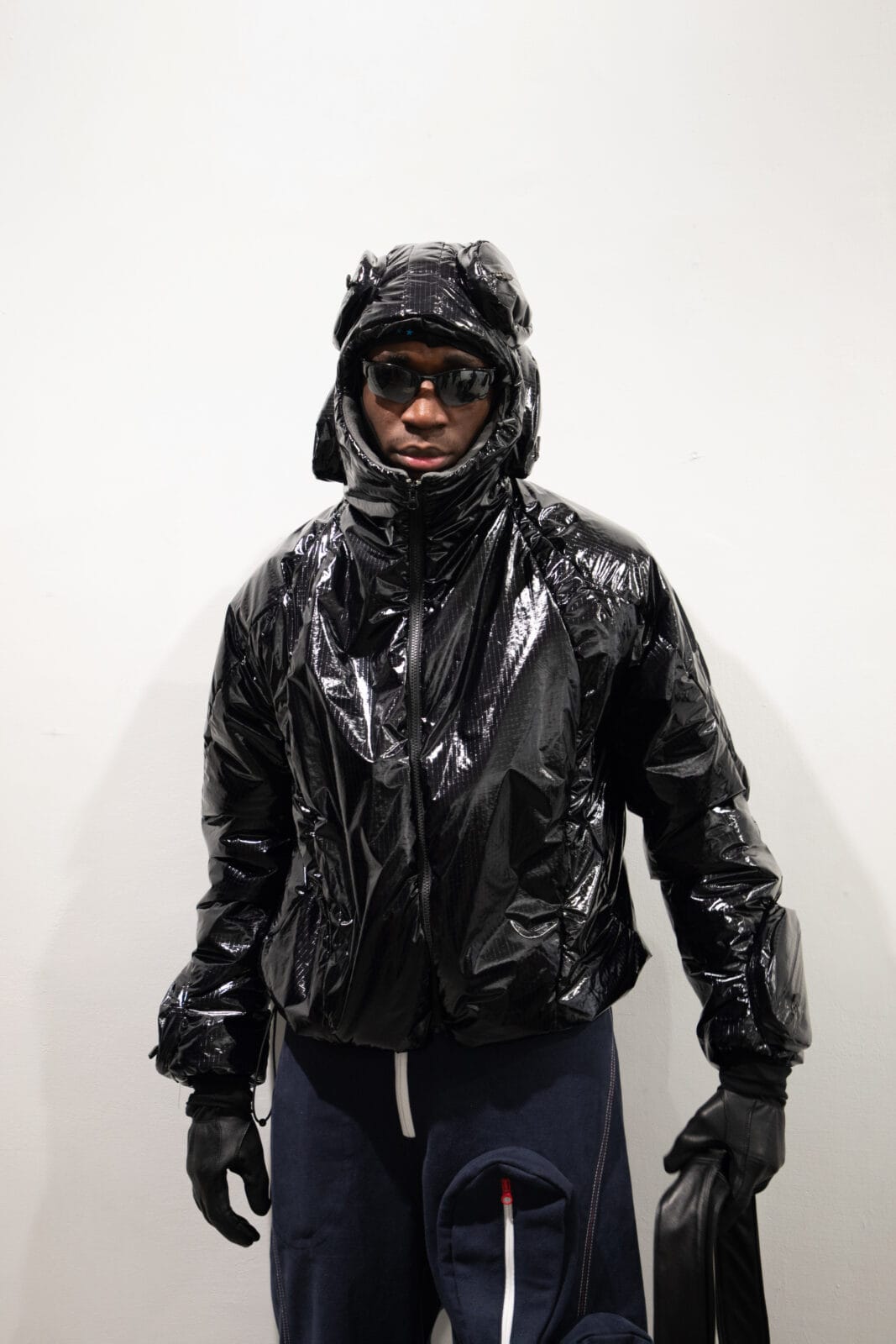
AC: When we first started developing the 3D pockets, we tried to find techniques – are these elements that can be incorporated in different garments? We thought about how we could make it something that can represent us even if the logo isn’t visible. We’re just trying to put the pockets in as many variations as we can, like one [jacket] has four pockets on the hood. That was one of the best ideas, in my opinion. It can be for functionality, but you can also wear it if you’re going to an event, or if you want to push [your] fit a little bit more. Visually, in my opinion, it’s very pleasant. Very characteristic of us. So that was the reason behind it. We’re finding out that people actually like it a lot so I think we’re going to bring it into the new products.
RL: I think there’s a deliberate exaggeration, of course, when you have over 10 pockets on a jacket. I think it’s already a staple of Hooded now – having pockets in places that people haven’t seen before – especially on the hood. It just plays into this role of adaptation because nobody’s seen pockets on the side of someone’s hood, the same way you can see it on a Hooded jacket.
CM: What are Hooded’s next steps? What are your plans for the year?
RL: Bringing Hooded to London will be a really big stepping stone. We’re going to be collaborating with two really interesting upcoming designers as well.
AC: Our plan for this year is trying to get into strategic locations, for us that is Europe and the US. But we’ll focus on the US for the second part of the year. For London we’ll collaborate with two [designers] – MEDMO and MURA STUDIO.
RL: Two designers, really really talented. Just seeing their designs and their silhouettes, it made so much sense to reach out. Especially with Hooded not being in the UK yet. They also really try to create this other worldly appeal with their designs. It’s going to be interesting to see three different worlds collaborate and what comes of that. It’s going to be amazing. I can’t wait.