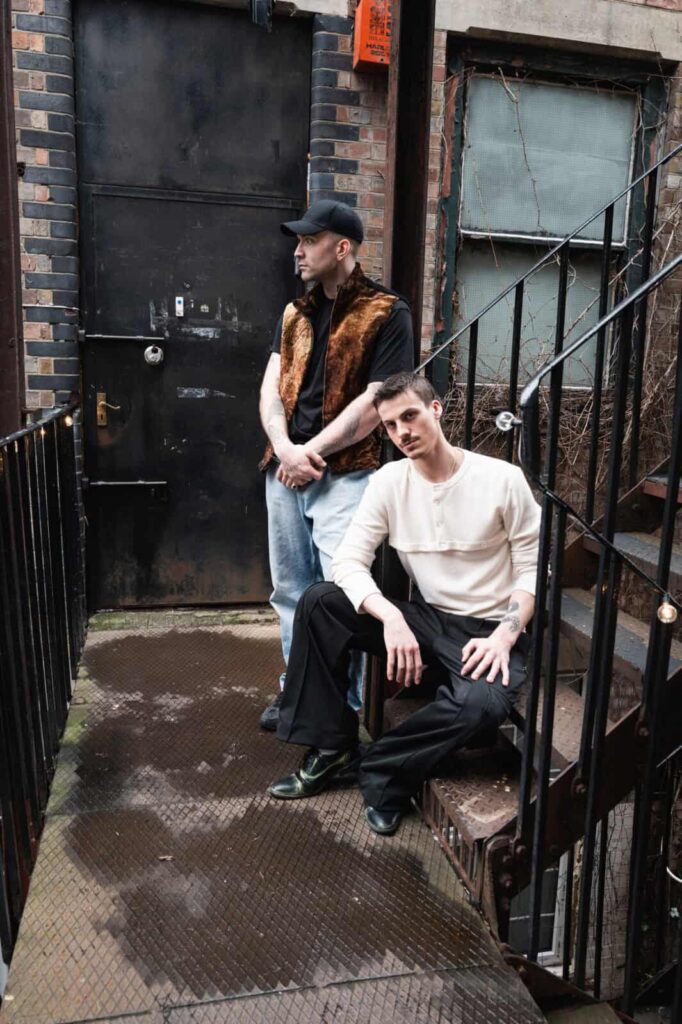
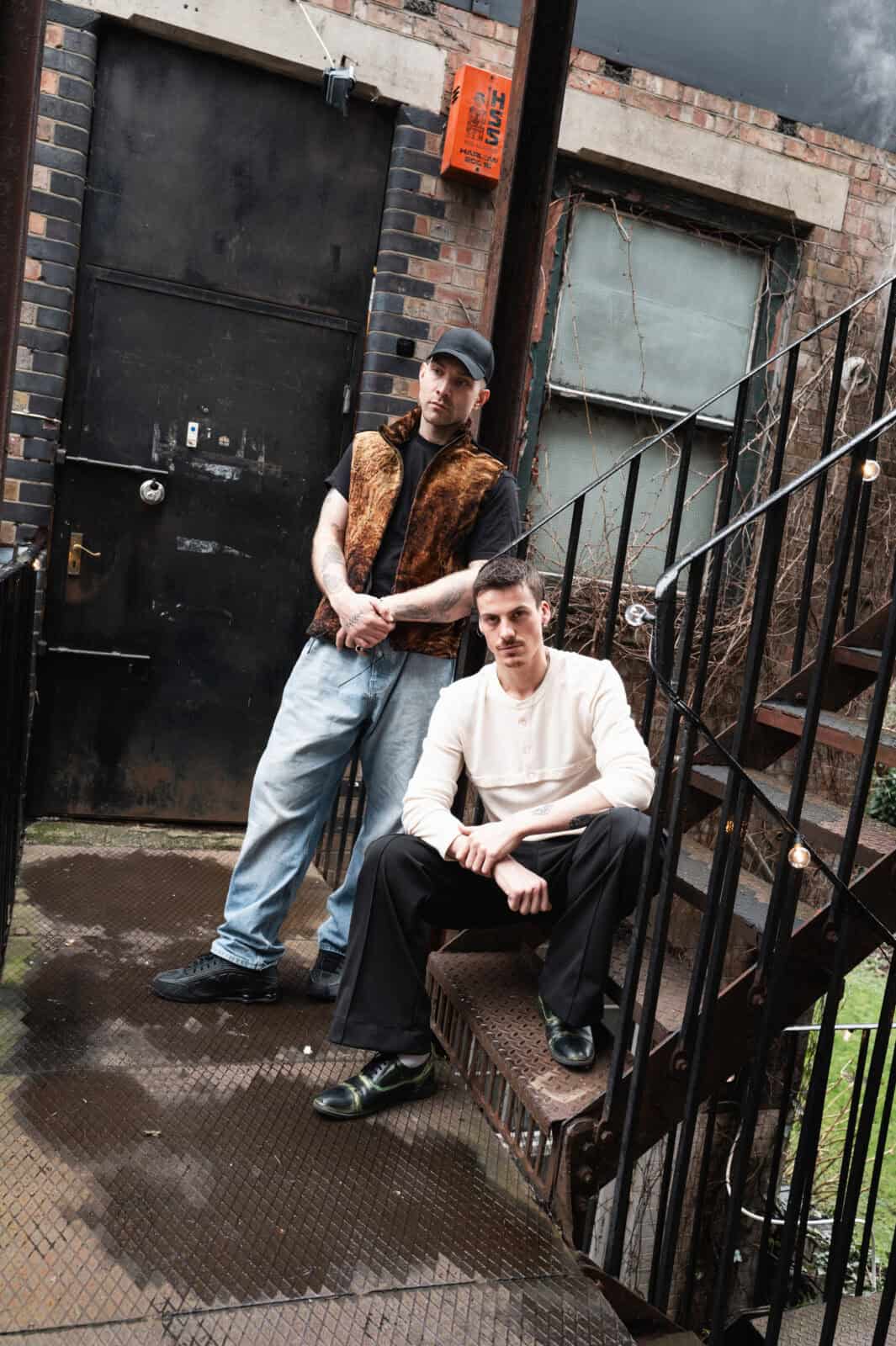
Ten minutes into our conversation at their East London studio, AGRO Studio founders George Oxby and Angus Cockram casually reveal that they met on Hinge. The classic London dating-app-to-creative-collaborators arc, a tale as old as dating apps themselves; what began as a swipe has since evolved, predictably, into a joint venture.
It’s the sort of origin story that explains a lot about the instinctive, occasionally chaotic (albeit equally charming) energy running through their work. I first came across the brand in September at their off-schedule London Fashion Week show, seated somewhere opposite George’s mother – who, he later tells us, was dressed like Anna Wintour, sunglasses and all – before learning backstage that the entire collection had been completed in just three weeks.
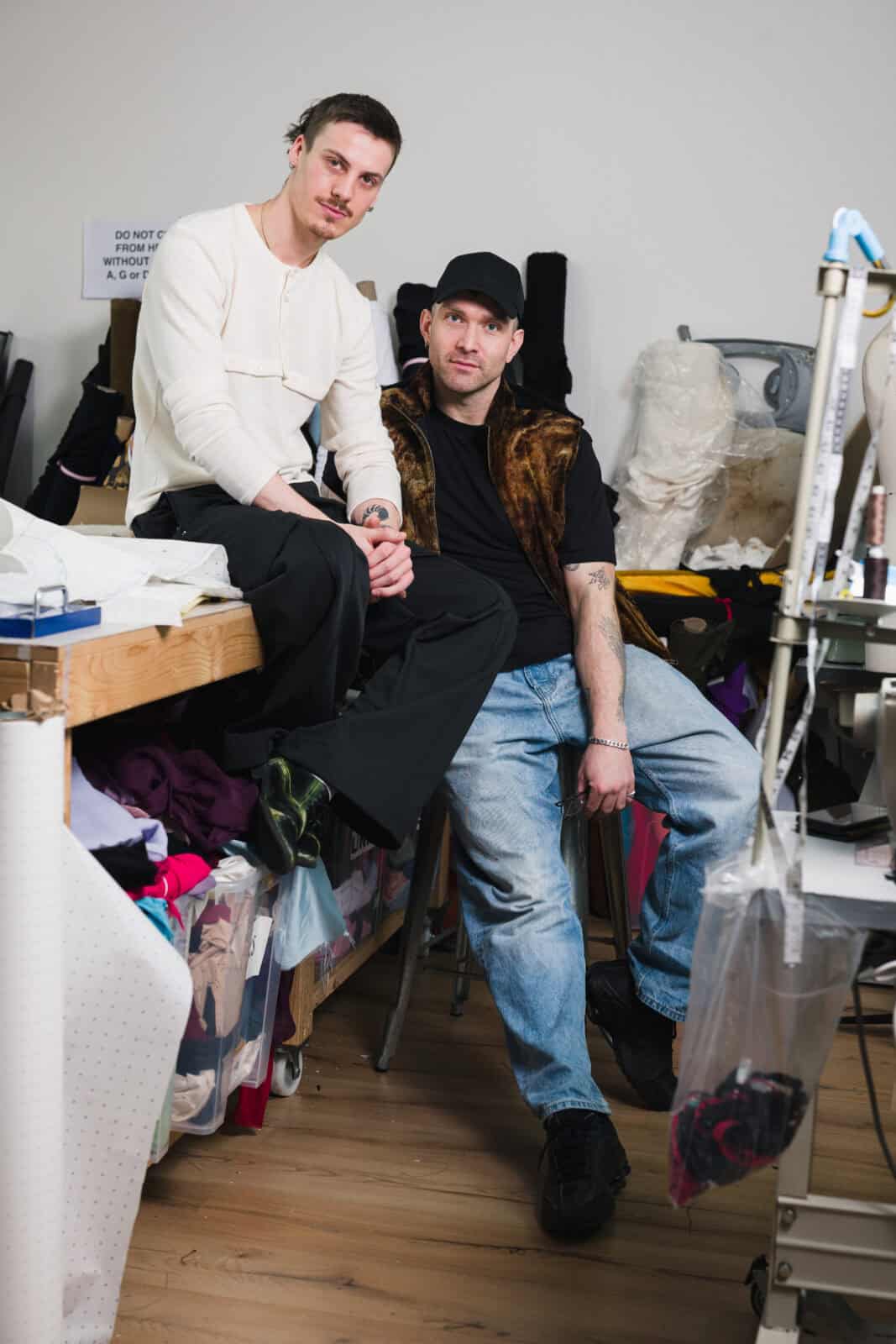
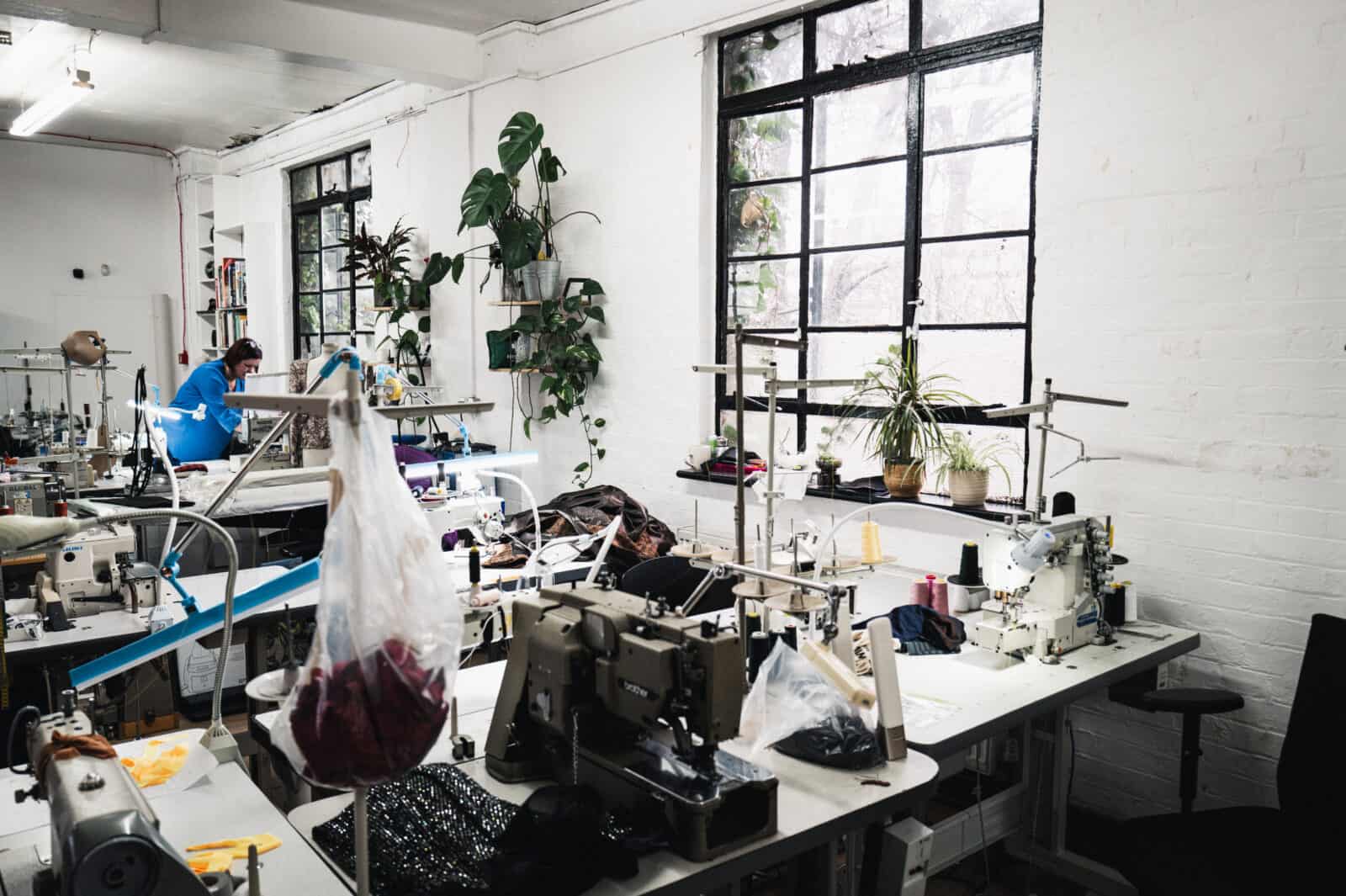
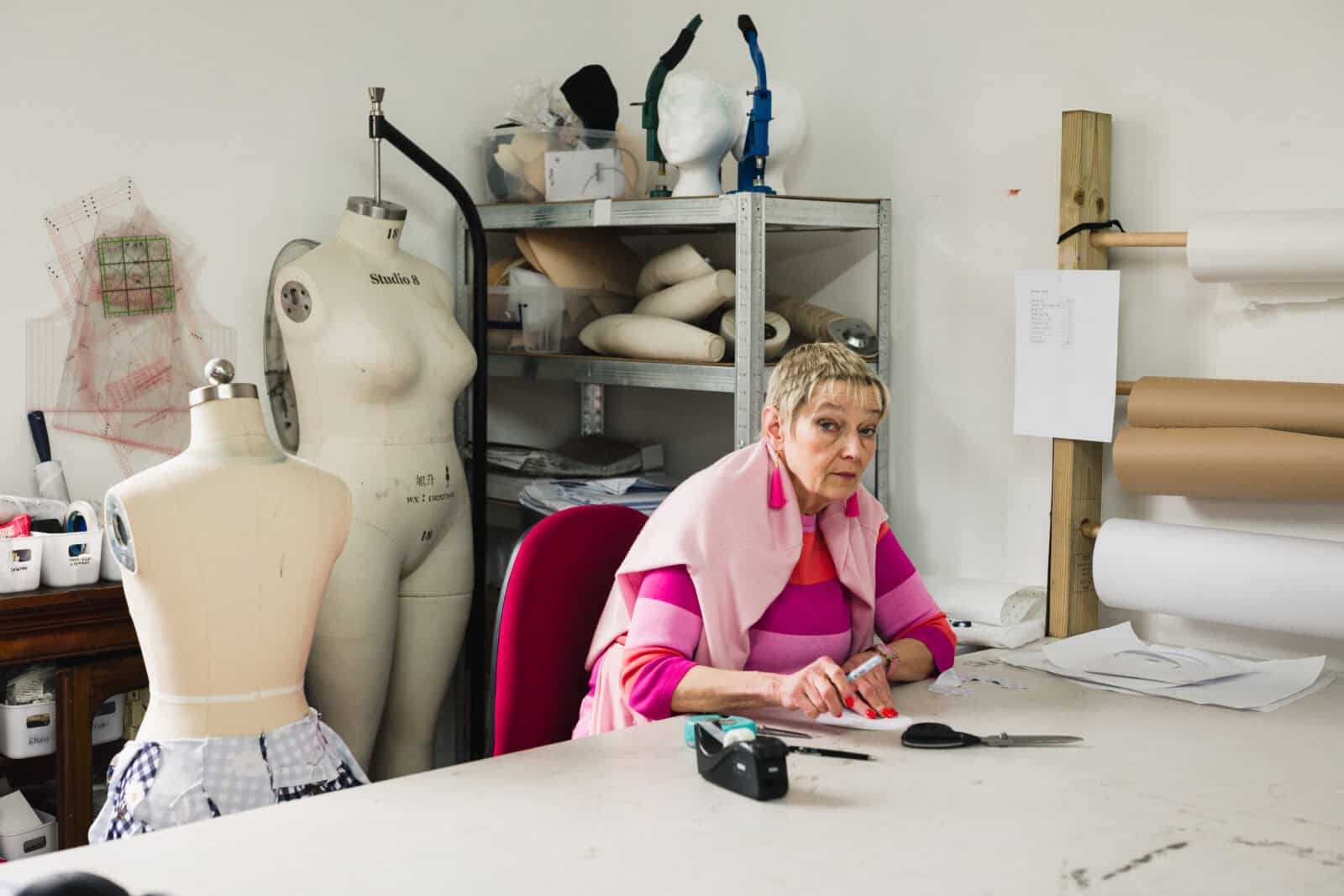
Four months later, Lauren, our Arts and Culture Editor, and I arrive at their East London studio with our team of photographers in tow. Climbing a set of industrial metal stairs into a light-filled atelier, we witness last-minute garment adjustments busily underway. Within minutes, we’ve rearranged half the furniture in pursuit of better lighting for our socials content, dragging a beautifully worn brown armchair across the room in the process. George explains that it was a gift from his aunt, offered in exchange for a dress – “a pretty good deal,” he shrugs.
Founded in 2021, the London-based duo have spent the past three years building a reputation through bespoke commissions for star-studded clientele, primarily known for their work in music and film. Now showing on the official LFW schedule for the first time, AGRO Studio presents AW26 The Wanderer: a collection preoccupied with prolonged movement, isolation, and the slow, sometimes mystical transformation that comes from going somewhere without ever quite arriving. Produced on a markedly different timeline this season, although they joke that I should probably shave a few weeks off that figure.
After our brief Marie Kondo moment, we finally sit down to talk about the inspirations behind the collection.
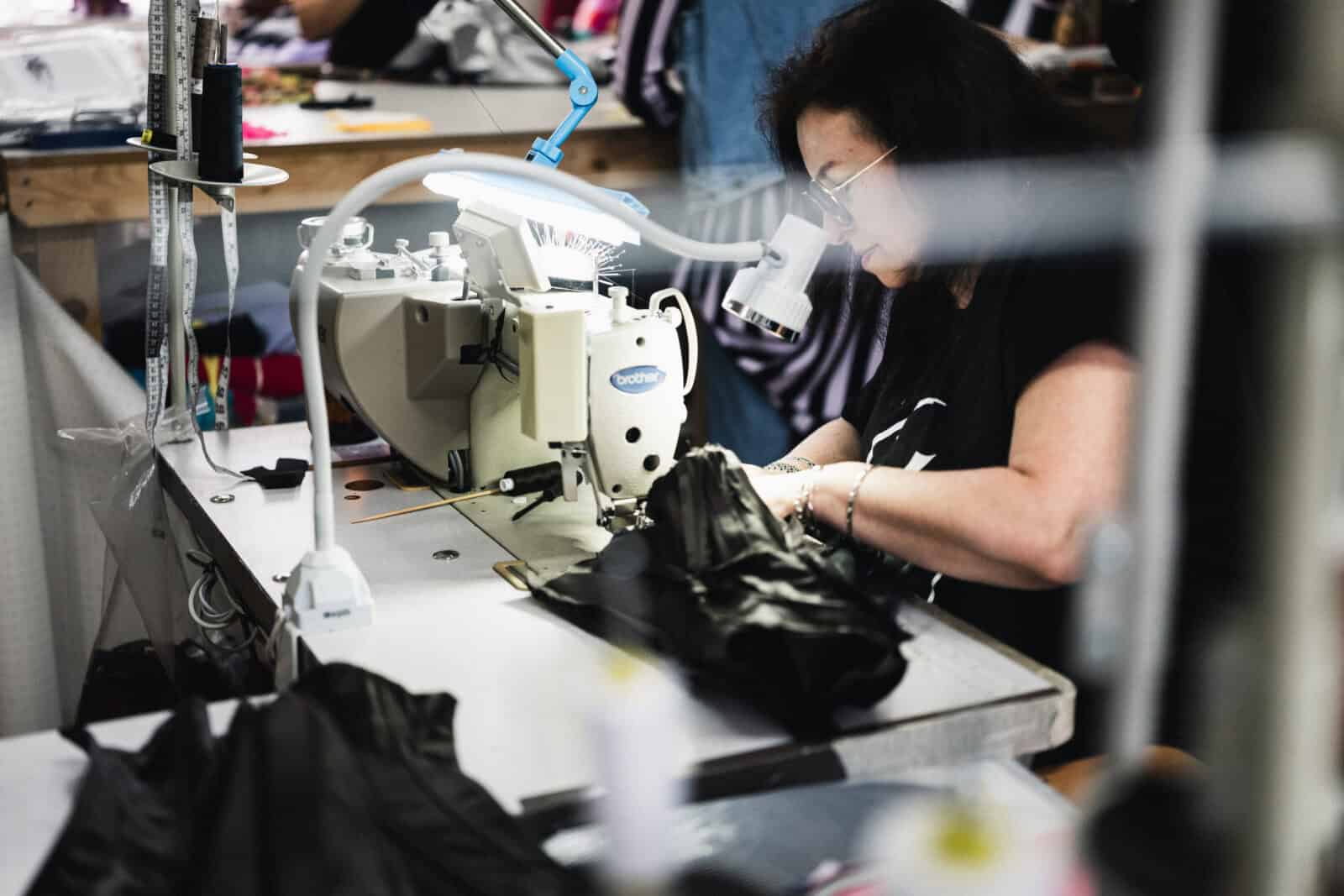
“There’s this archetypal character at the centre of it,” George explains. “Someone defined by an endless journey, not necessarily based on a specific visual reference, but this idea of accumulating experience over time.” Angus adds onto this sentiment. “We’re creating our own storylines now,” he continues. “Like our own tarot cards, in a sense.”
“We looked at these people who gain pattern through experience,” George continues, “through these never-ending journeys.” References range from King Lear to Arthurian legend, particularly Sir Gawain and the Green Knight, where a lone figure traverses forest and winter for a year, gradually eroded by time, weather and solitude. In AGRO Studio’s depiction, pride and valour are destabilised: hand-painted Union Jacks bleed across silk shirts and scarves, while punk gestures defy traditional silhouettes.
Materially, the collection moves between natural hides and contemporary fabrication. Icelandic sheepskin appears in rust, grey and black, alongside leather aviator layers, asymmetric hand-dyed knits and denim engraved with sheepskin curls. Elsewhere, bronze tinsel is knitted into more classic menswear tailoring, transforming a traditionally camp material into something unexpectedly severe. There’s a material richness that speaks to Angus’ inclination towards detail and texture, balanced by George’s focus on silhouette and forms.
“We’ve gone quite print-heavy this season,” Angus adds, citing stage backdrops and early twentieth-century theatre design, particularly Ballets Russes artist Léon Bakst, as key visual prompts. “It’s been about translating those references into something that feels contemporary, almost like tattoo graphics.”
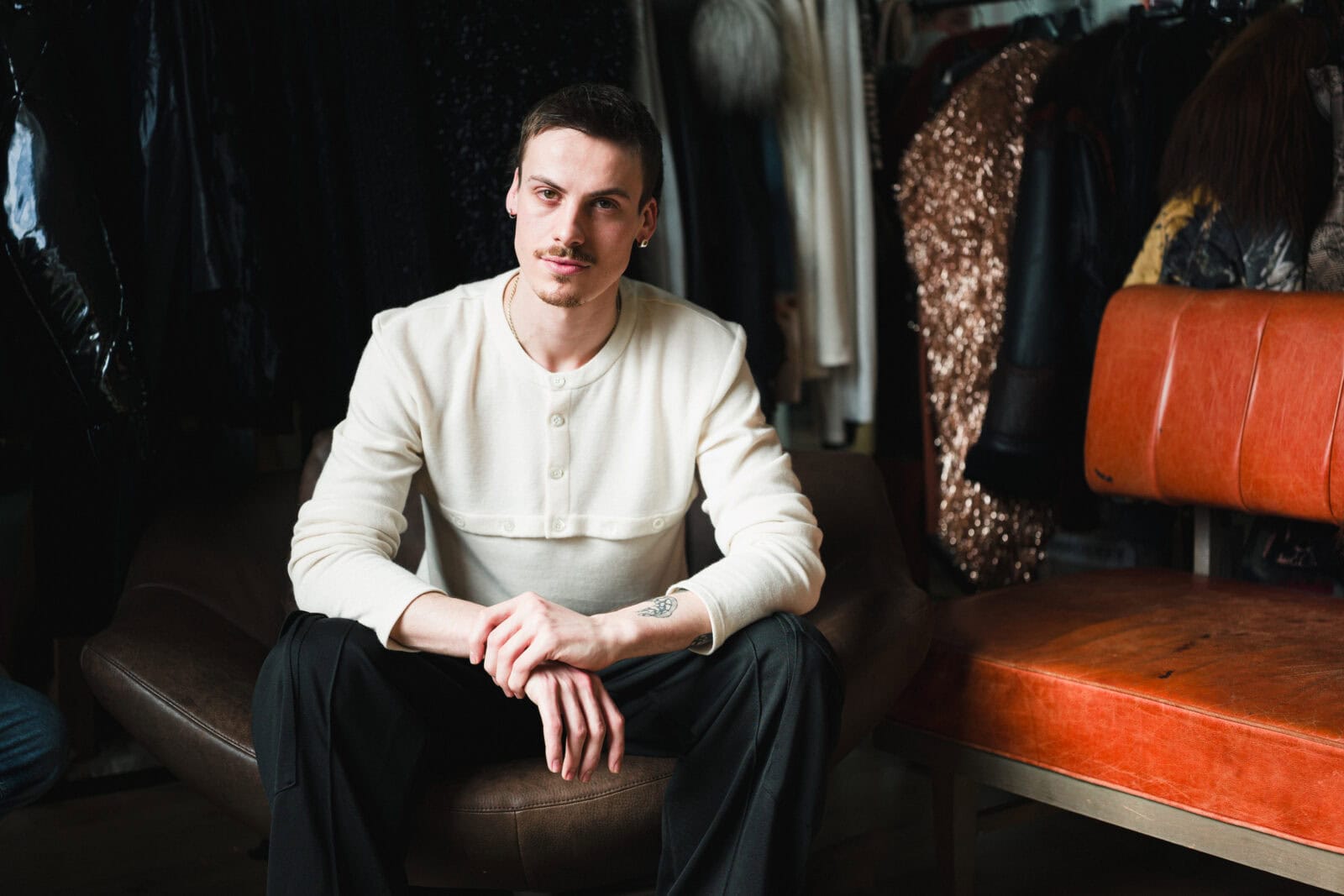
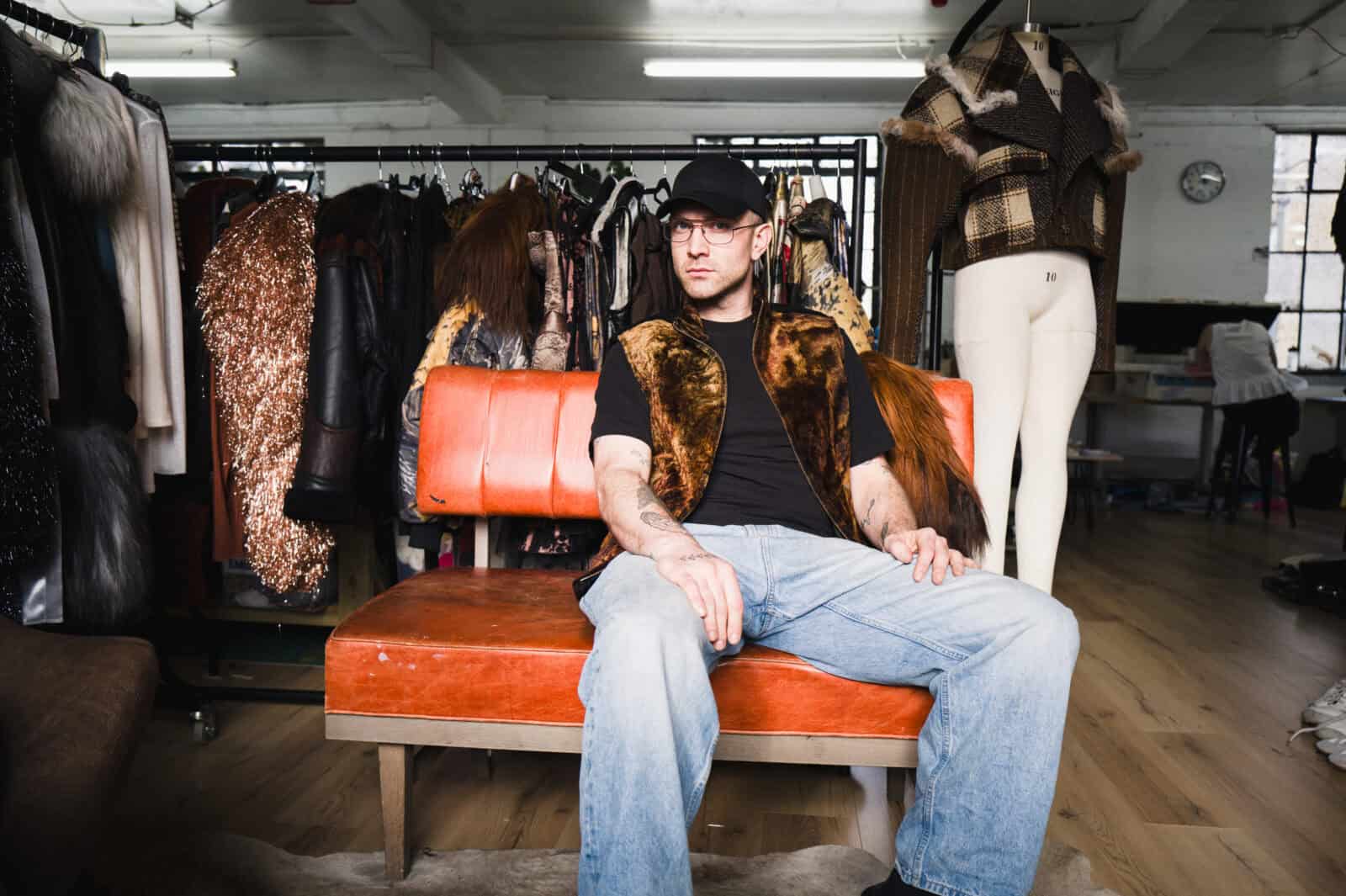
Couture-level eveningwear punctuates the collection, including one dress set with over 70,000 stones in a hematite-to-black gradient. Where their earlier work centred on dressing individual performers, the garment in service to the persona, runway collections demand something pointedly different.
“It’s quite easy to create one dress for someone specific,” Angus reflects. “But learning how to edit pieces so they work collectively, that’s taken time. It’s taken us a good three years to learn how to work together, how to communicate with each other.”
That sense of collective identity extends beyond. Britishness, while never presented literally, remains embedded in AGRO Studio’s visual language, mirrored through two distinctly juxtaposed upbringings: George having grown up in Brussels, while Angus lived out his childhood in Essex. “British identity is very complicated,” George says. “There’s so much to be proud of, and so much to think about critically. Within that, there’s a lot of texture.”
Pre-colonial histories, pagan mythologies and regional folk traditions all find their way into the collection’s visual references, particularly those rooted in the South West of England. This complexity extends to London Fashion Week, which in recent years, has found itself subject to a recurring narrative: that it’s somehow lost its relevance.
“Brexit and Covid compounded to hit our industry really hard,” George acknowledges. “Some brands have struggled to continue, others have restructured, and that’s opened up space for smaller, grassroots brands to emerge.”Despite the challenges, the pair remain optimistic about London’s creative ecosystem. “There’s still incredible talent coming out of here,” he continues. “We don’t have the same kind of international conglomerate presence buying up smaller labels, but the ideas are still here. It’s just a matter of time before the infrastructure catches up again.”
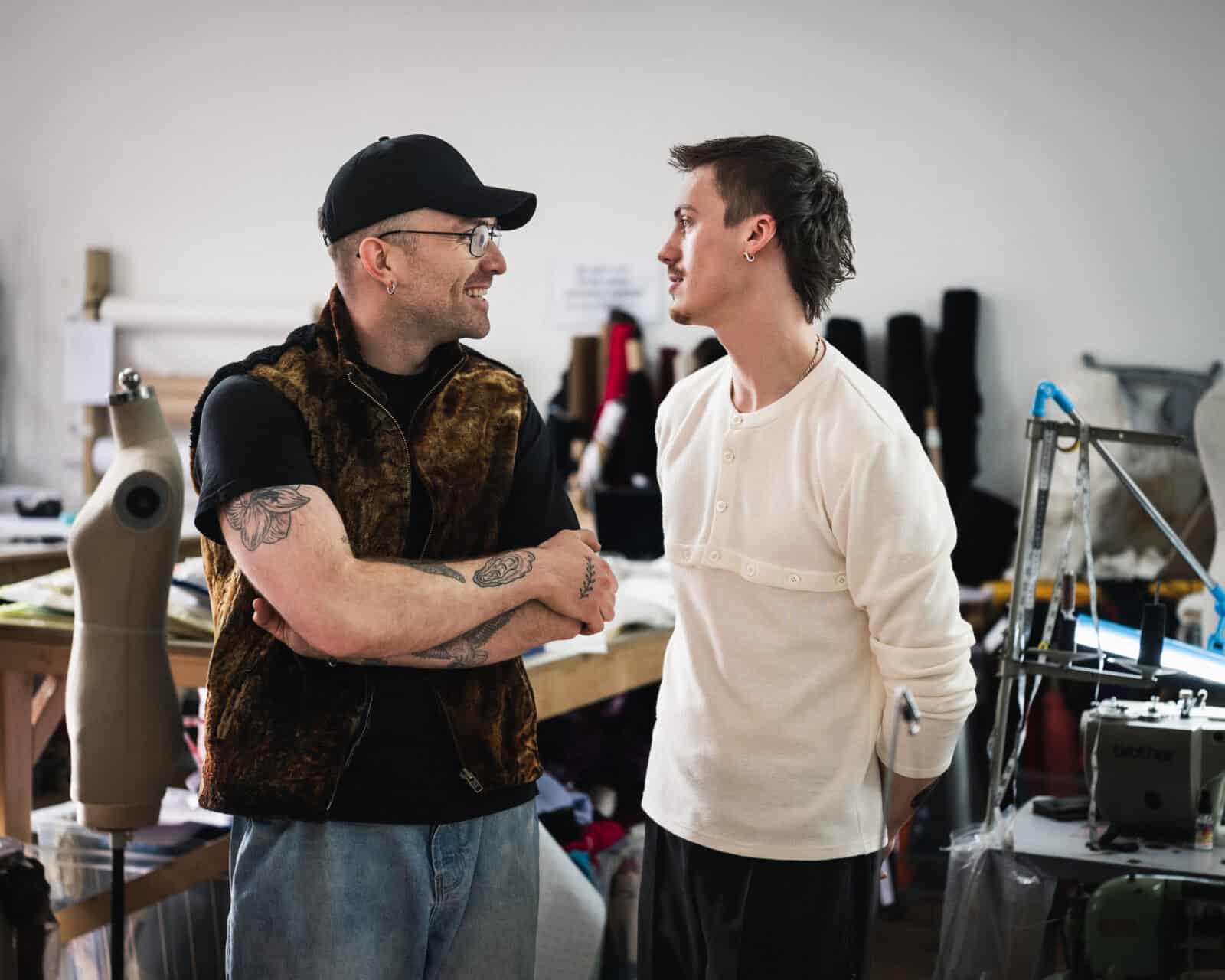
Of course, for all its literary references and couture-level detailing, The Wanderer remains unmistakably AGRO Studio. Asked which AW26 look they’d most like to see out in the world tomorrow, the answers come quickly.
“The black tinsel on Cher,” George says, without hesitation. “But on The Cher Show.”
Angus opts for one of the collection’s wool coats, cropped or full-length, imagining it on Harry Styles or Paul Mescal.
“There must be another iconic girlie we’re not thinking of,” George adds.
“Teyana Taylor in our corset?” Angus suggests.
“Pink,” George nods. “We love Pink.”
Later, the conversation turns to fashion’s current landscape. When I ask what currently feels tired in fashion, the dialogue shifts to focus on the studio’s own material language. “We intentionally didn’t do any Mongolian this season,” George explains, a texture that has long defined the brand’s earlier work. “We’ve definitely rinsed it.”
In its place, AW26 introduces Icelandic sheepskin. “Icelandic sheep is in,” he adds. “Orange is the new orange,” Angus chimes in, before George notes the sudden ubiquity of fur collars across recent fashion weeks. “Ginger is now the most popular hair colour on earth,” he continues, “and it’s beautiful and stunning.”
With everyone online currently throwing it back to 2016 (now, alarmingly, a decade ago) I ask what their own memories of the era look like. It was a time that felt, if not necessarily better, then at least more optimistic; rose-coloured, definitely aesthetically questionable, but a little less performative all the same.
“The shiny face filters on Instagram,” George laughs. “Do you remember them? Everyone was gagged.”
“I was too busy running away from the countryside to move to London,” Angus admits.
A reminder, perhaps, of how much both they (and the industry) have shifted in the intervening years, early fun experimentation gradually giving way to the more practical realities of sustaining a brand in 2026.
When I ask what the biggest challenges have been in navigating London as an emerging label, the answer is immediate. “Cash flow,” George says plainly. “It’s not about the people, the team is incredible, but managing finances is difficult. There isn’t the same level of fashion-specific investment here as in other cities.”
“It’s all a risk,” Angus adds. “In good ways and bad. You end up eating a lot of rice and beans.”
Even after the interview ends, the conversation drifts towards the idea of radical authenticity in the industry, something George and Angus seem to approach with a notable lack of pretence. It’s real human connection that tends to unlock the natural synergies, the collaboration and the trust.
So what’s next?
“World domination,” Angus offers.
“Sustainable growth,” George clarifies. “Finding our cult. Finding our people.”
Building a brand, or, indeed, an emerging magazine, requires a certain amount of improvisation. As they joke, someone asks for the email of your press team and you say, of course, before remembering that you are the press team.
In that sense, perhaps, it’s less about playing it cool than about showing up – whether that’s a swipe on Hinge or the decision to start something on your own. For now, at least, AGRO seem content to figure it out as they go.
The Wanderer was realised in collaboration with creative production and music by WFB Live, hair direction by Luke Pluckrose for L’Oréal Professionnel, key makeup by Martina Derosa, styling by Douglas Miller, eyewear by A-Society, footwear by Untitlab, and embroidery by Rosie Brain.