
Dystopian yet tender, Jaime Welsh’s photographs evoke a haunting duality: a contradiction between the safety and innocence of childhood and the stark backdrop of authoritarian architecture. His subjects, often young and vulnerable or introspective, inhabit spaces that seem to remember more than they reveal. His compositions are not just portraits – they are psychological landscapes, scenes from dreams, and emblems of the past and future.
Now on show at Ginny on Frederick in London, Convalescent marks a thoughtful evolution in Welsh’s practice. A Portuguese artist now based in the capital, his photographs look at the interplay of spaces designed for control becoming sites of emotional ambiguity. Convalescent is shot entirely at Villa Karma, a modernist building in Montreux, previously used as a leprosarium and priory, before becoming the home of neurologist Theodor Beer. Designed by Adolf Loos, the building’s logic – Raumplan, an approach that organises space through interlocking volumes rather than flat planes – plays a pivotal role in Welsh’s own structure. Each room is meticulously proportioned, yet never wholly revealed. This partial visibility creates a rhythm of concealment and disclosure that echoes the psychological nuance of Welsh’s imagery, generating a space where architectural form and emotional resonance converge. The building’s spatial logic becomes a metaphor for the psyche, compartmentalised and elusive. Welsh’s photographs navigate these volumes not just physically, but emotionally, tracing the contours of memory and perception within the authoritative architecture.
The exhibition guide references theorist Beatriz Colomina, whose writing on architecture as a system of overlapping representations resonates with Welsh’s approach. His images do not simply document space; they reconstruct it. Drawing from historical systems and visual archives, he builds new structures through instinct and material, allowing the image to exist independently while echoing the logic and deep-rooted histories of the original architecture. In Convalescent, these ideas take form across three works that dissolve the line between subject and structure, presence and reflection. Through Welsh himself, his lover, and a teenage boy, the photographs explore how the body becomes both witness to and extension of the spaces it occupies.
Walking into Ginny on Frederick, ‘Cornea’ (2025) hangs on the back wall. It depicts Welsh himself from above, seated on the steps at the entrance of the building – a threshold between immersion and escape. The figure appears suspended in contemplation, caught between looking out and being looked at. The view from above evokes both surveillance and distance, positioning the artist as part of the architecture he inhabits yet seemingly detached from it.
On the right, ‘The Black Marble’ (2025) turns toward intimacy. This time, the subject is Welsh’s lover, his clothing echoing the marble and iron door he approaches. A faint reflection of his face ghosts across the stone’s surface. Barefoot, his lightly blackened feet ground the image in something bodily and fragile, a contrast to the solidity of the surrounding structure.
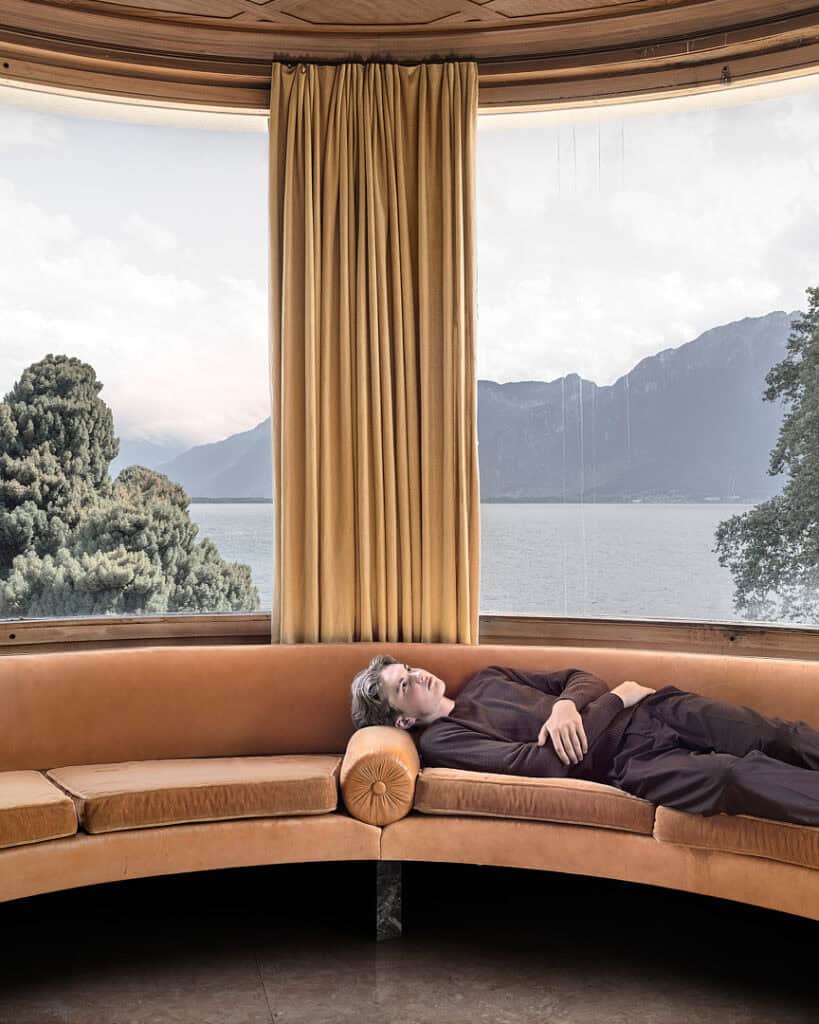
Elsewhere, ‘Convalescent’ (2025) extends this tension between stillness and unease. A boy lies upon a curving bouquet, framed by the Alps visible through wide, luminous windows. His body appears taut, his expression guarded. The heavy curtains threaten to close, transforming the peace of the view into a scene of entrapment, as if the landscape could dissolve at any moment.
In the lead up to the opening of Convalescent, The COLD Magazine spoke with Welsh. Though we communicated over email, that distance felt quite fitting. Our ‘quiet’ conversation across various screens offered a glimpse into his contemplative process. His answers – like his photography – resist easy interpretation, inviting the viewer into a profound encounter with space, memory, and control.
The COLD Magazine (CM): You began as a painter. How does that background influence your photographic compositions today? Can you walk us through your creative process?
Jaime Welsh (JW): Each image begins with a space, something architectural that I study, stage, and later rebuild through postproduction. The work develops slowly, through disruptive interventions and fine revisions. In that sense, it is close to painting, a gradual construction shaped by instinct and time. What interests me is the moment when the image begins to detach from the place it comes from and starts to exist on its own terms. Although the works are entirely photographic, they share with painting a sense of internal logic, a space that follows its own order rather than the reality it comes from.
CM: You often speak about being drawn to both space and subject, what tends to come first for you? Is it the architecture that calls you, or the human presence within it?
JW: The architecture usually comes first. Each space demands its own subject. For some time, I have been drawn to early childhood, especially in relation to authoritarian architecture. There is something in that pre-adult state that remains ungoverned, something that resists design. But in the Adolf Loos house, which is also a space of power, that openness had no place. The building called for a more introspective, existential presence: my own, my lover’s, and a boy found nearby.
CM: Your work is staged yet feels deeply natural in a way that somehow makes sense, how do you approach staging?
JW: The staging is researched and planned in detail. I rarely have much time on site because I often work in restricted or official buildings, so preparation is essential. I study the architect’s archive, the history of the space, and the objects that once occupied it. Then I begin to alter things, mostly by removing. I try to avoid anything theatrical. In directing the subject, movement and expression are strictly excluded…
CM: How much of your work is shaped by your childhood or upbringing?
JW: I don’t think of my work as a reflection of childhood in a personal sense. Inevitably, the way one sees the world begins there, but I’m not interested in autobiography. What interests me is how childhood operates within broader structures, social, moral, historical. It’s less about my own memories and more about the way innocence, authority, and fear are produced and learned. If traces of my upbringing appear, they do so indirectly, through these systems. I’m interested in how environments shape behaviour, how architecture carries its own doctrine, and how that persists quietly over time.
CM: There’s a clear fascination with interior design and architecture in your work, where does that stem from?
JW: It began early, with observation. Spaces reveal how people organise life, what they hide, what they want to appear as, what they value. Architecture exposes ideology more honestly than language. I’m interested in how objects and architecture produce the pleasure of looking. My concern with beauty is not emotional but structural, beauty as a surface condition, a form of order. I want to understand what makes something appear refined, and what that refinement conceals.
CM: Your upcoming body of work is all shot in Villa Karma in Montreux. Why Villa Karma?
JW: I encountered Villa Karma while researching Adolf Loos. What drew me to it was its atmosphere of secrecy. The Raumplan embodies that, each room precisely measured, yet never fully visible. That structure of control and concealment relates to how I build images.
CM: Your work explores memory as it relates to spaces, what is important about the history or emotional intensity tied to the spaces you photograph?
JW: Memory interests me when it’s built into architecture. I’m drawn to spaces where history isn’t celebrated but absorbed. It’s not about nostalgia or trauma, but about persistence, how a place can hold an idea long after its purpose and meaning have been lost. In these spaces, emotion isn’t expressed but contained.
CM: There’s a haunting quality to the idea that ‘if these walls could talk,’ but of course, they can’t. How do you navigate that space of silence and projection?
JW: I’m not interested in explaining what a space or an image should mean. The moment a work starts to explain itself, it stops asking anything. It becomes illustration, not art. My photographs depend on silence, on what’s withheld. Meaning should arise from the viewer’s mind, not from my instruction.
CM: What is your relationship with the viewer?
JW: I don’t think about a future spectator in terms of predicting their response. That’s not something I can, or want to, control. The work depends on uncertainty. It’s the condition that keeps it alive. What interests me is what resists explanation. If any connection occurs, it’s below the surface. My subconscious touching another’s.
CM: Scale seems to play a dual role in your work, both in the vastness or intimacy of the spaces you choose to photograph, and in the physical size of the final prints. How do you think about scale in these two dimensions?
JW: When I print, scale determines how the viewer’s body relates to the image. A large print can feel immersive, but I’m more interested in the confrontation it creates, the sense of being observed by the space itself. The decision is less about emotion and more about calibration, how size alters perception and proximity. I use highly advanced photographic equipment to capture the fine detail of materials, architecture, textiles, skin. Scale allows the viewer to see those surfaces clearly. I try to keep the works close to life-size, so the foreground elements correspond to real proportions and the viewer can relate physically to the image.
CM: The press release for your upcoming exhibition at Ginny on Frederick references Beatriz Colomina. Colomina writes that modern architecture is a system of overlapping representations. Do you see your photography as a way of representing architecture and its history, or as something more interpretive?
JW: Colomina’s idea of overlapping representation corresponds to how I study architecture through its images, archives, and histories. My approach begins there but moves away from analysis. I am less interested in mapping those systems than in rebuilding them through a slower, more instinctive process. When I photographed in the Chancellor’s Chambers at the University of Lisbon, I spent hours studying footage of the former Portuguese dictator touring those rooms, alongside the architects’ drawings. Rather than reproducing those systems, I reconstruct them intuitively, through material and time. The image becomes a new structure, one that mirrors the logic of the building while existing as something independent.
CM: When you’re not working, what kind of spaces do you seek out for comfort or inspiration? Are they similar to the ones you photograph, or completely different?
JW: I don’t look for spaces in terms of inspiration. My workspace and home are quite austere, extremely clean, organised, almost clinical. A bit like American Psycho, but without the violence. I need order around me to work; everything else feels like noise. The spaces I photograph are also built for control. In the end, all architecture regulates behaviour and produces its own form of order. My own spaces follow the same logic on a smaller scale, more internal but no less structured. I think all architecture and interior design is rhetorical. No space is neutral.
CM: How has your work evolved in preparing for this upcoming exhibition?
JW: I’m currently doing an artist residency at the Stiftung Laurenz-Haus in Basel. Working in Switzerland has been a gift; the time and distance have allowed me to focus entirely on the work. Villa Karma is very different from anything I have worked with before. It has its own agency and dictates how it wants to be seen. His architecture is already so precise and psychological that it almost resists change. Re-routing that architecture took some doing; it does not give itself easily.
CM: And lastly, have you seen Severance, the television series? Its sterile corporate spaces, repressed emotional undercurrents, and mythological overtones feel eerily aligned with the atmosphere in your work. Do you see parallels between its spatial storytelling and your own photographic exploration of architecture and memory?
JW: I haven’t watched Severance, but I looked up its imagery. The architecture seems to reflect an unease with order and detachment, spaces that both oppress and regulate behaviour and thought. I can see why you would draw a parallel. From what I have seen, it seems to explore the same tension that interests me, control pushed to the point where it becomes unsettling. Perhaps it resonates because that anxiety has become the condition of modern life. I will have to watch it, thank you for the recommendation.
Jaime Welsh’s Convalescent is on show at Ginny on Frederick until 17 December.