
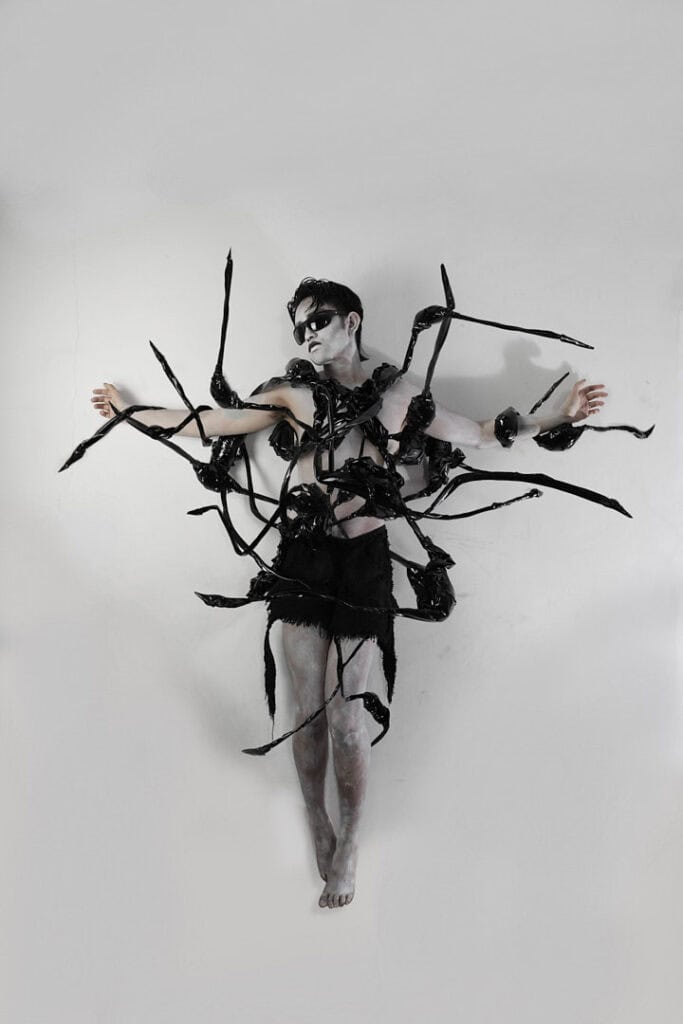
While Epitaph, Jean Louie Castillo’s AW25 collection, lingered among the tombstones of Highgate Cemetery, Tormentor seemed to burst from its crypts in a scream of fury. Presented in a grandiose hall tucked away in Westminster, Castillo’s latest work is an invocation of rage in all its forms. The Welsh-Filipino designer is no stranger to Flair Fashion, the incubator platform aimed at championing emerging talent and democratising the industry; back in February he sent ghostly figures drifting down its catwalk. This season, those phantoms returned transformed; no longer mourners but irate avengers, glistening in black lacquered fabrics, their eyes dark and unyielding as onyx.
The showcase opened with a knight. Armoured head to toe, steel glinting under the lights of the chandelier, the figure marched forward like a revenant pulled from another realm. What followed was a descent into metamorphosis. A body confined by thick braids twisted across the form like tendons, weaving a second skin over the flesh beneath. A raven-like silhouette, shoulders thrust outward, sharp and looming, as though the figure might spread its wings and lift off into shadow. Distressed denim appeared next: frayed and rugged like ruins left to weather, its surface etched with scars of wear and memory. Spikes tore violently through fabric, jutting out at strange angles. Finally came the “eruption”: Bambie Thug, cloaked in a storm of spikes and spider legs, striding fiercely into the light.


This was Tormentor, a collection steeped in a gothic sensibility that has found fresh resonance in the 2020s. Goth is in the air again – not only in music, where acts like Sharon Van Etten carry the torch lit by Siouxsie Sioux and The Cure, but also in cinema, with Wednesday and Robert Eggers’ Nosferatu reanimating the aesthetic for new generations. In fashion too, Vogue already declared a “goth revival” back in 2024, noting that the look is “anything, as long as it’s rooted in a celebration of darkness.”


The revival is no accident. Just as goth first rose during the political unrest of the 1980s, today’s return feels bound to a world haunted by political extremism, war, and the looming shadow of environmental collapse. Castillo himself sees rage as necessary in such times: “We need to be angry, otherwise it’s like you’re pretending, putting on this façade that everything is fine. But not everything always has to be OK.”
Castillo crafts a gothic kingdom that sits at the heart of this resurgence, where villains are reimagined as dreamers. “As goths and alternative people, we’re often seen as bad because we look crazy,” Castillo says. “But honestly, I think we’re quite gentle people, hopeless romantics.” It is in this tension that his vision comes alive.

The Cold Magazine (CM): What drew you to rage as a central theme, and how did you approach transforming that emotion into clothing?
Jean Louie Castillo (JLC): My last collection was called Epitaph and it was about grieving and heartbreak. There are so many different stages to heartbreak, but one thing I neglected was rage and anger. We’re always told to move on with love, which I do, but I decided to hyperfixate on rage for Tormentor. I think it’s OK to be angry sometimes. It’s a very underrated emotion that we often neglect because we’re so busy with our jobs and our lives. We don’t really have time for our feelings. So I thought, let me zoom in on that and see what comes out. And aesthetically it matches with my work.
CM: Your silhouettes mirror shards, spider legs, and armour, very sculptural forms of defense. What inspired these shapes?
JLC: I supported the idea of rage through the uncertainty of stepping into a new form, into a new body, into a new state of being. I created a lot of shapeshifting appearances, like the muscle jacket, lumps, and crumpling of the fabric. I wanted to include spikes, which might seem cliché, but when you’re feeling like you want to erupt, you want to escape your body. I portrayed that through spikes coming out of the arms in random places, like something trying to break out of you. With Bambie Thug’s final look I thought, let’s go crazy – let’s just have it OUT. I also worked with a lot of distressed denim, because that feeling of being distressed emotionally was something I wanted to replicate in the rugged fabric.
CM: The distressed denim and jagged textures give the collection an almost battle-worn quality. Were there any unexpected materials that shaped Tormentor?
JLC: Not really. From the very beginning I knew I wanted to use denim because I was skilled at it. I also used PVC, the black shiny glossy fabric. I’ve used that throughout my whole career, though not in the last collection, so this time I returned to it. The only thing I didn’t create was the armour, which was by Yannis Ammar, a French cosplay artist. I wanted to see cosplay costume design in the landscape of fashion. That’s something I’ve often been accused of (being a cosplayer) and I think, is that bad? I don’t think it’s a bad thing. So I decided to literally place a cosplay model into my collection and see what happened. It worked really well.
CM: Let’s talk about the knight then. How do you see that overlap between cosplay and fashion? What does it say about fashion’s ties to performance and role-play?
JLC: Historically everything was fashion, and then over time it becomes costume. Right now it’s literally a cosplay costume: it’s from Dark Souls III, the Soul of Cinder. But I was wondering, in the future will we be dressing crazier? Will we be dressing down? With the current state of the world, I think people are going all out with their looks. I wanted that melodramatic appearance from a cosplayer in the landscape of fashion. In my world, I don’t even know what costume is. I’m always dressing crazy. My friends–musicians, artists–we all look like characters. So to me it’s not that strange to send a knight down the runway. That’s just a Saturday night.
CM: Do you design with a particular character or archetype in mind?
JLC: Yes. The basis of my collections is this character called Sacre. It’s basically me, but a person I want to be, like a future version of myself or a hyperbolised one. He’s inspired by the Joker. His name comes from the Latin word for “sacred,” like Sacré-Coeur in Paris. It plays with the idea of good and bad. As goths and alternative people, we’re often seen as bad because we look crazy. But honestly, I think we’re quite gentle people, hopeless romantics. That’s the character I’ve been basing it on. For Tormentor I definitely had the knight as part of the muse, and also Bambie Thug, because their music releases a lot of rage: heavy, rock, powerful. The knight costume brought that sense of self-defense, the feeling of wanting to explode but also hold back in case it goes too far.
CM: London Fashion Week can often feel dominated by established names. How important do you think platforms like Flair are in shifting the spotlight to younger, more experimental voices?
JLC: It’s very important. They’re quite selective, and everyone on the platform is talented and experimental with textiles, surfaces, silhouettes. Right now I think people are craving otherness, so I’m thankful to Flair Fashion for considering me – twice in a row, by the way! As a designer who is world-building rather than just making clothes, I think people respond to that. Flair is incredible because you get a mix of different designers and audiences with different tastes. They can like it, hate it, question it. Diversity and cultural amalgamation are so important. I’ve had people come up to me saying, “I don’t know what goth is, but I LOVE it!” Flair brings new eyes to my work, and it’s the same for others. It’s a culture mash, and it’s beautiful.
CM: If Tormentor stages rage as rebirth, what emotional or philosophical terrain do you imagine exploring next?
JLC: I’ve already started my next project. It’s based on the concept of narcissism: what it means to be obsessed with oneself. I took reference from the Joker in the Batman series: he’s incredibly confident, he has money, he commits crimes, but he’s happy. It’s such a mind-boggling portrayal of a character, and I want to step into that and see what it’s like.