
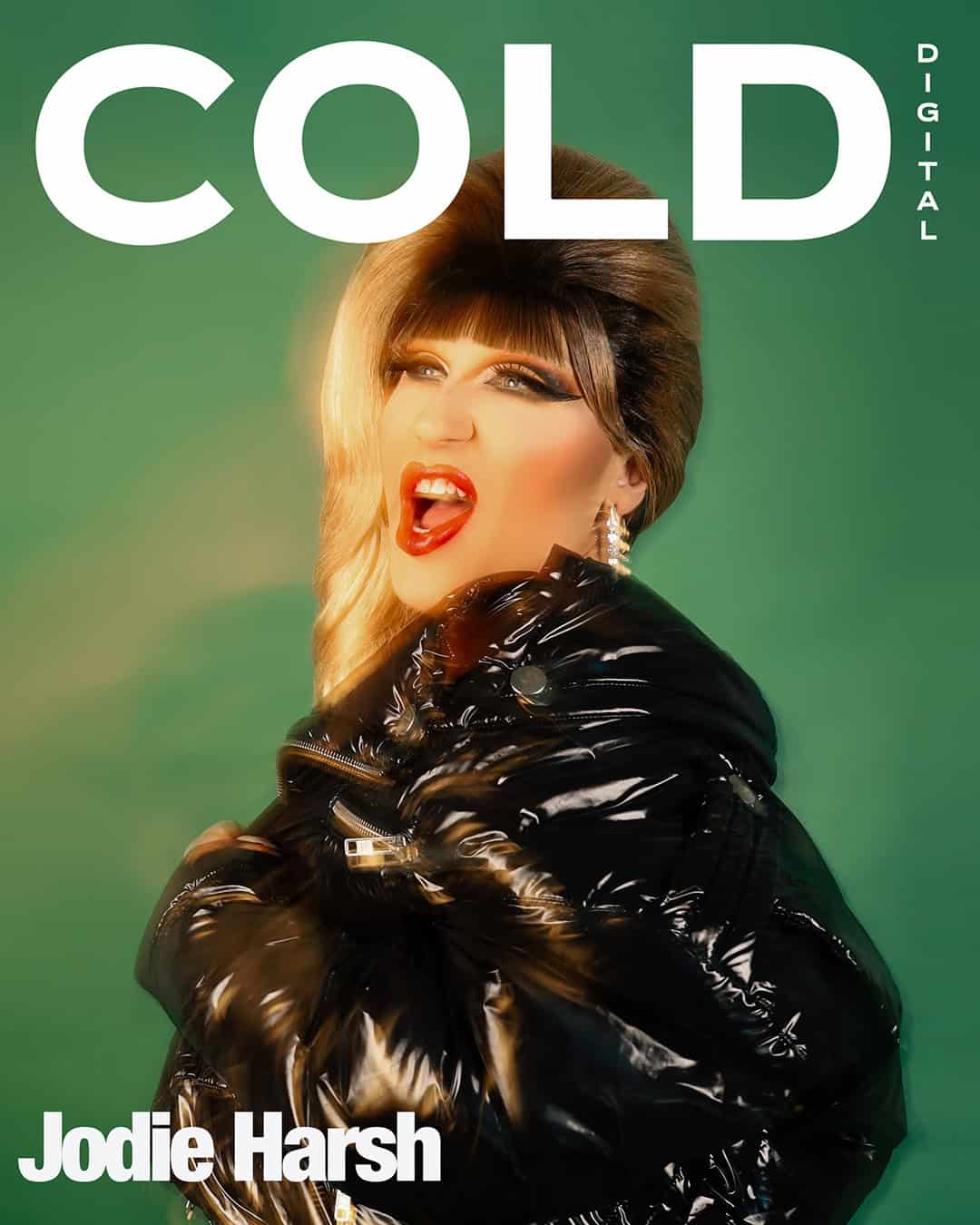
It’s the hottest-ever June in London. For some reason, I’ve decided to wear all-black. The ice in my glass is melting. The room seems to spin a bit, and it’s not because of the turntable in front of me in the Vinyl Room at House of Koko. I’ve turned the lights off, save for the atypically harsh sunlight slicing its way through barely-shading blinds. Luckily, I’m here for something cool: Jodie Harsh – a beauty to the eyes, a beast on the deck, and a bump-it (maybe) in the hair.
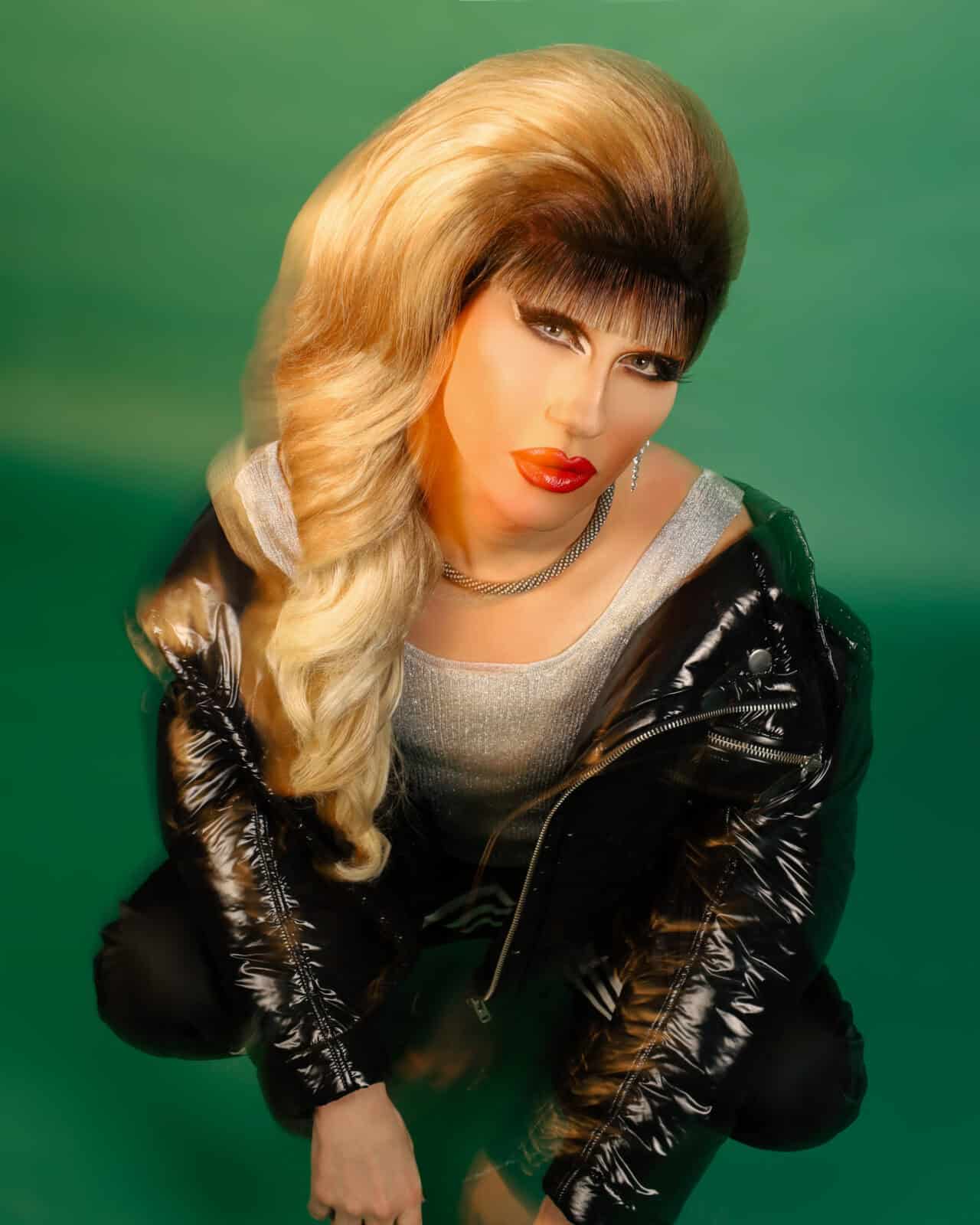
The author. The drag artiste. The Kylie-Minogue-tour-opener. And now, The COLD Magazine cover star. A ding on my laptop. She’s here. We begin:
The Cold Magazine (CM): Alright. So. You’ve built a very distinct persona with Jodie Harsh. How are you, the person on a random Tuesday morning, different from Jodie-Harsh-the-character?
Jodie Harsh (JH): I like to think I’m the same person. I’ve always described my drag as my work suit. So it’s what I put on when I’m going and presenting publicly in a kind of … performance type of space. There’s that famous RuPaul quote; “You’re born naked and the rest is drag.” And even though it’s like such a cliche to bring that up, it’s so fucking true. Like, we’re all in various different degrees of drag all the time and presenting different parts of ourselves and different surfaces of ourselves.
I’ve developed this look over the years, stuck with it, and it’s instantly recognisable. It’s a silhouette. When you’re half a mile away at a festival and you see me on stage in the distance, you know it’s me. It’s a signal. A mask, but not one hiding insecurities. It’s just the suit and tie I’d wear if I worked in the City. So how different am I? I don’t think I’m different at all.
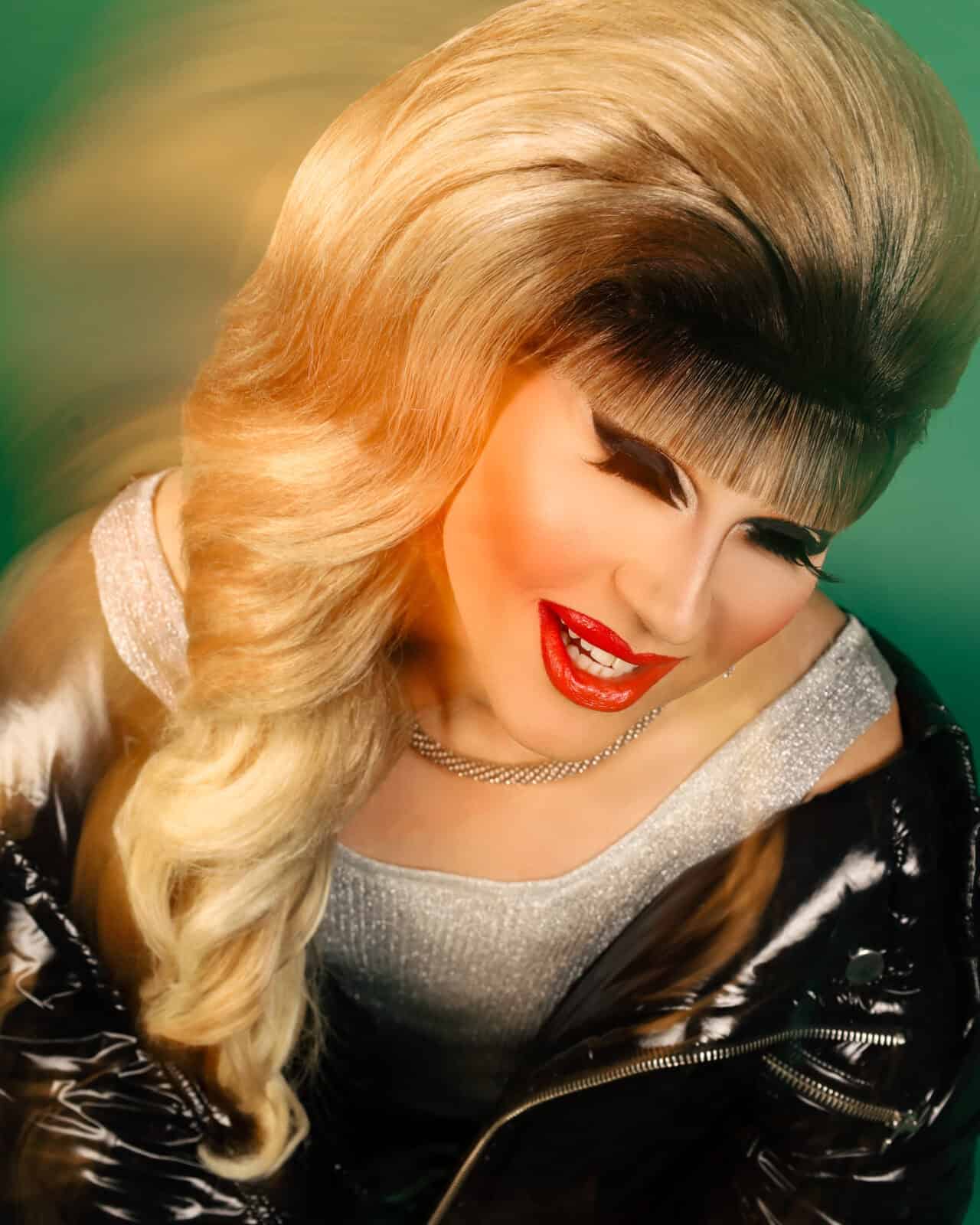
CM: Well, do you find that it has become harder or easier to be different – be outrageous – in London over the course of your career?
JH: I think the world has become more difficult to become outrageous in, especially recently, it seems to have ramped up a lot. When I was younger, people would shout stuff in the street or whatever if they saw me when I was in drag. You see someone like me, and it’s not a normal thing to see walking down the street, and some people react oddly because they’ve never seen anything like this before. I ordered an Uber the other day and the Uber drove off. The Uber sped off when I went to get in it, and I thought, ‘Oh, that driver’s looked up his wing mirror and seen me approaching.’ So, I think people’s reactions can be, um, negative if they’re that sort of person. I don’t know how different it is compared to when I was younger.
CM: What does true glamour look like to you in 2026?
JH:
A truly glamorous person…I don’t think it has to be artificial stuff. It’s the way you carry yourself. An attitude and a mood. I think we’re so homogenised these days and told to like the same things and things feel a little flat and gray. If you really stand out and just like what you really want to like, and live your life in the way that you really want to lead it, that soaks through your paws. It’s like a glamour pheromone that people can pick up on.
CM: That sounds to me like authenticity. Do you think they’re the same?
JH: Yes. Liking and appreciating the things that you want to like, as opposed to what you’re told to like.
CM: Has anything about you become more conservative with age?
JH: Well I got sober. My partying has got more conservative with age, the way I let loose and leave the dull world outside.
CM: What about more radical?
JH:
I think I’ve always been pretty radical. I mean, to be in any kind of situation, and to make yourself visually stand out and be very queer and very outspoken. It’s such a radical thing anyway. Now more than ever, really.
CM: Is there any one thing you’ve completely flipped your mind on ?
JH: I care less about what people think of me these days.
I think that’s something that can only come with age. It’s such a trapping of youth to care about what people think about you – whether that’s your friends or family or the public, whatever. It’s such a youthful thing.
I think as you experience life and other people and you grow, you sort of start to shake that off. And so at this age, I feel like I really don’t really care what people think about me.

CM: Is that also easier to say because you’ve been so successful doing your own thing ?
JH: That probably comes into it as well, yeah. For sure. I think it’s a combination of age, experience and success.
CM: Is there one thing within that that’s making you the most excited right now?
JH: Writing, for sure. I loved writing this book (You Had to Be There, available from July 2). I did a degree in creative writing at university, then got sidetracked by nightlife, drag and music. When a literary agent approached me about writing a book, I thought, “Really?” I’d always said I’d never write one. But I was approaching a big birthday and thought maybe it was the right time to look back. As I started putting finger to key, it felt like the last two decades came together and this is where I’m supposed to be right now.
CM: You said you’d never write a book. Why?
JH: I wasn’t sure people would care about my stories. And I’ve always been a really private person. The good thing about drag is you can flick a switch and turn it on. There are parts of yourself you’re hiding. I’ve always liked to keep my private life separate from my work. I thought writing a book would mean giving that up.
CM: Did those fears turn out to be well-founded?
JH: No. As soon as I started writing, I realised everything had to go in. It had to be deeply honest. Even though it’s about nightlife, it’s also about my journey through nightlife. As much as The Club is the star of the book, so am I. The gloves were off. You’re either in or you’re out, and I thought, “Okay. I’m in.”
CM: And how has queer nightlife changed since you started going out?
JH: It’s changed…dramatically. It barely exists like it did in the 10 years that my book is set. So many venues have gone away. So much land has been sold to turn into empty blocks of apartments – “luxury” apartments – and turned into Prets and whatever by fat-cat developers. We’ve just lost so many of the amazing nightclubs to those places.
And yeah, new nightclubs have popped up over the years, but – you know – WE know, right? A shiny, brand-new nightclub is not as sexy as some railway tunnel that’s been converted into like a really fucking fun club space. All those shiny new places – they just feel a little bit too sterilised. I feel like in London, all the best places were really buildings that had been, you know, actually standing for 150 years and they’ve got converted into clubs. Or there were railway arches, and you have to be able to feel the real…the soul in those spaces. So we’ve lost the majority of those places and queer nightlife has changed because so many places have gone. Physical places.
CM: And you don’t think that those have been replaced in a way that feels as meaningful?
JG:
Not as meaningful. There are new places, as I said, but the landscape has changed, and it’s not just the redevelopment.
It’s also the fact that we go to nightclubs to dance, hear new music. Just, you know. Discovery.
Develop our tastes, and hook up, meet people, have sex. And all of the above are now done on apps. All of them. If I want to discover new music I’m on Spotify or I’m Shazaming something on the radio or whatever.
If I want to hook up, there are one million dating apps. If I want to meet people, I’ve got this thing called Instagram. You know, if I want to develop my tastes, I’ve got things that are just shown to me.
An algorithm does it for me. Now, this is useful, but it’s also completely changed the way that youth culture would discover and develop their tastes and interests and the way they want to present themselves to the world.
CM: With that change from things being more in person to more online, are there parts of queer life that you fear have been lost, or of the experience that have been lost?
JH: Yeah, I’ve always found that queer nightclubs have been these sort of… microclimates. Where you could find a community. I certainly did. I remember walking into a club for the first time and seeing 2000 people.
And I’m 15 years old with a fake ID and I’ve breathed a sigh of relief and gone, “Oh my god, there are people like me. People like me do exist.”
I think the sense of necessity in queer nightlife has been lost. Because queer clubs were safe spaces. They still are, of course, safe spaces. I’m not denying that queer clubs exist or are very, very important for people. And I can only speak from experience, but I remember there will be so many queer clubs and they would all hold thousands of people and they’ve largely gone. But yeah, safety, community, gathering, meeting, dancing, hearing music, hooking up.
These things have changed dramatically because we’ve got apps. There’s less requirement to be in a physical space doing these things
CM: Well, thinking about clubs that hold thousands of people – there’s The Cause for instance. Do you think that’s in the same lexicon?
JH: Oh, yeah, that’s just as good as the clubs back in the day. We’re so lucky to have that place. There’s so much that goes on there. But my point is 20 years ago there were like 20 The Causes around London. You know what I mean? But thank God we’ve got these places – The Cause, Fold. Thank God someone has bought XOYO and pumped loads of money into it. Given it a really amazing sound system, given it a resurgence.
So thankfully, it’s not all doom and gloom. Outside of London, it’s probably a lot worse.
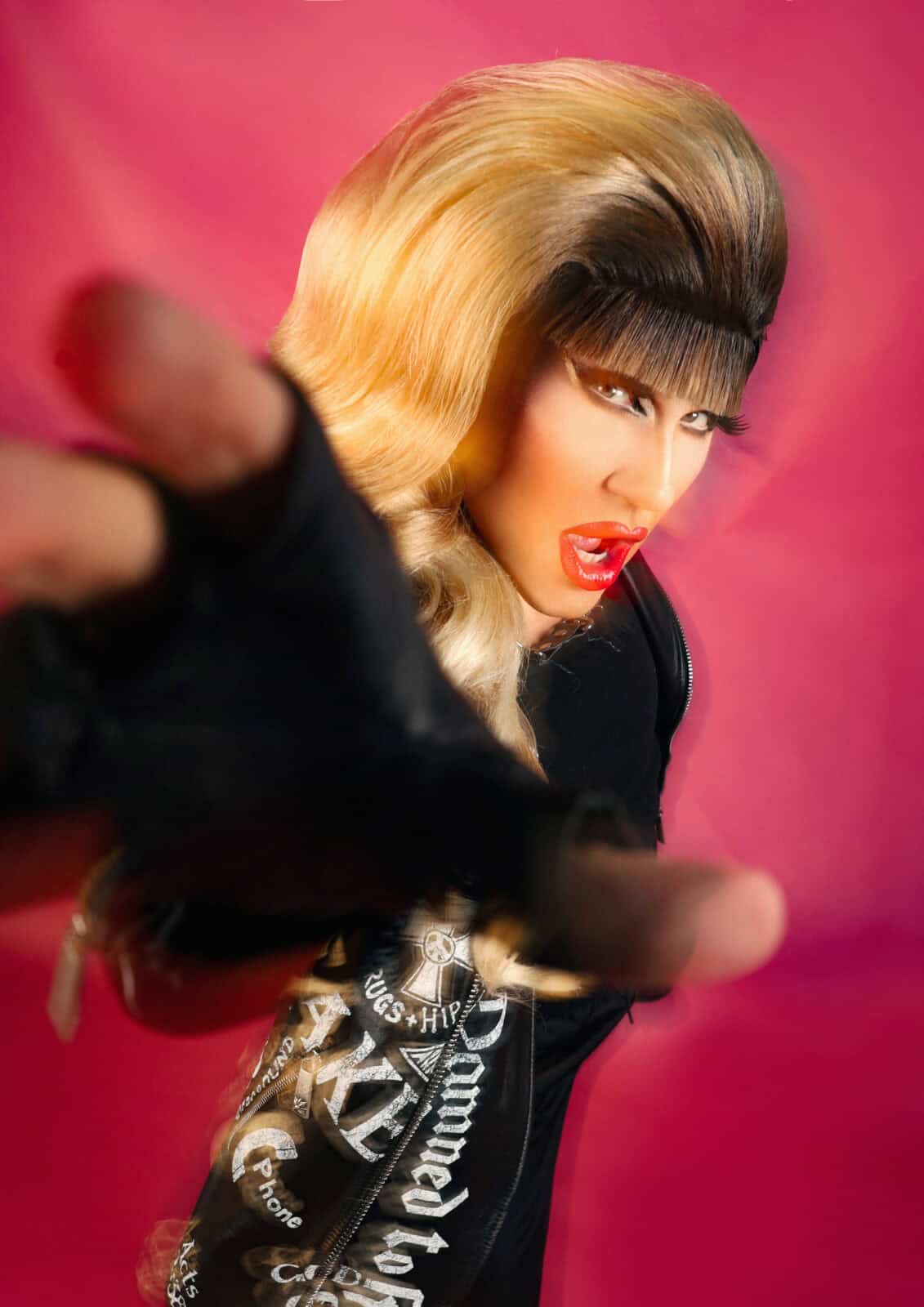
CM: You’ve been at the centre of nightlife for years. What’s something people misunderstand about club culture?
JH: That it’s a frivolous thing. The government certainly thinks it is, I think, sort of a frivolous thing. Or a luxury, or a dangerous thing.
In Berlin, they put blue plaques on the clubs, and the government protects them and puts money into them. They’re thought of as real cultural spaces like the ballet or the opera or an exciting art gallery opening. I personally give clubs the same value as those things.
CM: I agree. Okay pick one: Chaos or Glamour?
JH: Oh. Glamour.
CM: Do you consider yourself chaotic?
JH: I don’t consider myself chaotic. I think I used to be.
The chaos is all in that decade that the book covers. And I love being around a touch of chaos. But one of the reasons why I love being a DJ – and this is not the fundamental reason because that’s music and my love of performing music to people – but one of the reasons, one of the bonuses of being a DJ, for me personally, is that I get to stay a bit out of the chaos, and I’m in my booth protected. And I’m kind of just alone in my booth. I’m a bit of a loner up there in the booth and I’m just doing my thing.
So I like being a few steps away from the chaos. Personally.
CM: And that switched after the decade covered in your book?
JH: Yeah. For sure. I used to be pure chaos, go out on a Friday night and come back Tuesday morning.
CM: Was there something that distinctly switched there, or was it just age and experience?
JH: Aging. I got sober. I woke up one day and realised that partying that hard doesn’t really work for me, and it isn’t gonna work for my life.
And I just made a conscious decision to, um. Stop. Partying.
CM: Have social media and streaming changed the way crowds respond to music?
JH: Definitely. Social media and streaming. You see a lot of arms in the air filming DJ sets. And, of course, there are loads of clubs now that ban phones, which I do love. I think people are slowly learning to self-regulate phone use in clubs, and it’s becoming a little bit gauche to get your phone out in a club and to be taking selfies or filming all night or whatever. Filming the DJ.
I think one day in like 10, 20 years, we’ll look back and go, “Oh my God, do you remember when people were filming the DJ all night? like every drop?” I think it’s almost going to feel a bit like, “Oh my gosh, remember when people used to smoke cigarettes?” Do you know what I mean? Like, pre-vaping.
CM: I’ve got to say I don’t like the taste of a cigarette, but it does look cool. The aesthetic of it.
JH: It is rock-and-roll, isn’t it? But it’s not for me. I think health is wealth, I really do, and I just value my health so much these days. I think health is cool.
CM: Have you ever heard a song that made you go, “Dang, I wish I had written that”?
JH: Anything that’s really simple and effective – I like dance tunes that serve as a mantra. “Music Sounds Better With You” by Daft Punk is a good place to start – one line repeated, packed with meaning and a proper earworm! That’s the goal.
CM: So when you look back at your lifetime lexicography of parties – what makes a party truly memorable six months later, rather than just fun in the moment?
JH: I think the exact right mix of people, the exact right music, the element of the DJ being aware that their role is to educate and also entertain in a fifty-fifty split. I think the venue is very important. Lighting is SO important. Because of course, we want dark, but not too dark, and you’ve got to have the right movement in the lights, and the right smoke, the right the right hazer, like that’s just an atmosphere that’s created with lighting and smoke. I think a night has got to feel like a story. Things have got to unfold. Have chapters. And it’s all down to your personal adventure that night.
CM: What would 16 year old Jodie think of you now?
JH: I mean, 16 year old me, I had, like, posters of Kylie Minogue on my wall and a fake ID in my pocket. I was sneaking trips to London, and now I’m sort of DJing all over London, and last summer I went on tour with Kylie.
I was her opening DJ. Experiences like that are so beyond my wildest dreams, to be honest.
You know, obviously I work hard and that’s very important and I didn’t come from any kind of special background.
I’ve just had ideas and worked hard at them and wanted to create interesting, exciting things for people, whether it’s music or clubs, I’ve just wanted to bring that to people. Bring people a little bit of joy. And thought of it with a business mind as well at the same time. And, I think I’d be proud of myself, and also think, ‘Wow, that looks so exciting, I can’t wait.’
CM: So you had posters of Kylie Minogue at 16. What was that moment like then, when you got the call that you were going to be opening for her?
JH: Oh, my God, amazing.
When my manager said to me, ‘Kylie wants you to come on the road with her and do a few months over the summer with her Tension tour’, I was like, ‘Wow, this is…That’s really cool’. I mean, that’s being in front of a lot of people.
That’s a lot of big arenas. You know, we did four nights at the O2 alone.
And I did all of the UK and all of Europe with her. And so, thanks to her, I played to probably above a million people on that tour.
CM: Do you know how she heard about you?
JH: I’m Jodie Harsh.
CM: If nightlife disappeared tomorrow, what would you do instead?
JH: I’d write. I’d continue writing about nightlife and sharing the stories. Nightlife is all about stories, right?
And what happened last night. So, I guess we can keep sharing that and sharing the music. But nightlife’s not gonna finish tomorrow.
Humans always have had a desire to – even when we were cavemen – we were dancing round a fire to the flickering flames, dancing to the beat of a drum. So I don’t think anything’s changed. Hundreds and thousands of years later.
CM: That’s quite comforting. Because, you know. Nightlife has really been going through it.
JH: It ebbs and flows. It always has done and it always will. I’m sure in the 80s, when I wasn’t around, there were moments like this where in Thatcher’s Britain it was like, “Oh my God, there’s this really cool underground club called blah, blah, blah, but other than that, there’s nowhere to go! The government shut all the clubs!”. You know, it’s just what happens. It’s what happens. Nightlife will come back. It’s perennial.


