
When the lights dimmed inside the vast tent at the Tuileries Gardens, a single line of text appeared across a giant inverted pyramid: “Do you dare enter the House of Dior?”
It was both question and provocation, a challenge not only to the audience but to Jonathan Anderson himself. Newly appointed as Dior’s artistic director for both menswear and womenswear, the Irish designer was stepping into one of fashion’s most mythic and merciless legacies. Few maisons carry such haunted weight. Yves Saint Laurent. Marc Bohan. Gianfranco Ferré. John Galliano. Raf Simons. Maria Grazia Chiuri. Each carved their mark into Dior’s mythology, each leaving behind a burden as heavy as it was luminous.
Anderson chose not to avoid that history but to wrestle with it head-on. Before a single model appeared, the audience was plunged into an Adam Curtis film projected above them: a dizzying montage of horror sequences, Dior archive reels, and Hitchcockian fragments. Christian Dior’s own image flickered against that of Marlene Dietrich, until the entire history of the house collapsed into a shoebox. Curtis’s metaphor for memory, both fragile and endlessly retrievable.
“Of course it’s terrifying,” Anderson admitted ahead of the show. “I thought of it like the shoe box everyone has in their house of old photos and memories. So I can open it, take from it, shut it and not look at. Like everyone does.” The trick, though, is knowing when to close the lid.


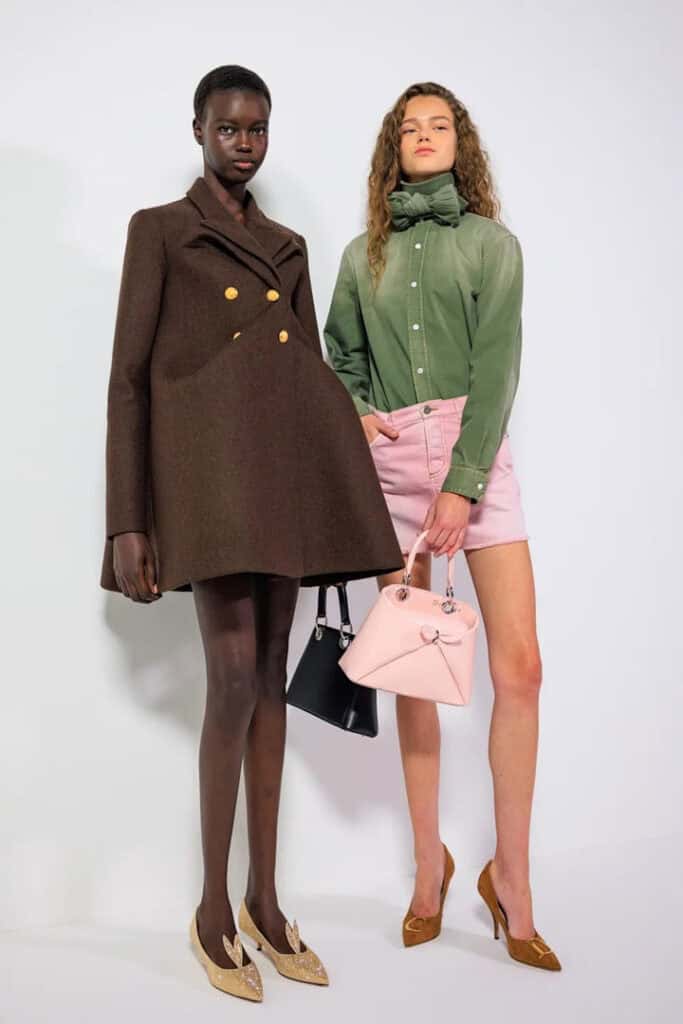
The collection unfolded as a conversation between reverence and rebellion. The opening look, a bell-shaped crino in white anchored the show in couture tradition. Moments later, a tuxedo with a flying peplum arrived, not with satin trousers but a slashed denim mini. Then came Dior’s eternal icon, the Bar jacket, reimagined in Donegal tweed, cropped to doll-like proportions and paired with a pleated schoolgirl skirt.
A Chantilly lace slipdress ballooned into ghostly butterfly wings, a spectral echo of Dior’s Cigale dress. A scarlet satin blouse with a towering lace collar transformed its wearer into something between phantom and courtier. One look summoned the energy of a “fashion highwayman,” complete with tricorne hat and billowing cargo trousers.
The collection was completed in just two months, yet the craftsmanship betrayed no haste. Dior’s ateliers rendered Anderson’s hybrid visions with micro-pleats, scalloped embroidery, and lace so delicate it seemed barely possible to produce.
By the finale, the opening challenge–Do you dare enter the House of Dior?–had shifted in meaning. It was no longer just for the audience but a mirror held up to Anderson himself. To step into Dior is to face not just legacy but hysteria: the burden of expectation, the inevitability of criticism, and the fragility underpinning grandeur.
Anderson’s debut did not resolve these tensions. It amplified them, turned them into fabric, bows, lace, and capes. That, perhaps, is the point. Dior has always thrived on its own destruction and reinvention – burning down one vision so another might rise.