
Are we sick of hearing about climate change? Recent polling suggests a drop in the number of UK adults who see climate change as an important issue; the phrase ‘climate fatigue’ has overtaken concerns about ‘climate anxiety’ in even the most liberal of circles.
But here’s the thing: climate change is not going away just because we’re bored of it. The planet has recently reached its first environmental tipping point, and 3.6 billion people are currently highly vulnerable to the impacts of climate change including droughts, floods, storms, heat stress and food insecurity. It’s vital, then, that we find new ways to engage people on the same existential threat – whilst also offering a space to reflect on and process what’s to come.
In this context, it’s fantastic to see the Barbican’s autumn season take an unapologetic ecological focus. The season sees a doubling down on commitments to inspire and transform conversations about climate change with experimental documentary series Land Cinema, Earth-inspired classical concerts and free exhibition Rounds by Lucy Raven. So the appearance of All Kaiju Attack: Earth SOS! alongside all this might seem a little surprising – surely giant radioactive spiders are not a pressing biodiversity concern? Perhaps Japanese monster movies with their mutant bug costumes and comic-book destruction are a little bit…unserious?
But arts institutions are steadily waking up to the critical value of popular culture. Beginning with ‘poptimism’ in music criticism (the idea that ‘pop music’ is worthy of professional interest and critique), recent years have seen genre cinema finally get its flowers – from Everything Everywhere All At Once (2022) sweeping the Oscars to 2025’s ‘golden year’ for horror. There’s an appetite for overthinking it, with a video essay on almost every major movie franchise of the past fifteen years. And so it follows that in All Kaiju Attack, the Barbican looks to Godzilla, the longest continuously running film series of all time, to divine what his enduring popularity says about our shared ecological beliefs, fantasies and fears.
Appearing initially in the 1954 epic Godzilla, the titular monster is typically presented as a colossal prehistoric sea creature that has been awakened and empowered by exposure to nuclear radiation or testing, wreaking havoc on cities and towns across the Pacific. This image was powerful for a country still reeling from the trauma of the atomic bomb. This first film spawned a number of sequels and spin-offs in which Godzilla must take on new monsters; a wider subgenre of kaiju movies; and arguably the entire ‘radioactive super hero’ trope.
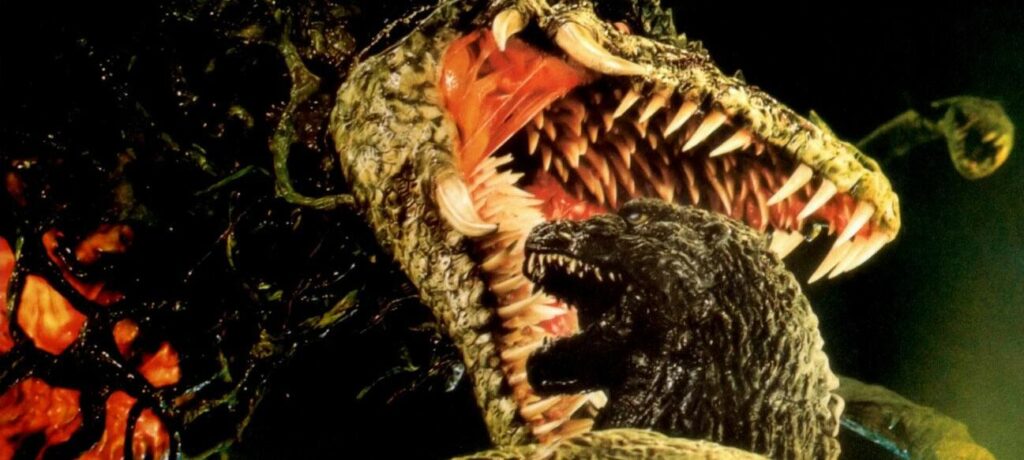
The Barbican’s programme kicked off in September with Godzilla vs. Biollante (1984), a film dealing with genetic experiments gone wrong, and Godzilla vs. Megalon (1973) in which nuclear testing provokes an underground civilization to release two new kaiju on the world. By this time, Godzilla had transformed from his first 1954 appearance as a man-made horror into an eco-warrior saviour. And this, it seems, is the story that the Barbican is interested in telling.
Unlike Godzilla’s moodier, more awe-inspiring early iterations, this film is colourful, playful, almost comedic. But of course, it doesn’t lose the main draw – its dizzying sense of scale. The makers of Son of Godzilla’s monster costumes don’t change much about the anatomy of the creatures they’re modelling on – they don’t have to. Anyone who’s ever seen a flea under a microscope will understand the revulsion that comes from making a small thing huge. We spend fifteen minutes of stilted expository dialogue waiting for our first glimpse of a mantis, large as a house, crawling through the jungle. Most of the action unfolds on an intricately designed soundstage set complete with towers and machinery, but when Godzilla wipes out its toy-town counterpart in less than five minutes, it’s a reminder of how small we can be made to feel.Crucially, the havoc that kaiju wreak is almost always the fault of humans. The main obstacles faced by the characters in Son of Godzilla are: giant mantis, blistering heat, strange fevers. And they’re all a direct result of their well-meaning, but hubristic meddling. The ending, too, is uneasy – our group of heroes ‘defeat’ the kaiju by freezing the entire island but are soberly reminded that when the snow melts, they’ll rise again.
The implication is unsettling. We cannot undo our impact on the planet, and our attempts to fix things only create new and stranger catastrophes. Perhaps this is why everyone in Son of Godzilla recognizes Godzilla by name. Whilst they’ll run away and scream, they’re conceptually at home with the fact that sometimes giant monsters come and crush everything. Maybe there’s a parallel here with our own desensitization to extreme weather events – perhaps everyone in the Godzilla universe is suffering from kaiju fatigue.
And yet out here in the jungle, there is actually little for Godzilla to destroy. We see him raise his son, defend his territory, doze on rocks. He carries out the life cycles of any animal; he only becomes a monster when humans get in the way. Manilla, Godzilla’s son, even forms a bond with a human woman who has spent her life living harmoniously with nature on the island. It’s a natural fit – he’s adorably ugly, all pudgy limbs and big eyes, his pratfalls soundtracked by a kerplunking comedic theme. Perhaps in all this light-heartedness is a vision of hope: that although the monstrosities of man-made climate change might be here to stay, there is a way to live alongside them.
All Kaiju Attack: Earth SOS! continues at the Barbican with Ebirah, Horror of the Deep (1966) + introduction by curator Alex Davidson on Tuesday 18th November and Gamera the Brave (2006) + introduction by Yuriko Hamaguchi on Wednesday 10th December.