
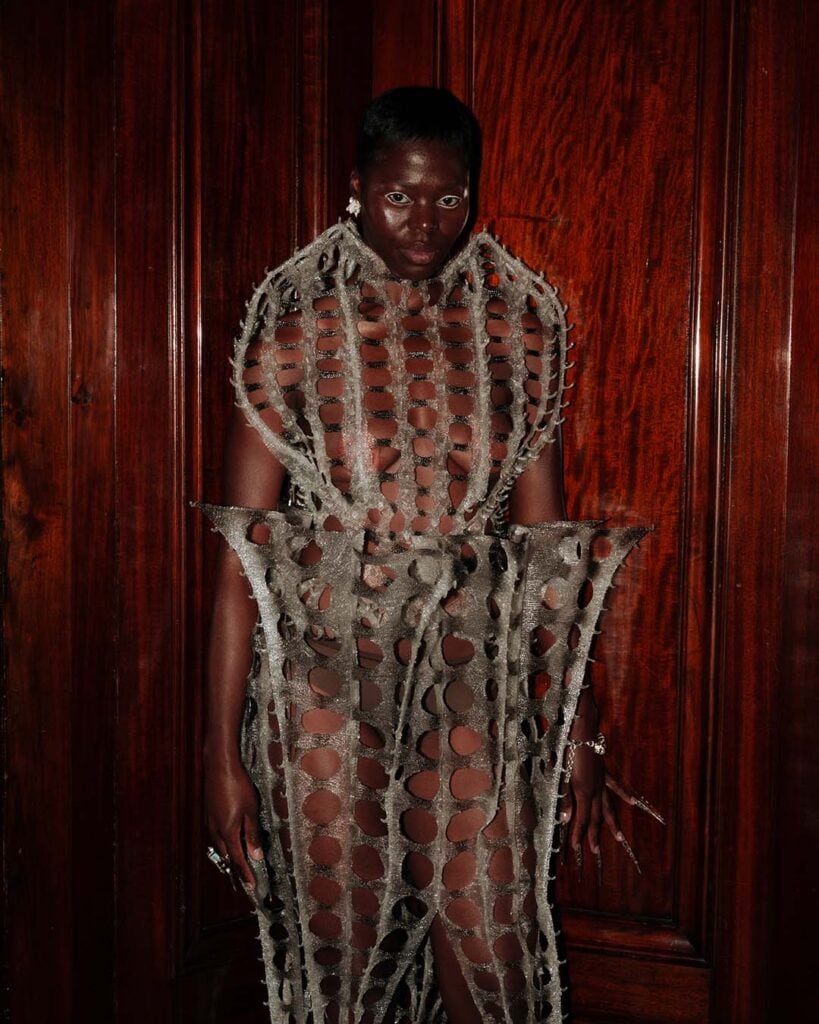
My relationship with dreams has become a complicated one. I’ve come to associate them with the more unwelcome shadows of the past, the subconscious thoughts I try to push away in broad daylight; the ones that surface uninvited when I’m doing something mundane, like crossing the street. Not dark or terrible thoughts, just the harmlessly mortifying kind. Small humiliations that make you wince, resurfacing when you least expect them. For a while, I thought this was all dreaming was: a recycling of (often bleak) memory and mortification. Then came The Midnight Sun, Karina Bond’s latest collection – a reimagining of the dream as something lucid, expansive, and hopeful: the mithridate to all this mental static toxin.
The Sarabande Foundation scholar and Central Saint Martins graduate builds universes out of imagination and biodegradable TPU and PLA filaments – multi-coloured, otherworldly realms that make you push past the sleep paralysis demons crouched at the foot of the bed and move beyond, to alien desert lands and Timothy Leary–worthy hallucinatory trips.
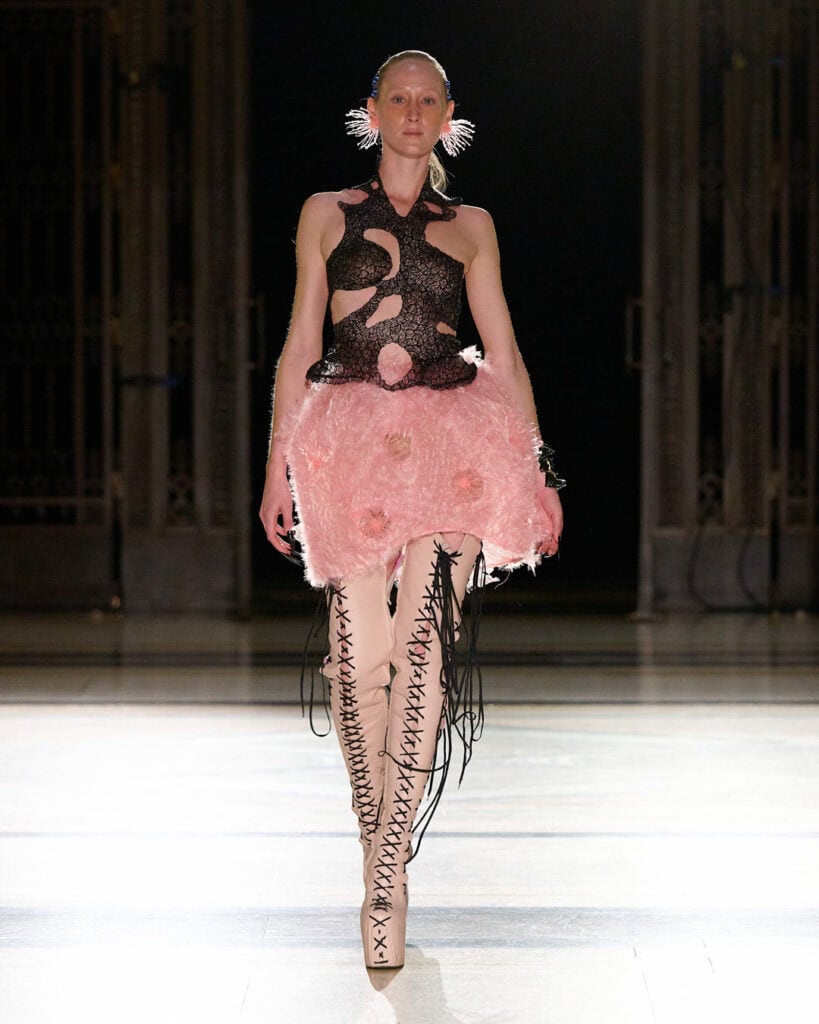
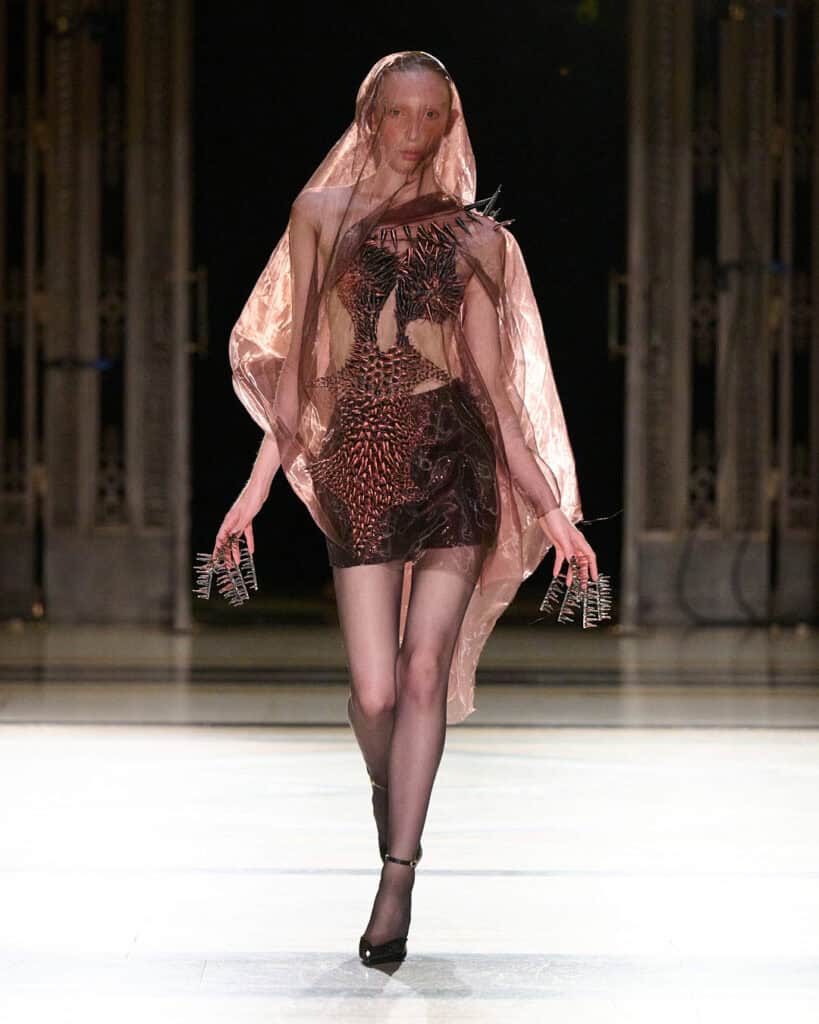
Dreams, after all, are not abstractions – sometimes they’re so vivid and textured that they become almost indistinguishable from waking life. At times, the dreamer can’t quite tell which side of consciousness they’re on. It’s this idea of lucidity, of being aware yet still inside the illusion, that inspired Bond for The Midnight Sun. “I’d never had a lucid dream before,” she told me later, “but when I finally did, I realised I could envision whatever I wanted.”
And so she did. The collection saw Area 51 meet the runway in a psychedelic amalgamation of retro-futurism and ‘desertcore’. The molten gold two-piece lined with blue crystalline stalactites; a fuchsia corset bursting with branch-like filaments; the sand-toned “Desert Rose,” made of thousands of hand-drawn discs to form its crystalline structure, or a thorny pearl mini dress – pick your poison. Models glided slowly, their movements elastic and deliberate, hands tipped with elongated, spore-like nails. Master Efi Davies, avant-garde hairdresser at Toni & Guy, sculpted sleek, beehive-style hairdos for the occasion, a touch of Mars Attacks! (1996) Martian Girl with couture, beaded embellishments as a twist.
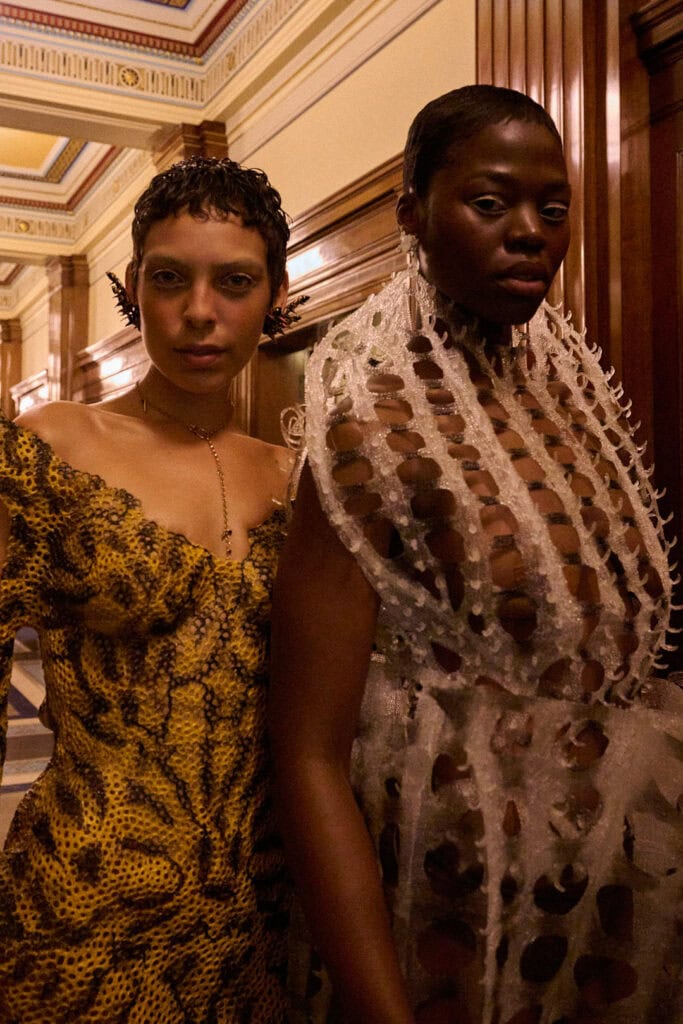
As we spoke, it struck me that dreams (lucid or otherwise) might just be another form of design: a way of the mind carving, or 3D printing in this case, what fabric can’t yet hold. Studies say only around 55% of people have experienced a lucid dream, but after The Midnight Sun, it felt as though Karina Bond had briefly invited us all into hers: and, for once, I didn’t mind not waking up.
The Cold Magazine (CM): The Midnight Sun transforms the concept of dreams into fashion. What drew you to depicting this alternate universe through clothing?
Karina Bond (KB): We can get a little deep here. I haven’t told this to any other magazine, so you’re getting the first scoop! Dreams are such a popular topic, but to me they’re personal. I recently had my first lucid dreams – I’d never had them before. People always say, “It’s the most incredible thing, you find yourself in this dream universe and realise, wait, I’m dreaming.” When it finally happened to me last year, I thought, Oh my god, I can envision whatever I want. That was the starting point. Since then, I’ve had maybe five or six lucid dreams, and when I do, I try to imagine the most unreal, beautiful outfits and then bring them to life. It sounds a bit mad, but that’s truly where the collection began.
CM: I find lucid dreams terrifying. I had one once and woke up in a panic. You’re sort of stuck, right?
KB: I get sleep paralysis all the time. That’s like the middle point, where you can move into lucid dreaming. I used to be terrified of it as a teenager, but I’ve learned to accept it. You also get sound hallucinations: sometimes I’ll hear dogs barking and think it’s real. So the whole concept of dreaming fascinates me. That’s why this collection is such a personal one.
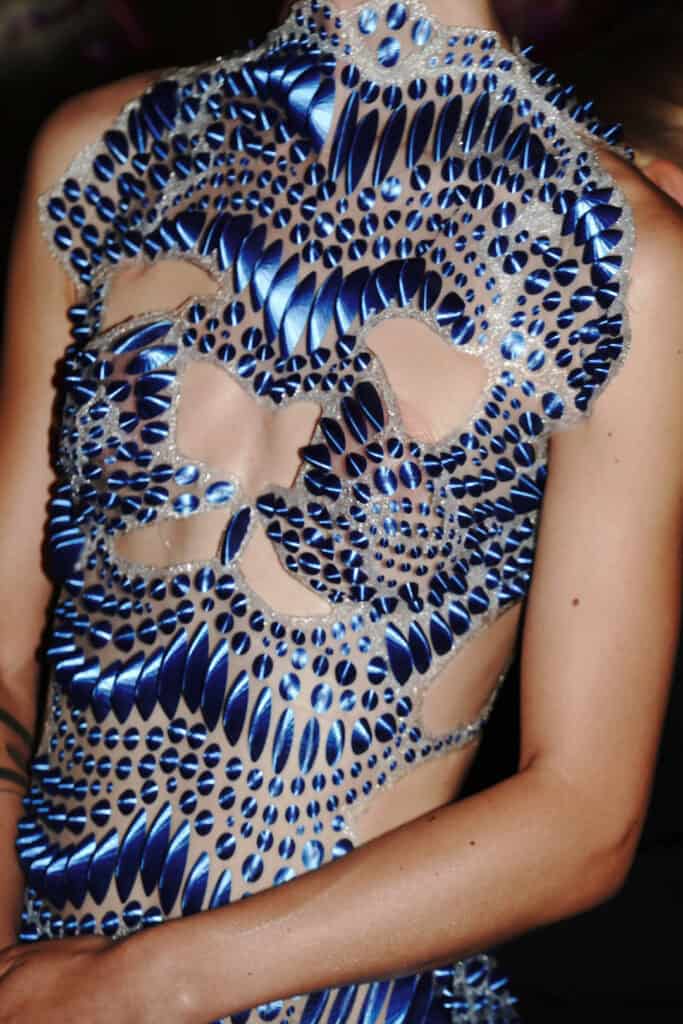
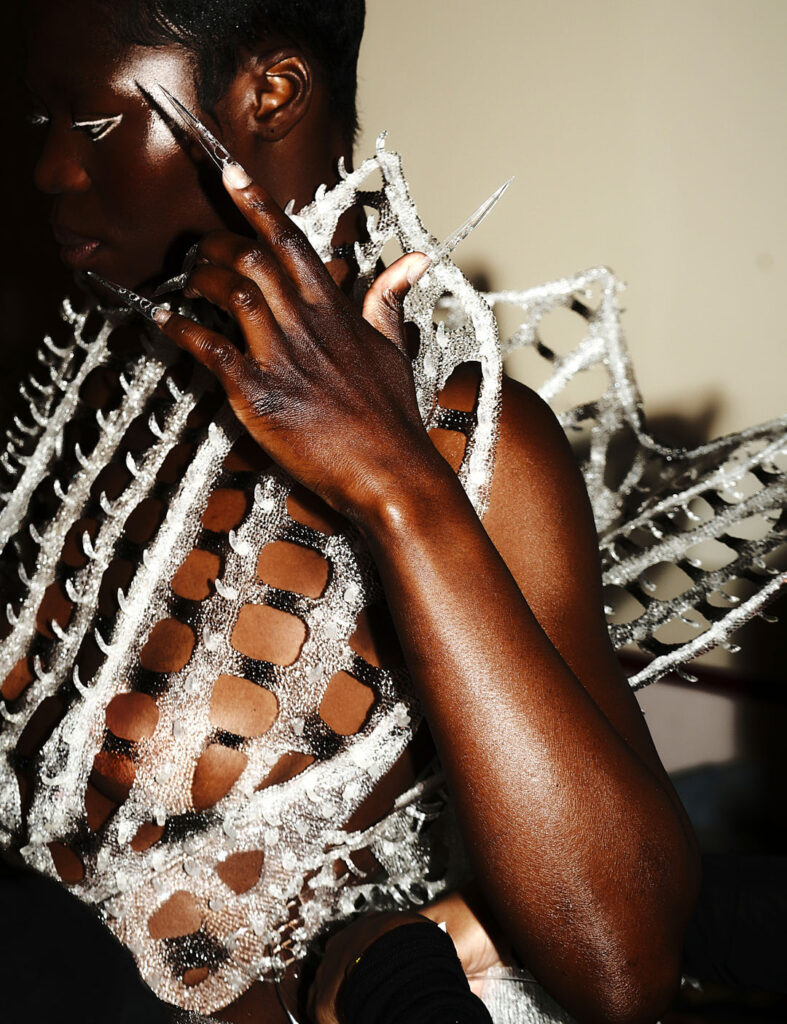
CM: Can you talk me through your creative process? How did you start working with 3D printing and materials?
KB: It started in my last year at CSM. For my graduate collection, I made one look entirely out of hot glue; I used a glue gun in the same way I now use a 3D pen and created this sculptural textile. That piece actually won me the L’Oréal Prize, and because it was during COVID, I had to wear it myself on the runway. It was 28 degrees, so I nearly melted! Later, I collaborated with Toni & Guy on another avant-garde collection, but the hot glue began melting under the lights and onto the models, so I had to find another way to get the same effect. My dad actually suggested a 3D pen, and I haven’t looked back since. For me, it’s always been about inventing new textiles: fabric is fabric, but I want to sculpt around the body, to make the body part of the design itself.
CM: What possibilities does 3D printing open up that fabric can’t?
KB: A 3D print already adapts to your body. With fabric, you have to cut, sew, add seams… you’re trying to make something 2D into 3D. But 3D printing skips that step; it’s already made for the body. That’s why I think it’s the future. You’re not reworking materials that have existed for thousands of years.
CM: Many of the looks felt alien, or like sea creatures/plants, particularly with those long nails. How did those details fit into your larger vision?
KB: It’s funny, because people keep saying it looks coral-like or underwater, and I genuinely didn’t plan that! My idea was an alien desert world – a planet under a perpetual sun, inhabited by strange creatures. But I do love the sea; I’m a total water baby. Maybe those references sneak in subconsciously.
CM: Especially that orange coral look from the last collection [AW25] – someone was wearing it in the front row this season.
KB: Yes, Eve-Lily! She came to my February show and said, “I need to wear this next time you show.” And I said, “Deal!”
CM: Were there any external influences behind The Midnight Sun, like films, music, or other artists?
KB: I’m a huge film and music buff. I’ve played piano since I was four. I don’t play much now, but it’s something I always return to. I design to music: the soundtrack I used for The Midnight Sun was on repeat while I worked. And I love films, especially Tim Burton. Anything that builds its own world through imagination really inspires me.
CM: You also designed accessories for this collection – what was it like working on smaller-scale designs rather than full garments?
KB: I collaborated with Vicki Sarge on jewellery for the first time, and it was such a new experience. Working small means you have to bring the same level of intricacy and storytelling to a much tighter space. We 3D-printed both the jewellery and the nails–Giulia did the nails–-and for each look we treated them like characters. We’d ask, “Who is she? What’s she wearing? How do the nails connect to that?” It was really fun.
CM: AI-driven fashion is growing fast, but your work is very tactile. Why is material presence important to you?
KB: Because at the end of the day, digital fashion is still digital: you can wear it on screen, but not in real life. 3D printing bridges that gap; it takes the limitless imagination of AI and makes it real. You’ll always want to wear something. For me, these pieces are like a second skin.
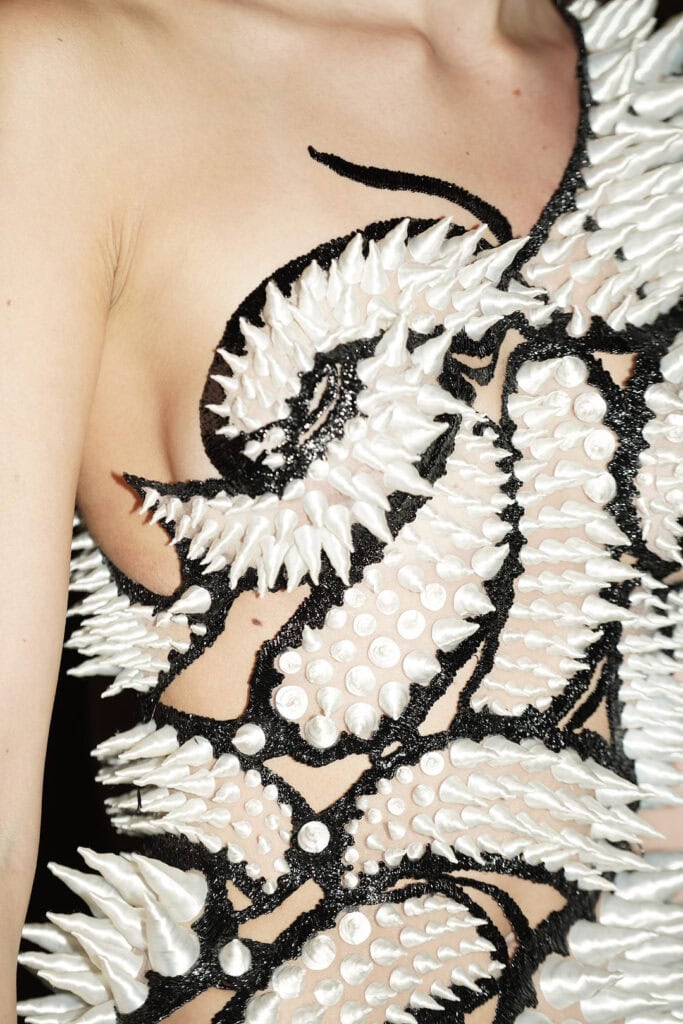
CM: Let’s talk about the final look – the Desert Rose. What inspired it?
KB: The theme started with lucid dreams, but I imagined them set in this alien desert. One of the first objects my parents brought when we moved was a large desert rose crystal. I’ve always loved it, and I didn’t realise most people didn’t know what it was! It’s not a flower, it’s a stone formation – so beautiful, and perfect for 3D printing. You simply can’t do that with fabric. Also, I usually work in bright colours, but this time I wanted something more grounded and earthy, all sand tones and neutrals.
CM: Are there any future themes or ideas you’d like to explore next?
KB: I already have an idea for next season. It’s going to be more scientific. With 3D printing, there’s so much technology involved, and I find that fascinating. I always feel like an inventor in a lab. So next time, it’ll come from a more technical, scientific angle than a poetic one like dreams.
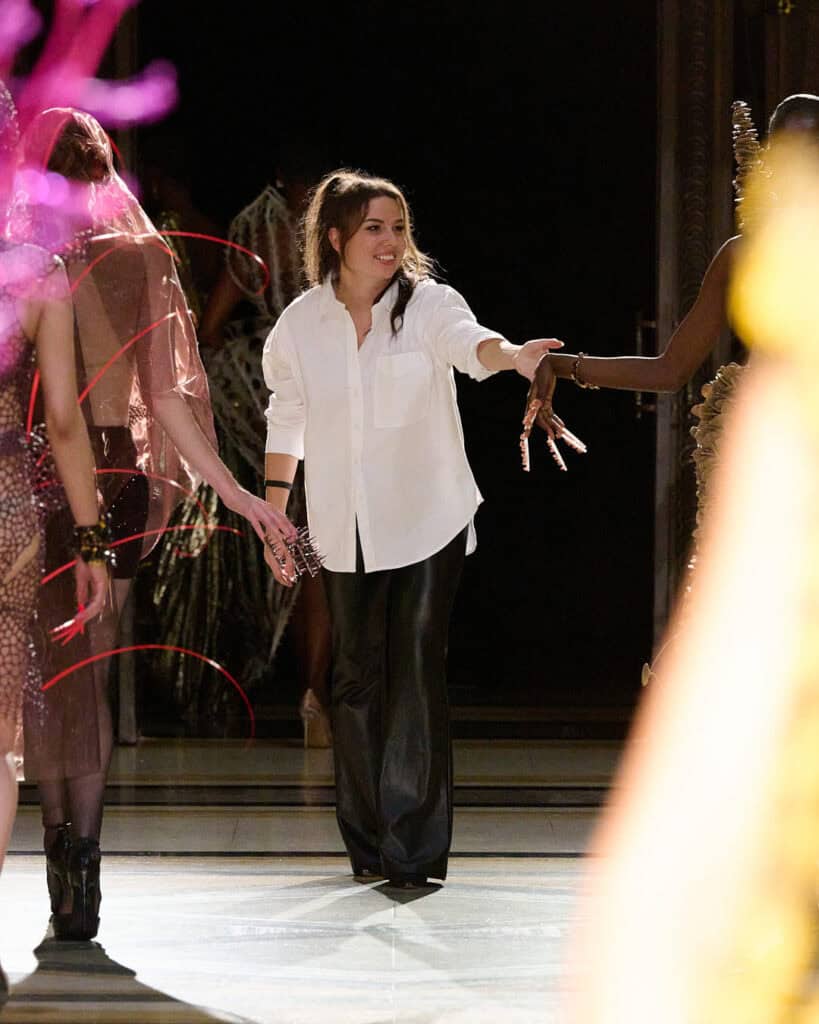
CM: What’s next for you in general?
KB: The bags are the next big step. I showed two of them briefly during the show, but I’m officially launching them next month, maybe in early November, just in time for Christmas. They’re fully 3D-printed, and I’m creating six different designs. I’m also shooting a campaign, which I’m so excited about because I get to build my own world again: the set, the mood, everything. I want it to feel immersive, like you’re stepping into another part of The Midnight Sun universe. Eventually, I’d love to develop 3D-printed clothing that’s actually wearable day to day, something people can live in, not just see on the catwalk. That’s the dream.