

“Karmine was born just over a year ago as a series of experiments. I wanted to understand what truly worked and what was just a personal obsession. The point now is to build a language.”
Last year saw a fixation on the clean aesthetic, defined by neutral palettes, polite silhouettes, and an inoffensive elegance. Against this sterilised surface, emerging Italian brand Karmine is a deliberate stain on the scene – bold, brash, and stubbornly resistant to refinement.
What started as a series of experiments and small online drops has evolved into an untamed project, one in which denim takes center stage alongside workwear and heavy cotton pieces. Each garment is a tangible rebellion against the prevailing, polished and consumer-driven trends. Karmine trades carefully curated fits for texture-driven looks, and at just over a year old, the brand is writing its own fashion rulebook.

Even in its name, relating to a deep red pigment, Karmine mirrors the passion and pain woven into its clothing. Items like the Korange Waxed Denim, with its waxed finish, saturated orange hues, and custom patch, reject all semblance of cleanliness and monotony. Hand-finished with subtle variations, no two pairs bear the same result. Simultaneously, the Worker Japan Jacket, cut from raw denim, skillfully dyed and stone washed, achieves an authentic, lived-in look, with metal hooks and concealed front pockets creating an armour-like finish.
For those looking for something a little rougher around the edges, something real, Karmine offers the solution. When asked what he is pushing back against, founder Carmine stated, “In an age overrun by AI, fakeness, and performative trends, we need brands like Karmine more than ever. The world is becoming too clean, too polished. I want the hand to be visible. The mistakes. I’m interested in something that still carries a human vibration.” Its hand-made garments do just that. Each piece is an unregulated work of art, raw imperfection.

The label’s tagline: “Made in pain. Made in my room. Made in Italy” echoes Karmine’s creative vision – one that attempts to slice through the cultural static with items that carry as much meaning as the hands that craft them, and the lives that inhabit them. Carmine tells us, “I actually sewed the first jeans in my bedroom. Today, production is entrusted to people with years of artisanal experience. That’s why made in Italy is a concrete choice as opposed to a formula, and made in pain is more than just an aesthetic phrase. At first it was physical as well: long hours of work, marked hands and exhaustion.” Where minimalism lacks depth, Karmine provides custom handworked detail.
A browse through the online store reveals balloon-fit trousers, laser-engraved artwork, and edgy leather-like-looks, each a fresh take on utilitarian silhouettes and workwear codes. And it’s not just through fabric texture that Karmine manages to make a statement. The Denim Trench Coat Gasoline leans into a charged colour palette, featuring a rare blend of deep blue and green tones to create an iridescent effect. The finish is reminiscent of petrol shimmering under light, another nod towards the gritty, industrial theme that runs throughout many of the brand’s designs.
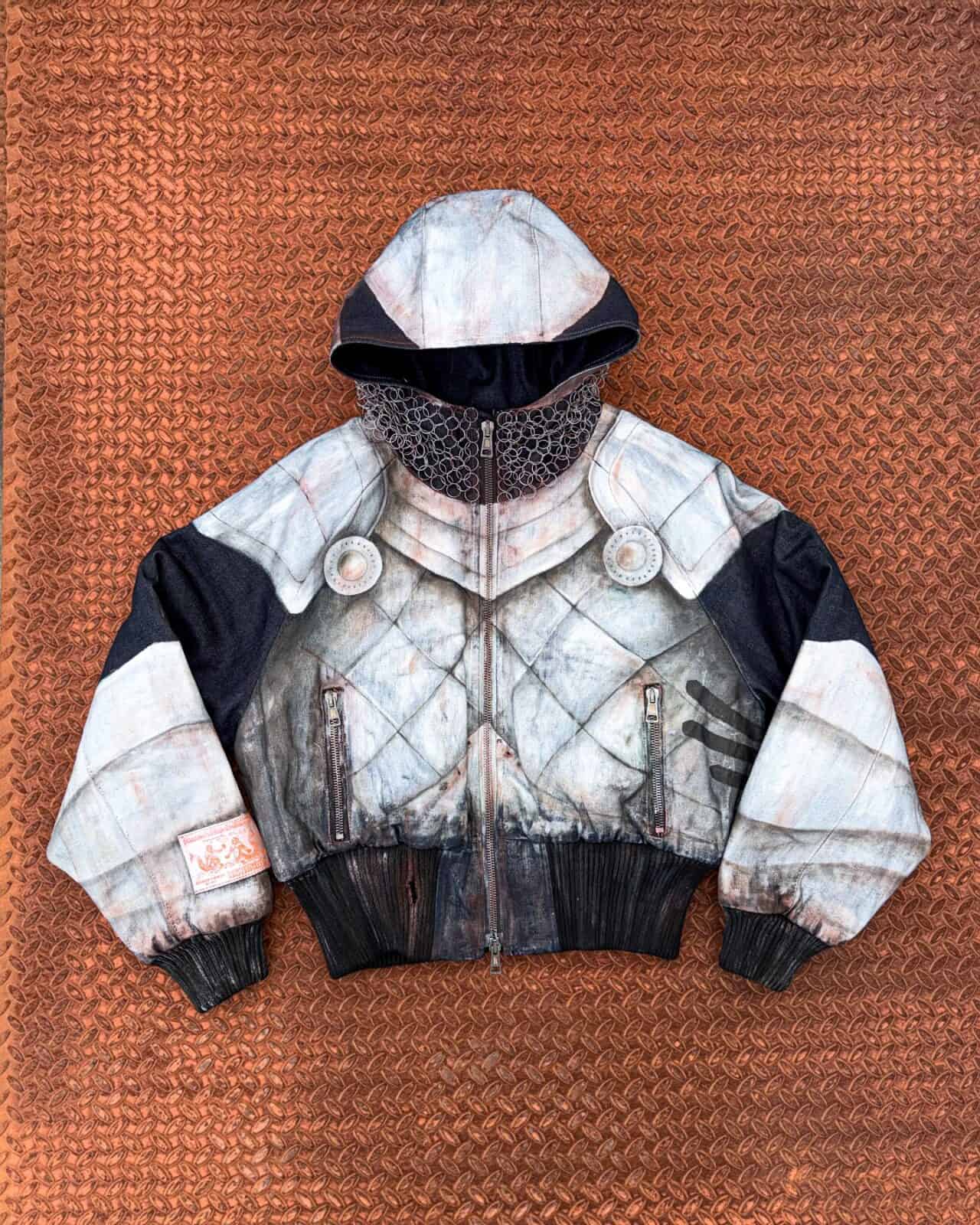
Captions seen on their Instagram also provide a window into its emotion-driven ethos.“Don’t act clean wearing this,” and “Let things be fragile. That’s how you connect – that’s how you feel good,” reflect a culture willing to embrace openness.
For Karmine, it’s clear that material choice is, and always has been, a deliberate decision. “Denim is a paradox. It’s one of the most widely used fabrics in the world, yet it remains one of the most open to experimentation,” the designer remarks. “I always try to think of fabric as a body. When I choose one, I already imagine what kind of garment it will become and what kind of ‘experience’ it needs to go through. It can be a wound, a bruise, a dirty effect, or a resin-coated surface that feels like skin. I work a lot with dark nuances, tones that recall dried blood, oxidation, and compressed matter.” The method in the madness is evident, and garments marked by wax, ozone, and water, all tell their own story – one in which vulnerability and strength can coexist.
This sentiment is echoed through the founder’s admission that, “It’s almost like having a dialogue with the material.” Where poetry carries weight through language, here, the art favours texture over text. This shared exchange becomes a collaborative relationship between the maker, the material, and the wearer, each piece possessing its own unique personality. Carmine even states, “making a thousand identical pairs of trousers is easier than making two hundred that are all different from one another. I don’t want to create artificial scarcity.” The overall message is impossible to ignore: there is no room for conformity in Karmine’s world.
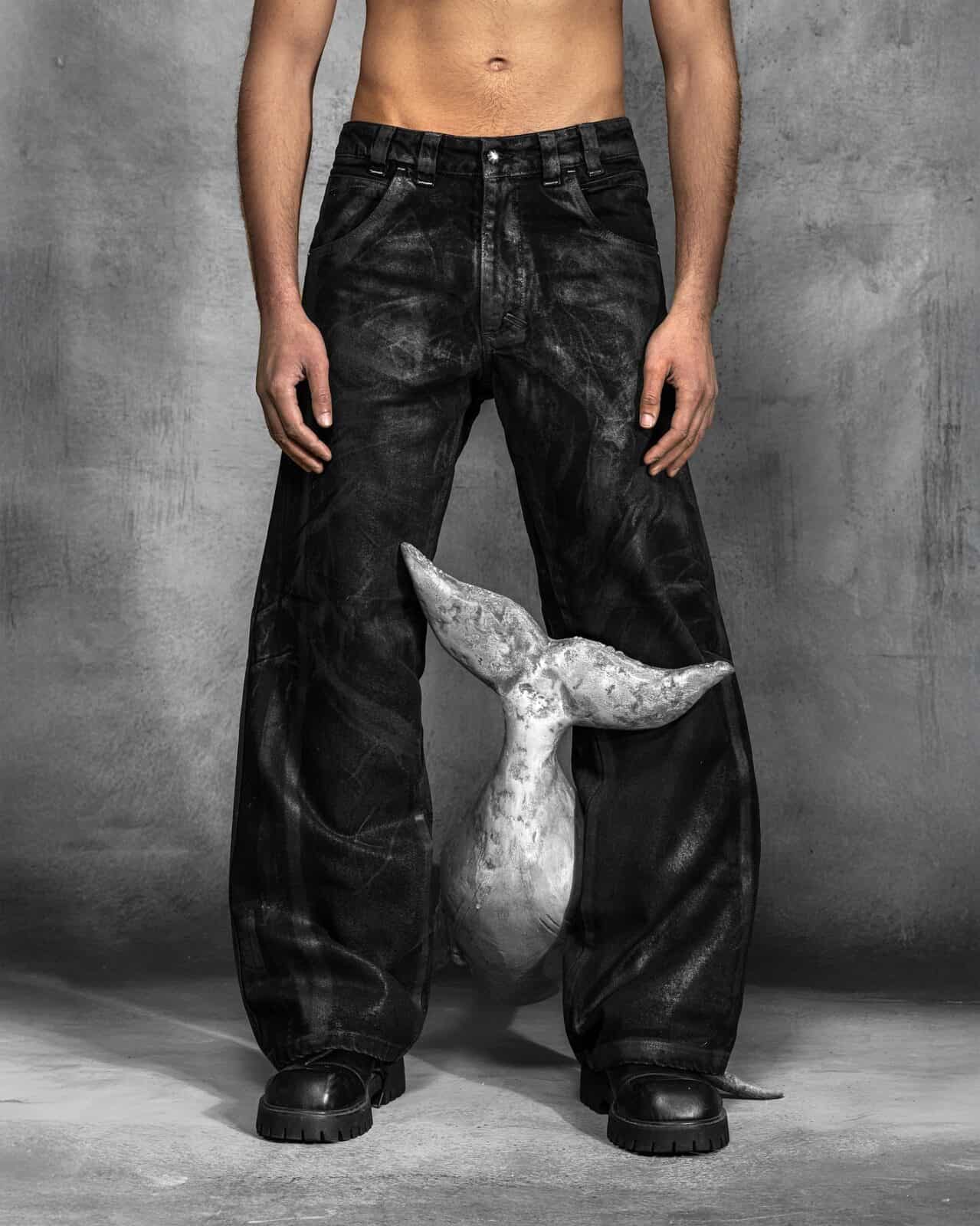
In contrast to larger labels dominating the scene, this young independent studio looks to a more experimental, eco-conscious, and hands-on approach to processing. Karmine’s rising profile proves that commercial growth doesn’t have to come at the expense of the planet or a sense of individuality.
While some may be accustomed to the uniformity of clean, controlled fits, Karmine insists on something more human and flawed. Its garments do not strive for perfection, instead, they’re shaped by process and emotion. The result is an intimate reinterpretation of fashion as we know it.