
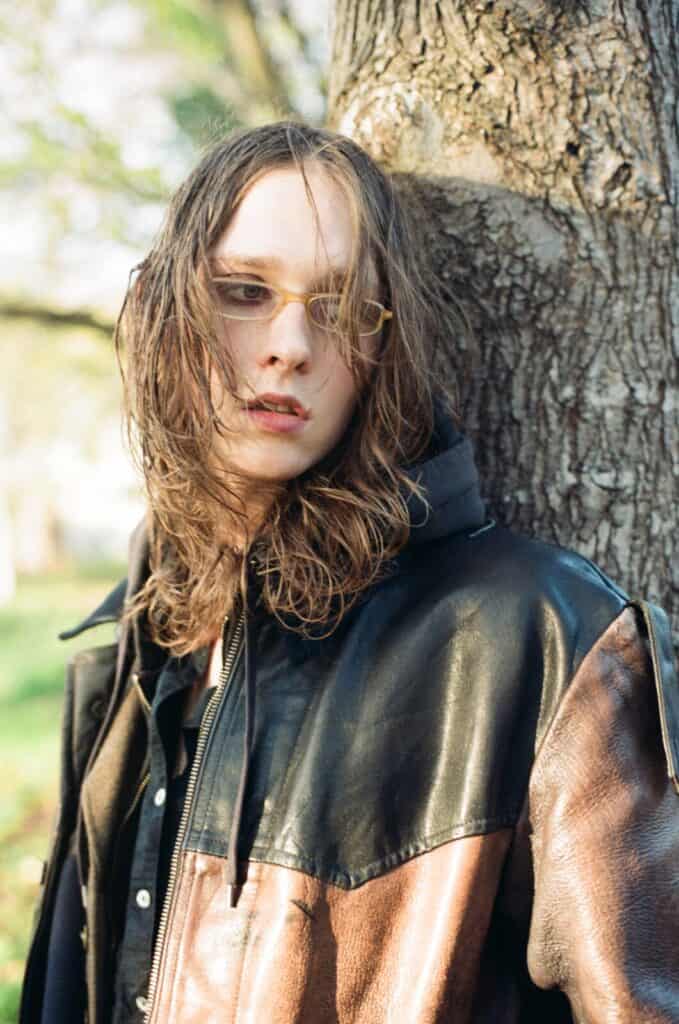
Lately, Lauren Auder has been in earth-shattering love. “The world has had a completely different sheen, like when you’re walking through a forest on psychedelics. Everything is the same, but it has a different glow.”
Auder is an erudite musician-model-Substacker whose new album, Whole World As Vigil, takes equal doses of inspiration from anarchist gay author Dennis Cooper and guerilla philosopher Hakim Bey as it does from Madchester music and Paris’ gabber scene, the latter of which she says was “a huge part of me forming myself as an adult.”

To discuss the album, she rings me from outside a hospital, hitting a brat-green vape between thoughts. “A lot of music right now is so cool and nonchalant,” she says before taking another puff, “but I wanted to make the opposite of that. I wanted to make music that’s hot and intense and visceral. I want it to feel like there’s something at risk.”
Auder cut her musical teeth as a teenager making floaty SoundCloud beats for ascendant rappers like Slowthai and Jeshi while moonlighting as Celine model, all of which probably was quite cool and nonchalant. But her solo career has ever since edged much closer toward that hot and intense and visceral other-world: her woozy, baritone voice; her baroque, neu-Gregorian sensibilities; her EPs with names like 5 Songs for The Dysphoric and tracks titled “in god’s childlike hand”.

“I came out as trans six years ago,” she says. Much of her early music was “hung up with” this profound actualisation of the self, she says, against a socio-political topography that has been “pretty fucking bad” for trans people, as she told NME in 2020. Even 2023’s infinite spine, her debut album, was a gothic travelogue of this journey. “Hell is a body in which I just cannot reside,” she dirged on ‘118-madonna’, “… I lost myself in shapes that were not mine.”
But what happens when you’ve stopped having to wrestle with your own self? What happens when you reach the end of identity? “I realised, once you figure yourself out, you still have to keep living. There is no end, it’s all about malleability and change.”
Whole World As Vigil is an album about stepping into this ongoing negotiation and finding spaces and moments of safety within all its undulating, oceanic transformation. This, after all, is the meaning of ‘vigil’: a time of quiet and contemplative introspection and prayer that draws oneself momentarily away from the world, traditionally on the eve of a religious festival.
Auder laughs that she likes using religious concepts and words – a leitmotif in her work, inherited from an upbringing in provincial and Catholic France – because it’s like “snapping your finger at listeners” to signal that something has gravity, a shortcut straight to profundity. But religion, she feels, maps quite easily onto love. It also maps quite readily onto trans experiences, what with Christianity’s logic of rebirth, shapeshifting bodies, and ecstatic, euphoric salvation, which all give this intertextual texture a certain “glee”.

“A loving relationship,” she explains, “is one of those spaces that feels like utopia. With [Whole World As Vigil], I wanted to ask: what if you held every moment of your life with that same level of importance and care?”
This, ironically, is quite a Christian message. Finding utopia in the sheer, world-changing power of love; letting that love bleed into the rest of your life. Or maybe it’s not ironic at all. I’m sure Auder is well aware of the resonances this all has.
“I wanted to put the small details of life in touch with the cosmic,” she says, “to show that the deeper you go, the larger things start appearing.” This, she says, was part of her path to salvation. Lauren Auder’s personal theology.Lauren Auder, Whole World As Vigil, is out March 27th.


