
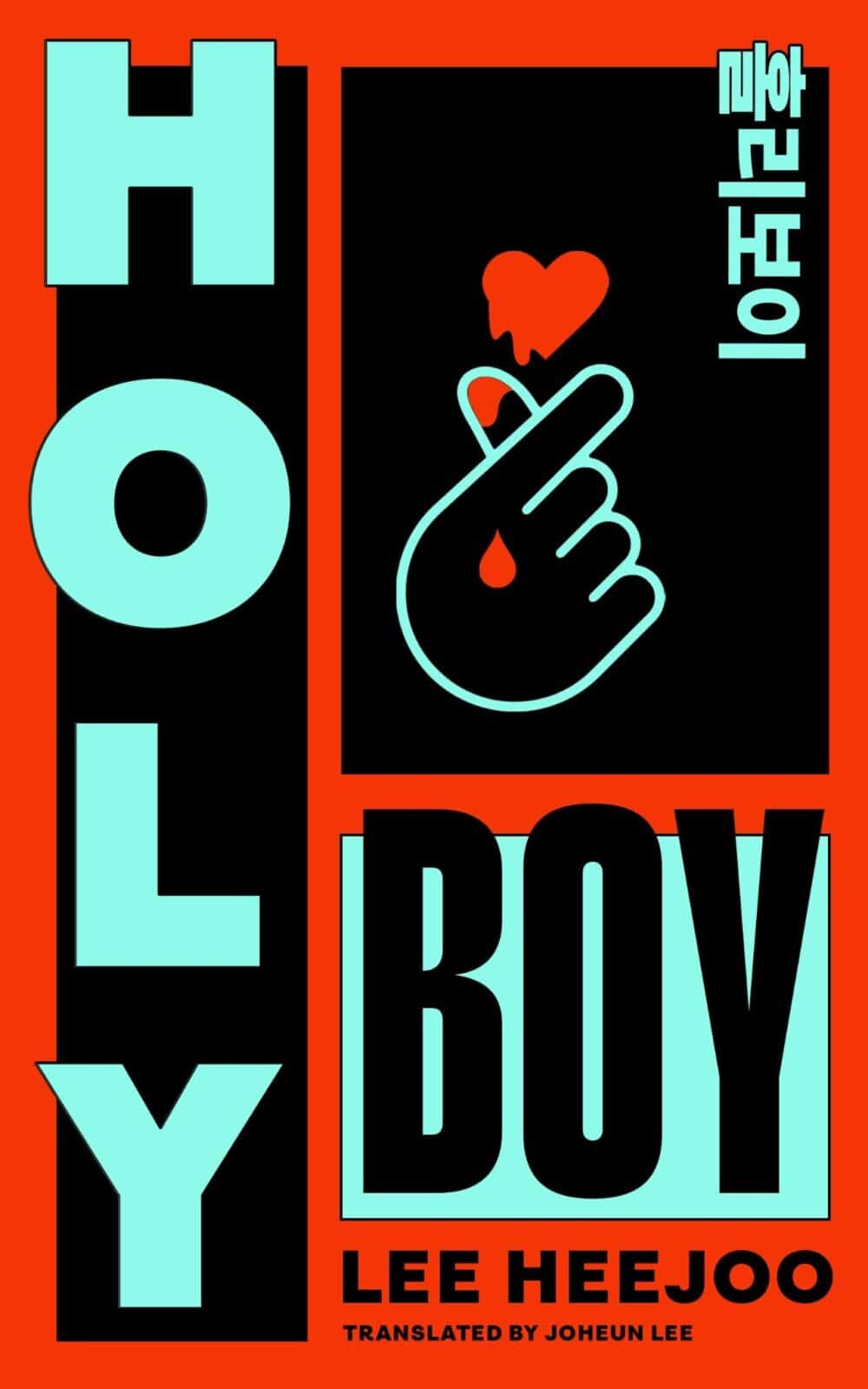
“Don’t you think even Yosep’s excretions make him beautiful?” ponders a young woman in a cafe. The young man in question is a shiny, twenty-one-year-old K-Pop star. The woman? That’s Nami, his kidnapper.
Lee Heejoo’s Holy Boy is a simmering, gunk and pus-filled exploration into the dynamic between idol and fan. In the last summer of the 20th century, four female fans kidnap their favourite K-Pop idol, but as the ramifications of what they’ve done begin to surface and jealousy seeps in, the kidnappers’ plot spirals out of control.
This is a hot novel, and I’m not talking about the sex doll in the basement. Holed up in a secluded mountain cabin in a fictional seaside town with their beloved Yosep, Ahnna, Nami, Mihee and Heeae are trapped in a literal pressure cooker. The summer heat rages on and, as the question “what now?” looms over their heads, suicides, shoot-outs, and poisoned drinks are soon to follow. In the tenses of moments, you almost expect condensation to appear on the pages.
While its large cast of characters can at times have you wishing for a dramatis personae in the front matter, this atmosphere is one of the novel’s greatest strengths. The town of Eungrang is fictional, but the province of Gangwon-do is very real. It’s one of the northernmost regions in South Korea and doubles as a coastal holiday destination and a borderland between North and South Korea. Our four kidnappers contemplate slipping quietly across the border, and military bases live side-by-side with ice cream huts and high-rise hotels.
It’s an eerie, frozen-in-time sort of place that echoes other dichotomies at play in the novel.
Kidnapping Yosep is a serious crime, but also the most fun these women have had in years. Their infatuations are often at odds with each other, and yet, the four create something of a found family. K-Pop is a sex-drenched industry, preying on women’s fantasies and desires, but its stars are eternally virginal.
Heejoo is no stranger to tales from the pop culture underground. Her debut novel, Phantom Limb Pain, also investigates K-Pop fandom through an autofictional lens. It was released in Korea in 2016 to nation-wide acclaim. Today, she openly speaks about her real-life love of K-Pop, telling Foyles in 2026, “I’ve been a fan of NCT WISH since their debut, and they recently covered TWICE’s “TT”! It’s so cute – I watch the video every day. I can’t wake up in the morning without it.”

Surprisingly, though, Heejoo’s dissection of K-Pop fan culture in Holy Boy feels more like the work of a historian than an active participant. Set in 1999, we find ourselves in the era before livestreams and fancams, when fans stalked idols the old school, analog way – sleeping under bridges, tracking taxis, and sending love letters written in menstrual blood.
Don’t expect a dissection of Yosep’s inner-world, either. Full of burnt soup and sleeping pills, with two “broken” legs keeping him bedbound, the holy boy himself soon becomes nothing more than set dressing here. The real drama occurs between the four women. There’s Ahnna, the middle-aged mischief maker who concocts the scheme; Mihee, a young girl in her 20s who fights other Yosep fans in the streets; Nami, a firebrand and trainee shaman whose truly believes Yosep is the only one for her; and Heeae, a woman unlike the rest who is biologically related to the star.
Far from being caricatures or archetypes of different kinds of fans, each woman is singular. Heejoo is more interested in the cold marriages, absent mothers, and impoverished childhoods that led them to this point than she is in the details of which Yosep posters they hung on their walls. Ultimately, Holy Boy is a biting investigation into what it means to be a lonely woman in the world, and a look into the lengths the human mind will take to invent beauty in dark places.
Just as the literary scholar Eve Kosofsky Sedgwick argues that love triangles often serve as a springboard for homosocial bonding (where Edward’s hate for Jacob – for instance – matters more than anything to do with Bella) Yosep becomes the bridge that allows these women to enter each other’s lives – forming complex entanglements and embarking on shenanigans and murders that illuminate the grimmer parts of their own psyches.
Heejoo gets to the heart of it in one telling scene:
“Everyone needed a star in their hearts,” proclaims Mihee, “an unreachable flower on the cliff to watch for the rest of their lives.” Thinking of her mother, who moved from boyfriend to boyfriend, she thinks, “Whenever they found a job or bought a rose or cake for her, her mother became excited before she could stop herself, and it angered her to feel happy in that situation, where she had been sitting around all day in the dark, sunless room […] And eventually, it led her to raise hell.”
Raising hell. Drugs, drink, men, murder – it manifests for different women in different ways, but for Ahnna, Mihee, Nami, Heeae, it’s kidnapping an international superstar. While the K-Pop angle, or perhaps the fandom-turned-deadly angle will reel in certain readers, those best primed to hear what Heejoo is trying to say are the scholars of so-called “weird girl books” – Ottessa Moshfegh, Rachel Yoder, Mona Awad, whose subjects remain women’s taboo worlds. Like the hobbling Annie Wilkes from Stephen King’s Misery, who has become something of a paean to the monstrous feminine, I suspect these four villains will worm their way into many reader’s hearts, in their own crooked, slimy way.


